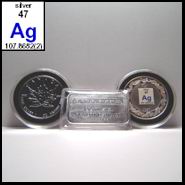
| Element | |
|---|---|
47AgSilver107.868222
8 18 18 1 |
|
| Basic properties | |
|---|---|
| Atomic number | 47 |
| Atomic weight | 107.86822 amu |
| Element family | Transition metals |
| Period | 5 |
| Group | 1 |
| Block | s-block |
| Discovery year | 5000 BC |
| Isotope distribution |
|---|
107Ag 51.83% 109Ag 48.17% |
107Ag (51.83%) 109Ag (48.17%) |
| Physical properties | |
|---|---|
| Density | 10.501 g/cm3 (STP) |
Atomic hydrogen (H) 8.988E-5 Meitnerium (Mt) 28 | |
| Melting | 961 °C |
Helium (He) -272.2 Carbon (C) 3675 | |
| Boiling | 2212 °C |
Helium (He) -268.9 Tungsten (W) 5927 | |
| Chemical properties | |
|---|---|
| Oxidation states (less common) | +1 (-2, -1, 0, +2, +3) |
| First ionization potential | 7.576 eV |
Cesium (Cs) 3.894 Helium (He) 24.587 | |
| Electron affinity | 1.304 eV |
Nobelium (No) -2.33 Atomic chlorine (Cl) 3.612725 | |
| Electronegativity | 1.93 |
Cesium (Cs) 0.79 Atomic fluorine (F) 3.98 | |
| Electronic properties | |
|---|---|
| Electrons per shell | 2, 8, 18, 18, 1 |
| Electronic configuration | [Kr] 4d10 |
|
Bohr atom model
| |
|
Orbital box diagram
| |
| Valence electrons | 11 |
| Lewis dot structure |
|
| Orbital Visualization | |
|---|---|
|
| |
| Electrons | - |
Silver (Ag): Periodic Table Element
Abstract
Silver (Ag, atomic number 47) is a lustrous white transition metal distinguished by its exceptional electrical and thermal conductivity properties. With a melting point of 960.8°C and density of 10.49 g/cm³, silver crystallizes in a face-centered cubic structure and exhibits the electron configuration [Kr]4d¹⁰5s¹. The element demonstrates predominantly monovalent oxidation chemistry, forms extensive coordination complexes, and maintains significant industrial applications in electronics, catalysis, and materials science. Silver's unique combination of physical properties, including the highest electrical conductivity of all metals and excellent ductility, establishes its fundamental importance in modern technology despite its relative scarcity in the Earth's crust at approximately 0.08 ppm abundance.
Introduction
Silver occupies position 47 in the periodic table as the central member of Group 11, positioned between copper (Z = 29) and gold (Z = 79) in the coinage metals triad. This noble metal has been recognized since antiquity as one of the seven metals of classical civilization, yet its scientific understanding has evolved significantly through modern analytical chemistry and materials science. The element's distinctive [Kr]4d¹⁰5s¹ electron configuration places it within the d-block transition series, though its completely filled d-subshell imparts characteristics that bridge typical transition metal behavior with those of post-transition elements. Silver's position in the electrochemical series, with a standard reduction potential of +0.799 V for the Ag⁺/Ag couple, reflects its noble character while maintaining sufficient reactivity for diverse chemical transformations. The metal's significance extends beyond its historical monetary applications to encompass critical roles in electronic devices, photographic processes, and advanced materials technologies that capitalize on its unparalleled conductivity properties.
Physical Properties and Atomic Structure
Fundamental Atomic Parameters
Silver exhibits atomic number 47 with a standard atomic weight of 107.8682 ± 0.0002 u, derived from two stable isotopes: ¹⁰⁷Ag (51.839% natural abundance) and ¹⁰⁹Ag (48.161% natural abundance). The electronic configuration [Kr]4d¹⁰5s¹ demonstrates the characteristic single s-electron over a completed d-subshell arrangement shared by all Group 11 elements. This configuration results in an atomic radius of 144 pm and ionic radius of 115 pm for Ag⁺, intermediate between copper (128 pm atomic) and gold (144 pm atomic). The effective nuclear charge experienced by the outermost 5s electron is approximately 2.87, moderated by the incomplete shielding provided by the filled 4d¹⁰ subshell. First ionization energy measures 730.8 kJ/mol, reflecting the relative ease of 5s electron removal, while successive ionization energies increase dramatically to 2070 kJ/mol and 3361 kJ/mol for the second and third ionizations, respectively, indicating the stability of the underlying 4d¹⁰ electronic core.
Macroscopic Physical Characteristics
Silver manifests as a brilliant white metallic solid with exceptional lustre and reflectivity exceeding 95% for wavelengths above 450 nm. The metal crystallizes in a face-centered cubic (fcc) structure with lattice parameter a = 408.53 pm at ambient conditions, exhibiting coordination number 12 and space group Fm3̄m. This close-packed arrangement contributes to silver's remarkable ductility and malleability, permitting formation of wires one atom in thickness and foils measuring mere hundreds of atoms thick. Thermal properties include a melting point of 960.8°C, boiling point of 2162°C, and heat of fusion of 11.28 kJ/mol. The exceptionally high thermal conductivity of 429 W/m·K at 25°C ranks among the highest for all materials, exceeded only by diamond and superfluid helium-4. Density at standard conditions measures 10.49 g/cm³, while the linear coefficient of thermal expansion equals 18.9 × 10⁻⁶ K⁻¹. Specific heat capacity maintains 0.235 J/g·K, contributing to silver's effectiveness in thermal management applications.
Chemical Properties and Reactivity
Electronic Structure and Bonding Behavior
The chemical behavior of silver derives fundamentally from its [Kr]4d¹⁰5s¹ electronic configuration, which positions the element at the boundary between typical transition metal chemistry and noble metal characteristics. The completely filled 4d subshell provides limited participation in chemical bonding compared to earlier transition metals with partially occupied d-orbitals. Consequently, silver's bonding primarily involves the single 5s electron, leading to predominant formation of monovalent Ag⁺ compounds. The d¹⁰ configuration results in diamagnetic behavior and colorless compounds when paired with non-polarizable ligands. Covalent character becomes significant in silver compounds due to the relatively small ionic radius and high first ionization energy, particularly evident in silver halides where electronegativity differences approach those found in typical covalent materials. Coordination chemistry favors linear two-coordinate geometries, as exemplified by [Ag(NH₃)₂]⁺ and [Ag(CN)₂]⁻ complexes, though tetrahedral four-coordinate arrangements occur in specific circumstances such as [Ag(H₂O)₄]⁺ in aqueous solutions.
Electrochemical and Thermodynamic Properties
Silver exhibits electronegativity of 1.93 on the Pauling scale, positioned between copper (1.90) and lead (1.87), indicating moderate electron-attracting capability. Electron affinity measures 125.6 kJ/mol, substantially higher than hydrogen (72.8 kJ/mol) and approaching that of oxygen (141.0 kJ/mol), reflecting the element's capacity for anion formation under specific conditions. The standard reduction potential Ag⁺/Ag = +0.799 V places silver among the noble metals, though less noble than gold (+1.50 V) and platinum (+1.18 V). This electrochemical position explains silver's resistance to atmospheric oxidation while maintaining sufficient reactivity toward oxidizing acids and complexing agents. Thermodynamic stability of the +1 oxidation state predominates across most chemical environments, with Ag²⁺ species requiring strongly oxidizing conditions and specialized stabilization through complex formation. The relatively high second ionization energy (2070 kJ/mol) compared to the first (730.8 kJ/mol) reinforces the preference for monovalent chemistry, while the dramatic increase to the third ionization energy (3361 kJ/mol) effectively precludes Ag³⁺ formation under normal chemical conditions.
Chemical Compounds and Complex Formation
Binary and Ternary Compounds
Silver forms an extensive series of binary compounds exhibiting varying degrees of ionic and covalent character. The silver halides represent the most systematically studied series: AgF (colorless, water-soluble), AgCl (white, photosensitive), AgBr (pale yellow, photosensitive), and AgI (yellow, highly photosensitive). These compounds demonstrate increasing covalent character and decreasing solubility as halogen atomic number increases, with AgI exhibiting three distinct polymorphic forms depending on temperature. Silver oxide (Ag₂O) forms as a brown-black solid through precipitation from alkaline solutions, decomposing at 160°C to metallic silver and oxygen, illustrating the thermodynamic instability of higher oxidation states. Silver sulfide (Ag₂S) occurs naturally as the mineral argentite and forms readily through reaction with atmospheric hydrogen sulfide, producing the characteristic tarnishing observed on silver surfaces. Ternary compounds include silver carbonate (Ag₂CO₃), a yellow precipitate used in photographic emulsions, and silver chromate (Ag₂CrO₄), a red crystalline solid employed in analytical chemistry for halide determinations.
Coordination Chemistry and Organometallic Compounds
Silver coordination chemistry is dominated by the Ag⁺ cation, which exhibits strong preferences for linear two-coordinate geometries with nitrogen, sulfur, and carbon donor atoms. Classical complexes include diammine silver(I) [Ag(NH₃)₂]⁺, dicyano silver(I) [Ag(CN)₂]⁻, and dithiosulfato silver(I) [Ag(S₂O₃)₂]³⁻, the latter being crucial in photographic fixing processes. The preference for linear coordination arises from d¹⁰ electronic configuration and strong σ-bonding interactions that minimize electron repulsion. Tetrahedral coordination occurs in complexes with phosphine ligands such as [Ag(PPh₃)₄]⁺, while higher coordination numbers remain rare due to size constraints and electronic preferences. Organometallic silver chemistry centers on σ-bonded alkyl and aryl derivatives, typically stabilized through coordination to additional ligands or formation of cluster compounds. Silver acetylides represent important explosive compounds formed through reaction with terminal alkynes in alkaline media. Modern applications include silver carbene complexes employed as carbene transfer reagents and silver acetate utilized in oxidative coupling reactions for carbon-carbon bond formation.
Natural Occurrence and Isotopic Analysis
Geochemical Distribution and Abundance
Silver maintains a crustal abundance of approximately 0.08 ppm by mass, ranking 65th among the elements in terrestrial distribution. The element occurs primarily in sulfide mineral associations, including argentite (Ag₂S), proustite (Ag₃AsS₃), pyrargyrite (Ag₃SbS₃), and stephanite (Ag₅SbS₄), though native metallic silver deposits exist in certain geological environments. Major silver-bearing ores are associated with lead-zinc sulfide systems, copper porphyry deposits, and epithermal precious metal veins formed through hydrothermal processes. Geochemical behavior reflects chalcophile character, with silver concentrating in sulfur-rich phases during magmatic differentiation and hydrothermal alteration. Ocean water contains dissolved silver at concentrations of 0.01-4.8 ng/L, with higher values in deeper waters due to biological uptake and remobilization processes. Marine sediments accumulate silver through precipitation of sulfide phases and adsorption onto organic matter, creating potential future extraction resources.
Nuclear Properties and Isotopic Composition
Natural silver consists of two stable isotopes with nearly equal abundances: ¹⁰⁷Ag (51.839%) and ¹⁰⁹Ag (48.161%), representing an unusual situation among the elements where stable isotopes exist in nearly 1:1 ratio. Both isotopes possess nuclear spin I = 1/2, magnetic moments of μ = -0.1135 μN (¹⁰⁷Ag) and μ = -0.1306 μN (¹⁰⁹Ag), and NMR-active nuclei useful for structural determination in silver compounds. Radioisotopes span mass numbers from 93 to 130, with half-lives ranging from milliseconds to years. ¹¹⁰ᵐAg (t₁/₂ = 249.8 days) represents the most significant artificial isotope, produced in nuclear reactors and employed in radiographic applications and cancer therapy research. The isotopic composition enables precise atomic weight determination crucial for analytical chemistry applications, particularly in gravimetric analysis using silver halide precipitations. Stellar nucleosynthesis produces silver isotopes through both s-process and r-process pathways, with neutron capture on palladium precursors contributing to solar system silver abundance.
Industrial Production and Technological Applications
Extraction and Purification Methodologies
Contemporary silver production occurs primarily as a byproduct of copper, lead, and zinc refining operations, accounting for approximately 70% of annual silver supply totaling 25,000-30,000 metric tons globally. Primary extraction employs the Parkes process for lead bullion desilverization, wherein molten zinc selectively dissolves silver from lead-silver alloys, followed by zinc distillation to recover concentrated silver. Electrolytic refining processes deposit pure copper at cathodes while silver accumulates in anode slimes containing 15-20% silver content. Subsequent treatment with dilute sulfuric acid removes base metals, while fire refining with silica flux eliminates remaining impurities to achieve 99.9% purity. Hydrometallurgical techniques utilize cyanide leaching (4Ag + 8CN⁻ + O₂ + 2H₂O → 4[Ag(CN)₂]⁻ + 4OH⁻) for low-grade ore processing, followed by zinc cementation or electrowinning for metallic silver recovery. Environmental considerations increasingly favor thiosulfate leaching as an alternative to cyanide-based processes, though economic factors and reaction kinetics continue to support traditional cyanidation for most operations.
Technological Applications and Future Prospects
Silver's supreme electrical conductivity (63.0 × 10⁶ S/m at 20°C) drives extensive applications in electronic devices, electrical contacts, and high-frequency components where resistance losses must be minimized. Radio frequency applications utilize silver plating on copper substrates to exploit skin effect phenomena, while printed electronics employ silver nanoparticle inks for flexible circuit fabrication. Photovoltaic applications consume significant silver quantities for front-side contacts in crystalline silicon solar cells, with typical consumption of 100-200 mg per cell creating substantial materials demand as solar deployment expands. Catalytic applications exploit silver's selective oxidation capabilities, particularly for ethylene oxide production (C₂H₄ + ½O₂ → C₂H₄O) over silver-aluminum oxide catalysts at 250°C. Antimicrobial properties drive silver utilization in medical devices, water treatment systems, and textile applications, where ionic silver provides broad-spectrum biocidal activity. Future technological developments focus on silver nanomaterials for enhanced surface area applications, silver-based superconductors for quantum computing applications, and recycling technologies to address supply sustainability challenges as demand continues expanding across multiple industrial sectors.
Historical Development and Discovery
Silver ranks among the seven metals of antiquity, with archaeological evidence indicating utilization dating to 4000 BCE in Anatolia and the Aegean region. Ancient civilizations developed sophisticated extraction techniques including cupellation processes for separating silver from lead ores, enabling large-scale production that supported monetary systems throughout classical antiquity. Greek mining operations at Laurium produced approximately 30 tonnes annually from 600-300 BCE, while Roman extraction reached peak production of 200 tonnes per year, establishing economic foundations for imperial expansion. Medieval European mining centers in Bohemia, Saxony, and the Harz Mountains continued silver production through increasingly sophisticated techniques, though output remained limited until New World discoveries revolutionized global supply. Spanish colonial extraction from Potosí and Mexican deposits increased annual production to over 1000 tonnes by the 16th century, fundamentally altering global economics and establishing silver's role in international trade. Scientific understanding of silver chemistry developed through 18th and 19th century investigations by Lavoisier, Gay-Lussac, and others who established fundamental principles of silver compound formation and established analytical methods that remain in use today. Modern understanding emerged through 20th century crystallographic studies, electronic structure calculations, and surface science investigations that revealed the atomic-level basis for silver's unique properties and technological applications.
Conclusion
Silver maintains a distinctive position among the elements through its combination of noble metal characteristics with exceptional physical properties that enable diverse technological applications. The element's unique [Kr]4d¹⁰5s¹ electronic configuration provides the foundation for both its chemical inertness under ambient conditions and its unparalleled electrical and thermal transport properties. Industrial significance continues expanding through emerging applications in renewable energy systems, advanced electronics, and antimicrobial technologies, while traditional uses in photography and monetary applications evolve toward new paradigms. Future research directions encompass silver nanomaterial development, sustainable extraction and recycling methodologies, and novel applications exploiting quantum-scale properties. The element's scarcity relative to copper and its concentration in byproduct streams necessitate continued development of efficient recovery processes and material substitution strategies to support growing technological demands. Silver's fundamental importance in modern technology, combined with its long historical significance, establishes its continued relevance in addressing 21st century challenges in energy, electronics, and materials science.

Please let us know how we can improve this web app.