Printed from https://www.webqc.org

Dysprosium @ Periodic Table of Chemical Elements

12345678 910111213141516 1718
IIIIIIbIVb VbVIbVIIbVIIIbIb IIbIIIIVVVI VIIVIII
1H
1.0079
2He
4.0026
3Li
6.9412
4Be
9.0121
5B
10.811
6C
12.010
7N
14.006
8O
15.999
9F
18.998
10Ne
20.179
11Na
22.989
12Mg
24.305
13Al
26.981
14Si
28.085
15P
30.973
16S
32.065
17Cl
35.453
18Ar
39.948
19K
39.098
20Ca
40.078
21Sc
44.955
22Ti
47.867
23V
50.941
24Cr
51.996
25Mn
54.938
26Fe
55.845
27Co
58.933
28Ni
58.693
29Cu
63.546
30Zn
65.409
31Ga
69.723
32Ge
72.641
33As
74.921
34Se
78.963
35Br
79.904
36Kr
83.798
37Rb
85.467
38Sr
87.621
39Y
88.905
40Zr
91.224
41Nb
92.906
42Mo
95.942
43Tc
98.906
44Ru
101.07
45Rh
102.90
46Pd
106.42
47Ag
107.86
48Cd
112.41
49In
114.81
50Sn
118.71
51Sb
121.76
52Te
127.60
53I
126.90
54Xe
131.29
55Cs
132.90
56Ba
137.32
57La
138.90
72Hf
178.49
73Ta
180.94
74W
183.84
75Re
186.20
76Os
190.23
77Ir
192.21
78Pt
195.08
79Au
196.96
80Hg
200.59
81Tl
204.38
82Pb
207.21
83Bi
208.98
84Po
208.98
85At
209.98
86Rn
222.01
87Fr
223.01
88Ra
226.02
89Ac
227.02
104Rf
261.10
105Db
262.11
106Sg
266.12
107Bh
264.12
108Hs
269
109Mt
278
110Ds
281
111Rg
282
112Cn
285
113Nh
286
114Fl
289
115Mc
290
116Lv
293
117Ts
294
118Og
294
Lanthanoids58Ce
140.11
59Pr
140.90
60Nd
144.24
61Pm
146.91
62Sm
150.36
63Eu
151.96
64Gd
157.25
65Tb
158.92
66Dy
162.50
67Ho
164.93
68Er
167.25
69Tm
168.93
70Yb
173.04
71Lu
174.96
Actinoids90Th
232.03
91Pa
231.03
92U
238.02
93Np
237.04
94Pu
244.06
95Am
243.06
96Cm
247.07
97Bk
247.07
98Cf
251.07
99Es
252.08
100Fm
257.09
101Md
258.09
102No
259.10
103Lr
260.10
Alkali metals Alkali earth metals Transition metals Other metals Metaloids Non-metals Halogens Noble gases
Element

66

Dy

Dysprosium

162.5001

2
8
18
28
8
2
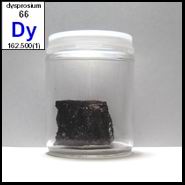
Dysprosium photo
Basic properties
Atomic number66
Atomic weight162.5001 amu
Element familyN/A
Period6
Group2
Blocks-block
Discovery year1886
Isotope distribution
156Dy
0.06%
158Dy
0.10%
160Dy
2.34%
161Dy
18.9%
162Dy
25.5%
163Dy
24.9%
164Dy
28.2%
160Dy: 2.34%161Dy: 18.90%162Dy: 25.50%163Dy: 24.90%164Dy: 28.20%
160Dy (2.34%)
161Dy (18.90%)
162Dy (25.50%)
163Dy (24.90%)
164Dy (28.20%)
Physical properties
Density 8.55 g/cm3 (STP)
Atomic hydrogen (H) 8.988E-5
Meitnerium (Mt) 28
Melting1407 °C
Helium (He) -272.2
Carbon (C) 3675
Boiling2335 °C
Helium (He) -268.9
Tungsten (W) 5927
Chemical properties
Oxidation states
(less common)
+3
(0, +2, +4)
First ionization potential 5.939 eV
Cesium (Cs) 3.894
Helium (He) 24.587
Electron affinity 0.352 eV
Nobelium (No) -2.33
Atomic chlorine (Cl) 3.612725
Electronegativity1.22
Cesium (Cs) 0.79
Atomic fluorine (F) 3.98
Atomic radius
Covalent radius 1.67 Å
Atomic hydrogen (H) 0.32
Francium (Fr) 2.6
Metallic radius 1.78 Å
Beryllium (Be) 1.12
Cesium (Cs) 2.65
66DyWebQC.OrgCovalentMetallic
Compounds
FormulaNameOxidation state
DyCl2Dysprosium(II) chloride+2
Dy(CH3COO)3Dysprosium(III) acetate+3
Dy(NO3)3Dysprosium(III) nitrate+3
Dy(OH)3Dysprosium(III) hydroxide+3
Dy2O3Dysprosium oxide+3
Dy2Se3Dysprosium selenide+3
Dy2Sn2O7Dysprosium stannate+3
Dy2Ti2O7Dysprosium titanate+3
DyCl3Dysprosium(III) chloride+3
DyF3Dysprosium(III) fluoride+3
DyI3Dysprosium(III) iodide+3
DyPDysprosium phosphide+3
Electronic properties
Electrons per shell2, 8, 18, 28, 8, 2
Electronic configuration[Xe] 4f106s2
Bohr atom model
Bohr atom model
Orbital box diagram
Orbital box diagram
Valence electrons12
Lewis dot structure Dysprosium Lewis dot structure
Orbital Visualization
🏠
▶️
📐
Electrons-

Dysprosium (Dy): Periodic Table Element

Scientific Review Article | Chemistry Reference Series

Abstract

Dysprosium (Dy, Z = 66) represents a lanthanide element characterized by exceptional magnetic properties and significant technological applications. This rare-earth metal exhibits the highest magnetic susceptibility among stable elements at low temperatures, demonstrating ferromagnetic ordering below 90.5 K and complex antiferromagnetic behavior at intermediate temperatures. Dysprosium manifests predominantly in the +3 oxidation state, forming numerous binary and ternary compounds with varied industrial applications. The element's unique magnetic characteristics enable critical applications in permanent magnets for electric vehicles, wind turbines, and data storage devices. Production derives primarily from ion-adsorption clay ores and monazite sand processing. Current global demand significantly exceeds supply due to expanding clean energy technologies requiring dysprosium-enhanced neodymium-iron-boron magnets.

Introduction

Dysprosium occupies position 66 in the periodic table within the lanthanide series, situated between terbium and holmium. The element's electronic configuration [Xe]4f106s2 places it among the heavy rare-earth elements, where partially filled 4f orbitals confer distinctive magnetic and optical properties. Its discovery in 1886 by Paul Émile Lecoq de Boisbaudran represented a significant advancement in rare-earth chemistry, though pure elemental isolation remained elusive until ion-exchange techniques emerged in the 1950s. Modern dysprosium applications center on its extraordinary magnetic behavior, particularly in permanent magnet technologies critical for renewable energy infrastructure. The element's scarcity and unique properties position it as strategically important for emerging clean energy technologies, with demand projections indicating potential supply constraints in advancing electrification and wind power sectors.

Physical Properties and Atomic Structure

Fundamental Atomic Parameters

Dysprosium exhibits atomic number 66 with electronic configuration [Xe]4f106s2, placing ten electrons in the 4f subshell. The atomic radius measures 2.28 Å, while the trivalent ionic radius (Dy3+) equals 1.03 Å in eight-coordinate environments. Effective nuclear charge influences significantly the contraction observed across the lanthanide series. The 4f electrons provide minimal shielding due to their deeply penetrating character, resulting in pronounced lanthanide contraction effects. First ionization energy reaches 573 kJ/mol, reflecting the moderate electropositive character typical of lanthanides. Successive ionization energies demonstrate the stability of the +3 oxidation state, with the second and third ionization energies measuring 1130 kJ/mol and 2200 kJ/mol respectively.

Macroscopic Physical Characteristics

Dysprosium metal displays a bright metallic silver luster and relatively soft mechanical properties, allowing machining without sparking when overheating is avoided. The element crystallizes in hexagonal close-packed structure at room temperature, transforming to body-centered cubic geometry at 1654 K. Density equals 8.540 g/cm³ at 298 K, reflecting the compact lanthanide structure. Melting point occurs at 1680 K (1407°C), while the boiling point reaches 2840 K (2567°C). Heat of fusion measures 11.06 kJ/mol, and heat of vaporization equals 280 kJ/mol. Specific heat capacity at constant pressure equals 27.7 J/(mol·K) at 298 K. The element demonstrates exceptional magnetic properties, with magnetic susceptibility χv ≈ 5.44 × 10⁻³, representing among the highest values for any element.

Chemical Properties and Reactivity

Electronic Structure and Bonding Behavior

The partially filled 4f10 configuration governs dysprosium's chemical reactivity and bonding characteristics. The +3 oxidation state predominates in virtually all compounds, achieved through loss of the two 6s electrons and one 4f electron. The resulting Dy3+ ion exhibits paramagnetic behavior with five unpaired 4f electrons, generating a magnetic moment of 10.65 Bohr magnetons. Coordination chemistry typically involves high coordination numbers ranging from 8 to 12, reflecting the large ionic radius and electrostatic bonding preferences. Bond formation occurs primarily through ionic mechanisms, though some covalent character appears in bonds with electronegative elements. The 4f orbitals remain largely non-bonding due to their contracted radial distribution, contrasting with d-block transition metals where d orbitals participate directly in bonding.

Electrochemical and Thermodynamic Properties

Electronegativity values on the Pauling scale equal 1.22, indicating moderate electropositive character. Standard reduction potential for the Dy3+/Dy couple measures -2.35 V versus the standard hydrogen electrode, demonstrating strong reducing capability in aqueous media. Electron affinity remains essentially zero, typical of metals with stable electron configurations upon cation formation. Successive ionization energies reveal the electronic structure influence: removal of 6s electrons occurs relatively easily, while 4f electron removal requires substantially higher energy. Thermodynamic stability of the +3 oxidation state reflects optimal balance between ionization energy and lattice energy considerations in ionic compounds. Electrochemical behavior in non-aqueous solvents permits access to the +2 oxidation state under specialized conditions.

Chemical Compounds and Complex Formation

Binary and Ternary Compounds

Dysprosium forms an extensive series of binary compounds across multiple oxidation states. The most significant oxide, dysprosium(III) oxide (Dy2O3, dysprosia), appears as a white paramagnetic powder exhibiting higher magnetic susceptibility than iron oxides. Formation occurs readily through direct oxidation: 4 Dy + 3 O2 → 2 Dy2O3. Halide compounds include dysprosium(III) fluoride (DyF3, green), chloride (DyCl3, white), bromide (DyBr3, white), and iodide (DyI3, green). These halides demonstrate typical lanthanide characteristics with high melting points and ionic bonding. Chalcogenide compounds encompass multiple stoichiometries: DyS, DyS2, Dy2S3, and Dy5S7, reflecting varied sulfur coordination environments. Carbide and nitride phases include Dy3C, Dy2C3, and DyN, exhibiting refractory properties and metallic conductivity.

Coordination Chemistry and Organometallic Compounds

Dysprosium coordination complexes typically exhibit coordination numbers between 8 and 12, accommodating the large Dy3+ ionic radius. Aqueous solutions contain the [Dy(OH2)9]3+ complex as the predominant species, demonstrating characteristic yellow coloration. Sulfate coordination produces dysprosium(III) sulfate (Dy2(SO4)3), which exhibits notable paramagnetic properties. Carbonate complexes include both hydrated (Dy2(CO3)3·4H2O) and hydroxycarbonate (DyCO3(OH)) phases, with the tetrahydrate demonstrating exceptional stability in amorphous form. Oxalate decahydrate (Dy2(C2O4)3·10H2O) represents among the few water-insoluble dysprosium compounds. Organometallic chemistry remains limited due to the hard acid character of Dy3+ and the preference for ionic bonding mechanisms.

Natural Occurrence and Isotopic Analysis

Geochemical Distribution and Abundance

Crustal abundance of dysprosium averages 5.2 mg/kg, positioning it among the more abundant heavy rare-earth elements. Seawater concentrations remain extremely low at 0.9 ng/L, reflecting poor solubility in alkaline marine environments. Geochemical behavior follows typical lanthanide patterns, with preferential concentration in felsic igneous rocks and associated pegmatite deposits. Primary mineral associations include xenotime (YPO4), monazite ((Ce,La,Nd,Th)PO4), and bastnäsite ((Ce,La)CO3F), where dysprosium substitutes for other rare-earth elements. Ion-adsorption clay deposits in southern China provide the primary commercial source, with dysprosium comprising 7-8% of heavy rare-earth concentrates. No dysprosium-dominant minerals have been identified, necessitating extraction from mixed rare-earth ores through complex separation processes.

Nuclear Properties and Isotopic Composition

Naturally occurring dysprosium comprises seven stable isotopes: 156Dy (0.06%), 158Dy (0.10%), 160Dy (2.34%), 161Dy (18.91%), 162Dy (25.51%), 163Dy (24.90%), and 164Dy (28.18%). The most abundant isotope, 164Dy, contains 98 neutrons and exhibits nuclear spin I = 0. 161Dy and 163Dy possess nuclear spins of 5/2, enabling nuclear magnetic resonance applications. Twenty-nine radioisotopes have been synthesized with mass numbers ranging from 138 to 173. The most stable artificial isotope, 154Dy, demonstrates a half-life of approximately 3 × 10⁶ years through alpha decay. 159Dy exhibits a half-life of 144.4 days via electron capture. Thermal neutron absorption cross-section reaches 994 barns for 164Dy, among the highest values in the periodic table, enabling applications in nuclear reactor control systems.

Industrial Production and Technological Applications

Extraction and Purification Methodologies

Primary dysprosium production derives from monazite sand processing and ion-adsorption clay ore extraction. Initial concentration employs magnetic separation and flotation processes to remove gangue minerals and concentrate rare-earth content. Ion-exchange chromatography provides the critical separation step, exploiting subtle differences in ionic radii and complex formation constants among lanthanides. Solvent extraction using organophosphorus compounds enables large-scale purification with high selectivity factors. Metallic dysprosium production involves reduction of dysprosium(III) fluoride or chloride using calcium or lithium metals in tantalum crucibles under inert atmosphere: 3 Ca + 2 DyF3 → 2 Dy + 3 CaF2. Product purification requires careful separation of metallic dysprosium from halide byproducts based on density differences. Global production reached approximately 3100 tonnes in 2021, with China (40%), Myanmar (31%), and Australia (20%) representing major producing regions.

Technological Applications and Future Prospects

Dysprosium's exceptional magnetic properties drive critical applications in permanent magnet technologies. Neodymium-iron-boron magnets incorporate up to 6% dysprosium substitution to enhance coercivity and temperature stability for electric vehicle motors and wind turbine generators. This enhancement prevents demagnetization at elevated operating temperatures, extending magnet performance lifetime. Nuclear reactor control rods utilize dysprosium oxide-nickel cermets, exploiting the element's extraordinary thermal neutron absorption cross-section of 994 barns. Terfenol-D magnetostrictive alloys, containing dysprosium with iron and terbium, exhibit the highest room-temperature magnetostriction coefficient among known materials, enabling precision actuators and sonar transducers. Optical applications include metal-halide lamp phosphors, where dysprosium bromide and iodide produce intense green and red emission spectra. Emerging quantum physics applications exploit dysprosium's magnetic anisotropy in Bose-Einstein condensate research and dipolar quantum gas studies.

Historical Development and Discovery

The discovery chronology of dysprosium illustrates the progressive refinement of rare-earth element separation techniques throughout the late 19th and early 20th centuries. Paul Émile Lecoq de Boisbaudran achieved initial separation of dysprosium oxide from holmium-containing erbium ores in Paris during 1886, requiring over thirty separation attempts to achieve adequate purity. The designation "dysprosium" derives from the Greek δυσπρόσιτος (dysprositos), meaning "hard to get," reflecting the extraordinary difficulty encountered in isolation procedures. Early separation relied on fractional crystallization and precipitation methods with limited efficiency and purity. The development of ion-exchange chromatography by Frank Spedding at Iowa State University during the 1950s revolutionized rare-earth separation, enabling high-purity dysprosium production for the first time. Modern understanding of dysprosium's magnetic behavior emerged through advances in solid-state physics and materials science, culminating in contemporary applications requiring precisely controlled magnetic properties.

Conclusion

Dysprosium's position as the most magnetically susceptible stable element establishes its critical role in advanced magnetic technologies essential for clean energy infrastructure. The element's unique combination of high thermal neutron absorption, exceptional magnetostriction, and temperature-stable magnetic properties enables applications spanning nuclear reactor control, precision actuators, and high-performance permanent magnets. Future research directions include development of recycling technologies to address supply constraints, investigation of dysprosium-free permanent magnet alternatives, and exploration of quantum applications leveraging its magnetic anisotropy. Continued technological advancement in electric vehicles and renewable energy systems will likely intensify demand for dysprosium-enhanced materials, necessitating expanded production capacity and improved separation efficiencies.

Periodict table
Please let us know how we can improve this web app.

Menu Balance Molar mass Gas laws Units Chemistry tools Periodic table Chemical forum Symmetry Constants Contribute Contact us
How to cite?