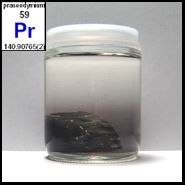
| Element | |
|---|---|
59PrPraseodymium140.9076522
8 18 21 8 2 |
|
| Basic properties | |
|---|---|
| Atomic number | 59 |
| Atomic weight | 140.907652 amu |
| Element family | N/A |
| Period | 6 |
| Group | 2 |
| Block | s-block |
| Discovery year | 1885 |
| Isotope distribution |
|---|
141Pr 100% |
| Physical properties | |
|---|---|
| Density | 6.773 g/cm3 (STP) |
Atomic hydrogen (H) 8.988E-5 Meitnerium (Mt) 28 | |
| Melting | 931 °C |
Helium (He) -272.2 Carbon (C) 3675 | |
| Boiling | 3212 °C |
Helium (He) -268.9 Tungsten (W) 5927 | |
| Chemical properties | |
|---|---|
| Oxidation states (less common) | +3 (0, +1, +2, +4, +5) |
| First ionization potential | 5.462 eV |
Cesium (Cs) 3.894 Helium (He) 24.587 | |
| Electron affinity | 0.109 eV |
Nobelium (No) -2.33 Atomic chlorine (Cl) 3.612725 | |
| Electronegativity | 1.13 |
Cesium (Cs) 0.79 Atomic fluorine (F) 3.98 | |
| Atomic radius | |
|---|---|
| Covalent radius | 1.76 Å |
Atomic hydrogen (H) 0.32 Francium (Fr) 2.6 | |
| Metallic radius | 1.82 Å |
Beryllium (Be) 1.12 Cesium (Cs) 2.65 | |
| Compounds | ||
|---|---|---|
| Formula | Name | Oxidation state |
| C6O12Pr2 | Praseodymium(III) oxalate | +3 |
| Pr(ClO4)3 | Praseodymium(III) perchlorate | +3 |
| Pr(NO3)3 | Praseodymium(III) nitrate | +3 |
| Pr(OH)3 | Praseodymium(III) hydroxide | +3 |
| Pr2(CO3)3 | Praseodymium(III) carbonate | +3 |
| Pr2(SO4)3 | Praseodymium(III) sulfate | +3 |
| Pr2(SeO4)3 | Praseodymium(III) selenate | +3 |
| Pr2O3 | Praseodymium(III) oxide | +3 |
| Pr6O11 | Praseodymium(III,IV) oxide | +3/+4 |
| PrF4 | Praseodymium(IV) fluoride | +4 |
| PrO2 | Praseodymium(IV) oxide | +4 |
| PrNO | Praseodymium(V) oxide nitride | +5 |
| Electronic properties | |
|---|---|
| Electrons per shell | 2, 8, 18, 21, 8, 2 |
| Electronic configuration | [Xe] 4f3 |
|
Bohr atom model
| |
|
Orbital box diagram
| |
| Valence electrons | 5 |
| Lewis dot structure |
|
| Orbital Visualization | |
|---|---|
|
| |
| Electrons | - |
Praseodymium (Pr): Periodic Table Element
Abstract
Praseodymium (Pr), atomic number 59, constitutes the third member of the lanthanide series and demonstrates characteristic rare-earth metal properties. This silvery, malleable metal exhibits distinctive green coloration in its salts and compounds, arising from its unique f³ electronic configuration. The element manifests primarily trivalent oxidation behavior in aqueous solutions, though higher oxidation states remain accessible under specific conditions. Industrial applications center on magnetic materials, optical systems, and specialized alloys. Natural occurrence patterns mirror other early lanthanides, with crustal abundance of approximately 9.1 parts per million. Extraction processes typically involve complex separation procedures from mixed rare-earth ores, particularly monazite and bastnäsite minerals.
Introduction
Praseodymium occupies position 59 in the periodic table, representing a fundamental member of the lanthanide series between cerium and neodymium. The element's classification within the f-block demonstrates the systematic filling of 4f orbitals characteristic of rare-earth elements. Electronic structure analysis reveals a [Xe]4f³6s² configuration, establishing the foundation for its chemical behavior and bonding characteristics. Discovery emerged through systematic separation of didymium by Carl Auer von Welsbach in 1885, marking significant progress in rare-earth element isolation techniques. Contemporary understanding encompasses comprehensive knowledge of atomic structure, thermodynamic properties, and technological applications spanning magnetic materials to optical devices.
Physical Properties and Atomic Structure
Fundamental Atomic Parameters
Praseodymium exhibits atomic number 59 with electronic configuration [Xe]4f³6s², establishing three unpaired electrons in 4f orbitals. Atomic radius measurements indicate 247 pm for the neutral atom, placing it among the larger lanthanide elements. Ionic radii demonstrate systematic contraction along the lanthanide series, with Pr³⁺ measuring approximately 106 pm in octahedral coordination. Effective nuclear charge calculations account for shielding effects of core electrons, particularly the limited screening provided by 4f electrons. First ionization energy measures 527 kJ/mol, second ionization requires 1020 kJ/mol, and third ionization demands 2086 kJ/mol, reflecting progressive difficulty in electron removal from filled orbitals.
Macroscopic Physical Characteristics
Pure praseodymium metal displays a silvery-white metallic appearance with notable ductility and malleability comparable to silver. Density measurements yield 6.77 g/cm³ at standard conditions, consistent with lanthanide series trends. Crystal structure analysis reveals double hexagonal close-packed (dhcp) arrangement at ambient temperature, designated as the α-phase. Phase transition occurs at 795°C to body-centered cubic structure (β-phase) before melting at 931°C (1208 K). Boiling point reaches 3520°C (3793 K) under standard pressure conditions. Specific heat capacity measures 193 J/(kg·K), while thermal conductivity demonstrates 12.5 W/(m·K) at room temperature. Electrical resistivity exhibits 68 nΩ·m, indicating metallic conduction characteristics.
Chemical Properties and Reactivity
Electronic Structure and Bonding Behavior
Chemical reactivity patterns derive from the 4f³ electronic configuration and accessibility of 6s and 5d orbitals for bonding. Praseodymium readily adopts the +3 oxidation state through loss of 6s² and one 4f electron, achieving greater thermodynamic stability. The +4 oxidation state becomes accessible under oxidizing conditions, particularly in solid-state compounds where lattice energies compensate for high ionization energies. Recently discovered +5 oxidation state exists only under specialized conditions, representing formal loss of all 4f³ valence electrons. Coordination chemistry typically involves high coordination numbers (8-12) due to the large ionic radius of Pr³⁺ and limited directional bonding constraints from f orbitals. Bond formation predominantly exhibits ionic character with minimal covalent contributions.
Electrochemical and Thermodynamic Properties
Electronegativity values demonstrate 1.13 on the Pauling scale, characteristic of highly electropositive lanthanide elements. Standard reduction potential for Pr³⁺/Pr couple measures -2.35 V, indicating strong reducing character. The Pr⁴⁺/Pr³⁺ couple exhibits exceptionally positive potential (+3.2 V), rendering Pr⁴⁺ species unstable in aqueous media through water oxidation. Successive ionization energies follow expected trends with significant increases corresponding to removal of core electrons. Electron affinity measurements remain negligible, consistent with metallic character. Thermodynamic data for compound formation indicate high stability for Pr₂O₃ (ΔHf° = -1809 kJ/mol) and notable exothermic character for halide formation. Standard entropy values for metallic praseodymium measure 73.2 J/(mol·K).
Chemical Compounds and Complex Formation
Binary and Ternary Compounds
Praseodymium oxide chemistry exhibits complexity through multiple stoichiometric phases. Sesquioxide Pr₂O₃ represents the most thermodynamically stable form under reducing conditions, crystallizing in hexagonal structure. Higher oxides include Pr₆O₁₁ (mixed +3/+4 oxidation states) and PrO₂ (pure +4 state), accessible under high oxygen pressure. Halide chemistry demonstrates systematic trends with PrF₃, PrCl₃, PrBr₃, and PrI₃ all adopting typical lanthanide structures. Tetrafluoride PrF₄ formation requires specialized synthetic conditions involving fluorine gas. Sulfide and nitride compounds follow expected patterns with PrS₂, Pr₂S₃, and PrN representing stable phases. Ternary compounds encompass perovskite structures (PrCoO₃), garnets (Pr₃Al₅O₁₂), and intermetallic phases with transition metals.
Coordination Chemistry and Organometallic Compounds
Coordination complexes demonstrate high coordination numbers typical of large lanthanide cations. Crown ether complexes exhibit selective binding based on ionic radius matching, with 18-crown-6 forming both 1:1 and 4:3 stoichiometries. Chelating ligands including EDTA, acetylacetonate, and cyclopentadienide produce well-characterized complexes. Organometallic chemistry remains limited by absence of π-backbonding capability inherent to f-orbitals. Cyclopentadienyl compounds Pr(C₅H₅)₃ adopt typical lanthanide geometries with predominantly ionic bonding character. Recent advances have demonstrated molecular Pr⁴⁺ complexes under specialized conditions, expanding understanding of higher oxidation state chemistry.
Natural Occurrence and Isotopic Analysis
Geochemical Distribution and Abundance
Crustal abundance measurements indicate 9.1 mg/kg (ppm) for praseodymium, comparable to boron concentration. Geochemical behavior follows patterns established by ionic radius and charge considerations, concentrating in phosphate, carbonate, and silicate mineral phases. Primary ore sources include monazite ((Ce,La,Nd,Pr)PO₄) and bastnäsite ((Ce,La,Nd,Pr)CO₃F), where praseodymium constitutes approximately 4-5% of total rare-earth content. Deposit locations span diverse geological environments including carbonatites, pegmatites, and placer concentrations. Weathering processes typically concentrate rare-earth elements through formation of resistant mineral phases. Marine distribution demonstrates depletion relative to crustal abundance due to low solubility of trivalent species.
Nuclear Properties and Isotopic Composition
Natural praseodymium consists exclusively of the stable isotope ¹⁴¹Pr, establishing it as a monoisotopic element with precisely defined atomic weight (140.90766 u). Nuclear structure includes 82 neutrons, representing a magic number that contributes to exceptional stability. Nuclear spin quantum number equals 5/2 with magnetic moment measuring +4.275 nuclear magnetons. Artificial radioisotopes span mass numbers from 121 to 159, with ¹⁴³Pr exhibiting the longest half-life (13.6 days). Decay modes include β⁻ emission for neutron-rich isotopes and electron capture/β⁺ emission for neutron-deficient species. Nuclear cross-sections for thermal neutron absorption measure 11.5 barns, relevant for reactor physics calculations.
Industrial Production and Technological Applications
Extraction and Purification Methodologies
Commercial production begins with acid digestion of monazite or bastnäsite concentrates using concentrated sulfuric acid at elevated temperatures. Monazite processing involves additional steps for thorium removal through selective precipitation. Rare-earth separation employs ion-exchange chromatography or solvent extraction techniques utilizing tributyl phosphate. Separation efficiency depends on subtle differences in ionic radii and complexation behavior among lanthanides. Metal production typically involves metallothermic reduction of anhydrous fluoride or chloride using calcium or lithium metals under inert atmosphere. Purification to 99.9% purity requires vacuum distillation and zone refining techniques. Annual global production approximates 2,000 tonnes of rare-earth oxides containing praseodymium.
Technological Applications and Future Prospects
Permanent magnet applications represent the largest consumption sector, particularly in Nd-Fe-B compositions where praseodymium substitution enhances temperature stability and coercivity. Wind turbine generators, electric vehicle motors, and computer hard drives constitute primary end uses. Optical applications exploit unique absorption characteristics for yellow light filtering in safety glasses and laser systems. Ceramic pigment applications utilize praseodymium-doped zircon for stable yellow coloration in high-temperature environments. Catalytic applications include automotive exhaust treatment and selective oxidation processes. Emerging technologies encompass quantum computing applications and specialized optical materials for telecommunications. Economic considerations increasingly favor recycling and material substitution strategies to address supply constraints.
Historical Development and Discovery
Praseodymium discovery traces to systematic rare-earth element separation work conducted by Carl Gustav Mosander beginning in 1841. Initial isolation of didymium from cerium salts represented preliminary progress, though the composite nature remained unrecognized. Spectroscopic evidence suggested didymium complexity, notably through observations by Marc Delafontaine, but definitive separation awaited improved analytical techniques. Carl Auer von Welsbach achieved successful separation in 1885, employing fractional crystallization methods to isolate distinct praseodymium and neodymium fractions. Nomenclature derives from Greek prasinos (leek-green) reflecting characteristic salt coloration. Early applications focused on gas mantles and optical filters before expansion into magnetic materials during the 20th century. Modern understanding incorporates electronic structure theory, coordination chemistry principles, and advanced characterization methods unavailable to early investigators.
Conclusion
Praseodymium demonstrates characteristic lanthanide properties while maintaining unique features derived from its specific f³ electronic configuration. Industrial significance continues expanding through magnetic material applications and emerging technologies. Chemical behavior reflects predominant trivalent character with accessible higher oxidation states under appropriate conditions. Future research directions encompass advanced separation technologies, recycling methodologies, and novel applications in quantum technologies. Environmental considerations increasingly influence production strategies and material utilization patterns.

Please let us know how we can improve this web app.