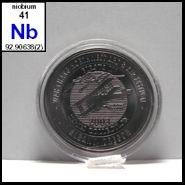
| Element | |
|---|---|
41NbNiobium92.9063822
8 18 12 1 |
|
| Basic properties | |
|---|---|
| Atomic number | 41 |
| Atomic weight | 92.906382 amu |
| Element family | Transition metals |
| Period | 5 |
| Group | 1 |
| Block | s-block |
| Discovery year | 1801 |
| Isotope distribution |
|---|
93Nb 100% |
| Physical properties | |
|---|---|
| Density | 8.57 g/cm3 (STP) |
Atomic hydrogen (H) 8.988E-5 Meitnerium (Mt) 28 | |
| Melting | 2468 °C |
Helium (He) -272.2 Carbon (C) 3675 | |
| Boiling | 4927 °C |
Helium (He) -268.9 Tungsten (W) 5927 | |
| Chemical properties | |
|---|---|
| Oxidation states (less common) | +5 (-3, -1, 0, +1, +2, +3, +4) |
| First ionization potential | 6.758 eV |
Cesium (Cs) 3.894 Helium (He) 24.587 | |
| Electron affinity | 0.917 eV |
Nobelium (No) -2.33 Atomic chlorine (Cl) 3.612725 | |
| Electronegativity | 1.6 |
Cesium (Cs) 0.79 Atomic fluorine (F) 3.98 | |
| Atomic radius | |
|---|---|
| Covalent radius | 1.47 Å |
Atomic hydrogen (H) 0.32 Francium (Fr) 2.6 | |
| Metallic radius | 1.46 Å |
Beryllium (Be) 1.12 Cesium (Cs) 2.65 | |
| Compounds | ||
|---|---|---|
| Formula | Name | Oxidation state |
| NbB2 | Niobium diboride | +2 |
| NbO | Niobium monoxide | +2 |
| NbN | Niobium nitride | +3 |
| NbP | Niobium phosphide | +3 |
| NbC | Niobium carbide | +4 |
| NbCl4 | Niobium(IV) chloride | +4 |
| NbF4 | Niobium(IV) fluoride | +4 |
| NbO2 | Niobium dioxide | +4 |
| Nb2O5 | Niobium pentoxide | +5 |
| NbCl5 | Niobium pentachloride | +5 |
| LiNbO3 | Lithium niobate | +5 |
| KNbO3 | Potassium niobate | +5 |
| Electronic properties | |
|---|---|
| Electrons per shell | 2, 8, 18, 12, 1 |
| Electronic configuration | [Kr] 4d4 |
|
Bohr atom model
| |
|
Orbital box diagram
| |
| Valence electrons | 5 |
| Lewis dot structure |
|
| Orbital Visualization | |
|---|---|
|
| |
| Electrons | - |
Niobium (Nb): Periodic Table Element
Abstract
Niobium (symbol Nb, atomic number 41) represents a strategically significant transition metal belonging to group 5 of the periodic table. With atomic mass 92.90637 ± 0.00001 u and electron configuration [Kr] 4d⁴ 5s¹, niobium exhibits distinctive physical and chemical properties including exceptional superconducting capabilities and corrosion resistance. The element demonstrates primary oxidation states of +3 and +5, forms body-centered cubic crystalline structure, and exhibits melting point 2750 K with density 8.57 g/cm³. Niobium's industrial significance centers on steel strengthening applications where minimal additions substantially enhance mechanical properties, superconducting technologies including MRI magnets and particle accelerators, and aerospace superalloys for high-temperature applications. Natural occurrence predominantly involves pyrochlore and columbite minerals, with Brazil maintaining dominant global production. The element's discovery by Charles Hatchett in 1801 initiated prolonged nomenclature controversy resolved through IUPAC standardization in 1950.
Introduction
Niobium occupies position 41 in the periodic table as the first member of the second transition series, exhibiting characteristic d-block properties with notable deviations from expected trends. The element's electronic configuration [Kr] 4d⁴ 5s¹ creates unique bonding characteristics distinguishing it from lighter group 5 congeners vanadium and heavier tantalum. Located in period 5, niobium demonstrates intermediate atomic radius between these elements while maintaining distinct chemical reactivity patterns. The metal's industrial prominence emerged during the twentieth century as metallurgical applications revealed extraordinary strengthening effects in steel alloys and superconducting properties crucial for modern technology. Geochemically, niobium represents a lithophile element with crustal abundance approximately 20 parts per million, occurring primarily in alkaline igneous rocks and associated pegmatites. The element's refractory nature and chemical stability reflect strong metal-oxygen bond formation, contributing to both industrial utility and extraction challenges.
Physical Properties and Atomic Structure
Fundamental Atomic Parameters
Niobium's atomic structure centers on nuclear composition containing 41 protons with predominant isotope ⁹³Nb possessing 52 neutrons, resulting in nuclear spin I = 9/2 and magnetic moment μ = +6.1705 nuclear magnetons. The electron configuration [Kr] 4d⁴ 5s¹ deviates from expected [Kr] 4d³ 5s² arrangement due to exchange energy considerations favoring half-filled 4d orbitals. Atomic radius measures 146 pm while ionic radii vary significantly with oxidation state: Nb³⁺ exhibits 72 pm, Nb⁴⁺ measures 68 pm, and Nb⁵⁺ contracts to 64 pm. Effective nuclear charge calculations indicate progressive screening by inner electrons, with 4d electrons experiencing Zeff approximately 4.7. First ionization energy equals 652.1 kJ/mol, reflecting moderate metallic bonding strength, while successive ionizations require 1382, 2416, 3700, and 4877 kJ/mol respectively. Electron affinity remains poorly defined for niobium, typical of early transition metals with partially filled d-orbitals.
Macroscopic Physical Characteristics
Niobium crystallizes in body-centered cubic structure with lattice parameter a = 3.3004 Å at room temperature, space group Im3m. The metal exhibits lustrous gray appearance with characteristic bluish tint when oxidized surfaces form thin interference films. Density at standard conditions equals 8.57 g/cm³, positioning niobium between lighter vanadium (6.11 g/cm³) and denser tantalum (16.69 g/cm³). Thermal properties include melting point 2750 K (2477°C) and boiling point 5017 K (4744°C), indicating strong metallic bonding consistent with refractory character. Heat of fusion measures 30.0 kJ/mol while vaporization enthalpy equals 689.9 kJ/mol. Specific heat capacity at constant pressure equals 24.60 J/(mol·K) at 298 K. The metal demonstrates paramagnetic behavior with magnetic susceptibility χ = +2.08 × 10⁻⁴ at room temperature. Mechanical properties include Mohs hardness 6, comparable to titanium, with excellent ductility enabling extensive cold working. Thermal expansion coefficient equals 7.3 × 10⁻⁶ K⁻¹, while thermal conductivity measures 53.7 W/(m·K) at room temperature.
Chemical Properties and Reactivity
Electronic Structure and Bonding Behavior
Niobium's chemical reactivity derives from four available 4d electrons and single 5s electron, enabling variable oxidation states from +1 to +5. The +5 oxidation state achieves maximum stability through complete 4d orbital vacating, forming compounds with predominantly ionic character. Lower oxidation states (+2, +3, +4) involve partial d-orbital occupancy, creating metal-metal bonding opportunities in cluster compounds. Bond formation typically involves hybridization of 4d and 5s orbitals with oxygen 2p orbitals in oxide systems, producing strong covalent-ionic hybrid bonds. Nb-O bond lengths in Nb₂O₅ range from 1.78 to 2.25 Å depending on coordination environment, with bond energies approaching 750 kJ/mol for terminal oxo bonds. The metal demonstrates hard acid character in Pearson's classification, preferring oxygen and fluorine donors over sulfur or nitrogen ligands. Coordination numbers vary extensively from 4 to 8, with octahedral and square antiprismatic geometries most common in +5 oxidation state compounds. Niobium-carbon bonds in carbide phases exhibit considerable covalent character with bond lengths approximately 2.2 Å.
Electrochemical and Thermodynamic Properties
Electronegativity values for niobium equal 1.6 on the Pauling scale and 1.23 on the Allred-Rochow scale, indicating moderate electropositive character typical of early transition metals. Standard reduction potentials vary significantly with pH and oxidation state: Nb₂O₅ + 10H⁺ + 10e⁻ → 2Nb + 5H₂O exhibits E° = -0.644 V in acidic solution, while NbO₄³⁻ + 4H₂O + 5e⁻ → Nb + 8OH⁻ shows E° = -1.186 V under basic conditions. The Nb⁵⁺/Nb⁴⁺ couple demonstrates E° = +0.58 V, indicating stability of pentavalent state. Thermodynamic data reveals high formation enthalpies for niobium oxides: ΔH°f = -1899.5 kJ/mol for Nb₂O₅, explaining exceptional chemical stability and resistance to reduction. Gibbs free energies of formation favor oxide formation under oxidizing conditions, with Nb₂O₅ exhibiting ΔG°f = -1766.0 kJ/mol at 298 K. Electrochemical behavior in aqueous solution involves complex hydrolysis equilibria forming polymeric species, particularly in near-neutral pH ranges where Nb₆O₁₉⁸⁻ clusters predominate.
Chemical Compounds and Complex Formation
Binary and Ternary Compounds
Niobium pentoxide Nb₂O₅ represents the most stable binary compound, crystallizing in multiple polymorphic forms including orthorhombic T-phase, monoclinic B-phase, and tetragonal TT-phase structures. Formation occurs through atmospheric oxidation at elevated temperatures according to 4Nb + 5O₂ → 2Nb₂O₅ with ΔH° = -1899.5 kJ/mol. Lower oxides include NbO (cubic structure), NbO₂ (rutile structure), and intermediate phases Nb₂O₃ and Nb₄O₅. Niobium halides demonstrate complete series for fluoride NbF₅ through NbF₂, with pentafluoride exhibiting highly hygroscopic character and strong Lewis acid behavior. Chlorides include NbCl₅ and NbCl₄, both forming through direct combination with elemental chlorine. Carbide phases encompass NbC and Nb₂C, exhibiting exceptional hardness and thermal stability approaching 4000°C. Nitride NbN crystallizes in rocksalt structure with metallic conductivity and superconducting transition at 16 K. Sulfides NbS₂ and NbS₃ adopt layered structures with semiconductor properties.
Coordination Chemistry and Organometallic Compounds
Niobium coordination complexes exhibit diverse geometries reflecting d⁰ through d⁴ electronic configurations across oxidation states. Pentavalent complexes typically adopt octahedral coordination with ligands such as oxalate, forming [Nb(C₂O₄)₃]⁻ anions, or square antiprismatic arrangement in eight-coordinate species like [NbF₈]³⁻. Oxo complexes include niobate anions [NbO₄]³⁻ and polyoxoniobates such as [Nb₆O₁₉]⁸⁻, exhibiting corner-sharing octahedral connectivity patterns. Lower oxidation state complexes demonstrate metal-metal bonding, particularly in aqueous chloride solutions forming [Nb₆Cl₁₂]²⁺ cluster ions with octahedral metal framework. Organometallic chemistry encompasses cyclopentadienyl derivatives Nb(C₅H₅)₂Cl₂ and alkyl complexes, though thermal stability remains limited compared to early transition metal analogs. Carbonyl complexes require strongly reducing conditions for formation, with [Nb(CO)₆]⁻ representing a rare anionic species requiring sophisticated synthetic techniques. Alkylidene and alkylidyne complexes demonstrate significant importance in metathesis catalysis applications.
Natural Occurrence and Isotopic Analysis
Geochemical Distribution and Abundance
Niobium maintains crustal abundance approximately 20 parts per million, ranking 34th among elements in terrestrial distribution. Geochemical behavior classifies niobium as a lithophile element with strong affinity for silicate phases, concentrating preferentially in acidic igneous rocks and associated pegmatites. Primary ore minerals include pyrochlore (Na,Ca)₂Nb₂O₆(OH,F) and columbite-tantalite series (Fe,Mn)(Nb,Ta)₂O₆, with pyrochlore containing up to 74% niobium pentoxide. Carbonatite complexes host major pyrochlore deposits, representing alkaline igneous environments with concentrated incompatible element assemblages. Secondary mineral phases include fergusonite (Y,Er,Ce,Fe)(Nb,Ta,Ti)O₄ and euxenite (Y,Ca,Ce,U,Th)(Nb,Ta,Ti)₂O₆. Weathering processes typically form residual placers through mechanical concentration of resistant niobium minerals. Seawater contains dissolved niobium at concentrations averaging 1.5 × 10⁻⁸ g/L, while river systems transport particulate niobium at mean concentrations 1.9 mg/kg in suspended sediments.
Nuclear Properties and Isotopic Composition
Natural niobium consists entirely of isotope ⁹³Nb with 100% abundance, representing one of 22 monoisotopic elements. Nuclear properties include spin I = 9/2, magnetic dipole moment μ = +6.1705 nuclear magnetons, and electric quadrupole moment eQ = -0.32 barns. Nuclear stability derives from magic neutron number N = 52, contributing to exceptional longevity with no observed decay processes. Artificial isotopes range from mass 81 to 113, with longest-lived radioactive species ⁹⁴Nb exhibiting half-life 2.03 × 10⁴ years through electron capture decay to ⁹⁴Mo. Nuclear cross-sections for thermal neutron capture equal 1.15 barns for ⁹³Nb(n,γ)⁹⁴Nb reaction, producing metastable ⁹⁴ᵐNb with 6.26-minute half-life. Fission yield of ⁹³Nb from ²³⁵U thermal fission equals 6.38%, making this isotope significant in nuclear reactor neutron balance calculations. Medical isotope ⁹⁵Nb finds applications in positron emission tomography with 35-day half-life and γ-ray emissions at 765.8 keV.
Industrial Production and Technological Applications
Extraction and Purification Methodologies
Industrial niobium production begins with pyrochlore concentrate upgrading through magnetic and flotation separation techniques, achieving 60-65% Nb₂O₅ content from initial 2-3% ore grades. Primary extraction involves high-temperature chlorination using carbon and chlorine gas according to Nb₂O₅ + 5C + 5Cl₂ → 2NbCl₅ + 5CO at 1000°C, producing volatile niobium pentachloride. Alternative hydrofluoric acid digestion generates soluble fluorocomplexes through Nb₂O₅ + 10HF → 2H₂NbF₇ + 3H₂O, enabling liquid-liquid extraction with organic solvents like methyl isobutyl ketone. Purification from tantalum employs differential solvent extraction based on distribution coefficients, with niobium preferentially extracting into organic phases under specific acid concentrations. Reduction to metallic niobium utilizes electron beam melting of niobium pentoxide or sodium reduction of potassium heptafluoroniobate according to K₂NbF₇ + 5Na → Nb + 5NaF + 2KF. Ultra-high purity metal production for superconducting applications requires electron beam zone refining, achieving impurity levels below 10 parts per million for interstitial elements.
Technological Applications and Future Prospects
Steel strengthening represents the dominant application consuming approximately 85% of global niobium production through ferroniobium additions containing 60-70% niobium. Precipitation hardening mechanisms involve niobium carbide and carbonitride formation, enabling strength increases exceeding 30% with additions below 0.1 weight percent. High-strength low-alloy steels for pipeline construction utilize niobium's grain refinement effects, reducing steel wall thickness requirements while maintaining pressure ratings. Superconducting applications encompass niobium-titanium alloys for MRI magnets and niobium-tin intermetallic compounds for high-field accelerator magnets, with critical current densities exceeding 2000 A/mm² at 12 Tesla. Pure niobium superconducting radio frequency cavities enable particle accelerator systems including the Large Hadron Collider, operating at 1.9 K with quality factors exceeding 10¹⁰. Aerospace superalloys incorporate niobium for γ' phase stability in nickel-based systems, extending creep resistance at 1100°C service temperatures. Emerging applications include quantum computing implementations utilizing niobium Josephson junctions and thin-film technologies for high-frequency electronics. Medical device applications exploit biocompatibility for orthopedic implants, while decorative applications utilize anodic coloration producing interference colors through controlled oxide thickness.
Historical Development and Discovery
Charles Hatchett's discovery of niobium in 1801 originated from analysis of a mineral sample from Connecticut forwarded to London by John Winthrop in 1734. Initial isolation from columbite ore yielded an unknown metal oxide, which Hatchett named "columbium" honoring America as Columbia. Heinrich Rose's 1844 research revealed the distinction between niobium and tantalum, previously considered identical elements, leading to systematic separation techniques. The element received its current name from Niobe in Greek mythology, daughter of Tantalus, reflecting the close chemical relationship between niobium and tantalum. Prolonged nomenclature controversy persisted until 1950 when IUPAC officially adopted "niobium" over American preference for "columbium," though industrial usage retained both names through the 20th century. Early metallurgical applications emerged in 1920s incandescent lamp filament production, utilizing niobium's refractory properties and ductility. Eugene Kunzler's 1961 discovery of niobium-tin superconductivity at Bell Laboratories revolutionized high-field magnet technology, enabling magnetic resonance imaging and particle physics research. Modern industrial development accelerated through Brazilian mineral discoveries in the 1950s, establishing current global supply patterns dominated by pyrochlore mining operations in Minas Gerais.
Conclusion
Niobium occupies a unique position among transition metals, combining refractory character with exceptional superconducting properties and metallurgical versatility. The element's industrial significance continues expanding through steel strengthening applications enabling lighter, stronger structural materials and superconducting technologies advancing quantum computing and high-energy physics research. Environmental considerations favor niobium's continued utilization given minimal toxicity profiles and recycling potential from steel scrap sources. Future research directions encompass quantum information processing applications, advanced alloy development for extreme environment applications, and expanded superconducting technologies for energy storage and transmission systems. Scientific understanding of niobium's complex solution chemistry and solid-state physics continues evolving, promising additional technological innovations leveraging this element's distinctive properties.

Please let us know how we can improve this web app.