| Element | |
|---|---|
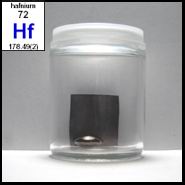
72HfHafnium178.4922
8 18 32 10 2 |
|
| Basic properties | |
|---|---|
| Atomic number | 72 |
| Atomic weight | 178.492 amu |
| Element family | Transition metals |
| Period | 6 |
| Group | 2 |
| Block | s-block |
| Discovery year | 1922 |
| Isotope distribution |
|---|
176Hf 5.2% 177Hf 18.6% 178Hf 27.1% 179Hf 13.7% 180Hf 35.2% |
176Hf (5.21%) 177Hf (18.64%) 178Hf (27.15%) 179Hf (13.73%) 180Hf (35.27%) |
| Physical properties | |
|---|---|
| Density | 13.31 g/cm3 (STP) |
Atomic hydrogen (H) 8.988E-5 Meitnerium (Mt) 28 | |
| Melting | 2227 °C |
Helium (He) -272.2 Carbon (C) 3675 | |
| Boiling | 5400 °C |
Helium (He) -268.9 Tungsten (W) 5927 | |
| Chemical properties | |
|---|---|
| Oxidation states (less common) | +4 (-2, 0, +1, +2, +3) |
| First ionization potential | 6.825 eV |
Cesium (Cs) 3.894 Helium (He) 24.587 | |
| Electron affinity | 0.178 eV |
Nobelium (No) -2.33 Atomic chlorine (Cl) 3.612725 | |
| Electronegativity | 1.3 |
Cesium (Cs) 0.79 Atomic fluorine (F) 3.98 | |
| Atomic radius | |
|---|---|
| Covalent radius | 1.52 Å |
Atomic hydrogen (H) 0.32 Francium (Fr) 2.6 | |
| Metallic radius | 1.59 Å |
Beryllium (Be) 1.12 Cesium (Cs) 2.65 | |
| Compounds | ||
|---|---|---|
| Formula | Name | Oxidation state |
| HfB2 | Hafnium diboride | +2 |
| HfI3 | Hafnium(III) iodide | +3 |
| Hf(NO3)4 | Hafnium nitrate | +4 |
| HfC | Hafnium carbide | +4 |
| HfCl4 | Hafnium tetrachloride | +4 |
| HfF4 | Hafnium tetrafluoride | +4 |
| HfI4 | Hafnium(IV) iodide | +4 |
| HfO2 | Hafnium(IV) oxide | +4 |
| HfS2 | Hafnium disulfide | +4 |
| La2Hf2O7 | Lanthanum hafnate | +4 |
| Ta4HfC5 | Tantalum hafnium carbide | +4 |
| Electronic properties | |
|---|---|
| Electrons per shell | 2, 8, 18, 32, 10, 2 |
| Electronic configuration | [Xe] 4f14 |
|
Bohr atom model

| |
|
Orbital box diagram

| |
| Valence electrons | 4 |
| Lewis dot structure |
|
| Orbital Visualization | |
|---|---|
|
| |
| Electrons | - |
| Reactions |
|---|
| 3 Hf + 2 N2 = Hf3N4 |
Hafnium (Hf): Periodic Table Element
Abstract
Hafnium (atomic number 72, symbol Hf) is a lustrous, silvery-gray tetravalent transition metal characterized by remarkable chemical similarity to zirconium due to the lanthanide contraction effect. With a standard atomic weight of 178.49 ± 0.01 u, hafnium exhibits exceptional nuclear properties including a thermal neutron capture cross-section approximately 600 times that of zirconium. The element crystallizes in a hexagonal close-packed structure at room temperature, transitioning to body-centered cubic symmetry above 2388 K. Hafnium's most significant industrial applications derive from its neutron-absorbing properties in nuclear reactor control rods and its utility as a high-k dielectric material in semiconductor fabrication. Natural occurrence is exclusively in association with zirconium minerals, primarily zircon, where hafnium content typically ranges from 1-4% by mass. Discovery by Coster and de Hevesy in 1923 through X-ray spectroscopy analysis validated Mendeleev's 1869 prediction of element 72.
Introduction
Hafnium occupies a unique position in the periodic table as element 72, representing the culmination of the first transition series following the lanthanide insertion. Located in Group 4 alongside titanium and zirconium, hafnium demonstrates the profound impact of f-orbital contraction on atomic properties. The lanthanide contraction phenomenon results in hafnium and zirconium possessing nearly identical ionic radii (0.78 Å vs. 0.79 Å for the +4 oxidation states), creating an exceptional degree of chemical similarity between these elements. This relationship establishes hafnium as the archetypal example of relativistic effects in transition metal chemistry, where expected trends in atomic size are counteracted by increased nuclear charge and electron-nucleus interactions.
The element's significance extends beyond fundamental chemistry into critical technological applications. Hafnium's remarkable nuclear properties, particularly its exceptional neutron capture capability, position it as an indispensable material in nuclear reactor technology. Simultaneously, its chemical stability and dielectric properties have established hafnium compounds as essential components in advanced semiconductor manufacturing, where hafnium oxide serves as a high-k gate dielectric in modern integrated circuits below 45 nanometer feature sizes.
Physical Properties and Atomic Structure
Fundamental Atomic Parameters
Hafnium exhibits atomic number 72 with an electronic configuration of [Xe] 4f14 5d2 6s2, placing it in the d-block transition metal series. The filled 4f subshell preceding the 5d electrons creates significant shielding effects that influence hafnium's chemical behavior. Effective nuclear charge calculations indicate that the 5d and 6s electrons experience substantial nuclear attraction modulated by the intervening f-electron density. The atomic radius of hafnium (1.59 Å) demonstrates minimal expansion from the fifth to sixth period due to lanthanide contraction, contrasting sharply with typical periodic trends observed in earlier transition series.
Ionization energy data reveal the stability of hafnium's electron configuration, with first ionization energy of 658.5 kJ/mol, second ionization energy of 1440 kJ/mol, third ionization energy of 2250 kJ/mol, and fourth ionization energy of 3216 kJ/mol. These values reflect the progressive removal of 6s and 5d electrons, with the significant increase to the fourth ionization corresponding to disruption of the stable d2 configuration. Electronegativity values on the Pauling scale place hafnium at 1.3, indicating moderate electropositive character consistent with early transition metal behavior.
Macroscopic Physical Characteristics
Hafnium manifests as a lustrous, steel-gray metal exhibiting exceptional ductility and corrosion resistance under ambient conditions. The element crystallizes in a hexagonal close-packed (hcp) structure at room temperature with lattice parameters a = 3.196 Å and c = 5.051 Å, yielding a c/a ratio of 1.580. This structural arrangement provides close atomic packing with coordination number 12, contributing to hafnium's mechanical stability and density properties.
Thermal analysis reveals a polymorphic transition at 2388 K (2115°C) where the α-phase (hcp) transforms to β-phase (body-centered cubic) structure. The transition enthalpy associated with this transformation is 3.5 kJ/mol, reflecting moderate structural reorganization energy. Melting point occurs at approximately 2506 K (2233°C) with an enthalpy of fusion of 27.2 kJ/mol. The boiling point reaches 4876 K (4603°C) under standard atmospheric pressure, demonstrating substantial thermal stability characteristic of refractory metals.
Density measurements establish hafnium at 13.31 g/cm³ at room temperature, approximately twice that of zirconium (6.52 g/cm³). This dramatic density difference provides the primary macroscopic distinction between these otherwise chemically identical elements. Thermal expansion behavior follows typical metallic patterns with linear expansion coefficient of 5.9 × 10⁻⁶ K-1 at room temperature. Specific heat capacity measures 0.144 J/(g·K) at 298 K, reflecting the thermal energy storage characteristics of the metallic lattice.
Chemical Properties and Reactivity
Electronic Structure and Bonding Behavior
Hafnium's chemical reactivity is dominated by the availability of 5d and 6s electrons for bonding interactions, with the filled 4f shell remaining largely inert under typical chemical conditions. The most stable oxidation state is +4, achieved through formal removal of the 6s2 and 5d2 electrons, resulting in a d0 configuration for Hf4+. This electron configuration eliminates crystal field stabilization effects, making hafnium(IV) compounds amenable to various coordination geometries without electronic preference constraints.
Bond formation characteristics reveal strong ionic character in hafnium-oxygen and hafnium-halogen interactions, with calculated ionic character exceeding 60% based on electronegativity differences. Covalent bonding contributions become more significant in hafnium-carbon and hafnium-nitrogen compounds, where orbital overlap between hafnium d orbitals and ligand π systems can occur. Hafnium-hafnium metallic bonding in the pure element involves delocalized electrons in the conduction band, contributing to electrical conductivity of approximately 3.3 × 10⁶ S/m at room temperature.
Lower oxidation states (+3, +2) are known but demonstrate limited stability under ambient conditions. Hafnium(III) compounds typically exhibit strong reducing character and are susceptible to oxidation or disproportionation. The predominance of the +4 oxidation state reflects the energetic favorability of achieving the d0 configuration and the high lattice energies or solvation energies associated with the highly charged Hf4+ cation.
Electrochemical and Thermodynamic Properties
Standard electrode potentials place hafnium among the more electropositive metals, with the Hf4+/Hf couple exhibiting E° = -1.70 V versus the standard hydrogen electrode. This value indicates strong reducing character of metallic hafnium and tendency toward oxidation under aqueous conditions. The potential difference relative to zirconium (E° = -1.45 V for Zr4+/Zr) reflects subtle differences in hydration energies and lattice parameters despite overall chemical similarity.
Thermodynamic stability analysis of hafnium compounds reveals exceptionally negative formation enthalpies, particularly for oxides and nitrides. Hafnium dioxide (HfO2) exhibits ΔH°f = -1144.7 kJ/mol, indicating extraordinary thermochemical stability that contributes to the compound's refractory character. Similarly, hafnium carbide demonstrates ΔH°f = -210 kJ/mol, consistent with its status as the most refractory binary carbide compound known.
Electronegativity values on multiple scales provide insight into bonding character: Pauling scale (1.3), Mulliken scale (1.16), and Allred-Rochow scale (1.23) all indicate moderate electropositive character. These values position hafnium as intermediate between highly electropositive alkali metals and more electronegative late transition metals, consistent with its ability to form both ionic and covalent bonds depending on the chemical environment.
Chemical Compounds and Complex Formation
Binary and Ternary Compounds
Hafnium tetrachloride (HfCl4) represents the most extensively studied hafnium halide, exhibiting tetrahedral molecular geometry in the gas phase and polymeric chain structures in the solid state. Sublimation occurs at 590 K under atmospheric pressure, with vapor phase consisting primarily of monomeric tetrahedral units. The compound serves as a precursor for hafnium metal production via reduction with magnesium or sodium in the Kroll process, where thermodynamic favorability derives from the large lattice energy of magnesium chloride or sodium chloride products.
Hafnium dioxide represents the most thermodynamically stable binary oxide, crystallizing in the monoclinic baddeleyite structure analogous to zirconium dioxide. The compound exhibits exceptional thermal stability with melting point at 3085 K (2812°C) and maintains structural integrity under extreme temperature cycling. Refractive index measurements indicate n = 2.16 at 589 nm, contributing to optical applications in specialized high-temperature environments. The high dielectric constant (κ ≈ 25) positions hafnium dioxide as a critical high-k dielectric material in semiconductor applications.
Hafnium carbide (HfC) crystallizes in the rock salt structure with exceptional thermal properties, including the highest melting point of any binary carbide compound (4163 K, 3890°C). The compound exhibits metallic conductivity due to delocalized electrons in the conduction band, distinguishing it from typical ceramic materials. Hardness measurements place HfC at approximately 20 GPa on the Vickers scale, reflecting strong covalent bonding between hafnium and carbon atoms. Thermal expansion coefficient of 6.6 × 10⁻⁶ K-1 indicates dimensional stability under thermal cycling conditions.
Ternary compounds of particular significance include tantalum hafnium carbide (Ta4HfC5), which holds the distinction of possessing the highest melting point of any known compound at 4263 K (3990°C). This extraordinary thermal stability results from the combination of strong metal-carbon bonding and favorable electronic structure interactions between tantalum and hafnium atoms within the carbide matrix.
Coordination Chemistry and Organometallic Compounds
Coordination complexes of hafnium typically exhibit coordination numbers between 6 and 8, reflecting the large ionic radius of Hf4+ and absence of crystal field stabilization effects. Hafnium tetrachloride readily forms hexacoordinate complexes with oxygen and nitrogen donor ligands, including [HfCl4(H2O)2] and [HfCl4(py)2] (py = pyridine). These complexes demonstrate octahedral geometry with minor distortions arising from ligand sterics rather than electronic effects.
Higher coordination numbers are accessible through multidentate ligands, with [Hf(acac)4] (acac = acetylacetonate) exhibiting eight-coordinate dodecahedral geometry. The β-diketonate ligands provide chelation through oxygen donor atoms, creating thermodynamically stable complexes with practical utility in chemical vapor deposition applications for hafnium-containing thin films.
Organometallic chemistry of hafnium parallels that of zirconium, with hafnocene dichloride (Cp2HfCl2) serving as a prototypical metallocene compound. The bent sandwich structure reflects the d0 electron configuration, where cyclopentadienyl ligands occupy equatorial positions and chloride ligands adopt axial coordination. These metallocenes demonstrate catalytic activity in olefin polymerization through Ziegler-Natta mechanisms, where the electrophilic hafnium center activates alkene substrates for controlled chain growth.
Advanced organohafnium catalysts include pyridyl-amidohafnium complexes that enable iso-selective polymerization of propylene with exceptional stereocontrol. These single-site catalysts produce isotactic polypropylene with narrow molecular weight distributions, demonstrating the potential for hafnium-based systems in precision polymer synthesis applications.
Natural Occurrence and Isotopic Analysis
Geochemical Distribution and Abundance
Hafnium occurs exclusively in association with zirconium minerals throughout Earth's crust, with crustal abundance estimated between 3.0 and 4.8 parts per million by mass. The element never exists as a free metal in nature due to its high chemical reactivity and thermodynamic favorability of oxide formation. Geochemical behavior closely parallels zirconium, resulting in hafnium/zirconium ratios that remain relatively constant across different geological environments, typically ranging from 1:50 to 1:25 in most zirconium-bearing minerals.
Primary hafnium reservoirs include heavy mineral sand deposits containing zircon (ZrSiO4), where hafnium substitutes for zirconium in the crystal lattice through isomorphous replacement. Zircon specimens typically contain 1-4% hafnium by mass, though exceptional samples from pegmatite environments may exceed 10% hafnium content. The mineral hafnon ((Hf,Zr)SiO4) represents the hafnium-dominant analog of zircon, occurring rarely in high-temperature geological environments where hafnium/zirconium fractionation processes favor hafnium concentration.
Secondary hafnium sources include alkaline igneous complexes containing eudialyte and armstrongite, where hafnium concentrates through specialized crystallization processes. Carbonatite intrusions, particularly those associated with rare earth element mineralization, provide additional hafnium resources through late-stage hydrothermal processes that can selectively concentrate hafnium relative to zirconium. Economic hafnium deposits are primarily associated with heavy mineral sands in coastal regions of Brazil, Australia, and South Africa, where weathering and transport processes have concentrated zircon-bearing sediments.
Nuclear Properties and Isotopic Composition
Natural hafnium consists of five stable isotopes: 176Hf (5.26%), 177Hf (18.60%), 178Hf (27.28%), 179Hf (13.62%), and 180Hf (35.08%). These abundance values reflect nucleosynthetic processes in stellar environments, where successive neutron capture events during s-process nucleosynthesis create the observed isotopic distribution. The even-mass isotopes (176Hf, 178Hf, 180Hf) demonstrate higher abundances consistent with nuclear stability preferences for paired nucleons.
Nuclear properties of hafnium isotopes reveal exceptionally large thermal neutron capture cross-sections, ranging from 23 barns for 180Hf to 373 barns for 177Hf. These values aggregate to an effective capture cross-section of approximately 104 barns for natural hafnium, approximately 600 times larger than zirconium's 0.18 barn cross-section. This dramatic difference in neutron interaction probability forms the basis for hafnium's application in nuclear reactor control systems, where selective neutron absorption provides precise reactivity control.
Radioactive hafnium isotopes span mass numbers from 153 to 192, with half-lives ranging from 400 milliseconds (153Hf) to 7.0 × 10¹⁶ years (174Hf). The long-lived isotope 174Hf occurs naturally as a primordial radionuclide undergoing α-decay, contributing minimally to natural radioactivity due to its extremely long half-life. The extinct radionuclide 182Hf (t1/2 = 8.9 × 10⁶ years) serves as an important chronometer for early solar system processes, particularly planetary core formation through hafnium-tungsten isotopic systematics.
Nuclear isomer 178m2Hf represents a metastable state with unusual properties, including the possibility of stimulated gamma emission through X-ray triggering mechanisms. While theoretical calculations suggested potential applications in energy storage systems, practical implementation faces significant technical and economic constraints that limit realistic applications.
Industrial Production and Technological Applications
Extraction and Purification Methodologies
Industrial hafnium production occurs primarily as a byproduct of zirconium purification for nuclear applications, where hafnium removal is essential to achieve the low neutron capture cross-sections required for reactor fuel cladding. The chemical similarity between hafnium and zirconium necessitates sophisticated separation techniques, as conventional chemical methods based on differential solubility or reactivity prove inadequate for industrial-scale operations.
Liquid-liquid extraction represents the dominant industrial separation methodology, utilizing selective complexation of hafnium and zirconium with organic ligands in two-phase systems. Typical extraction systems employ thiocyanate or organophosphorous extractants in hydrocarbon solvents, where subtle differences in complex formation constants enable progressive separation through multistage countercurrent extraction. The THOREX process utilizes tributyl phosphate (TBP) in kerosene, achieving separation factors of 1.4-1.8 per stage, requiring 50-100 theoretical stages for complete separation.
Alternative separation approaches include fractional crystallization of fluoride double salts, where ammonium hexafluorohafnate and ammonium hexafluorozirconate exhibit slightly different solubility characteristics. This method, historically employed by early researchers, achieves separation through repeated recrystallization cycles but requires extensive processing time and generates significant waste streams. Modern industrial practice favors liquid-liquid extraction for economic efficiency and environmental considerations.
Hafnium metal production utilizes the Kroll reduction process, where purified hafnium tetrachloride undergoes reduction with magnesium or sodium at elevated temperatures (1100°C) under inert atmosphere conditions. The reaction HfCl4 + 2Mg → Hf + 2MgCl2 proceeds with ΔG° = -545 kJ/mol at process temperatures, ensuring thermodynamic favorability. Further purification employs the van Arkel-de Boer process, where hafnium reacts with iodine at 500°C to form volatile hafnium tetraiodide, which subsequently decomposes at 1700°C on tungsten filaments to deposit pure metallic hafnium.
Technological Applications and Future Prospects
Nuclear reactor control systems represent hafnium's most significant industrial application, where exceptional neutron capture properties enable precise reactivity control in both commercial power reactors and naval propulsion systems. Control rod assemblies containing hafnium provide superior neutron absorption compared to alternative materials like boron carbide or cadmium, with enhanced mechanical strength and corrosion resistance under reactor operating conditions. The high melting point and chemical stability of hafnium ensure reliable performance throughout extended reactor operation cycles.
Semiconductor manufacturing applications utilize hafnium dioxide as a high-k dielectric material in advanced metal-oxide-semiconductor field-effect transistors (MOSFETs) below 45-nanometer gate lengths. The high dielectric constant (κ ≈ 25) relative to silicon dioxide (κ ≈ 3.9) enables reduced gate oxide thickness while maintaining acceptable leakage current levels. This technology breakthrough has enabled continued scaling of integrated circuits according to Moore's Law, with hafnium-based gate dielectrics now standard in commercial microprocessors and memory devices.
Aerospace applications leverage hafnium's refractory properties in specialized high-temperature alloys, particularly the C103 superalloy (89% niobium, 10% hafnium, 1% titanium) employed in liquid-propellant rocket engine nozzles. The Apollo Lunar Module descent engine utilized hafnium-containing alloys to withstand extreme thermal cycling and chemical environments encountered during lunar landing operations. Contemporary aerospace applications extend to hypersonic vehicle components and advanced jet engine parts operating at temperatures exceeding 1500°C.
Emerging applications in spintronics research focus on hafnium diselenide (HfSe2) and related layered compounds that exhibit charge density wave phenomena and superconductivity. These materials demonstrate potential for quantum computing applications and advanced electronic devices based on spin-dependent transport properties. Additionally, hafnium-based catalysts show promise for controlled polymerization reactions, enabling production of specialized polymers with tailored molecular architectures and enhanced performance characteristics.
Historical Development and Discovery
The theoretical foundation for hafnium's existence emerged from Dmitri Mendeleev's 1869 formulation of the periodic law, which predicted the existence of an element with properties intermediate between scandium and thorium in what would become Group 4 of the modern periodic table. Mendeleev's periodic system, initially organized by atomic mass, anticipated element 72 as a heavier analog of titanium and zirconium, though early attempts to locate this missing element focused incorrectly on rare earth mineral sources.
Henry Moseley's pioneering X-ray spectroscopy work in 1914 established atomic number as the fundamental organizing principle of the periodic table, definitively identifying gaps at positions 43, 61, 72, and 75. This methodology provided unambiguous evidence for element 72's existence and guided subsequent discovery efforts. The technique enabled researchers to distinguish between elements based on characteristic X-ray emission spectra rather than chemical properties alone, proving essential for hafnium identification given its chemical similarity to zirconium.
Georges Urbain's controversial claim in 1911 to have discovered element 72, which he named "celtium," exemplified the challenges facing early researchers attempting to identify new elements using purely chemical methods. Urbain's material, isolated from rare earth minerals, subsequently proved to contain no element 72 when subjected to X-ray spectroscopic analysis. This episode highlighted the limitations of chemical separation techniques and demonstrated the critical importance of physical characterization methods for definitive element identification.
The definitive discovery occurred in 1922 when Dirk Coster and George de Hevesy at the University of Copenhagen applied X-ray spectroscopy to Norwegian zircon specimens, identifying characteristic L-series X-ray lines corresponding to element 72. Their systematic analysis confirmed the element's presence in zirconium minerals rather than rare earth sources, validating theoretical predictions based on electronic structure arguments. The choice of name "hafnium" honored Copenhagen (Latin: Hafnia), the city where the discovery took place and home to Niels Bohr's influential atomic theory research.
Metallic hafnium isolation followed in 1924 when Anton van Arkel and Jan de Boer developed the thermal decomposition method for hafnium tetraiodide, enabling preparation of pure metal samples for property characterization. This achievement required sophisticated high-temperature techniques and represented a significant advance in preparative chemistry methodology. The successful separation of hafnium from zirconium also established fundamental principles that continue to guide modern industrial separation processes, demonstrating the enduring relevance of early chemical research to contemporary technology applications.
Conclusion
Hafnium exemplifies the profound influence of relativistic effects and lanthanide contraction on periodic trends, creating a unique element whose properties differ dramatically from simple extrapolation of lighter group members. The extraordinary chemical similarity to zirconium, combined with contrasting nuclear properties, positions hafnium as both a fundamental case study in theoretical chemistry and a critical material for advanced technological applications. Nuclear reactor control systems depend entirely on hafnium's exceptional neutron capture characteristics, while continued progress in semiconductor miniaturization relies on hafnium dioxide's superior dielectric properties.
Future research directions encompass both fundamental investigations into hafnium's electronic structure and bonding behavior, as well as applied studies targeting novel applications in quantum materials, advanced catalysis, and extreme environment technologies. The element's unique combination of chemical stability, nuclear properties, and thermal performance ensures continued relevance across multiple scientific and technological disciplines, with potential breakthroughs in areas ranging from quantum computing to hypersonic aerospace systems.

Please let us know how we can improve this web app.
