| Element | |
|---|---|
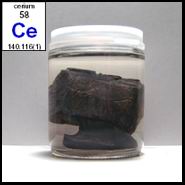
58CeCerium140.11612
8 18 19 9 2 |
|
| Basic properties | |
|---|---|
| Atomic number | 58 |
| Atomic weight | 140.1161 amu |
| Element family | N/A |
| Period | 6 |
| Group | 2 |
| Block | s-block |
| Discovery year | 1803 |
| Isotope distribution |
|---|
136Ce 0.19% 138Ce 0.25% 140Ce 88.48% |
140Ce (99.51%) |
| Physical properties | |
|---|---|
| Density | 6.77 g/cm3 (STP) |
Atomic hydrogen (H) 8.988E-5 Meitnerium (Mt) 28 | |
| Melting | 798 °C |
Helium (He) -272.2 Carbon (C) 3675 | |
| Boiling | 3257 °C |
Helium (He) -268.9 Tungsten (W) 5927 | |
| Chemical properties | |
|---|---|
| Oxidation states (less common) | +3, +4 (+2) |
| First ionization potential | 5.539 eV |
Cesium (Cs) 3.894 Helium (He) 24.587 | |
| Electron affinity | 0.570 eV |
Nobelium (No) -2.33 Atomic chlorine (Cl) 3.612725 | |
| Electronegativity | 1.12 |
Cesium (Cs) 0.79 Atomic fluorine (F) 3.98 | |
| Atomic radius | |
|---|---|
| Covalent radius | 1.63 Å |
Atomic hydrogen (H) 0.32 Francium (Fr) 2.6 | |
| Metallic radius | 1.82 Å |
Beryllium (Be) 1.12 Cesium (Cs) 2.65 | |
| Compounds | ||
|---|---|---|
| Formula | Name | Oxidation state |
| CeS | Cerium monosulfide | +2 |
| CeSe | Cerium monoselenide | +2 |
| Ce2(SO4)3 | Cerium(III) sulfate | +3 |
| CeBr3 | Cerium(III) bromide | +3 |
| CeCl3 | Cerium(III) chloride | +3 |
| C54H105CeO6 | Cerium stearate | +3 |
| Ce(CH3SO3)3 | Cerium(III) methanesulfonate | +3 |
| CeO2 | Cerium(IV) oxide | +4 |
| Ce(SO4)2 | Cerium(IV) sulfate | +4 |
| (NH4)2Ce(NO3)6 | Ammonium cerium(IV) nitrate | +4 |
| Ce(ClO4)4 | Cerium(IV) perchlorate | +4 |
| Ce(OH)4 | Cerium(IV) hydroxide | +4 |
| Electronic properties | |
|---|---|
| Electrons per shell | 2, 8, 18, 19, 9, 2 |
| Electronic configuration | [Xe] 4f1 |
|
Bohr atom model

| |
|
Orbital box diagram

| |
| Valence electrons | 4 |
| Lewis dot structure |
|
| Orbital Visualization | |
|---|---|
|
| |
| Electrons | - |
Cerium (Ce): Periodic Table Element
Abstract
Cerium, a lanthanide element with atomic number 58 and symbol Ce, exhibits distinctive dual valence states of +3 and +4, setting it apart from other rare-earth elements. Cerium possesses a standard atomic weight of 140.116 ± 0.001 u and demonstrates remarkable electronic structure versatility due to the close energy proximity of its 4f, 5d, and 6s orbitals. The element exists in four polymorphic forms at ambient pressure, with the γ-phase being most stable at room temperature. Cerium's unique ability to access both trivalent and tetravalent oxidation states in aqueous solution facilitates its extraction from mineral ores and enables diverse industrial applications including catalytic converters, glass polishing compounds, and phosphor materials for LED technology.
Introduction
Cerium occupies position 58 in the periodic table as the second member of the lanthanide series, situated between lanthanum and praseodymium. The element represents the most abundant rare-earth element, constituting approximately 68 ppm of Earth's crustal composition, comparable to copper's abundance. This contradicts the historical designation as a "rare" earth element. Cerium's electronic configuration [Xe]4f¹5d¹6s² establishes its fundamental chemical behavior, though the proximate energy levels of the 4f, 5d, and 6s orbitals create unique bonding scenarios not observed in other lanthanides.
Physical Properties and Atomic Structure
Fundamental Atomic Parameters
Cerium exhibits atomic number Z = 58 with a nuclear charge effectively shielded by the preceding xenon core electron configuration. The ground-state electron configuration [Xe]4f¹5d¹6s² results from interelectronic repulsion effects within the compact 4f subshell, causing one electron to occupy the spatially extended 5d orbital. This unusual configuration persists only in the neutral atom; ionization to Ce²⁺ yields the regular [Xe]4f² configuration due to reduced interelectronic repulsion in the positively charged ion. The atomic radius measures approximately 181.8 pm, while the ionic radii depend significantly on coordination number and oxidation state: Ce³⁺ exhibits 103.4 pm (coordination number 6) and Ce⁴⁺ exhibits 87 pm (coordination number 6). Effective nuclear charge calculations indicate values of approximately 2.85 for the 4f electrons and 10.55 for the 6s electrons.
Macroscopic Physical Characteristics
Cerium metal exhibits a distinctive silvery-white metallic luster with ductile mechanical properties similar to silver. The element crystallizes in multiple polymorphic forms depending on temperature and pressure conditions. At ambient temperature, γ-cerium adopts face-centered cubic (fcc) structure with lattice parameter a = 5.161 Å and density 6.770 g/cm³. Upon cooling below approximately −15°C, transformation to β-cerium occurs, characterized by double hexagonal close-packed (dhcp) structure and density 6.689 g/cm³. Further cooling below −150°C produces α-cerium with fcc structure and increased density of 8.16 g/cm³. High-temperature δ-cerium exists above 726°C with body-centered cubic (bcc) structure. The melting point reaches 1068 K (795°C), while the boiling point attains 3716 K (3443°C). Thermodynamic parameters include heat of fusion 5.460 kJ/mol and heat of vaporization 398 kJ/mol.
Chemical Properties and Reactivity
Electronic Structure and Bonding Behavior
Cerium's chemical reactivity stems from its accessible 4f, 5d, and 6s electrons, enabling both +3 and +4 oxidation states. The +3 oxidation state predominates in most compounds, consistent with other lanthanides, while the +4 state becomes thermodynamically favorable under oxidizing conditions due to the stability of the empty 4f⁰ electronic configuration. Cerium exhibits strong reducing properties with standard reduction potential E° = −2.34 V for the Ce³⁺/Ce couple. The Ce⁴⁺/Ce³⁺ couple demonstrates variable potential depending on ligand environment, typically ranging from +1.44 V to +1.72 V in different media. Bond formation involves primarily ionic character with some covalent contribution from d-orbital participation. Common coordination numbers range from 6 to 12, reflecting the large ionic radii typical of lanthanide elements.
Electrochemical and Thermodynamic Properties
Cerium demonstrates electronegativity values of 1.12 on the Pauling scale and 1.17 on the Allred-Rochow scale, indicating highly electropositive character. Successive ionization energies exhibit the pattern: first ionization energy 534.4 kJ/mol, second ionization energy 1050 kJ/mol, third ionization energy 1949 kJ/mol, and fourth ionization energy 3547 kJ/mol. The relatively modest fourth ionization energy facilitates Ce⁴⁺ formation under appropriate conditions. Electron affinity measurements indicate slightly endothermic values around 50 kJ/mol. Standard reduction potentials demonstrate cerium's strong reducing nature in the metallic state, while Ce⁴⁺ species function as powerful oxidizing agents in aqueous solution, capable of oxidizing water under acidic conditions with liberation of oxygen gas.
Chemical Compounds and Complex Formation
Binary and Ternary Compounds
Cerium forms extensive series of binary compounds across multiple oxidation states. Principal oxides include cerium(III) oxide Ce₂O₃ and cerium(IV) oxide CeO₂ (ceria). Ceria adopts the fluorite structure and exhibits nonstoichiometric behavior with formula CeO₂₋ₓ where x ≈ 0.2, indicating mixed Ce³⁺/Ce⁴⁺ oxidation states. Halide compounds include all trihalides CeX₃ (X = F, Cl, Br, I), typically prepared by oxide-hydrogen halide reactions. Cerium tetrafluoride CeF₄ represents the only stable tetrahalide, appearing as white crystalline solid. Chalcogenide formation yields compounds such as Ce₂S₃, Ce₂Se₃, and Ce₂Te₃, along with monochalcogenides CeS, CeSe, and CeTe exhibiting metallic conductivity. Phosphide CeP, nitride CeN, and carbide CeC₂ demonstrate refractory properties with high melting points exceeding 2000°C.
Coordination Chemistry and Organometallic Compounds
Cerium coordination chemistry encompasses diverse ligand types and geometries. Aqueous Ce³⁺ typically coordinates eight to nine water molecules in [Ce(H₂O)₈₋₉]³⁺ complexes. Cerium(IV) exhibits higher coordination numbers, exemplified by ceric ammonium nitrate (NH₄)₂[Ce(NO₃)₆], where cerium achieves 12-coordinate geometry through bidentate nitrate ligands. This compound serves as a standard oxidant in analytical chemistry and organic synthesis. Organometallic cerium chemistry includes cyclopentadienyl derivatives and the notable cerocene Ce(C₈H₈)₂, which adopts uranocene-type structure with sandwich geometry. The 4f¹ electron in cerocene exhibits intermediate localization behavior between metallic and ionic limits. Alkyl, alkenyl, and alkynyl organocerium compounds demonstrate enhanced nucleophilicity compared to corresponding lithium or magnesium reagents while maintaining reduced basicity.
Natural Occurrence and Isotopic Analysis
Geochemical Distribution and Abundance
Cerium constitutes the 25th most abundant element in Earth's crust with concentration of 68 ppm, exceeding common metals including lead (13 ppm) and tin (2.1 ppm). Soil concentrations range from 2 to 150 ppm with average values around 50 ppm, while seawater contains approximately 1.5 parts per trillion. Primary geological occurrence involves rare-earth minerals, principally monazite (Ce,La,Nd,Th)PO₄ and bastnäsite (Ce,La,Nd)CO₃F. Monazite typically contains 25-30% cerium oxide equivalent, while bastnäsite contains 35-40% cerium oxide equivalent. Cerium's unique +4 oxidation state enables selective concentration in oxidizing environments and incorporation into zircon ZrSiO₄ through ionic radius compatibility between Ce⁴⁺ and Zr⁴⁺. Specialized cerium minerals include cerianite CeO₂ and mixed thorium-cerium oxides (Ce,Th)O₂ formed under highly oxidizing conditions.
Nuclear Properties and Isotopic Composition
Natural cerium comprises four isotopes: ¹³⁶Ce (0.19%), ¹³⁸Ce (0.25%), ¹⁴⁰Ce (88.4%), and ¹⁴²Ce (11.1%). All naturally occurring isotopes exhibit observational stability, though theoretical predictions suggest potential decay modes. ¹³⁶Ce and ¹³⁸Ce may undergo double electron capture to barium isotopes with half-lives exceeding 3.8 × 10¹⁶ years and 5.7 × 10¹⁶ years, respectively. ¹⁴²Ce potentially undergoes double beta decay to ¹⁴²Nd with half-life exceeding 5.0 × 10¹⁶ years. ¹⁴⁰Ce represents the most abundant isotope due to its magic neutron number (N = 82) providing enhanced nuclear stability and low neutron capture cross-sections during stellar nucleosynthesis. Synthetic radioisotopes include ¹⁴⁴Ce (half-life 284.9 days), ¹³⁹Ce (half-life 137.6 days), and ¹⁴¹Ce (half-life 32.5 days), produced as uranium fission products. Nuclear magnetic resonance studies utilize ¹³⁹Ce with nuclear spin I = 3/2 and magnetic moment μ = 0.97 nuclear magnetons.
Industrial Production and Technological Applications
Extraction and Purification Methodologies
Cerium extraction exploits its unique oxidation chemistry among lanthanides. Bastnäsite processing begins with purification using dilute hydrochloric acid to remove calcium carbonate impurities, followed by air roasting at elevated temperatures. While most lanthanides oxidize to sesquioxides Ln₂O₃, cerium forms dioxide CeO₂, enabling selective separation through differential solubility in 0.5 M hydrochloric acid. Monazite processing involves electromagnetic separation followed by hot concentrated sulfuric acid treatment to generate water-soluble rare-earth sulfates. Partial neutralization to pH 3-4 with sodium hydroxide precipitates thorium hydroxide, while subsequent ammonium oxalate treatment converts rare earths to insoluble oxalates. Thermal decomposition yields mixed oxides, with cerium dioxide remaining insoluble in nitric acid treatment. Industrial production capacity exceeds 20,000 tonnes annually, with China dominating global supply at approximately 85% market share.
Technological Applications and Future Prospects
Cerium dioxide serves as the primary industrial form for most applications. Chemical-mechanical planarization (CMP) utilizes ceria's hardness and chemical reactivity for semiconductor wafer polishing, consuming approximately 40% of global cerium production. Glass decolorization employs ceria to oxidize ferrous impurities to nearly colorless ferric species, particularly in optical glass manufacturing. Catalytic applications include automotive catalytic converters where ceria functions as oxygen storage component, enhancing carbon monoxide and nitrogen oxide conversion efficiency. Cerium-doped yttrium aluminum garnet (Ce:YAG) phosphors enable white LED production through blue light absorption and yellow emission, revolutionizing solid-state lighting technology. Pyrophoric applications utilize ferrocerium alloys in lighter flints, while mischmetal (50% Ce, 25% La, remainder other lanthanides) serves as steel additive for inclusion modification. Emerging applications include solid oxide fuel cell electrolytes, ultraviolet radiation blocking materials, and advanced refractory compositions for high-temperature industrial processes.
Historical Development and Discovery
Cerium discovery occurred simultaneously in 1803 through independent investigations by Jöns Jakob Berzelius and Wilhelm Hisinger in Sweden, and Martin Heinrich Klaproth in Germany. The element was isolated from cerite ore found at Bastnäs mine in Sweden, with naming honoring the asteroid Ceres discovered two years earlier by Giuseppe Piazzi. Initial isolation yielded impure ceria containing all lanthanides present in the mineral source, representing approximately 45% pure cerium oxide by modern standards. Carl Gustaf Mosander achieved pure ceria separation in the late 1830s through systematic chemical fractionation, removing lanthana and "didymia" (later identified as praseodymium and neodymium oxides). Wilhelm Hisinger's financial support enabled extensive chemical investigations, while Mosander's residence with Berzelius facilitated collaborative research efforts. Industrial applications emerged with Carl Auer von Welsbach's gas mantle invention utilizing thorium oxide-cerium dioxide mixtures for incandescent lighting. World War II Manhattan Project investigations explored cerium compounds as refractory materials for uranium and plutonium metallurgy, leading to advanced purification techniques developed at Ames Laboratory.
Conclusion
Cerium occupies a unique position among lanthanide elements due to its accessible +4 oxidation state and distinctive electronic structure. The element's abundance contradicts its historical rare-earth classification, while its diverse applications span traditional metallurgy to cutting-edge nanotechnology. Future research directions include advanced ceramic formulations, novel catalytic systems exploiting cerium's redox chemistry, and quantum dot applications utilizing controlled 4f electron behavior. Environmental considerations regarding extraction and processing methods continue driving sustainable technology development, while expanding LED and automotive applications ensure continued technological relevance for this versatile element.

Please let us know how we can improve this web app.
