| Element | |
|---|---|
53IIodine126.9044732
8 18 18 7 |
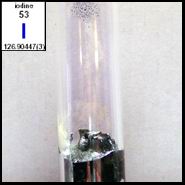
|
| Basic properties | |
|---|---|
| Atomic number | 53 |
| Atomic weight | 126.904473 amu |
| Element family | Halogens |
| Period | 5 |
| Group | 17 |
| Block | p-block |
| Discovery year | 1811 |
| Isotope distribution |
|---|
127I 100% |
| Physical properties | |
|---|---|
| Density | 4.93 g/cm3 (STP) |
Atomic hydrogen (H) 8.988E-5 Meitnerium (Mt) 28 | |
| Melting | 113.5 °C |
Helium (He) -272.2 Carbon (C) 3675 | |
| Boiling | 184.4 °C |
Helium (He) -268.9 Tungsten (W) 5927 | |
| Chemical properties | |
|---|---|
| Oxidation states (less common) | -1, +1, +3, +5, +7 (+2, +4, +6) |
| First ionization potential | 10.451 eV |
Cesium (Cs) 3.894 Helium (He) 24.587 | |
| Electron affinity | 3.059 eV |
Nobelium (No) -2.33 Atomic chlorine (Cl) 3.612725 | |
| Electronegativity | 2.66 |
Cesium (Cs) 0.79 Atomic fluorine (F) 3.98 | |
| Electronic properties | |
|---|---|
| Electrons per shell | 2, 8, 18, 18, 7 |
| Electronic configuration | [Kr] 4d10 |
|
Bohr atom model

| |
|
Orbital box diagram

| |
| Valence electrons | 7 |
| Lewis dot structure |
|
| Orbital Visualization | |
|---|---|
|
| |
| Electrons | - |
Iodine (I): Periodic Table Element
Abstract
Iodine (I, atomic number 53) represents the heaviest stable halogen and exhibits unique chemical characteristics arising from its electronic structure [Kr]5s²4d¹⁰5p⁵. The element demonstrates the highest melting point (114°C) and boiling point (184°C) among the halogens due to pronounced van der Waals interactions. Iodine manifests as a semi-lustrous, violet-colored solid under standard conditions and forms diatomic I₂ molecules with the weakest interhalogen bond among stable halogens. The element exhibits electronegativity of 2.66 on the Pauling scale and demonstrates distinctive semiconducting properties with a band gap of 1.3 eV. Iodine forms extensive compounds across oxidation states ranging from -1 to +7, with particular significance in organoiodine chemistry and industrial applications including radiocontrast media and acetic acid production.
Introduction
Iodine occupies position 53 in the periodic table as the fourth member of group 17, situated below fluorine, chlorine, and bromine in the halogen series. The element's significance extends from fundamental chemical principles to critical technological applications. Discovered in 1811 by French chemist Bernard Courtois from seaweed ash, iodine derives its name from the Greek word "iodes," meaning violet, referencing its characteristic purple vapor. The element's atomic structure, featuring seven valence electrons in its outermost shell, drives its chemical behavior as an oxidizing agent, though it remains the weakest among stable halogens. Iodine's unique properties, including its status as the only monoisotopic halogen and its exceptional ability to form compounds with nearly all elements except noble gases, establish its fundamental importance in chemistry and industry.
Physical Properties and Atomic Structure
Fundamental Atomic Parameters
Iodine possesses atomic number 53 with electron configuration [Kr]5s²4d¹⁰5p⁵, placing it in period 5 of the periodic table. The element exhibits atomic radius of 140 pm, representing the largest among stable halogens due to increased electron-electron repulsion and shielding effects. Iodine's effective nuclear charge experiences significant attenuation from inner electron shells, contributing to its distinctive chemical properties. The seven valence electrons occupy the fifth shell, with five electrons in the 5p orbital creating one unpaired electron that participates in chemical bonding. Successive ionization energies demonstrate the element's metallic character compared to lighter halogens, with first ionization energy of 1008.4 kJ/mol. The element's electron affinity of 295.2 kJ/mol represents the lowest among stable halogens, reflecting decreased nuclear attraction for additional electrons due to increased atomic radius and electron shielding.
Macroscopic Physical Characteristics
Iodine manifests as a lustrous, blue-black crystalline solid under standard conditions, adopting an orthorhombic crystal structure identical to chlorine and bromine. The element exhibits density of 4.933 g/cm³ at 20°C, significantly exceeding other halogens due to its high atomic mass of 126.904 u. Thermal properties demonstrate pronounced trends characteristic of group 17, with melting point of 114°C and boiling point of 184°C representing the highest values among stable halogens. Heat of fusion measures 15.52 kJ/mol, while heat of vaporization reaches 41.57 kJ/mol, both reflecting strong intermolecular forces. Specific heat capacity of 0.145 J/(g·K) indicates relatively low thermal energy storage compared to lighter elements. The element exhibits distinctive sublimation behavior, transitioning directly from solid to purple vapor phase at room temperature and atmospheric pressure, though contrary to popular misconception, iodine does melt when heated appropriately.
Chemical Properties and Reactivity
Electronic Structure and Bonding Behavior
Iodine's chemical reactivity stems from its electronic configuration, featuring one unpaired electron in the 5p orbital that readily participates in covalent bonding. The element forms diatomic I₂ molecules through covalent bonding, characterized by I-I bond length of 266.6 pm in gaseous phase and 271.5 pm in solid crystalline form, representing one of the longest single bonds known in chemistry. Common oxidation states span from -1 in iodide compounds to +7 in periodate species, with +1, +3, and +5 oxidation states demonstrating significant stability. Coordination chemistry exhibits extensive diversity, with iodine functioning as both Lewis acid and Lewis base depending on molecular environment. The element demonstrates pronounced polarizability due to its large electron cloud, facilitating formation of charge-transfer complexes and influencing solvent-dependent coloration from violet in nonpolar solvents to brown in polar media.
Electrochemical and Thermodynamic Properties
Electronegativity values position iodine at 2.66 on the Pauling scale, 2.21 on the Mulliken scale, and 2.5 on the Allred-Rochow scale, representing the lowest electronegativity among stable halogens. This characteristic drives iodine's behavior as the weakest oxidizing agent within the group, with standard reduction potential E°(I₂/I⁻) = +0.535 V. Successive ionization energies reveal first ionization at 1008.4 kJ/mol, second ionization at 1845.9 kJ/mol, and third ionization at 3180 kJ/mol, demonstrating increasing energy requirements for electron removal. Electron affinity of 295.2 kJ/mol indicates moderate tendency to accept electrons, significantly lower than lighter halogens. Thermodynamic stability of various iodine compounds reflects oxidation state preferences, with iodide (I⁻) serving as the strongest reducing agent among halide ions, readily oxidized back to elemental iodine under appropriate conditions.
Chemical Compounds and Complex Formation
Binary and Ternary Compounds
Iodine forms binary compounds with virtually all elements except noble gases, demonstrating remarkable versatility in chemical combination. Hydrogen iodide (HI) represents the strongest hydrogen halide acid, with exceptional solubility in water reaching 425 L HI per L H₂O. Commercial hydroiodic acid contains 48-57% HI by mass and forms an azeotrope at 126.7°C. Metal iodides exhibit systematic trends based on cation charge and size, with ionic character predominating in compounds with electropositive metals in low oxidation states. Silver iodide (AgI) demonstrates extreme insolubility in water (Ksp = 8.3 × 10⁻¹⁷), serving as a qualitative test for iodide presence. Alkaline earth iodides demonstrate high water solubility due to favorable lattice energy to hydration energy ratios. Transition metal iodides exhibit variable oxidation states and coordination geometries, with examples including TiI₄ (tetrahedral), FeI₂ (layered structure), and ScI₃ (predominantly ionic).
Coordination Chemistry and Organometallic Compounds
Coordination complexes of iodine span diverse structural motifs and oxidation states. Iodine(III) complexes adopt square pyramidal geometries according to VSEPR theory, while iodine(V) compounds demonstrate octahedral arrangements. Polyiodide anions such as I₃⁻, I₅⁻, and I₇⁻ form through sequential addition of I₂ molecules to iodide, stabilized by charge delocalization and hydrogen bonding in appropriate solvents. Charge-transfer complexes arise from iodine's polarizable electron density, exemplified by I₂-starch complexes producing characteristic blue coloration. Interhalogen compounds demonstrate iodine's ability to form stable bonds with other halogens, including ICl, IBr, IF₃, IF₅, and the exceptional IF₇, representing the highest coordination number achieved by any halogen. These compounds exhibit diverse molecular geometries determined by VSEPR theory and demonstrate applications in selective halogenation reactions.
Natural Occurrence and Isotopic Analysis
Geochemical Distribution and Abundance
Iodine exhibits crustal abundance of approximately 0.45 ppm, representing the 62nd most abundant element in Earth's crust. Geochemical behavior reflects the element's chemical properties, with concentrated occurrence in sedimentary deposits, particularly those associated with ancient marine environments. Seawater contains dissolved iodine at concentrations averaging 0.064 ppm, primarily as iodate (IO₃⁻) in oxygenated waters and iodide (I⁻) in reducing environments. Biogenic concentration occurs in marine algae, particularly kelp species that can concentrate iodine up to 30,000 times seawater levels. Industrial extraction focuses on Chilean nitrate deposits (caliche), where iodine occurs as sodium iodate, and Japanese brine wells associated with natural gas extraction. Secondary sources include processing brines from oil and gas production, where iodine concentrates through geological processes.
Nuclear Properties and Isotopic Composition
Iodine demonstrates unique nuclear characteristics as both monoisotopic and mononuclidic element, with ¹²⁷I representing the sole naturally occurring isotope. This isotope exhibits nuclear spin I = 5/2 and magnetic moment μ = +2.813 nuclear magnetons, making it valuable for nuclear magnetic resonance applications. The atomic mass of 126.90447 u represents a precisely known constant of nature due to the element's monoisotopic character. Among 40 known radioactive isotopes, ¹²⁵I (half-life 59.4 days) and ¹³¹I (half-life 8.02 days) demonstrate particular significance in medical applications. Neutron activation cross-sections for ¹²⁷I measure 6.2 barns for thermal neutrons, enabling production of radioactive isotopes for research and medical applications. Nuclear decay pathways include beta-minus decay for neutron-rich isotopes and beta-plus decay or electron capture for neutron-deficient species, with several isotopes exhibiting isomeric states accessible through gamma ray bombardment.
Industrial Production and Technological Applications
Extraction and Purification Methodologies
Industrial iodine production relies primarily on two major sources: Chilean nitrate ore processing and Japanese brine extraction from natural gas wells. Chilean operations involve leaching caliche deposits with water to dissolve sodium iodate, followed by reduction with sodium bisulfite to produce elemental iodine according to the reaction: IO₃⁻ + 3HSO₃⁻ → I⁻ + 3HSO₄⁻, then I⁻ + 5IO₃⁻ + 6H⁺ → 3I₂ + 3H₂O. Japanese processes utilize underground brines containing iodide concentrations up to 100 ppm, employing oxidation with chlorine gas: 2I⁻ + Cl₂ → I₂ + 2Cl⁻. Purification involves sublimation of crude iodine, exploiting the element's favorable vapor pressure characteristics. Global production reaches approximately 32,000 metric tons annually, with Chile contributing 60% and Japan 30% of world output. Economic considerations include energy costs for sublimation purification and environmental regulations governing halogen emissions.
Technological Applications and Future Prospects
Iodine's technological applications exploit its unique chemical and physical properties across diverse industrial sectors. Radiocontrast media represent the largest application, consuming approximately 15,000 metric tons annually in compounds such as diatrizoate and iohexol, which enhance X-ray image contrast due to iodine's high atomic number and X-ray absorption coefficient. Catalytic applications include the Cativa process for acetic acid production, where iodine promoters enhance rhodium catalyst efficiency in methanol carbonylation reactions. Pharmaceutical applications encompass antiseptic formulations, thyroid hormone synthesis, and specialized drug delivery systems. Emerging technologies include solid-state batteries utilizing iodine cathodes, polarizing films for liquid crystal displays, and advanced materials incorporating hypervalent iodine compounds for selective organic transformations. Future developments focus on sustainable extraction methods, recycling technologies, and novel applications in energy storage and advanced manufacturing processes.
Historical Development and Discovery
The discovery of iodine traces to 1811 when French chemist Bernard Courtois observed purple vapors while processing seaweed ash for saltpeter production during the Napoleonic Wars. Courtois noted that sulfuric acid added to seaweed ash residues produced violet fumes that crystallized on cold surfaces. Recognition as a new element occurred through investigations by Joseph Louis Gay-Lussac and Humphry Davy, who independently characterized its properties and confirmed its elemental nature. Gay-Lussac named the element "iode" from Greek "iodes" (violet-like) in 1813. Early chemical investigations revealed iodine's relationship to chlorine through analogous compound formation and similar chemical behavior. The 19th century witnessed systematic exploration of iodine chemistry, including discovery of various oxidation states and interhalogen compounds. Casimir Davaine's 1873 identification of iodine's antiseptic properties initiated its medical applications. Industrial production began with Chilean nitrate processing in the early 20th century, followed by Japanese brine extraction techniques developed in mid-century. Modern understanding encompasses sophisticated coordination chemistry, organometallic compounds, and advanced technological applications that continue expanding iodine's importance in contemporary chemistry and industry.
Conclusion
Iodine occupies a distinctive position among the halogens, combining fundamental chemical principles with extensive technological applications. Its unique properties—including the highest melting and boiling points among stable halogens, distinctive semiconducting behavior, and exceptional polarizability—reflect underlying electronic structure and intermolecular interactions. The element's versatile oxidation state chemistry, spanning from -1 to +7, enables formation of diverse compounds with applications ranging from life-sustaining thyroid hormones to advanced industrial catalysts. Current research directions emphasize sustainable production methods, novel coordination complexes, and emerging applications in energy storage technologies. Future developments will likely expand iodine's role in advanced materials science, pharmaceutical chemistry, and environmental remediation, maintaining its significance in both fundamental chemistry and technological innovation.

Please let us know how we can improve this web app.
