| Element | |
|---|---|
104RfRutherfordium261.108752
8 18 32 32 10 2 |
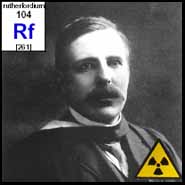
|
| Basic properties | |
|---|---|
| Atomic number | 104 |
| Atomic weight | 261.10875 amu |
| Element family | Transition metals |
| Period | 7 |
| Group | 2 |
| Block | s-block |
| Discovery year | 1969 |
| Isotope distribution |
|---|
| None |
| Physical properties | |
|---|---|
| Density | 17 g/cm3 (STP) |
Atomic hydrogen (H) 8.988E-5 Meitnerium (Mt) 28 | |
| Melting | 2100 °C |
Helium (He) -272.2 Carbon (C) 3675 | |
| Chemical properties | |
|---|---|
| Oxidation states (less common) | +4 (+3, +4) |
| First ionization potential | 6.011 eV |
Cesium (Cs) 3.894 Helium (He) 24.587 | |
| Atomic radius | |
|---|---|
| Covalent radius | 1.57 Å |
Atomic hydrogen (H) 0.32 Francium (Fr) 2.6 | |
| Electronic properties | |
|---|---|
| Electrons per shell | 2, 8, 18, 32, 32, 10, 2 |
| Electronic configuration | [Rn] 5f14 |
|
Bohr atom model

| |
|
Orbital box diagram

| |
| Valence electrons | 4 |
| Lewis dot structure |
|
| Orbital Visualization | |
|---|---|
|
| |
| Electrons | - |
| Reactions |
|---|
| Rf + O2 = RfO2 |
| 2 Rf + O2 = 2 RfO |
Rutherfordium (Rf): Periodic Table Element
Abstract
Rutherfordium exhibits the characteristics of a synthetic superheavy element positioned in period 7 and group 4 of the periodic table. With atomic number 104 and symbol Rf, this element manifests properties consistent with its classification as the first transactinide element and the heaviest known member of group 4. The most stable isotope, 267Rf, demonstrates a half-life of approximately 48 minutes. Chemical investigations confirm rutherfordium's behavior as the heavier homologue of hafnium, displaying tetravalent oxidation states and forming volatile tetrachlorides. The element's production requires particle accelerator technology, limiting detailed characterization to gas-phase and aqueous solution studies. Relativistic effects significantly influence its atomic structure and bonding behavior, resulting in enhanced covalent character compared to lighter group 4 congeners.
Introduction
Rutherfordium occupies a unique position as the first element in the transactinide series, representing the initial member of the fourth transition series in the extended periodic table. Located in period 7 and group 4, rutherfordium demonstrates the continuation of periodic trends beyond the actinide series. The element's electronic configuration [Rn]5f146d27s2 places it as the heaviest homologue of titanium, zirconium, and hafnium. Discovered independently by research teams at the Joint Institute for Nuclear Research in Dubna and the Lawrence Berkeley National Laboratory in the late 1960s, rutherfordium exemplifies the challenges associated with superheavy element synthesis and characterization. The element's extreme synthetic nature and radioactive instability necessitate specialized experimental techniques for property determination.
Physical Properties and Atomic Structure
Fundamental Atomic Parameters
Rutherfordium possesses atomic number 104, establishing its nuclear charge and corresponding electronic structure. The neutral atom exhibits the electron configuration [Rn]5f146d27s2, confirmed through high-level ab initio calculations. Relativistic effects significantly stabilize the 7s orbital while destabilizing the 6d orbitals, creating an excitation energy of only 0.3-0.5 eV to the 6d17s27p1 excited state. The atomic radius approximates 150 pm, representing an increase from hafnium's 155 pm due to relativistic expansion of the 7s orbital. Effective nuclear charge calculations indicate reduced shielding efficiency of the 5f electrons compared to the 4f electrons in hafnium, contributing to the element's unique chemical properties.
Macroscopic Physical Characteristics
Theoretical calculations predict rutherfordium exists as a metallic solid under standard conditions with hexagonal close-packed crystal structure, characterized by c/a = 1.61. The calculated density reaches approximately 17 g/cm³, reflecting the high atomic mass and relatively compact structure typical of late transition metals. Under extreme pressure conditions of 50-72 GPa, rutherfordium transitions to body-centered cubic structure, bypassing the intermediate ω-phase observed in hafnium. The predicted melting point, based on group trends and relativistic considerations, likely exceeds 2000 K. Heat capacity and thermal conductivity values remain experimentally undetermined due to the element's synthetic nature and short half-life.
Chemical Properties and Reactivity
Electronic Structure and Bonding Behavior
Rutherfordium demonstrates chemical behavior characteristic of group 4 elements, with the +4 oxidation state exhibiting exceptional stability. The 6d27s2 valence configuration readily loses all four valence electrons to form Rf4+ ions. Relativistic effects enhance the covalent character of rutherfordium bonds compared to its lighter congeners, resulting in decreased ionic radii and modified coordination preferences. The Rf4+ ion exhibits an ionic radius of 76 pm, slightly larger than Hf4+ (72 pm) and Zr4+ (71 pm). Electronegativity values, estimated through relativistic calculations, approximate 1.3 on the Pauling scale. The element's bonding characteristics demonstrate increased s-orbital participation due to relativistic stabilization.
Electrochemical and Thermodynamic Properties
The standard reduction potential for the Rf4+/Rf couple exceeds -1.7 V, indicating moderate reducing character relative to other group 4 elements. Successive ionization energies reflect the progressive removal of 6d electrons preferentially over 7s electrons, contrary to the behavior of lighter homologues. First ionization energy calculations suggest approximately 6.0 eV, with subsequent ionizations requiring significantly higher energies. The electron affinity of neutral rutherfordium remains experimentally undetermined but theoretical estimates suggest values comparable to other early transition metals. Thermodynamic stability analyses indicate rutherfordium compounds generally exhibit lower formation enthalpies than corresponding hafnium compounds due to relativistic destabilization of bonding orbitals.
Chemical Compounds and Complex Formation
Binary and Ternary Compounds
Rutherfordium forms binary compounds consistent with group 4 chemistry, including the refractory dioxide RfO2 and volatile tetrahalides RfX4 (X = F, Cl, Br). Rutherfordium tetrachloride demonstrates enhanced volatility compared to HfCl4 due to increased covalent bonding character resulting from relativistic effects. The tetrahedral molecular geometry of RfCl4 has been confirmed through gas-phase thermochromatography studies. Hydrolysis reactions produce oxyhalides RfOX2 through partial hydrolysis mechanisms. Binary sulfides and nitrides likely form under appropriate synthetic conditions, though experimental confirmation remains limited by the element's radioactive properties.
Coordination Chemistry and Organometallic Compounds
Aqueous solution studies demonstrate rutherfordium's ability to form stable coordination complexes with halide ligands. The hexachloride complex [RfCl6]2- exhibits formation constants intermediate between corresponding zirconium and hafnium species. Fluoride coordination produces [RfF6]2-, [RfF7]3-, and [RfF8]4- complexes, with the hexafluoride showing decreased stability relative to hafnium analogues. Hydroxide precipitation studies indicate formation of Rf(OH)4 under basic conditions. Organometallic chemistry remains largely unexplored due to experimental limitations, though theoretical calculations suggest reduced metal-carbon bond strengths compared to lighter group 4 elements.
Natural Occurrence and Isotopic Analysis
Geochemical Distribution and Abundance
Rutherfordium exhibits zero natural abundance on Earth due to the absence of stable isotopes and the extremely short half-lives of all known isotopes. The element's hypothetical geochemical behavior would follow patterns established by hafnium, concentrating in zircon minerals and felsic igneous rocks. Estimated crustal abundance remains effectively zero, with no detectable quantities in any terrestrial or extraterrestrial samples. The element's position in the nuclear landscape places it well beyond the valley of beta stability, precluding natural formation through stellar nucleosynthesis processes.
Nuclear Properties and Isotopic Composition
Seventeen radioactive isotopes of rutherfordium have been identified, ranging from 252Rf to 270Rf with the exceptions of 264Rf and 269Rf. The most stable isotope, 267Rf, exhibits a half-life of 48 minutes through alpha decay and spontaneous fission. Lighter isotopes predominantly undergo spontaneous fission with half-lives measured in milliseconds to seconds. Nuclear stability patterns show enhanced stability for odd neutron number isotopes due to reduced spontaneous fission probability. The isotope 261mRf, with a half-life of 68 seconds, serves as the primary species for chemical studies. Alpha decay energies typically range from 8-10 MeV, with branching ratios heavily favoring spontaneous fission for even-mass isotopes.
Industrial Production and Technological Applications
Extraction and Purification Methodologies
Rutherfordium production requires heavy-ion fusion reactions utilizing particle accelerators capable of achieving sufficient beam energies for compound nucleus formation. The primary synthesis pathway involves bombardment of 249Cf targets with 12C projectiles, producing 257Rf with cross-sections of approximately 10 nanobarns. Alternative production routes include 242Pu + 22Ne reactions yielding various rutherfordium isotopes. Production rates typically achieve 1-10 atoms per hour under optimal conditions. Separation from target materials and decay products utilizes gas-phase thermochromatography and rapid chemical separation techniques optimized for the element's short half-life constraints.
Technological Applications and Future Prospects
Current applications of rutherfordium remain restricted to fundamental research investigations of superheavy element chemistry and nuclear physics. The element serves as a critical benchmark for testing theoretical predictions of relativistic effects in chemical bonding and atomic structure. Future applications may emerge in nuclear physics research, particularly in studies of island of stability predictions and superheavy element synthesis mechanisms. Advanced accelerator technologies and improved target design may enable production of longer-lived isotopes, potentially expanding research capabilities. No industrial or commercial applications exist due to the element's extreme rarity and radioactive instability.
Historical Development and Discovery
The discovery of rutherfordium represents one of the most contentious priority disputes in modern chemistry. Initial claims emerged from the Joint Institute for Nuclear Research at Dubna in 1964, reporting detection of 0.3-second spontaneous fission activity attributed to 260Rf. This assignment proved incorrect, as no rutherfordium isotope exhibits such decay characteristics. The Berkeley team at Lawrence Berkeley National Laboratory achieved definitive synthesis in 1969 through 249Cf + 12C reactions, identifying 257Rf through alpha decay correlation chains. The naming controversy persisted for decades, with Soviet scientists proposing "kurchatovium" honoring Igor Kurchatov, while American researchers advocated "rutherfordium" after Ernest Rutherford. The International Union of Pure and Applied Chemistry officially adopted "rutherfordium" in 1997, resolving the systematic nomenclature dispute. This discovery marked the beginning of systematic superheavy element research and established experimental protocols for transactinide chemistry investigations.
Conclusion
Rutherfordium demonstrates the successful extension of periodic law beyond the actinide series, confirming theoretical predictions regarding group 4 chemical behavior under extreme relativistic conditions. The element's properties validate computational chemistry approaches for superheavy element prediction while revealing subtle deviations from simple extrapolation of lighter congener properties. Enhanced covalent bonding character and modified coordination preferences illustrate the profound influence of relativistic effects on chemical behavior. Future research directions include synthesis of longer-lived isotopes, detailed spectroscopic characterization, and exploration of unusual oxidation states. Rutherfordium's study contributes fundamentally to understanding the limits of chemical periodicity and the stability of superheavy nuclei.

Please let us know how we can improve this web app.
