| Element | |
|---|---|
38SrStrontium87.6212
8 18 8 2 |
|
| Basic properties | |
|---|---|
| Atomic number | 38 |
| Atomic weight | 87.621 amu |
| Element family | Alkali earth metals |
| Period | 5 |
| Group | 2 |
| Block | s-block |
| Discovery year | 1787 |
| Isotope distribution |
|---|
84Sr 0.56% 86Sr 9.86% 87Sr 7.00% 88Sr 82.58% |
84Sr (0.56%) 86Sr (9.86%) 87Sr (7.00%) 88Sr (82.58%) |
| Physical properties | |
|---|---|
| Density | 2.64 g/cm3 (STP) |
Atomic hydrogen (H) 8.988E-5 Meitnerium (Mt) 28 | |
| Melting | 769 °C |
Helium (He) -272.2 Carbon (C) 3675 | |
| Boiling | 1384 °C |
Helium (He) -268.9 Tungsten (W) 5927 | |
| Chemical properties | |
|---|---|
| Oxidation states (less common) | +2 (+1) |
| First ionization potential | 5.695 eV |
Cesium (Cs) 3.894 Helium (He) 24.587 | |
| Electron affinity | 0.052 eV |
Nobelium (No) -2.33 Atomic chlorine (Cl) 3.612725 | |
| Electronegativity | 0.95 |
Cesium (Cs) 0.79 Atomic fluorine (F) 3.98 | |
| Atomic radius | |
|---|---|
| Covalent radius | 1.85 Å |
Atomic hydrogen (H) 0.32 Francium (Fr) 2.6 | |
| Van der Waals radius | 2.49 Å |
Atomic hydrogen (H) 1.2 Francium (Fr) 3.48 | |
| Metallic radius | 2.15 Å |
Beryllium (Be) 1.12 Cesium (Cs) 2.65 | |
| Compounds | ||
|---|---|---|
| Formula | Name | Oxidation state |
| Sr(NO3)2 | Strontium nitrate | +2 |
| SrCl2 | Strontium chloride | +2 |
| Sr(OH)2 | Strontium hydroxide | +2 |
| SrCO3 | Strontium carbonate | +2 |
| SrS | Strontium sulfide | +2 |
| SrCrO4 | Strontium chromate | +2 |
| SrTiO3 | Strontium titanate | +2 |
| C36H70SrO4 | Strontium stearate | +2 |
| C6H10O6Sr | Strontium lactate | +2 |
| Sr(ClO3)2 | Strontium chlorate | +2 |
| Sr2RuO4 | Distrontium ruthenate | +2 |
| Sr3N2 | Strontium nitride | +2 |
| Electronic properties | |
|---|---|
| Electrons per shell | 2, 8, 18, 8, 2 |
| Electronic configuration | [Kr] 5s2 |
|
Bohr atom model

| |
|
Orbital box diagram

| |
| Valence electrons | 2 |
| Lewis dot structure |
|
| Orbital Visualization | |
|---|---|
|
| |
| Electrons | - |
Strontium (Sr): Periodic Table Element
Abstract
Strontium (Sr, atomic number 38) is a soft, silvery-white alkaline earth metal that occupies Group 2 of the periodic table. This divalent element exhibits physical and chemical properties intermediate between calcium and barium, demonstrating characteristic reactivity with air and water to form hydroxides and oxides. Natural strontium occurs predominantly as the sulfate mineral celestine (SrSO₄) and the carbonate strontianite (SrCO₃), with crustal abundance averaging 360 ppm. The element manifests four stable isotopes (⁸⁴Sr, ⁸⁶Sr, ⁸⁷Sr, ⁸⁸Sr) with ⁸⁸Sr comprising 82.6% of natural abundance. Industrial applications historically centered on cathode-ray tube glass production, while current uses encompass pyrotechnics, ferrite magnets, and specialized optical applications. Radioactive ⁹⁰Sr poses environmental concerns due to its 28.9-year half-life and bone-seeking behavior.
Introduction
Strontium represents a significant alkaline earth metal within Group 2 of the periodic table, positioned between calcium (atomic number 20) and barium (56). The element's discovery traces to 1790 when Adair Crawford and William Cruickshank identified distinct properties in mineral samples from Strontian, Scotland. Thomas Charles Hope subsequently proposed the name "strontites" in 1793, with Sir Humphry Davy achieving first isolation through electrolysis in 1808. The electronic configuration [Kr]5s² establishes strontium's divalent character and alkaline earth properties.
Strontium's position in the periodic table reflects systematic trends in atomic radius, ionization energy, and electronegativity that characterize the alkaline earth series. The element exhibits metallic bonding through delocalized 5s electrons while maintaining ionic behavior in compound formation. Industrial significance peaked during cathode-ray tube production, consuming 75% of global strontium output, though current applications have diversified following display technology evolution.
Physical Properties and Atomic Structure
Fundamental Atomic Parameters
Strontium possesses atomic number 38 with electronic configuration [Kr]5s², establishing its alkaline earth classification through two outer s-electrons. The atomic radius measures 215 pm, intermediate between calcium (197 pm) and barium (222 pm), reflecting periodic trends in atomic size. Ionic radius for Sr²⁺ equals 118 pm, facilitating high coordination numbers in crystal structures due to the large cation size.
First ionization energy amounts to 549.5 kJ/mol, lower than calcium (589.8 kJ/mol) but higher than barium (502.9 kJ/mol), consistent with decreasing ionization energy down Group 2. Second ionization energy reaches 1064.2 kJ/mol, required for divalent cation formation. Electronegativity on the Pauling scale equals 0.95, indicating metallic character and tendency toward ionic bonding in compounds.
Macroscopic Physical Characteristics
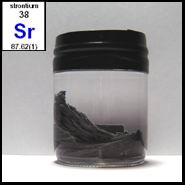
Strontium exhibits a soft, silvery-white metallic appearance with slight yellowish tint when freshly cut. The metal crystallizes in face-centered cubic structure at room temperature, transitioning through two additional allotropic forms at 235°C and 540°C. Density measures 2.64 g/cm³, positioning between calcium (1.54 g/cm³) and barium (3.594 g/cm³) according to periodic trends.
Melting point occurs at 777°C, slightly lower than calcium (842°C), while boiling point reaches 1377°C, again intermediate between Group 2 neighbors. Heat of fusion equals 7.43 kJ/mol with heat of vaporization at 136.9 kJ/mol. Specific heat capacity measures 0.301 J/g·K at 25°C. These thermal properties reflect metallic bonding strength and electronic structure influence on lattice energies.
Chemical Properties and Reactivity
Electronic Structure and Bonding Behavior
The [Kr]5s² electronic configuration governs strontium's chemical behavior, with the two outer electrons readily ionized to form Sr²⁺ cations. This divalent oxidation state dominates all stable compounds, though transient monovalent intermediates appear in specialized synthetic conditions. The large ionic radius facilitates coordination numbers ranging from 6 to 12 in crystalline compounds, with higher coordination preferred in ionic lattices.
Bond formation predominantly involves ionic character due to significant electronegativity differences with nonmetals. Sr-O bond lengths typically range from 2.4-2.6 Å depending on coordination environment and lattice parameters. Polarization effects become apparent with smaller, highly charged anions, introducing partial covalent character through orbital overlap and electron density deformation.
Electrochemical and Thermodynamic Properties
Standard electrode potential for the Sr²⁺/Sr couple measures -2.89 V, positioning strontium among highly reducing metals and facilitating ready oxidation in aqueous and atmospheric environments. This value lies between calcium (-2.84 V) and barium (-2.92 V), maintaining Group 2 periodicity. The negative potential indicates thermodynamic instability of metallic strontium in oxidizing conditions.
Electronegativity values include 0.95 (Pauling scale) and 0.99 (Allred-Rochow scale), emphasizing metallic character and electron-donating tendency. Successive ionization energies demonstrate the characteristic alkaline earth pattern: 549.5 kJ/mol (first), 1064.2 kJ/mol (second), with third ionization energy exceeding 4200 kJ/mol due to noble gas core disruption. Electron affinity approaches zero, consistent with metals' tendency to lose rather than gain electrons.
Chemical Compounds and Complex Formation
Binary and Ternary Compounds
Strontium oxide (SrO) forms through direct combination with oxygen, exhibiting rock salt crystal structure with Sr-O distance of 2.57 Å. The compound demonstrates strong basicity, reacting vigorously with water to produce strontium hydroxide. Peroxide formation (SrO₂) occurs under high oxygen pressure, while superoxide Sr(O₂)₂ represents a metastable yellow solid with limited thermal stability.
Halide compounds demonstrate systematic trends in lattice energies and solubility. Strontium fluoride (SrF₂) crystallizes in fluorite structure with limited water solubility (0.017 g/100 mL at 18°C), while chloride (SrCl₂), bromide (SrBr₂), and iodide (SrI₂) exhibit increasing solubility and decreasing lattice energies. Hydration numbers vary from 6 for fluoride to 2 for iodide, reflecting anion size effects on solvation.
Ternary compounds include strontium sulfate (SrSO₄, celestine), characterized by low solubility (0.0135 g/100 mL) and orthorhombic crystal structure. Carbonate (SrCO₃, strontianite) adopts aragonite structure with moderate thermal stability. These minerals constitute primary natural sources for strontium extraction and processing.
Coordination Chemistry and Organometallic Compounds
Strontium forms diverse coordination complexes with polydentate ligands, particularly crown ethers and cryptands where size-selective binding occurs. Complex with 18-crown-6 demonstrates enhanced stability compared to calcium analogs due to optimal cation-cavity size matching. Coordination numbers range from 8 to 12 in these macrocyclic assemblies, with denticity governing structural geometry.
Organostrontium chemistry remains limited compared to organomagnésium compounds due to increased ionic character and synthetic challenges. Strontium dicyclopentadienyl (Sr(C₅H₅)₂) requires synthesis under inert atmosphere through mercury elimination reactions. These compounds exhibit air and moisture sensitivity, decomposing readily through hydrolysis and oxidation pathways. Applications center on specialized synthetic methodology rather than widespread utility.
Natural Occurrence and Isotopic Analysis
Geochemical Distribution and Abundance
Strontium ranks as the 15th most abundant element in Earth's crust with average concentration of 360 ppm, exceeded only by barium among alkaline earth metals. Distribution follows geochemical processes favoring incorporation into igneous rocks through ionic substitution for calcium and potassium in feldspar and mica structures. Sedimentary environments concentrate strontium through evaporite formation and biogenic precipitation processes.
Primary mineral forms include celestine (SrSO₄) and strontianite (SrCO₃), with celestine representing the predominant commercial source. Celestine deposits occur in sedimentary basins, often associated with gypsum and anhydrite formation through diagenetic processes. Strontianite forms through hydrothermal alteration and occurs less frequently in economically viable concentrations. Seawater contains approximately 8 mg/L strontium, maintaining Sr/Ca ratios around 0.008-0.009 that reflect oceanic mixing and carbonate precipitation equilibria.
Nuclear Properties and Isotopic Composition
Natural strontium consists of four stable isotopes: ⁸⁴Sr (0.56%), ⁸⁶Sr (9.86%), ⁸⁷Sr (7.00%), and ⁸⁸Sr (82.58%). These abundances vary geographically due to radiogenic ⁸⁷Sr production from ⁸⁷Rb decay (half-life 4.88 × 10¹⁰ years), forming the basis for rubidium-strontium geochronology. Nuclear spin values are zero for even-mass isotopes and 9/2 for ⁸⁷Sr.
Radioactive isotopes include ⁸⁹Sr (half-life 50.6 days) and ⁹⁰Sr (half-life 28.9 years), both produced through nuclear fission processes. ⁸⁹Sr decays by electron capture to ⁸⁹Y, while ⁹⁰Sr undergoes β⁻ decay to ⁹⁰Y. Nuclear cross-sections for thermal neutron absorption are relatively small, with ⁸⁸Sr showing 0.058 barns. These properties influence isotopic applications in medicine and nuclear technology.
Industrial Production and Technological Applications
Extraction and Purification Methodologies
Commercial strontium production begins with celestine mining, concentrated in Spain (200,000 tonnes annually), Iran (200,000 tonnes), and China (80,000 tonnes) as of 2024. Processing involves carbothermic reduction at elevated temperatures, converting sulfate to sulfide through reaction: SrSO₄ + 2C → SrS + 2CO₂. The resulting "black ash" contains strontium sulfide mixed with unreacted materials and carbon residues.
Conversion to carbonate form employs carbon dioxide bubbling through filtered strontium sulfide solutions, precipitating SrCO₃ with high purity. Alternative methods involve direct sodium carbonate leaching of celestine, though yields remain lower. Metallic strontium production utilizes aluminum reduction of strontium oxide at high temperatures, followed by vacuum distillation to separate products. Electrolytic methods employ molten salt baths of strontium and potassium chlorides.
Technological Applications and Future Prospects
Historical applications centered on cathode-ray tube glass manufacturing, where strontium and barium oxides blocked X-ray emission from electron beam impacts. Glass compositions typically contained 8.5% SrO and 10% BaO, requiring approximately 75% of global strontium production at peak demand. Display technology evolution toward liquid crystal and plasma systems eliminated this primary market.
Current applications include ferrite magnet production, where strontium carbonate serves as a flux and magnetic property modifier. Pyrotechnic formulations utilize strontium compounds for red flame coloration through characteristic emission at 460.7 nm and 687.8 nm wavelengths. Emerging technologies focus on strontium-based optical atomic clocks, utilizing the narrow ⁵S₀ → ³P₀ transition for precision timekeeping that may redefine the SI second. Environmental applications explore strontium's role in nuclear waste remediation through selective biosorption processes.
Historical Development and Discovery
Strontium's discovery originated from mineral analysis in Strontian, Scotland, where lead mine operations encountered unusual "heavy spar" materials. Adair Crawford and William Cruickshank recognized distinct properties in 1790, differentiating these samples from known barium minerals through systematic chemical analysis. Crawford concluded that the Scottish mineral represented "a new species of earth which has not hitherto been sufficiently examined."
Thomas Charles Hope extended this investigation at the University of Glasgow, proposing the name "strontites" in 1793 and establishing elemental uniqueness through flame test observations of characteristic crimson-red coloration. Friedrich Gabriel Sulzer and Johann Friedrich Blumenbach provided independent confirmation, naming the mineral "strontianite" and distinguishing it from witherite through analytical methods.
Sir Humphry Davy achieved metallic isolation in 1808 using newly developed electrolytic techniques, announcing results to the Royal Society on June 30, 1808. His method employed strontium chloride and mercuric oxide mixtures subjected to electrical current, producing metallic strontium amalgam subsequently separated by distillation. Davy standardized nomenclature to "strontium" following alkaline earth naming conventions, establishing the modern elemental designation.
Industrial development commenced with strontium hydroxide applications in sugar beet processing during the 19th century. Augustin-Pierre Dubrunfaut patented crystallization processes in 1849, though large-scale implementation awaited process improvements in the 1870s. German sugar industries consumed 100,000-150,000 tons annually before World War I, driving strontianite mining operations in Münsterland until Gloucestershire celestine deposits provided more economical sources from 1884 to 1941.
Conclusion
Strontium occupies a distinctive position within alkaline earth metals, demonstrating systematic periodic trends while exhibiting unique applications in modern technology. The element's intermediate properties between calcium and barium establish predictable chemical behavior, though specialized characteristics enable specific technological solutions. Industrial evolution from sugar processing through cathode-ray tube manufacturing to contemporary optical clock applications illustrates strontium's adaptability to emerging technological demands.
Future research directions encompass nuclear waste remediation through biological strontium sequestration, advanced optical atomic clock development for precision metrology, and specialized ceramic applications exploiting thermal and electrical properties. Environmental considerations regarding ⁹⁰Sr contamination continue driving remediation technology development, while fundamental research explores coordination chemistry applications in selective metal extraction and separation processes.

Please let us know how we can improve this web app.
