Printed from https://www.webqc.org

Actinium @ Periodic Table of Chemical Elements

12345678 910111213141516 1718
IIIIIIbIVb VbVIbVIIbVIIIbIb IIbIIIIVVVI VIIVIII
1H
1.0079
2He
4.0026
3Li
6.9412
4Be
9.0121
5B
10.811
6C
12.010
7N
14.006
8O
15.999
9F
18.998
10Ne
20.179
11Na
22.989
12Mg
24.305
13Al
26.981
14Si
28.085
15P
30.973
16S
32.065
17Cl
35.453
18Ar
39.948
19K
39.098
20Ca
40.078
21Sc
44.955
22Ti
47.867
23V
50.941
24Cr
51.996
25Mn
54.938
26Fe
55.845
27Co
58.933
28Ni
58.693
29Cu
63.546
30Zn
65.409
31Ga
69.723
32Ge
72.641
33As
74.921
34Se
78.963
35Br
79.904
36Kr
83.798
37Rb
85.467
38Sr
87.621
39Y
88.905
40Zr
91.224
41Nb
92.906
42Mo
95.942
43Tc
98.906
44Ru
101.07
45Rh
102.90
46Pd
106.42
47Ag
107.86
48Cd
112.41
49In
114.81
50Sn
118.71
51Sb
121.76
52Te
127.60
53I
126.90
54Xe
131.29
55Cs
132.90
56Ba
137.32
57La
138.90
72Hf
178.49
73Ta
180.94
74W
183.84
75Re
186.20
76Os
190.23
77Ir
192.21
78Pt
195.08
79Au
196.96
80Hg
200.59
81Tl
204.38
82Pb
207.21
83Bi
208.98
84Po
208.98
85At
209.98
86Rn
222.01
87Fr
223.01
88Ra
226.02
89Ac
227.02
104Rf
261.10
105Db
262.11
106Sg
266.12
107Bh
264.12
108Hs
269
109Mt
278
110Ds
281
111Rg
282
112Cn
285
113Nh
286
114Fl
289
115Mc
290
116Lv
293
117Ts
294
118Og
294
Lanthanoids58Ce
140.11
59Pr
140.90
60Nd
144.24
61Pm
146.91
62Sm
150.36
63Eu
151.96
64Gd
157.25
65Tb
158.92
66Dy
162.50
67Ho
164.93
68Er
167.25
69Tm
168.93
70Yb
173.04
71Lu
174.96
Actinoids90Th
232.03
91Pa
231.03
92U
238.02
93Np
237.04
94Pu
244.06
95Am
243.06
96Cm
247.07
97Bk
247.07
98Cf
251.07
99Es
252.08
100Fm
257.09
101Md
258.09
102No
259.10
103Lr
260.10
Alkali metals Alkali earth metals Transition metals Other metals Metaloids Non-metals Halogens Noble gases
Element

89

Ac

Actinium

227.0278

2
8
18
32
18
9
2
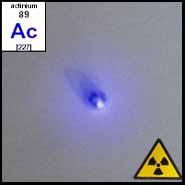
Actinium photo
Basic properties
Atomic number89
Atomic weight227.0278 amu
Element familyActinoids
Period7
Group2
Blocks-block
Discovery year1902
Isotope distribution
None
Physical properties
Density 10.07 g/cm3 (STP)
Atomic hydrogen (H) 8.988E-5
Meitnerium (Mt) 28
Melting1050 °C
Helium (He) -272.2
Carbon (C) 3675
Boiling3197 °C
Helium (He) -268.9
Tungsten (W) 5927
Chemical properties
Oxidation states+3
First ionization potential 5.172 eV
Cesium (Cs) 3.894
Helium (He) 24.587
Electron affinity 0.350 eV
Nobelium (No) -2.33
Atomic chlorine (Cl) 3.612725
Electronegativity1.1
Cesium (Cs) 0.79
Atomic fluorine (F) 3.98
Atomic radius
Covalent radius 1.86 Å
Atomic hydrogen (H) 0.32
Francium (Fr) 2.6
Compounds
FormulaNameOxidation state
Ac(NO3)3Actinium(III) nitrate+3
Ac2O3Actinium(III) oxide+3
Ac2S3Actinium(III) sulfide+3
AcBr3Actinium(III) bromide+3
AcCl3Actinium(III) chloride+3
AcF3Actinium(III) fluoride+3
AcI3Actinium(III) iodide+3
AcOFActinium oxyfluoride+3
AcPO4Actinium(III) phosphate+3
Electronic properties
Electrons per shell2, 8, 18, 32, 18, 9, 2
Electronic configuration[Rn] 6d17s2
Bohr atom model
Bohr atom model
Orbital box diagram
Orbital box diagram
Valence electrons3
Lewis dot structure Actinium Lewis dot structure
Orbital Visualization
🏠
▶️
📐
Electrons-

Actinium (Ac): Periodic Table Element

Scientific Review Article | Chemistry Reference Series

Abstract

Actinium (Ac) represents the first element of the actinide series, positioned at atomic number 89 in the periodic table with electronic configuration [Rn] 6d¹ 7s². This silvery-white radioactive metal exhibits distinctive luminescent properties, emitting a pale blue glow due to its intense radioactivity which ionizes surrounding air molecules. Actinium demonstrates chemical behavior analogous to the lanthanides, particularly lanthanum, predominantly forming compounds in the +3 oxidation state. The element occurs naturally in uranium and thorium ores at extraordinarily low concentrations, approximately 0.2 mg per tonne of uranium ore. Industrial production relies on neutron irradiation of radium-226 in nuclear reactors, yielding milligram quantities suitable for research applications. The most stable isotope, ²²⁷Ac, exhibits a half-life of 21.772 years, undergoing predominantly beta decay with occasional alpha emission. Actinium's extreme scarcity and radioactivity limit its applications to specialized fields including neutron source technology and targeted alpha therapy research.

Introduction

Actinium occupies a unique position as the prototypical actinide element, establishing the foundation for understanding the electronic structure and chemical behavior of the 5f transition series. Located in period 7 and group 3 of the periodic table, actinium exhibits [Rn] 6d¹ 7s² electronic configuration that initiates the systematic filling of 5f orbitals in subsequent actinide elements. The element's name derives from the Greek "aktinos," meaning ray or beam, referencing its distinctive radioactive emissions discovered during early radiochemical investigations.

The systematic study of actinium has provided fundamental insights into actinide chemistry, periodic trends beyond the lanthanides, and the theoretical foundations of heavy element electronic structure. Actinium's position as the actinide series progenitor parallels lanthanum's role in the lanthanide series, demonstrating similar chemical properties while maintaining distinct nuclear characteristics. The element's discovery during the pioneering era of radioactivity research by André-Louis Debierne in 1899 and Friedrich Oskar Giesel in 1902 contributed significantly to understanding natural radioactive decay chains and isotopic relationships in heavy elements.

Physical Properties and Atomic Structure

Fundamental Atomic Parameters

Actinium possesses atomic number 89 with electronic configuration [Rn] 6d¹ 7s², positioning three valence electrons in the outermost electron shells. The first ionization energy measures approximately 499 kJ/mol, reflecting the relatively easy removal of the 7s electrons to achieve the stable radon-like core configuration. The atomic radius measures 188 pm, while the ionic radius of Ac³⁺ measures approximately 112 pm, representing significant contraction upon ionization due to increased effective nuclear charge and loss of valence electrons.

Effective nuclear charge calculations indicate values of approximately 3.2 for the 6d electron and 2.8 for the 7s electrons, with extensive shielding provided by inner electron shells. Nuclear magnetic resonance studies reveal that ²²⁷Ac exhibits nuclear spin I = 3/2 with nuclear magnetic moment μ = +1.1 nuclear magnetons. The substantial increase in subsequent ionization energies prevents formation of oxidation states beyond +3 under normal chemical conditions, establishing the characteristic +3 oxidation state dominance throughout actinium chemistry.

Macroscopic Physical Characteristics

Actinium exhibits characteristic metallic properties with a distinctive silvery-white appearance that displays remarkable luminescent behavior. The intense radioactivity causes surrounding air molecules to ionize, producing a visible pale blue glow that distinguishes actinium from other metallic elements. The metal demonstrates moderate hardness with estimated shear modulus similar to lead, allowing mechanical processing under appropriate radiological safety conditions.

Crystallographic analysis reveals a face-centered cubic structure with lattice parameter a = 531.1 pm at ambient temperature, providing the structural basis for metallic conductivity and mechanical properties. Thermal properties include an estimated melting point of 1050°C (1323 K) and boiling point of 3200°C (3473 K), reflecting moderate metallic bonding strength typical of early actinide elements. The density measures 10.07 g/cm³, significantly higher than corresponding lanthanide elements due to actinoid contraction effects. Specific heat capacity values remain poorly characterized due to experimental difficulties associated with handling radioactive samples of sufficient size for calorimetric measurements.

Chemical Properties and Reactivity

Electronic Structure and Bonding Behavior

Actinium's chemical reactivity stems from its electronic configuration featuring three readily removable valence electrons that achieve the stable noble gas configuration of radon upon ionization. The ionization energy sequence of 499 kJ/mol, 1170 kJ/mol, and 1930 kJ/mol for successive electron removal establishes the thermodynamic favorability of the +3 oxidation state. Standard reduction potential measurements place the Ac³⁺/Ac couple at -2.13 V versus the standard hydrogen electrode, indicating powerful reducing capabilities comparable to other early actinides.

Ionic bonding dominates actinium compound formation, with the Ac³⁺ cation representing the largest known tripositive ion with coordination numbers ranging from 8 to 12 depending on ligand size and steric requirements. The first coordination sphere typically contains 10.9 ± 0.5 water molecules in aqueous solution, establishing extensive hydration networks that influence solution chemistry and complex formation. Crystal field effects remain minimal due to the absence of occupied 5f orbitals in Ac³⁺, resulting in coordination geometries determined primarily by electrostatic and steric factors rather than ligand field stabilization.

Electrochemical and Thermodynamic Properties

Electrochemical measurements establish actinium's electronegativity at 1.1 on the Pauling scale, reflecting moderate electropositivity among the actinide series. The electron affinity of neutral actinium remains experimentally uncharacterized due to handling difficulties, though theoretical calculations suggest values comparable to other early actinides. Successive ionization energies demonstrate the characteristic pattern favoring +3 oxidation states: first ionization at 499 kJ/mol, second at 1170 kJ/mol, and third at 1930 kJ/mol, creating substantial energy barriers preventing higher oxidation state formation under ambient conditions.

Thermodynamic stability analysis reveals that actinium compounds exhibit high lattice energies when paired with small, highly charged anions, similar to lanthanide analogs. Standard enthalpy of formation values for actinium compounds include estimated values of -1950 kJ/mol for Ac₂O₃ and -1277 kJ/mol for AcF₃, reflecting the strength of ionic interactions. Gibbs free energy calculations confirm thermodynamic favorability of actinium oxidation in aqueous and atmospheric environments, driving spontaneous reaction with water vapor and oxygen to form protective oxide coatings that inhibit further oxidation.

Chemical Compounds and Complex Formation

Binary and Ternary Compounds

Actinium forms an extensive series of binary compounds exhibiting predominantly ionic bonding characteristics throughout. Actinium halides constitute the most systematically studied series, with actinium trifluoride (AcF₃) exhibiting hexagonal crystal structure isotypic with LaF₃. Lattice parameters for AcF₃ measure a = 741 pm and c = 755 pm, with calculated density of 7.88 g/cm³. Actinium trichloride (AcCl₃) and tribromide (AcBr₃) adopt hexagonal structures with space group P6₃/m, demonstrating systematic trends in ionic radii and lattice energies across the halide series.

Actinium oxides manifest primarily as Ac₂O₃, obtained through thermal decomposition of hydroxide or oxalate precursors at elevated temperatures. The sesquioxide exhibits trigonal crystal structure with space group P-3m1, featuring lattice parameters a = 408 pm and c = 630 pm with calculated density of 9.18 g/cm³. Actinium sulfide (Ac₂S₃) demonstrates cubic structure with space group I-43d, exhibiting significant thermal stability and resistance to atmospheric oxidation. Ternary compounds include actinium phosphate hemihydrate (AcPO₄·0.5H₂O) with hexagonal structure and various oxyhalides including AcOF, AcOCl, and AcOBr, each representing distinct crystallographic arrangements optimizing electrostatic interactions.

Coordination Chemistry and Organometallic Compounds

Coordination complex formation with actinium involves primarily electrostatic interactions due to the absence of occupied 5f orbitals available for covalent bonding in the +3 oxidation state. Macrocyclic ligands demonstrate exceptional selectivity for actinium ions, with crown ethers exhibiting size-selective binding dependent on cavity dimensions. DOTA (1,4,7,10-tetraazacyclododecane-1,4,7,10-tetraacetic acid) provides optimal binding for Ac³⁺ through octadentate coordination, forming thermodynamically stable complexes suitable for medical applications.

Organometallic actinium compounds remain largely unexplored due to experimental challenges associated with radioactive handling and short isotope half-lives. Theoretical calculations suggest that actinium cyclopentadienide (AcCp₃) would exhibit ionic bonding character with minimal covalent contribution from 5f orbitals. Coordination complexes with polydentate ligands including EDTA, DTPA, and specialized chelating agents demonstrate potential for selective actinium separation and controlled delivery applications. These complexes function primarily through electrostatic stabilization rather than covalent bonding, with actinium serving as a highly charged cation accommodated by appropriate ligand donor atom arrangements.

Natural Occurrence and Isotopic Analysis

Geochemical Distribution and Abundance

Actinium occurs naturally at extraordinarily low concentrations as a transient intermediate in uranium and thorium decay chains. Crustal abundance measurements indicate approximately 5.5 × 10⁻¹⁵ g/g actinium content, making it one of the rarest naturally occurring elements. Uranium ores contain approximately 0.2 mg ²²⁷Ac per tonne of uranium, while thorium ores contain approximately 5 ng ²²⁸Ac per tonne of thorium. These concentrations reflect the balance between continuous production through radioactive decay and rapid removal through actinium's own radioactive decay processes.

Geochemical behavior follows patterns established by other trivalent actinides and lanthanides, with actinium exhibiting strong affinity for oxygen-donor ligands in mineral phases. Uraninite, pitchblende, and thorianite represent the primary natural sources, though actinium concentrations remain too low for direct extraction. Secondary uranium minerals including autunite and carnotite contain trace actinium concentrations that vary with uranium content and deposit age. Weathering processes rapidly mobilize actinium from primary minerals, contributing to extremely low but detectable concentrations in groundwater and surface water systems downstream from uranium-bearing formations.

Nuclear Properties and Isotopic Composition

Natural actinium consists primarily of two radioactive isotopes: ²²⁷Ac (half-life 21.772 years) from the uranium-235 decay chain and ²²⁸Ac (half-life 6.15 hours) from the thorium-232 decay chain. The ²²⁷Ac isotope undergoes beta decay in 98.62% of disintegrations with maximum energy 44.8 keV, while 1.38% undergo alpha decay with energy 4.95 MeV. Nuclear binding energy calculations yield 1748.7 MeV total binding energy for ²²⁷Ac, corresponding to 7.70 MeV per nucleon, reflecting moderate nuclear stability within the heavy element region.

Artificial isotopes span mass numbers from 203 to 236, with ²²⁵Ac representing significant interest for medical applications due to its 10.0-day half-life and alpha decay characteristics. The ²²⁶Ac isotope exhibits a 29.37-hour half-life with complex decay modes including alpha emission, beta decay, and electron capture, providing research applications in nuclear physics studies. Production methods for artificial isotopes include deuteron bombardment of radium-226 targets, generating ²²⁵Ac through (d,3n) reactions, and neutron activation of radium-226 producing ²²⁷Ac through successive neutron capture and beta decay sequences. Nuclear cross-section measurements indicate thermal neutron absorption values of 8.8 × 10² barns for ²²⁶Ra(n,γ)²²⁷Ra reactions leading to ²²⁷Ac formation.

Industrial Production and Technological Applications

Extraction and Purification Methodologies

Industrial actinium production relies exclusively on artificial synthesis due to prohibitively low natural concentrations and close chemical similarity to lanthanide contaminants. The primary production route involves neutron irradiation of radium-226 targets in nuclear reactors, operating at thermal neutron fluxes of 10¹³-10¹⁴ n/(cm²·s) for irradiation periods of several months. The nuclear reaction sequence proceeds through ²²⁶Ra(n,γ)²²⁷Ra followed by beta decay with 42.2-minute half-life to produce ²²⁷Ac with approximately 2% yield based on initial radium mass.

Separation methodologies exploit subtle differences in ionic radii and complexation behavior between actinium and lanthanide contaminants. Solvent extraction techniques employ thenoyltrifluoroacetone-benzene systems from aqueous solutions adjusted to pH 6.0 for selective actinium extraction. Ion exchange chromatography using specialized resins provides separation factors exceeding 10⁶ for actinium versus thorium separation in nitric acid media. Subsequent actinium-radium separation achieves ratios approaching 100:1 using low cross-linking cation exchange resins with nitric acid eluents. Global production capacity remains limited to milligram quantities annually, with major production facilities located in the United States, Russia, and European research centers.

Technological Applications and Future Prospects

Current actinium applications focus on specialized nuclear technology and medical research, leveraging the unique nuclear properties of specific isotopes. The ²²⁷Ac isotope serves as a neutron source when combined with beryllium targets, producing neutron fluxes through (α,n) nuclear reactions. These AcBe neutron sources exceed the activity of conventional AmBe and RaBe sources, finding applications in neutron activation analysis, well logging operations, and neutron radiography systems requiring portable neutron generation.

Emerging medical applications investigate ²²⁵Ac for targeted alpha therapy (TAT) in cancer treatment, capitalizing on the 10.0-day half-life and alpha particle emission characteristics. Chelation complexes with specialized ligands including DOTA and HEHA enable selective delivery to tumor sites while minimizing healthy tissue exposure. Radioisotope thermoelectric generator applications explore ²²⁷Ac potential for space missions requiring long-term power generation, though current production limitations restrict practical implementation. Future research directions include accelerator-based production methods for ²²⁵Ac synthesis, advanced separation technologies for improved purification efficiency, and theoretical investigation of superheavy actinide chemistry using actinium as a foundation for understanding periodic trends in the 5f electron series.

Historical Development and Discovery

Actinium compounds maintained historical significance through natural radioactive mineral deposits long before elemental isolation, with uranium-bearing ores containing trace actinium concentrations that contributed to overall radioactivity measurements. The systematic study of radioactive substances began during the late 19th century as researchers investigated the nature of uranium and thorium emissions discovered by Henri Becquerel and subsequently studied by Marie and Pierre Curie.

André-Louis Debierne achieved the first reported isolation of actinium in 1899 through systematic fractionation of pitchblende residues remaining after radium extraction by the Curies. Debierne's initial characterization described the element as chemically similar to titanium, later revised to resemble thorium behavior in 1900. Friedrich Oskar Giesel independently discovered a similar substance in 1902, initially naming it "emanium" due to its association with gaseous radioactive emanations. Comparative half-life measurements by Harriet Brooks, Otto Hahn, and Otto Sackur during 1904-1905 established the identity of Debierne's and Giesel's substances.

The element name "actinium" originated from Debierne's 1899 designation, derived from the Greek "aktinos" meaning ray or beam, referencing the characteristic radioactive emissions that distinguished the new element. Glenn T. Seaborg's systematic investigation of transuranium elements during the 1940s established the actinide concept, positioning actinium as the prototypical member of the 5f transition series. Modern radiochemical techniques developed during the Manhattan Project provided the methodological foundation for current actinium production and purification procedures, enabling milligram-scale synthesis for contemporary research applications.

Conclusion

Actinium represents a unique chemical element whose properties establish the foundation for understanding actinide series behavior while maintaining distinct characteristics derived from its position as the first 5f transition element. The element's [Rn] 6d¹ 7s² electronic configuration and resulting +3 oxidation state dominance demonstrate periodic trends that extend beyond the lanthanide series, providing critical insights into heavy element chemistry and electronic structure theory.

Industrial applications remain limited by extreme scarcity and radioactive handling requirements, though specialized applications in neutron source technology and emerging medical treatments demonstrate actinium's continued technological relevance. Future research directions include development of enhanced production methodologies, advanced separation techniques for improved purification efficiency, and theoretical investigation of actinide chemistry principles using actinium as a prototype for understanding 5f electron behavior in superheavy elements. The element's fundamental importance in nuclear chemistry education and radiochemical research ensures continued scientific investigation and technological innovation within the constraints imposed by its radioactive characteristics.

Periodict table
Please let us know how we can improve this web app.

Menu Balance Molar mass Gas laws Units Chemistry tools Periodic table Chemical forum Symmetry Constants Contribute Contact us
How to cite?