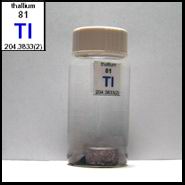
| Element | |
|---|---|
81TlThallium204.383322
8 18 32 18 3 |
|
| Basic properties | |
|---|---|
| Atomic number | 81 |
| Atomic weight | 204.38332 amu |
| Element family | Other metals |
| Period | 6 |
| Group | 13 |
| Block | p-block |
| Discovery year | 1861 |
| Isotope distribution |
|---|
203Tl 29.524% 205Tl 70.476% |
203Tl (29.52%) 205Tl (70.48%) |
| Physical properties | |
|---|---|
| Density | 11.85 g/cm3 (STP) |
Atomic hydrogen (H) 8.988E-5 Meitnerium (Mt) 28 | |
| Melting | 304 °C |
Helium (He) -272.2 Carbon (C) 3675 | |
| Boiling | 1457 °C |
Helium (He) -268.9 Tungsten (W) 5927 | |
| Chemical properties | |
|---|---|
| Oxidation states (less common) | +1, +3 (-5, -2, -1, +2) |
| First ionization potential | 6.109 eV |
Cesium (Cs) 3.894 Helium (He) 24.587 | |
| Electron affinity | 0.320 eV |
Nobelium (No) -2.33 Atomic chlorine (Cl) 3.612725 | |
| Electronegativity | 1.62 |
Cesium (Cs) 0.79 Atomic fluorine (F) 3.98 | |
| Atomic radius | |
|---|---|
| Covalent radius | 1.44 Å |
Atomic hydrogen (H) 0.32 Francium (Fr) 2.6 | |
| Van der Waals radius | 1.96 Å |
Atomic hydrogen (H) 1.2 Francium (Fr) 3.48 | |
| Metallic radius | 1.7 Å |
Beryllium (Be) 1.12 Cesium (Cs) 2.65 | |
| Compounds | ||
|---|---|---|
| Formula | Name | Oxidation state |
| TlNO3 | Thallium(I) nitrate | +1 |
| Tl2CO3 | Thallium(i) carbonate | +1 |
| Tl2O | Thallium(I) oxide | +1 |
| Tl2S | Thallium(I) sulfide | +1 |
| Tl2SO4 | Thallium(i) sulfate | +1 |
| Tl2Te | Thallium(I) telluride | +1 |
| Tl3PO4 | Thallium(I) phosphate | +1 |
| Tl(NO3)3 | Thallium(III) nitrate | +3 |
| Tl(OH)3 | Thallium(III) hydroxide | +3 |
| Tl2O3 | Thallium(III) oxide | +3 |
| TlF3 | Thallium trifluoride | +3 |
| TlH3 | Thallane | +3 |
| Electronic properties | |
|---|---|
| Electrons per shell | 2, 8, 18, 32, 18, 3 |
| Electronic configuration | [Xe] 4f14 |
|
Bohr atom model
| |
|
Orbital box diagram
| |
| Valence electrons | 3 |
| Lewis dot structure |
|
| Orbital Visualization | |
|---|---|
|
| |
| Electrons | - |
Thallium (Tl): Periodic Table Element
Abstract
Thallium (Tl, atomic number 81) is a silvery-white post-transition metal that exhibits unique chemical properties distinct from other Group 13 elements. The element displays a pronounced inert pair effect, favoring the +1 oxidation state over the more typical +3 state found in lighter Group 13 congeners. With a melting point of 304°C and density of 11.85 g·cm−3, thallium demonstrates soft metallic characteristics with high electrical conductivity. Natural isotopes 203Tl and 205Tl constitute nearly all naturally occurring thallium, with a standard atomic weight of 204.38 ± 0.01 u. The element exhibits exceptional toxicity, leading to restricted usage despite applications in electronics, infrared optics, and nuclear medicine. Historical significance stems from its discovery via flame spectroscopy in 1861, contributing to early understanding of spectroscopic analysis methods.
Introduction
Thallium occupies a unique position in the periodic table as element 81, located in Group 13 (IIIA) and Period 6. The element exhibits atypical behavior for its group, demonstrating properties that bridge characteristics of post-transition metals and alkali metals. Electronic configuration [Xe]4f145d106s26p1 reveals three valence electrons in the sixth shell, yet relativistic effects significantly influence chemical bonding patterns. The 6s electron pair experiences pronounced relativistic stabilization, creating an inert pair effect that distinguishes thallium from lighter Group 13 elements aluminum, gallium, and indium.
Discovery occurred independently in 1861 through the work of William Crookes and Claude-Auguste Lamy, who employed the newly developed flame spectroscopy technique. The characteristic green emission line at specific wavelengths provided the basis for the element's name, derived from the Greek "thallos" meaning green shoot or twig. Industrial significance remains limited due to extreme toxicity, though specialized applications exploit unique optical, electrical, and nuclear properties. Current production reaches approximately 10 metric tonnes annually as a byproduct of heavy metal sulfide ore processing.
Physical Properties and Atomic Structure
Fundamental Atomic Parameters
Thallium possesses atomic number 81 with electron configuration [Xe]4f145d106s26p1, placing it in the post-transition metal category. The atomic radius measures 170 pm, while the ionic radius varies significantly between oxidation states: Tl+ exhibits 150 pm radius compared to Tl3+ at 88.5 pm. This dramatic difference reflects the contrasting bonding environments and effective nuclear charge experienced in different oxidation states. First ionization energy equals 589.4 kJ·mol−1, considerably lower than lighter Group 13 elements due to relativistic expansion of outer orbitals. Subsequent ionization energies increase dramatically: second ionization energy reaches 1971 kJ·mol−1, while third ionization energy jumps to 2878 kJ·mol−1.
Electronegativity values demonstrate intermediate character: Pauling electronegativity equals 1.62, positioning thallium between typical metals and metalloids. The relatively low electronegativity reflects weak attraction for bonding electrons, consistent with metallic behavior. Electron affinity measures -19.2 kJ·mol−1, indicating minimal tendency to form anions. Crystal structure adopts hexagonal close-packed arrangement at room temperature, transitioning to body-centered cubic above 230°C. Metallic radius in the solid state equals 171 pm, reflecting efficient packing in the crystalline lattice.
Macroscopic Physical Characteristics
Thallium exhibits silvery-white metallic luster when freshly cut, rapidly tarnishing to bluish-gray upon air exposure. The metal demonstrates exceptional softness, easily cut with a knife at room temperature due to weak metallic bonding resulting from limited valence electron availability. Malleability and ductility allow mechanical deformation, though these properties are inferior to typical metals. Density equals 11.85 g·cm−3 at 20°C, reflecting the high atomic mass and efficient packing in the crystalline structure.
Thermal properties reveal relatively low melting point of 304°C (577 K), attributed to weak metallic bonding from limited electron delocalization. Boiling point reaches 1473°C (1746 K) under standard atmospheric pressure. Heat of fusion measures 4.14 kJ·mol−1, while heat of vaporization equals 165 kJ·mol−1. Specific heat capacity at constant pressure equals 26.32 J·mol−1·K−1, indicating moderate thermal energy storage capacity. Thermal conductivity of 46.1 W·m−1·K−1 reflects reasonable heat transfer capability despite weak metallic bonding.
Electrical conductivity demonstrates 6.17 × 10⁶ S·m−1, substantially lower than typical metals but sufficient for specialized electronic applications. The relatively high resistivity stems from limited valence electron mobility in the metallic lattice. Magnetic susceptibility exhibits diamagnetic behavior with χ = -50 × 10−6 cm3·mol−1, indicating paired electron configurations and absence of unpaired electrons in the ground state.
Chemical Properties and Reactivity
Electronic Structure and Bonding Behavior
Chemical reactivity patterns reflect the pronounced inert pair effect governing thallium chemistry. The 6s2 electron pair experiences significant relativistic stabilization, making these electrons less available for bonding compared to lighter Group 13 elements. Consequently, the +1 oxidation state predominates in aqueous solution and solid compounds, contrasting sharply with aluminum, gallium, and indium chemistry where +3 states are more stable.
Standard reduction potentials quantitatively demonstrate this stability preference. The Tl3+/Tl couple exhibits E° = +0.73 V, while the Tl+/Tl couple shows E° = −0.336 V. These values indicate that reduction of Tl3+ to Tl+ occurs spontaneously under standard conditions, with the disproportionation reaction 3Tl+ → 2Tl + Tl3+ having a positive cell potential. This electrochemical behavior underlies the instability of many thallium(III) compounds under ambient conditions.
Covalent bonding characteristics vary significantly between oxidation states. Thallium(I) compounds exhibit predominantly ionic character due to the large, polarizable Tl+ cation. Bond lengths typically exceed 2.5 Å in solid lattices, with coordination numbers ranging from 6 to 12 depending on the anion size. Thallium(III) compounds display greater covalent character, with shorter bond lengths around 2.0-2.3 Å and coordination numbers of 4 to 6. Hybridization patterns in molecular compounds involve sp3 or d2sp3 configurations for Tl(III) centers.
Electrochemical and Thermodynamic Properties
Electronegativity values position thallium at the boundary between metallic and semi-metallic behavior. On the Pauling scale, electronegativity equals 1.62, while the Mulliken scale gives 1.44, both indicating moderate electron-attracting power. These values lie between typical metals (0.9-1.5) and metalloids (1.8-2.2), consistent with thallium's intermediate chemical behavior.
Ionization energy trends reflect electronic structure effects. First ionization energy (589.4 kJ·mol−1) is significantly lower than aluminum (577.5 kJ·mol−1) despite higher nuclear charge, demonstrating relativistic orbital expansion and increased shielding by inner electrons. The large jump to second ionization energy (1971 kJ·mol−1) indicates strong preference for the +1 oxidation state. Third ionization energy (2878 kJ·mol−1) shows a smaller increment, reflecting removal of the final 6p electron.
Electron affinity measures -19.2 kJ·mol−1, indicating that thallium atoms do not readily form anions. This slightly positive value suggests minimal thermodynamic driving force for electron capture. Hydration enthalpies demonstrate significant differences between oxidation states: Tl+ exhibits ΔHhyd = −331 kJ·mol−1, while Tl3+ shows ΔHhyd = −4184 kJ·mol−1. The dramatically more negative value for Tl3+ reflects high charge density and strong electrostatic interactions with water molecules.
Chemical Compounds and Complex Formation
Binary and Ternary Compounds
Thallium(I) halides constitute the most stable and well-characterized binary compounds. TlF, TlCl, TlBr, and TlI adopt distinct crystal structures reflecting size effects. Thallium(I) fluoride crystallizes in the distorted sodium chloride structure due to the small fluoride ion, while thallium(I) chloride and bromide adopt the caesium chloride structure characteristic of large cation-anion combinations. Thallium(I) iodide exhibits the distorted sodium chloride structure despite large ionic radii.
Solubility patterns distinguish thallium(I) halides from typical Group 13 compounds. TlCl, TlBr, and TlI demonstrate poor aqueous solubility, resembling silver halides in their photosensitive behavior and precipitation characteristics. Thallium(I) fluoride shows moderate solubility at approximately 78 g per 100 mL water at 20°C. These solubility trends reflect lattice energy considerations and hydration effects.
Oxide chemistry reveals fundamental differences between oxidation states. Thallium(I) oxide (Tl2O) forms a black crystalline solid that is stable under ambient conditions. The compound exhibits basic character, dissolving in acids to produce thallium(I) salts. Thallium(III) oxide (Tl2O3) appears as a black solid that decomposes above 800°C, releasing oxygen and forming the more stable monoxide. This thermal instability reflects the thermodynamic preference for the +1 oxidation state.
Sulfide compounds demonstrate varying stoichiometries and structural complexity. Thallium(I) sulfide (Tl2S) crystallizes with the anti-fluorite structure, while mixed-valence compounds like Tl4O3 contain both Tl+ and Tl3+ centers in ordered arrangements. These compounds exhibit semiconductor properties with electrical conductivity varying with temperature and light exposure.
Coordination Chemistry and Organometallic Compounds
Thallium(I) coordination chemistry is dominated by the large, soft, polarizable nature of the cation. Common coordination numbers range from 6 to 12, with irregular geometries resulting from the sterically non-demanding 6s2 lone pair. Coordination compounds with oxygen donors typically exhibit high coordination numbers due to favorable electrostatic interactions. Nitrogen and sulfur donors form more covalent interactions with lower coordination numbers.
Complex formation constants reveal moderate to weak binding for most ligands. Crown ethers and cryptands form stable complexes due to size complementarity with the Tl+ cation. 18-crown-6 exhibits particularly high selectivity for thallium(I) over other Group 13 cations, with formation constants exceeding 104 M−1 in aqueous solution. These host-guest interactions find application in analytical separation procedures.
Thallium(III) coordination chemistry more closely resembles typical Group 13 behavior. Octahedral geometry predominates in aqueous solution, though square planar and tetrahedral arrangements occur with specific ligands. Stability constants are generally higher than corresponding Tl(I) complexes due to increased charge density and stronger electrostatic interactions.
Organothallium chemistry encompasses both Tl(I) and Tl(III) oxidation states with distinct structural preferences. Thallium(I) alkyls and aryls exhibit ionic character with polar Tl-C bonds. The dimethylthallium(I) cation [Tl(CH3)2]+ adopts linear geometry, isoelectronic with dimethylmercury. Thallium(III) organometallic compounds demonstrate greater covalent character but suffer from thermal instability, with decomposition temperatures typically below 100°C.
Cyclopentadienyl compounds illustrate oxidation state preferences in organometallic systems. Thallous cyclopentadienide (TlCp) contains Tl(I), contrasting with gallium and indium analogues that favor the +3 oxidation state. This difference reflects the enhanced stability of the thallium(I) oxidation state across all chemical environments.
Natural Occurrence and Isotopic Analysis
Geochemical Distribution and Abundance
Thallium concentrations in Earth's crust average approximately 0.7 mg·kg−1 (0.7 ppm), classifying it among the rarer elements. Geochemical behavior resembles that of alkali metals due to the large ionic radius and +1 charge of the dominant thallium species. Concentration mechanisms include isomorphous substitution in potassium minerals, with Tl+ readily replacing K+ in crystal lattices due to similar ionic radii (Tl+: 150 pm, K+: 138 pm).
Primary mineral occurrences include sulfide deposits where thallium substitutes for lead or potassium. Crookesite (TlCu7Se4), hutchinsonite (TlPbAs5S9), and lorándite (TlAsS2) represent the principal thallium-bearing minerals. These phases typically contain 16-60% thallium by mass but occur in extremely limited quantities with no commercial significance as thallium sources.
Secondary enrichment processes concentrate thallium in oxidation zones of sulfide deposits and in sedimentary environments. Clay minerals exhibit enhanced thallium uptake through ion exchange mechanisms, with concentrations reaching several ppm in specific geological formations. Granitic rocks generally contain higher thallium levels than basic igneous rocks, reflecting geochemical fractionation during magmatic differentiation.
The Allchar deposit in North Macedonia represents the world's most significant thallium accumulation, containing an estimated 500 tonnes of thallium distributed among various sulfide and selenide phases. This locality serves as the primary source of rare thallium minerals for research purposes and provides insight into hydrothermal concentration mechanisms.
Nuclear Properties and Isotopic Composition
Natural thallium consists of two stable isotopes: 203Tl (29.524% natural abundance) and 205Tl (70.476% natural abundance). Nuclear spin properties differ between isotopes: 203Tl exhibits nuclear spin I = 1/2 with magnetic moment μ = +1.622 nuclear magnetons, while 205Tl shows I = 1/2 with μ = +1.638 nuclear magnetons. These nuclear magnetic properties enable NMR spectroscopic applications for structural determination in thallium compounds.
Radioactive isotopes span mass numbers from 176 to 216, with varying half-lives and decay modes. 204Tl represents the longest-lived artificial isotope with t1/2 = 3.78 years, produced by neutron activation of stable thallium in nuclear reactors. Beta-minus decay to 204Pb occurs with maximum beta energy of 0.764 MeV, accompanied by gamma emission at specific energies.
201Tl holds particular significance for nuclear medicine applications, with t1/2 = 73.1 hours and decay by electron capture to 201Hg. Emitted X-rays (68-80 keV) and gamma rays (135 keV, 167 keV) provide optimal imaging characteristics with minimal patient radiation exposure. Production occurs via cyclotron bombardment of thallium targets with protons or deuterons, followed by separation and purification procedures.
Neutron cross-sections vary considerably between isotopes and energy ranges. 203Tl exhibits thermal neutron absorption cross-section of 11.4 barns, while 205Tl shows 0.104 barns. These values influence reactor behavior and isotope production calculations for nuclear applications.
Industrial Production and Technological Applications
Extraction and Purification Methodologies
Commercial thallium production relies exclusively on recovery from heavy metal sulfide ore processing, primarily copper, lead, and zinc smelting operations. Annual worldwide production approximates 10 metric tonnes, with China, Kazakhstan, and Belgium serving as major producers. The element does not occur in sufficient concentrations to justify primary mining operations.
Extraction processes begin with collection of flue dusts and slags from sulfide ore roasting operations. These materials typically contain 0.1-1.0% thallium mixed with numerous other metals and metalloids. Initial concentration involves selective leaching with dilute sulfuric acid or sodium hydroxide solutions, dissolving thallium while leaving insoluble residues.
Purification procedures employ sequential precipitation and dissolution cycles to eliminate impurities. Thallium(I) sulfate precipitation from acidic solution provides initial concentration, followed by reduction to metallic thallium via electrolysis on platinum or stainless steel cathodes. Alternative reduction methods include precipitation with zinc metal, producing thallium powder that requires subsequent melting and casting operations.
Final purification achieves 99.9% purity through zone refining or fractional crystallization of thallium salts. Quality control involves atomic absorption spectroscopy, X-ray fluorescence analysis, and mass spectrometry to verify elemental composition and detect trace impurities. Environmental considerations mandate careful handling of all process streams due to extreme thallium toxicity.
Technological Applications and Future Prospects
Electronics industry applications exploit the semiconductor properties of certain thallium compounds. Thallium(I) sulfide demonstrates photoconductivity with electrical resistance decreasing upon infrared radiation exposure, enabling photoresistor and bolometer fabrication. Thallium selenide serves in infrared detection systems due to favorable optical absorption characteristics in the 1-14 μm wavelength range.
Semiconductor doping applications utilize minute thallium quantities to modify electronic properties of host materials. Selenium rectifiers incorporate thallium additions to enhance performance characteristics, while sodium iodide and cesium iodide scintillation crystals employ thallium activation to improve gamma radiation detection efficiency. These applications require high-purity thallium compounds with precisely controlled concentrations.
High-temperature superconductor research investigates thallium-barium-calcium-copper oxide systems with critical temperatures exceeding 120 K. Mercury-doped thallium cuprate phases exhibit transition temperatures above 130 K under ambient pressure, approaching the performance of record-holding mercury cuprates. Commercial applications await resolution of toxicity concerns and development of safer handling procedures.
Optical applications capitalize on unique refractive index characteristics of thallium compounds. Thallium bromide-iodide mixtures (KRS-5) provide infrared-transparent optical elements for specialized instrumentation. High-density glasses incorporating thallium oxide exhibit favorable optical properties combined with low melting points, enabling specialized optical fiber and lens applications.
Nuclear medicine utilizes 201Tl for cardiac perfusion imaging, though technetium-99m has largely replaced thallium for routine procedures. Specialized applications include assessment of coronary artery disease and evaluation of myocardial viability in complex clinical cases. Portable generator systems enable thallium production at medical facilities without on-site cyclotron capabilities.
Historical Development and Discovery
The discovery of thallium in 1861 exemplifies the revolutionary impact of spectroscopic methods on analytical chemistry. William Crookes, investigating residues from sulfuric acid production at facilities near Tilkerode in the Harz Mountains, employed the newly developed flame spectroscopy technique pioneered by Robert Bunsen and Gustav Kirchhoff. Crookes observed a brilliant green emission line at wavelength 535 nm, distinct from all known elements at the time.
Simultaneously, Claude-Auguste Lamy conducted independent investigations of selenium-containing deposits from Frédéric Kuhlmann's sulfuric acid plant in France. Using similar spectroscopic equipment, Lamy identified the same characteristic green spectral line and recognized the presence of a new element. The concurrent discovery by two investigators working independently provided crucial confirmation of the element's existence and established spectroscopy as a definitive analytical tool.
Nomenclature selection reflected the distinctive spectroscopic signature. Crookes proposed the name "thallium" from the Greek word "thallos" meaning green shoot or twig, referencing the prominent green emission line that enabled detection. This spectroscopic approach to element identification represented a paradigm shift from traditional chemical analysis methods, enabling detection of trace quantities previously unobservable.
Isolation procedures developed independently by both discoverers established fundamental chemical properties. Lamy achieved the first metallic thallium preparation through electrolysis of thallium salts, producing small quantities of silvery metal that demonstrated typical metallic properties. Crookes obtained metallic thallium via zinc reduction of soluble thallium compounds, followed by melting and casting procedures.
Priority disputes arose between Crookes and Lamy regarding discovery credit, leading to scientific controversy throughout 1862-1863. The International Exhibition in London 1862 awarded medals to both investigators: Lamy received recognition "for the discovery of a new and abundant source of thallium," while Crookes was honored "for the discovery of the new element." Resolution occurred following Crookes' election as Fellow of the Royal Society in June 1863, acknowledging both contributors' roles in element characterization.
Early applications focused on rodenticide formulations due to the exceptional toxicity and near-tasteless character of thallium salts. Thallium(I) sulfate became widely used for pest control until safety concerns led to regulatory restrictions. The United States banned thallium-based rodenticides through Presidential Executive Order 11643 in February 1972, with other countries implementing similar prohibitions.
Medical applications emerged in the early 20th century, including treatment of ringworm infections, tuberculosis-related night sweats, and cosmetic hair removal procedures. These uses were discontinued due to narrow therapeutic indices and development of safer alternative treatments. Modern medical applications focus exclusively on nuclear imaging procedures using radioactive thallium isotopes.
Conclusion
Thallium occupies a distinctive position among the chemical elements, exhibiting properties that challenge traditional periodic trends and group relationships. The pronounced inert pair effect governing its chemistry results in predominance of the +1 oxidation state, contrasting sharply with lighter Group 13 congeners and creating unique chemical behavior patterns. Relativistic effects on electronic structure provide fundamental insights into heavy element chemistry and serve as a model system for theoretical investigations.
Technological applications remain limited by extreme toxicity concerns, though specialized uses in electronics, optics, and nuclear medicine continue to drive research interest. High-temperature superconductor investigations may yield future applications if safety and handling challenges can be adequately addressed. The element's role in advancing spectroscopic methodology historically demonstrates the crucial intersection between analytical technique development and element discovery.
Future research directions include theoretical modeling of relativistic effects in heavy element chemistry, development of safer handling protocols for industrial applications, and exploration of novel superconducting phases with enhanced performance characteristics. Environmental chemistry investigations will likely focus on biogeochemical cycling, toxicity mechanisms, and remediation strategies for contaminated sites. Understanding thallium chemistry provides broader insights into post-transition metal behavior and contributes to comprehensive knowledge of periodic table relationships.

Please let us know how we can improve this web app.