| Element | |
|---|---|
31GaGallium69.72312
8 18 3 |
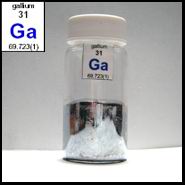
|
| Basic properties | |
|---|---|
| Atomic number | 31 |
| Atomic weight | 69.7231 amu |
| Element family | Other metals |
| Period | 4 |
| Group | 13 |
| Block | p-block |
| Discovery year | 1875 |
| Isotope distribution |
|---|
69Ga 60.1% 71Ga 39.9% |
69Ga (60.10%) 71Ga (39.90%) |
| Physical properties | |
|---|---|
| Density | 5.907 g/cm3 (STP) |
Atomic hydrogen (H) 8.988E-5 Meitnerium (Mt) 28 | |
| Melting | 29.76 °C |
Helium (He) -272.2 Carbon (C) 3675 | |
| Boiling | 2403 °C |
Helium (He) -268.9 Tungsten (W) 5927 | |
| Chemical properties | |
|---|---|
| Oxidation states (less common) | +3 (-5, -4, -3, -2, -1, 0, +1, +2) |
| First ionization potential | 5.999 eV |
Cesium (Cs) 3.894 Helium (He) 24.587 | |
| Electron affinity | 0.301 eV |
Nobelium (No) -2.33 Atomic chlorine (Cl) 3.612725 | |
| Electronegativity | 1.81 |
Cesium (Cs) 0.79 Atomic fluorine (F) 3.98 | |
| Atomic radius | |
|---|---|
| Covalent radius | 1.24 Å |
Atomic hydrogen (H) 0.32 Francium (Fr) 2.6 | |
| Van der Waals radius | 1.87 Å |
Atomic hydrogen (H) 1.2 Francium (Fr) 3.48 | |
| Metallic radius | 1.35 Å |
Beryllium (Be) 1.12 Cesium (Cs) 2.65 | |
| Compounds | ||
|---|---|---|
| Formula | Name | Oxidation state |
| Mg5Ga2 | Pentamagnesium digallide | -5 |
| Ga2O | Gallium(i) oxide | +1 |
| GaCl | Gallium(i) chloride | +1 |
| GaSe | Gallium(II) selenide | +2 |
| GaTe | Gallium(II) telluride | +2 |
| GaN | Gallium nitride | +3 |
| GaAs | Gallium arsenide | +3 |
| Ga2O3 | Gallium(III) oxide | +3 |
| GaCl3 | Gallium trichloride | +3 |
| GaP | Gallium phosphide | +3 |
| GaBr3 | Gallium(III) bromide | +3 |
| Ga(CH3)3 | Trimethylgallium | +3 |
| Electronic properties | |
|---|---|
| Electrons per shell | 2, 8, 18, 3 |
| Electronic configuration | [Ar] 3d10 |
|
Bohr atom model

| |
|
Orbital box diagram

| |
| Valence electrons | 3 |
| Lewis dot structure |
|
| Orbital Visualization | |
|---|---|
|
| |
| Electrons | - |
Gallium (Ga): Periodic Table Element
Abstract
Gallium (symbol Ga, atomic number 31) represents a post-transition metal element distinguished by its remarkably low melting point of 29.7646°C, positioning it among the few metals liquid at near-ambient temperatures. The element exhibits predominantly trivalent oxidation states in its compounds, forming stable binary and ternary compounds with characteristic semiconductor properties. Gallium demonstrates unique crystallographic behavior with orthorhombic symmetry and anisotropic thermal expansion properties. Industrial significance derives primarily from semiconductor applications, particularly in gallium arsenide and gallium nitride technologies for high-frequency electronics and optoelectronic devices. Natural occurrence remains limited to trace concentrations in aluminum and zinc ores, requiring specialized extraction processes for commercial production.
Introduction
Gallium occupies position 31 in the periodic table, constituting the first post-transition metal element in Group 13 (IIIA) and Period 4. The electronic configuration [Ar] 3d¹⁰ 4s² 4p¹ characterizes its chemical behavior, with the filled d-subshell providing additional nuclear shielding effects that influence its properties relative to aluminum. Discovered in 1875 by Paul-Émile Lecoq de Boisbaudran through spectroscopic analysis of zinc blende, gallium represented the first confirmation of Dmitri Mendeleev's periodic law predictions, originally designated as "eka-aluminum" based on its anticipated position. The element's significance has expanded substantially with the development of semiconductor technology, where gallium-based compounds serve as fundamental materials for modern electronic and optoelectronic applications. Contemporary industrial demand centers on gallium arsenide and gallium nitride production for high-frequency devices, light-emitting diodes, and photovoltaic systems.
Physical Properties and Atomic Structure
Fundamental Atomic Parameters
Gallium exhibits atomic number 31 with standard atomic weight 69.723 ± 0.001 u, representing the weighted average of two stable isotopes: ⁶⁹Ga (60.108% abundance) and ⁷¹Ga (39.892% abundance). The electronic structure [Ar] 3d¹⁰ 4s² 4p¹ demonstrates characteristic post-transition metal behavior, with the filled 3d¹⁰ subshell contributing to enhanced nuclear shielding. First ionization energy reaches 578.8 kJ mol⁻¹, significantly higher than aluminum (577.5 kJ mol⁻¹) due to d-electron contraction effects. Atomic radius measures 122 pm, while ionic radius for Ga³⁺ equals 62 pm in sixfold coordination. Electronegativity values span 1.81 (Pauling scale) and 1.76 (Allred-Rochow scale), indicating moderate electron-attracting capability within compound formation.
Macroscopic Physical Characteristics
Elemental gallium exhibits silvery-blue metallic appearance with distinctive low melting point of 29.7646°C (302.9146 K), establishing it as one of four non-radioactive metals liquid at near-ambient conditions alongside cesium, rubidium, and mercury. Boiling point extends to 2204°C (2477 K), yielding an exceptionally large liquid temperature range of approximately 2174 K. Density at melting point equals 5.91 g cm⁻³, with solid-state density reaching 5.907 g cm⁻³ at 20°C. Volume expansion of 3.1% occurs during solidification, representing unusual behavior among metallic elements. Crystal structure adopts orthorhombic symmetry with space group Cmca, containing eight atoms per unit cell. Nearest-neighbor distance measures 244 pm, with additional neighbors positioned at 271, 274, and 279 pm distances, forming dimeric Ga₂ units through covalent bonding interactions.
Chemical Properties and Reactivity
Electronic Structure and Bonding Behavior
Chemical reactivity patterns reflect the partially filled 4p¹ valence orbital configuration, enabling formation of predominantly trivalent compounds with occasional monovalent species. Gallium(III) represents the thermodynamically favored oxidation state, forming stable ionic and covalent compounds with electronegative elements. Bond formation utilizes sp³ hybridization in tetrahedral coordination or sp²d² hybridization in octahedral environments. Covalent bonding predominates in organogallium chemistry, where alkyl and aryl derivatives demonstrate moderate thermal stability. Gallium-gallium bonds appear in selected compounds such as Ga₂Cl₄, containing formal Ga(II) centers with metal-metal bonding. Lewis acidity characterizes gallium(III) compounds, accepting electron pairs from donor molecules to expand coordination spheres beyond the trivalent configuration.
Electrochemical and Thermodynamic Properties
Standard reduction potential for the Ga³⁺/Ga couple equals -0.529 V versus standard hydrogen electrode, indicating moderate reducing character of metallic gallium. Second and third ionization energies measure 1979.3 kJ mol⁻¹ and 2963 kJ mol⁻¹ respectively, reflecting progressive difficulty in electron removal from the contracted 4s² and 3d¹⁰ orbitals. Electron affinity reaches 28.9 kJ mol⁻¹, demonstrating limited tendency for anion formation. Thermodynamic stability of gallium(III) oxide (ΔH°f = -1089.1 kJ mol⁻¹) drives spontaneous air oxidation at elevated temperatures, forming protective surface layers under ambient conditions. Hydrolysis constants for aqueous Ga³⁺ indicate significant hydrolytic behavior, with first hydrolysis constant pKh₁ = 2.6, establishing acidic solution conditions through formation of [Ga(H₂O)₅OH]²⁺ species.
Chemical Compounds and Complex Formation
Binary and Ternary Compounds
Gallium oxide occurs in multiple polymorphic forms, with α-Ga₂O₃ representing the thermodynamically stable phase under standard conditions. The corundum-type structure exhibits exceptional thermal stability and wide bandgap characteristics (4.8 eV) suitable for high-temperature semiconductor applications. Gallium halides form complete series with fluorine, chlorine, bromine, and iodine, adopting molecular structures in the gas phase with dimeric arrangements in the solid state for heavier halides. Gallium trifluoride demonstrates ionic character with high lattice energy, while tribromide and triiodide exhibit predominantly covalent bonding. Gallium sulfide (Ga₂S₃) crystallizes in three distinct modifications: α-form (zincblende structure), β-form (wurtzite structure), and γ-form (defective spinel structure), each displaying semiconducting properties with varying bandgap energies. Binary gallium arsenide and gallium phosphide represent technologically crucial III-V semiconductors with direct bandgaps enabling efficient photon emission processes.
Coordination Chemistry and Organometallic Compounds
Coordination complexes of gallium(III) typically adopt octahedral geometry with coordination numbers ranging from four to six depending on ligand properties and steric requirements. Aqueous gallium solutions contain hexahydrated [Ga(H₂O)₆]³⁺ ions, which undergo successive hydrolysis reactions at elevated pH values. Chelating ligands such as ethylenediaminetetraacetic acid (EDTA) form thermodynamically stable complexes with formation constants exceeding 10²⁰. Organogallium chemistry encompasses trialkyl and triaryl derivatives, with trimethylgallium (Ga(CH₃)₃) serving as a key precursor for chemical vapor deposition applications. These compounds exhibit monomeric structures in solution, contrasting with dimeric organoaluminum analogs due to reduced Lewis acidity. Gallium-carbon bond energies approximate 255 kJ mol⁻¹, providing moderate thermodynamic stability under ambient conditions while enabling controlled thermal decomposition for thin-film deposition processes.
Natural Occurrence and Isotopic Analysis
Geochemical Distribution and Abundance
Crustal abundance of gallium averages 19 ppm, positioning it among moderately scarce elements within the lithosphere. Geochemical behavior follows aluminum closely due to similar ionic radii and charge densities, resulting in isomorphous substitution within aluminosilicate mineral structures. Primary mineral associations include bauxite ores (aluminum hydroxides), where gallium concentrations reach 50-100 ppm through preferential incorporation during weathering processes. Zinc sulfide minerals, particularly sphalerite (ZnS), contain elevated gallium concentrations up to 1000 ppm via ionic substitution mechanisms. Coal deposits accumulate gallium through biogeochemical processes, with certain coal types achieving concentrations exceeding 100 ppm. Seawater contains approximately 30 nL L⁻¹ gallium, maintained through equilibrium with aluminosilicate particulates and biological uptake processes.
Nuclear Properties and Isotopic Composition
Natural gallium comprises two stable isotopes: ⁶⁹Ga (60.108 ± 0.002%) and ⁷¹Ga (39.892 ± 0.002%), with no long-lived radioactive isotopes in natural occurrence. Nuclear properties include nuclear spin I = 3/2 for both isotopes, enabling nuclear magnetic resonance spectroscopy applications. Magnetic moments measure +2.01659 nuclear magnetons for ⁶⁹Ga and +2.56227 nuclear magnetons for ⁷¹Ga. Artificial radioisotopes span mass numbers from 60 to 89, with ⁶⁷Ga (half-life 3.261 days) and ⁶⁸Ga (half-life 67.7 minutes) finding applications in nuclear medicine imaging. Neutron cross-sections for thermal neutron capture equal 2.9 barns (⁶⁹Ga) and 5.1 barns (⁷¹Ga), indicating moderate neutron absorption characteristics. Beta-plus decay dominates light isotope disintegration pathways, while beta-minus decay characterizes heavy isotope behavior beyond mass 71.
Industrial Production and Technological Applications
Extraction and Purification Methodologies
Commercial gallium recovery utilizes aluminum processing waste streams, particularly Bayer process liquors from bauxite refining operations. Extraction efficiency ranges from 70-90% through alkaline leaching followed by selective precipitation using zinc dust reduction or electrolytic recovery methods. Purification requires zone refining techniques to achieve semiconductor-grade purity levels exceeding 99.9999% (6N), with impurity concentrations below 1 ppm for critical elements. Alternative sources include zinc smelter residues and coal fly ash, though processing economics favor aluminum industry byproducts for large-scale production. Annual global production approximates 320 metric tons, with China providing approximately 95% of world supply through integrated aluminum-gallium recovery facilities. Processing costs reflect energy-intensive purification requirements, with semiconductor-grade material commanding premium pricing due to stringent purity specifications.
Technological Applications and Future Prospects
Semiconductor applications dominate gallium consumption, with gallium arsenide wafers enabling high-frequency microwave devices, cellular base stations, and satellite communication systems. Compound semiconductor properties include direct bandgap characteristics, high electron mobility, and radiation resistance superior to silicon alternatives. Gallium nitride technology supports wide-bandgap power electronics, enabling efficient voltage conversion systems and high-power radio frequency amplifiers. Light-emitting diode manufacturing utilizes indium gallium nitride alloys for blue and white illumination sources, representing a rapidly expanding market segment. Solar photovoltaic applications employ gallium arsenide cells for space missions and concentrated terrestrial systems, achieving record efficiency levels exceeding 46% under concentrated sunlight. Liquid metal applications leverage the low melting point for specialized heat transfer systems, thermometry applications, and shape-memory alloys. Future development areas include spintronics devices, quantum computing applications, and advanced power semiconductor technologies for electric vehicle and renewable energy systems.
Historical Development and Discovery
Theoretical prediction of gallium preceded experimental discovery by four years, when Dmitri Mendeleev forecast the existence of "eka-aluminum" in 1871 based on periodic law principles. Predicted properties included atomic weight (68 u), density (5.9 g cm⁻³), melting point (low), and oxide formula (M₂O₃), demonstrating remarkable accuracy in periodic systematics. Paul-Émile Lecoq de Boisbaudran achieved first isolation in August 1875 through spectroscopic examination of zinc blende from the Pyrenees region, observing characteristic violet spectral lines at 417.2 and 403.3 nm wavelengths. Initial density determination yielded 4.7 g cm⁻³, prompting Mendeleev's suggestion for remeasurement, which confirmed the predicted value of 5.9 g cm⁻³. Naming derived from Latin "Gallia" (France), though popular interpretation suggested a pun on the discoverer's surname (Le coq = gallus in Latin). Industrial applications remained limited to specialty alloys and thermometry until semiconductor development in the 1960s established gallium arsenide as a technologically significant material. Contemporary research directions emphasize wide-bandgap gallium nitride technologies and advanced heterostructure devices for next-generation electronic applications.
Conclusion
Gallium exemplifies the successful integration of fundamental chemical knowledge with technological innovation, transforming from a laboratory curiosity to an essential element in modern semiconductor technology. Its unique combination of low melting point, trivalent chemistry, and compound semiconductor properties continues to drive research into advanced electronic materials and devices. The element's position in Group 13 provides predictable chemical behavior while enabling formation of technologically crucial III-V semiconductors with superior performance characteristics compared to silicon alternatives. Future applications in wide-bandgap power electronics, quantum devices, and next-generation photonic systems ensure continued relevance in advancing technological capabilities across multiple industrial sectors.

Please let us know how we can improve this web app.
