| Element | |
|---|---|
45RhRhodium102.9055022
8 18 16 1 |
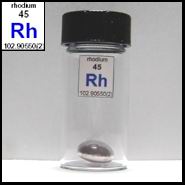
|
| Basic properties | |
|---|---|
| Atomic number | 45 |
| Atomic weight | 102.905502 amu |
| Element family | Transition metals |
| Period | 5 |
| Group | 1 |
| Block | s-block |
| Discovery year | 1804 |
| Isotope distribution |
|---|
103Rh 100% |
| Physical properties | |
|---|---|
| Density | 12.41 g/cm3 (STP) |
Atomic hydrogen (H) 8.988E-5 Meitnerium (Mt) 28 | |
| Melting | 1966 °C |
Helium (He) -272.2 Carbon (C) 3675 | |
| Boiling | 3727 °C |
Helium (He) -268.9 Tungsten (W) 5927 | |
| Chemical properties | |
|---|---|
| Oxidation states (less common) | +3 (-3, -1, 0, +1, +2, +4, +5, +6, +7) |
| First ionization potential | 7.459 eV |
Cesium (Cs) 3.894 Helium (He) 24.587 | |
| Electron affinity | 1.143 eV |
Nobelium (No) -2.33 Atomic chlorine (Cl) 3.612725 | |
| Electronegativity | 2.28 |
Cesium (Cs) 0.79 Atomic fluorine (F) 3.98 | |
| Atomic radius | |
|---|---|
| Covalent radius | 1.25 Å |
Atomic hydrogen (H) 0.32 Francium (Fr) 2.6 | |
| Metallic radius | 1.34 Å |
Beryllium (Be) 1.12 Cesium (Cs) 2.65 | |
| Compounds | ||
|---|---|---|
| Formula | Name | Oxidation state |
| RhCl3 | Rhodium(III) chloride | +3 |
| Rh(NO3)3 | Rhodium(III) nitrate | +3 |
| Rh2O3 | Rhodium(III) oxide | +3 |
| Rh2S3 | Rhodium(III) sulfide | +3 |
| RhBr3 | Rhodium(III) bromide | +3 |
| RhF3 | Rhodium trifluoride | +3 |
| RhI3 | Rhodium(III) iodide | +3 |
| RhF4 | Rhodium(IV) fluoride | +4 |
| RhO2 | Rhodium(IV) oxide | +4 |
| RhF5 | Rhodium pentafluoride | +5 |
| XeRhF6 | Xenon hexafluororhodate | +5 |
| RhF6 | Rhodium hexafluoride | +6 |
| Electronic properties | |
|---|---|
| Electrons per shell | 2, 8, 18, 16, 1 |
| Electronic configuration | [Kr] 4d8 |
|
Bohr atom model

| |
|
Orbital box diagram

| |
| Valence electrons | 9 |
| Lewis dot structure |
|
| Orbital Visualization | |
|---|---|
|
| |
| Electrons | - |
Rhodium (Rh): Periodic Table Element
Abstract
Rhodium (atomic number 45, symbol Rh) represents one of the rarest and most valuable transition metals in the periodic table. This silvery-white, hard, and corrosion-resistant element belongs to the platinum group metals and exhibits remarkable chemical inertness under standard conditions. With an atomic mass of 102.91 Da and a unique electron configuration of [Kr] 4d8 5s1, rhodium demonstrates exceptional catalytic properties that drive its primary industrial applications. The element's scarcity, with a crustal abundance of merely 0.0002 ppm, combined with its irreplaceable role in three-way automotive catalytic converters, establishes its position as one of the most economically significant precious metals. Rhodium's chemical behavior is characterized by multiple oxidation states, with +3 and +1 being most prevalent, and its resistance to acid dissolution except in aqua regia under specific conditions.
Introduction
Rhodium occupies a distinctive position within Group 9 of the periodic table, situated between ruthenium and palladium in the second transition series. This noble metal exhibits an anomalous ground-state electron configuration that deviates from the expected pattern for Group 9 elements, possessing only one electron in its outermost s orbital. The element was discovered in 1803 by William Hyde Wollaston through systematic analysis of platinum ores from South America, with its name derived from the Greek "rhodon" meaning rose, referring to the characteristic rose-red color of its chloride compounds. Rhodium's chemical properties are fundamentally governed by its d8 electronic configuration, which confers exceptional stability to square-planar coordination geometries and facilitates unique catalytic mechanisms. The element demonstrates remarkable resistance to corrosion and chemical attack, remaining unchanged by most acids and maintaining metallic luster under atmospheric conditions. These distinctive characteristics, combined with its extreme rarity, position rhodium as both a scientifically fascinating element and an industrially critical material.
Physical Properties and Atomic Structure
Fundamental Atomic Parameters
Rhodium possesses atomic number 45 with a nuclear composition consisting of 45 protons and typically 58 neutrons in its stable isotope 103Rh. The electronic configuration follows the notation [Kr] 4d8 5s1, representing an anomalous distribution where one electron occupies the 5s orbital rather than completing the 4d subshell. This electronic arrangement results in an effective nuclear charge experienced by the valence electrons of approximately 8.7, significantly higher than neighboring elements due to poor shielding by the d electrons. The atomic radius measures 134 pm for the metallic form, while common ionic radii span from 68 pm for Rh3+ to 80 pm for Rh1+ ions. The first ionization energy stands at 719.7 kJ/mol, reflecting the relatively low binding energy of the single 5s electron. Successive ionization energies demonstrate substantial increases: 1744 kJ/mol for the second and 2997 kJ/mol for the third, corresponding to removal of 4d electrons with progressively stronger nuclear attraction.
Macroscopic Physical Characteristics
Rhodium crystallizes in a face-centered cubic structure with a lattice parameter of 3.803 Å at room temperature, exhibiting metallic bonding characterized by delocalized electrons throughout the crystal lattice. The element displays a brilliant silvery-white metallic luster with exceptional reflectance properties, particularly for visible light wavelengths. Its melting point of 1964°C exceeds that of platinum, while the boiling point reaches 3695°C, indicating strong interatomic bonding within the solid phase. The density at room temperature measures 12.41 g/cm3, positioning rhodium as moderately dense among the platinum group metals. Heat capacity values include 25.0 J/(mol·K) at 298 K, with thermal conductivity of 150 W/(m·K), demonstrating efficient heat transfer properties. The enthalpy of fusion equals 26.59 kJ/mol, while vaporization requires 493 kJ/mol, reflecting the substantial energy needed to overcome metallic bonding. Rhodium exhibits diamagnetic behavior with a magnetic susceptibility of -8.3 × 10⁻⁶ cm3/mol, consistent with its filled d-orbital configuration.
Chemical Properties and Reactivity
Electronic Structure and Bonding Behavior
The d8 electron configuration of rhodium fundamentally governs its chemical behavior, providing eight electrons for d-orbital interactions while leaving the s orbital partially occupied. This arrangement facilitates the formation of square-planar complexes in oxidation state +1, where d-orbital splitting under strong-field ligands results in energetically favorable electron pairing. The element demonstrates variable oxidation states ranging from 0 to +6, with +3 and +1 being most thermodynamically stable under ambient conditions. In the +3 oxidation state, rhodium typically adopts octahedral coordination geometry with d6 low-spin configuration, exhibiting considerable kinetic inertness due to substantial ligand field stabilization energy. Bond formation involves significant d-orbital participation, leading to relatively short metal-ligand distances and enhanced covalent character compared to earlier transition metals. Electronegativity values measured on the Pauling scale reach 2.28, indicating moderate electron-withdrawing capability and propensity for forming polar covalent bonds with main group elements.
Electrochemical and Thermodynamic Properties
Rhodium exhibits distinctive electrochemical behavior characterized by multiple accessible oxidation states and corresponding reduction potentials. The standard electrode potential for the Rh3+/Rh couple measures +0.76 V versus the standard hydrogen electrode, indicating moderate nobility and resistance to oxidative dissolution under standard conditions. The Rh2+/Rh couple exhibits a potential of +0.60 V, while the RhO4-/RhO2 couple demonstrates +0.93 V in alkaline media. Successive ionization energies reflect the increasing difficulty of electron removal: 719.7 kJ/mol (first), 1744 kJ/mol (second), and 2997 kJ/mol (third), with subsequent ionizations requiring exponentially greater energy input. Electron affinity measurements indicate a slightly positive value of 110 kJ/mol, suggesting modest tendency to accept electrons. Thermodynamic stability of various oxidation states shows pronounced preference for +3 and +1 states in aqueous systems, with higher oxidation states becoming accessible only under strongly oxidizing conditions or in the presence of specific ligands that stabilize unusual electronic configurations.
Chemical Compounds and Complex Formation
Binary and Ternary Compounds
Rhodium forms a diverse array of binary compounds exhibiting varying degrees of thermodynamic stability and synthetic accessibility. The most significant binary oxide, Rh2O3, adopts a corundum-type structure and represents the thermodynamically stable oxide phase under atmospheric conditions. This sesquioxide demonstrates amphoteric behavior, dissolving in both strong acids and bases to form corresponding rhodium(III) species. Higher oxidation state oxides include rhodium(IV) oxide, RhO2, which exists as a metastable phase requiring specific synthetic conditions and demonstrates enhanced oxidizing properties. Binary halides encompass all four common halogens, with rhodium(III) chloride, RhCl3, being most extensively characterized due to its role as a synthetic precursor. The anhydrous trichloride exhibits polymeric structure with octahedral rhodium coordination, while the hydrated form RhCl3·3H2O demonstrates greater solubility and reactivity. Sulfide compounds include Rh2S3 and RhS2, typically formed under high-temperature conditions with limited thermal stability in oxidizing environments.
Coordination Chemistry and Organometallic Compounds
Rhodium's coordination chemistry represents one of the most extensively studied areas within platinum group metal chemistry, driven by exceptional catalytic properties and synthetic versatility. Square-planar coordination predominates in rhodium(I) complexes, exemplified by Wilkinson's catalyst RhCl(PPh3)3, which demonstrates remarkable efficiency in homogeneous hydrogenation reactions. The d8 electronic configuration provides optimal orbital overlap for square-planar geometry, minimizing electron-electron repulsion while maximizing ligand field stabilization energy. Rhodium(III) complexes typically adopt octahedral geometries with d6 low-spin configuration, exhibiting pronounced kinetic inertness that facilitates isolation of thermodynamically unstable species. Notable examples include hexaammine rhodium(III) complexes and various mixed-ligand species where different donor atoms occupy distinct coordination sites. Organometallic compounds encompass numerous carbonyl complexes, including tetrarhodium dodecacarbonyl Rh4(CO)12 and various substituted derivatives. These clusters demonstrate remarkable structural diversity and serve as precursors for heterogeneous catalysts through thermal decomposition and ligand displacement reactions.
Natural Occurrence and Isotopic Analysis
Geochemical Distribution and Abundance
Rhodium ranks among the rarest elements in Earth's crust with an average abundance estimated at 0.0002 parts per million by mass, making it approximately 50 times rarer than gold. This extreme scarcity reflects the element's siderophile nature, indicating preferential partitioning into metallic phases during planetary differentiation processes. Geochemical behavior demonstrates strong affinity for sulfide-bearing environments, particularly within ultramafic and mafic igneous complexes where platinum group elements concentrate during magmatic processes. Primary deposits occur predominantly in layered intrusions such as the Bushveld Complex in South Africa, Stillwater Complex in Montana, and various locations in the Ural Mountains of Russia. These formations represent large-scale magmatic events where fractional crystallization concentrated platinum group metals within specific stratigraphic intervals. Secondary deposits include placer accumulations derived from weathering of primary sources, though rhodium's chemical inertness limits secondary concentration mechanisms compared to more reactive precious metals.
Nuclear Properties and Isotopic Composition
Natural rhodium consists entirely of a single stable isotope, 103Rh, with nuclear composition of 45 protons and 58 neutrons. This monoisotopic character simplifies analytical procedures and eliminates isotopic fractionation effects during geochemical processes. Nuclear magnetic resonance properties include nuclear spin I = 1/2 and magnetic moment μ = -0.0884 nuclear magnetons, enabling effective NMR spectroscopic characterization of rhodium-containing compounds. Artificial radioisotopes span mass numbers from 93 to 117, with 101Rh and 102mRh representing the most stable radioactive species with half-lives of 3.3 years and 2.9 years, respectively. These isotopes undergo electron capture decay to produce ruthenium daughter products, while heavier isotopes experience beta-minus decay yielding palladium isotopes. Nuclear cross-sections for thermal neutron capture measure approximately 145 barns for 103Rh, making the element useful for neutron detection applications in nuclear reactor control systems. Production of radioactive isotopes occurs primarily through charged particle bombardment of ruthenium targets or neutron irradiation of rhodium metal in nuclear reactors.
Industrial Production and Technological Applications
Extraction and Purification Methodologies
Rhodium extraction represents one of the most complex and expensive processes in precious metals metallurgy due to the element's low concentrations and chemical similarity to other platinum group metals. Primary production begins with mining of platinum-bearing ores, typically containing less than 10 grams of rhodium per ton of ore processed. Initial concentration involves gravity separation and flotation techniques that concentrate sulfide minerals containing platinum group metals. Pyrometallurgical processing includes roasting operations at 800-900°C to eliminate sulfur, followed by smelting with fluxes to produce metallic alloys enriched in noble metals. Subsequent hydrometallurgical treatment employs sequential dissolution steps using aqua regia and selective precipitation reactions to separate individual platinum group metals. Rhodium purification utilizes ion exchange chromatography and specialized precipitation reactions, including formation of sodium hexachlororhodate complexes for intermediate purification steps. Final purification achieves 99.9% purity through multiple recrystallization cycles and thermal reduction procedures. Annual world production approximates 30 metric tons, with South Africa contributing approximately 80% of global supply through Bushveld Complex operations.
Technological Applications and Future Prospects
Automotive catalytic conversion consumes approximately 80% of annual rhodium production, specifically in three-way catalytic converters that simultaneously reduce nitrogen oxides while oxidizing carbon monoxide and hydrocarbons. Rhodium's unique ability to catalyze NOx reduction under the oscillating redox conditions typical of automotive exhaust systems cannot be replicated by other platinum group metals at comparable effectiveness. Chemical industry applications include homogeneous catalysis for hydroformylation reactions, where rhodium-phosphine complexes convert alkenes to aldehydes with exceptional selectivity and efficiency. The Monsanto acetic acid process historically utilized rhodium-based catalysts for methanol carbonylation, though iridium-based systems have largely supplanted this application due to improved economics. Emerging applications encompass asymmetric hydrogenation for pharmaceutical synthesis, where chiral rhodium complexes produce optically pure compounds essential for drug manufacturing. Electronic applications include high-reliability electrical contacts and specialized coatings for optical instruments where rhodium's reflectivity and corrosion resistance provide superior performance. Future technological developments may expand rhodium utilization in fuel cell electrocatalysis and advanced hydrogenation processes, though supply constraints remain a primary limitation for expanded applications.
Historical Development and Discovery
The discovery of rhodium in 1803 by William Hyde Wollaston represents a milestone in analytical chemistry and systematic element identification. Wollaston's methodical approach involved dissolving crude platinum ore in aqua regia, neutralizing with sodium hydroxide, and employing selective precipitation techniques to isolate individual components. The characteristic rose-red color of rhodium chloride complexes provided the etymological foundation for the element's name, derived from the Greek "rhodon" meaning rose. Early applications remained limited due to the element's rarity and challenging metallurgical properties, with initial uses confined to specialized laboratory equipment and high-temperature measurements. The development of automotive emission control regulations in the 1970s catalyzed dramatic expansion in rhodium demand, particularly following introduction of three-way catalytic converters by Volvo in 1976. This technological innovation transformed rhodium from a laboratory curiosity into a critical industrial material, driving extensive research into extraction efficiency and recycling methodologies. Scientific understanding of rhodium's catalytic properties evolved through systematic investigation of organometallic complexes, leading to Nobel Prize-winning developments in homogeneous catalysis and asymmetric synthesis. Contemporary research focuses on sustainable utilization strategies and development of alternative materials to address supply security concerns while maintaining technological capabilities.
Conclusion
Rhodium's unique combination of extreme rarity, chemical inertness, and exceptional catalytic properties establishes its irreplaceable role in modern technology and industrial processes. The element's distinctive d8 electronic configuration enables formation of extraordinarily active catalytic species while maintaining stability under harsh operating conditions. As automotive emission standards continue tightening globally, rhodium's importance in environmental protection technology will persist despite ongoing efforts to develop alternative catalyst formulations. Future research directions encompass development of more efficient recycling processes, exploration of rhodium-sparing catalyst designs, and investigation of novel applications in emerging energy technologies, ensuring continued scientific and economic significance for this remarkable element.

Please let us know how we can improve this web app.
