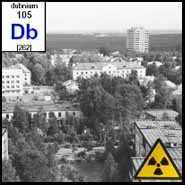
| Element | |
|---|---|
105DbDubnium262.114152
8 18 32 32 11 2 |
|
| Basic properties | |
|---|---|
| Atomic number | 105 |
| Atomic weight | 262.11415 amu |
| Element family | Transition metals |
| Period | 7 |
| Group | 2 |
| Block | s-block |
| Discovery year | 1970 |
| Isotope distribution |
|---|
| None |
| Physical properties | |
|---|---|
| Density | 21.6 g/cm3 (STP) |
Atomic hydrogen (H) 8.988E-5 Meitnerium (Mt) 28 | |
| Chemical properties | |
|---|---|
| Oxidation states (less common) | (+3, +4, +5) |
| Atomic radius | |
|---|---|
| Covalent radius | 1.49 Å |
Atomic hydrogen (H) 0.32 Francium (Fr) 2.6 | |
| Electronic properties | |
|---|---|
| Electrons per shell | 2, 8, 18, 32, 32, 11, 2 |
| Electronic configuration | [Rn] 5f14 |
|
Bohr atom model
| |
|
Orbital box diagram
| |
| Valence electrons | 5 |
| Lewis dot structure |
|
| Orbital Visualization | |
|---|---|
|
| |
| Electrons | - |
Dubnium (Db): Periodic Table Element
Abstract
Dubnium (Db, atomic number 105) represents the fifth member of group 5 transition metals in the periodic table, positioned beneath vanadium, niobium, and tantalum. This synthetic superheavy element exhibits extreme radioactivity with its most stable isotope, 268Db, demonstrating a half-life of approximately 16 hours. Dubnium manifests characteristic group 5 chemistry with a predominant +5 oxidation state, though relativistic effects significantly influence its chemical behavior. The element's synthesis requires sophisticated nuclear bombardment techniques, with production limited to single-atom experiments. Chemical investigations confirm dubnium's adherence to periodic trends while revealing unexpected complexation behavior that distinguishes it from lighter group 5 homologs. The element's discovery involved competing claims between Soviet and American research teams, ultimately resolved through international arbitration that recognized shared discovery credit. Current research focuses on elucidating its chemical properties through gas-phase and aqueous-solution studies, providing crucial insights into superheavy element chemistry and relativistic effects in the heaviest artificial elements.
Introduction
Dubnium occupies a unique position in the periodic table as element 105, representing the fifth member of the d-block transition metals in group 5. The element derives its significance from both its role in superheavy element research and its function as a testing ground for theoretical predictions regarding relativistic effects in heavy atoms. Located in the 6d transition series, dubnium follows the established pattern of group 5 elements with an electronic configuration of [Rn] 5f14 6d3 7s2, positioning three electrons in the outermost d orbitals available for chemical bonding.
The element's artificial nature necessitates sophisticated production methods involving nuclear bombardment reactions. Its extreme radioactivity, with half-lives measured in hours rather than years, presents fundamental challenges for chemical characterization. These limitations restrict investigation to single-atom experiments requiring advanced radiochemical techniques. Nevertheless, dubnium's study provides essential insights into the behavior of superheavy elements and validates theoretical models predicting electronic structure modifications in the heaviest artificial nuclei.
Physical Properties and Atomic Structure
Fundamental Atomic Parameters
Dubnium's atomic structure reflects the complex interplay between nuclear charge and electron distribution in superheavy elements. The element possesses 105 protons, establishing its position in the periodic table through fundamental nuclear properties. The electronic configuration [Rn] 5f14 6d3 7s2 demonstrates the characteristic pattern of group 5 elements, with three unpaired electrons occupying the 6d subshell. However, relativistic effects substantially modify the energy relationships between these orbitals compared to lighter homologs.
The 7s orbital experiences significant contraction, decreasing in size by approximately 25% relative to non-relativistic calculations and stabilizing by 2.6 eV. This contraction enhances the shielding effect for outer electrons, causing the 6d orbitals to expand and destabilize relative to their expected positions. Consequently, the first ionization energy decreases compared to tantalum, facilitating electron removal from the 6d subshell rather than the 7s level. The ionic radius increases systematically within group 5, with dubnium(V) exhibiting the largest ionic radius among the group members.
Spin-orbit coupling effects become pronounced in dubnium, splitting the 6d subshell into 6d3/2 and 6d5/2 components. The three valence electrons preferentially occupy the lower-energy 6d3/2 levels, establishing the electronic foundation for chemical behavior. Effective nuclear charge calculations indicate values consistent with periodic trends while accounting for enhanced screening effects from contracted inner orbitals.
Macroscopic Physical Characteristics
Theoretical calculations predict dubnium to crystallize in a body-centered cubic structure, maintaining the structural pattern established by vanadium, niobium, and tantalum. The predicted density of 21.6 g/cm³ reflects the substantial nuclear mass characteristic of superheavy elements, representing a significant increase from tantalum's density of 16.7 g/cm³. This density enhancement results from the combination of increased atomic mass and relativistic contraction effects on atomic dimensions.
Thermodynamic properties remain largely theoretical due to experimental limitations imposed by the element's radioactivity. Melting and boiling points are predicted to follow group 5 trends with modifications arising from relativistic effects. The metallic bonding characteristics should resemble those of tantalum, with enhanced covalent character in chemical compounds resulting from increased orbital overlap populations. Specific heat capacity and thermal conductivity values await experimental determination, though theoretical models suggest behavior intermediate between niobium and tantalum with possible deviations from linear trends.
Chemical Properties and Reactivity
Electronic Structure and Bonding Behavior
Dubnium's chemical reactivity stems from its five valence electrons arranged in the 6d3 7s2 configuration. The dominant +5 oxidation state results from complete removal of all valence electrons, forming Db5+ cations with enhanced thermodynamic stability compared to niobium and tantalum analogs. Lower oxidation states (+3 and +4) exhibit decreased stability relative to group 5 trends, with the +3 state being particularly unstable due to the energetic cost of removing 7s electrons while retaining 6d electrons.
Covalent bonding characteristics show enhanced character compared to tantalum compounds, manifested through decreased effective charges on dubnium atoms and increased orbital overlap populations with bonding partners. These effects arise from the spatial expansion of 6d orbitals and their reduced binding energies. Coordination chemistry follows established group 5 patterns with typical coordination numbers ranging from 4 to 8, depending on ligand size and electronic requirements.
Molecular orbital calculations for dubnium pentachloride demonstrate utilization of three 6d orbital levels in bonding, consistent with periodic expectations. However, the energy gaps between occupied and unoccupied orbitals differ from lighter homologs, influencing spectroscopic properties and chemical kinetics. Bond formation involves greater d-orbital participation compared to tantalum, enhancing the covalent character of dubnium compounds.
Electrochemical and Thermodynamic Properties
Electronegativity values for dubnium are predicted to follow periodic trends with slight modifications due to relativistic effects. The Pauling electronegativity is estimated at approximately 1.5, positioning dubnium between niobium (1.6) and tantalum (1.5) but with enhanced electron-withdrawing capability in its highest oxidation state. Successive ionization energies reflect the modified orbital energies, with the first ionization energy slightly lower than tantalum's value of 7.89 eV.
Standard reduction potentials for dubnium species remain experimentally undetermined but theoretical calculations suggest enhanced stability of the +5 state in aqueous solution. The Db5+/Db4+ couple is predicted to exhibit more positive potential values compared to corresponding tantalum couples, indicating greater resistance to reduction. Hydrolysis tendencies for Db5+ species should continue the decreasing trend observed within group 5, though rapid hydrolysis still occurs at neutral pH values.
Thermodynamic stability calculations indicate that dubnium compounds generally exhibit lower formation energies compared to tantalum analogs, reflecting the decreased binding energy of 6d electrons. This trend influences compound decomposition temperatures and chemical reactivity patterns. Electron affinity values are predicted to be small and positive, consistent with metallic character and the tendency to form cationic species in chemical reactions.
Chemical Compounds and Complex Formation
Binary and Ternary Compounds
Dubnium pentachloride (DbCl5) represents the most extensively studied binary compound, both theoretically and experimentally. Gas-phase calculations reveal molecular geometry consistent with trigonal bipyramidal structure, similar to other group 5 pentahalides. The compound exhibits enhanced covalent character compared to tantalum pentachloride, with shortened Db-Cl bond lengths and increased orbital overlap populations. Volatility studies demonstrate that DbCl5 is more volatile than the corresponding bromide but less volatile than niobium pentachloride under identical conditions.
Dubnium oxychloride (DbOCl3) forms under controlled oxygen partial pressures, exhibiting reduced volatility compared to the pentachloride. This compound follows periodic trends within group 5, with volatility ordering of NbOCl3 > TaOCl3 ≥ DbOCl3. The formation of oxychlorides depends critically on oxygen concentration, with trace amounts sufficient to promote oxidation reactions. Structural parameters suggest tetrahedral geometry around the dubnium center with double-bond character in the Db=O interaction.
Binary oxides of dubnium are predicted to adopt structures analogous to Nb2O5 and Ta2O5, though experimental characterization remains limited. Theoretical calculations suggest that Db2O5 should exhibit greater thermodynamic stability than corresponding niobium and tantalum oxides. Halide formation extends beyond chlorides to include bromides and fluorides, with dubnium pentafluoride predicted to be the most stable halide compound.
Coordination Chemistry and Organometallic Compounds
Dubnium coordination chemistry demonstrates remarkable complexity in aqueous systems, with experimental evidence revealing behavior that differs from simple periodic extrapolations. In hydrochloric acid solutions, dubnium forms anionic complexes including DbOX4- and [Db(OH)2X4]- species, where X represents halide ligands. These complexes exhibit extraction behavior more similar to niobium than tantalum, contradicting initial theoretical predictions.
Complex formation with hydroxo-chlorido ligands reveals a reversal in group 5 trends, with dubnium showing enhanced propensity for complex formation compared to tantalum. This behavior reflects the increased ionic radius and modified electronic structure resulting from relativistic effects. Coordination numbers vary from 4 to 6 depending on ligand requirements and steric constraints, with square pyramidal and octahedral geometries being most common.
In mixed acid systems containing nitric and hydrofluoric acids, dubnium forms DbOF4- complexes analogous to niobium rather than tantalum, which forms TaF6- under similar conditions. Extraction studies with methyl isobutyl ketone demonstrate unique selectivity patterns that distinguish dubnium from both niobium and tantalum. Ion-exchange chromatography reveals that dubnium(V) species separate preferentially with tantalum-containing fractions rather than niobium fractions, indicating subtle differences in coordination sphere preferences.
Natural Occurrence and Isotopic Analysis
Geochemical Distribution and Abundance
Dubnium does not occur naturally on Earth, existing only as an artificial element produced through nuclear synthesis reactions. The absence of natural occurrence results from the fundamental instability of all dubnium isotopes, with half-lives insufficient for geological time scales. Even the most stable isotope, 268Db, decays completely within days, preventing accumulation through any natural nuclear processes.
Theoretical considerations regarding primordial superheavy elements have historically included speculation about long-lived dubnium isotopes, but modern nuclear theory and experimental evidence firmly establish that no naturally occurring dubnium isotopes exist. The element's crustal abundance is effectively zero, with any atoms present representing recent artificial production through nuclear research facilities. This absence extends to meteoritic and extraterrestrial samples, where superheavy elements have never been detected despite sensitive analytical techniques.
Nuclear Properties and Isotopic Composition
Dubnium isotopes span mass numbers from 255 to 270, with all species exhibiting radioactive decay through alpha emission or spontaneous fission. The most stable isotope, 268Db, demonstrates a half-life of 16+6-4 hours, determined through recent experiments at JINR's Superheavy Element Factory. This isotope results from the alpha decay chain of 288moscovium, providing sufficient longevity for chemical characterization studies.
The second most stable isotope, 270Db, has been observed in only three decay events with individual lifetimes of 33.4, 1.3, and 1.6 hours. These isotopes represent the heaviest dubnium species characterized to date and were produced as decay products of 294tennessine synthesis experiments. The isotopic pattern reflects the challenge of creating neutron-rich superheavy nuclei, as stable configurations require neutron-to-proton ratios that exceed those achievable through current fusion techniques.
Nuclear decay modes include alpha emission to lawrencium isotopes and spontaneous fission yielding lighter fragment nuclei. The alpha decay energies range from 8.5 to 10.5 MeV, depending on the specific isotope and decay pathway. Spontaneous fission branching ratios vary among isotopes, with shorter-lived species exhibiting higher fission probabilities. Nuclear magnetic moments and excited state properties remain largely uncharacterized due to experimental limitations imposed by rapid decay rates.
Industrial Production and Technological Applications
Extraction and Purification Methodologies
Dubnium production occurs exclusively through nuclear bombardment reactions in specialized heavy-ion accelerator facilities. The primary synthesis pathway involves bombarding actinide targets with lighter nuclei, typically using 22Ne projectiles on 243Am targets or 15N beams on 249Cf targets. These reactions proceed through compound nucleus formation followed by neutron evaporation, yielding dubnium isotopes with extremely low cross-sections measured in picobarns.
The 243Am(22Ne,4n)261Db reaction represents the historical synthesis route discovered simultaneously by JINR and LBL teams. Modern production increasingly relies on 48Ca bombardment of heavier actinide targets, particularly 249Bk, which produces longer-lived isotopes through multi-step decay chains. Production rates remain extremely low, with successful experiments yielding single atoms per hour under optimal conditions.
Chemical separation and purification require rapid automated systems operating within minutes of isotope production. Ion-exchange chromatography with α-hydroxyisobutyrate demonstrates effective separation of dubnium(V) from actinide impurities and other transactinide elements. Volatility-based separation using controlled temperature gradients allows isolation of dubnium halides from reaction products. These techniques must accommodate both the short half-lives and the microscopic quantities available for study.
Technological Applications and Future Prospects
Current applications of dubnium remain confined to fundamental nuclear and chemical research, with no practical technological uses due to its extreme radioactivity and production limitations. The element serves as a crucial test case for understanding superheavy element chemistry and validating theoretical models that predict the properties of even heavier elements approaching the predicted "island of stability" near element 114.
Research applications focus primarily on studying relativistic effects in chemical bonding and electron configuration. These investigations provide essential calibration data for computational chemistry methods applied to superheavy elements. The unusual chemical behavior observed in dubnium complexation studies challenges existing theories and necessitates refinement of predictive models for heavier group 5 elements.
Future prospects center on synthesis of longer-lived isotopes that would enable more comprehensive chemical characterization. Advances in accelerator technology and target preparation may eventually permit study of dubnium compounds in condensed phases rather than single-atom experiments. However, fundamental nuclear stability limitations suggest that practical applications will remain highly specialized and confined to scientific research contexts.
Historical Development and Discovery
The discovery of dubnium emerged from the intense competition between Soviet and American research teams during the 1960s and 1970s, forming part of the broader "Transfermium Wars" that characterized superheavy element research. The Joint Institute for Nuclear Research (JINR) in Dubna first reported synthesis of element 105 in April 1968, using 22Ne bombardment of 243Am targets. Their initial results identified alpha decay activities of 9.4 and 9.7 MeV with half-lives between 0.05 and 3 seconds, assigned to 260Db and 261Db isotopes respectively.
Lawrence Berkeley Laboratory (LBL) subsequently reported synthesis in April 1970 through the 249Cf(15N,4n)260Db reaction, observing 9.1 MeV alpha decay activity. This work provided more definitive identification of the daughter nuclei, strengthening the discovery claim through systematic exclusion of alternative reaction pathways. JINR continued their investigations with improved experimental techniques, including initial chemical characterization using gas chromatography to demonstrate the element's group 5 identity.
The naming controversy persisted for nearly three decades, with JINR initially proposing "bohrium" and later "nielsbohrium" to honor Niels Bohr, while LBL advocated "hahnium" after Otto Hahn. The International Union of Pure and Applied Chemistry (IUPAC) formed the Transfermium Working Group in 1985 to resolve discovery disputes objectively. Their 1993 report credited both teams with independent discovery, leading to the compromise name "dubnium" adopted in 1997, honoring the location of JINR in Dubna, Russia. This resolution acknowledged the collaborative nature of superheavy element research while recognizing the contributions of both competing laboratories.
Conclusion
Dubnium represents a pivotal element in understanding the chemistry of superheavy elements, serving as the first group 5 member where relativistic effects substantially modify chemical behavior compared to periodic predictions. Its synthesis and characterization demonstrate the remarkable capabilities of modern nuclear chemistry while revealing the fundamental challenges inherent in studying elements at the limits of nuclear stability. The element's chemical properties confirm its group 5 identity while exhibiting unique complexation behavior that challenges simple extrapolation from lighter homologs.
Future research directions include synthesis of longer-lived isotopes, comprehensive spectroscopic characterization, and detailed investigation of organometallic chemistry. These studies will provide crucial insights into the electronic structure of superheavy elements and guide theoretical developments in relativistic quantum chemistry. Dubnium's role as a bridge between established transition metal chemistry and the exotic properties of superheavy elements ensures its continued importance in advancing our understanding of matter at the extremes of nuclear and chemical stability.

Please let us know how we can improve this web app.