Printed from https://www.webqc.org

Europium @ Periodic Table of Chemical Elements

12345678 910111213141516 1718
IIIIIIbIVb VbVIbVIIbVIIIbIb IIbIIIIVVVI VIIVIII
1H
1.0079
2He
4.0026
3Li
6.9412
4Be
9.0121
5B
10.811
6C
12.010
7N
14.006
8O
15.999
9F
18.998
10Ne
20.179
11Na
22.989
12Mg
24.305
13Al
26.981
14Si
28.085
15P
30.973
16S
32.065
17Cl
35.453
18Ar
39.948
19K
39.098
20Ca
40.078
21Sc
44.955
22Ti
47.867
23V
50.941
24Cr
51.996
25Mn
54.938
26Fe
55.845
27Co
58.933
28Ni
58.693
29Cu
63.546
30Zn
65.409
31Ga
69.723
32Ge
72.641
33As
74.921
34Se
78.963
35Br
79.904
36Kr
83.798
37Rb
85.467
38Sr
87.621
39Y
88.905
40Zr
91.224
41Nb
92.906
42Mo
95.942
43Tc
98.906
44Ru
101.07
45Rh
102.90
46Pd
106.42
47Ag
107.86
48Cd
112.41
49In
114.81
50Sn
118.71
51Sb
121.76
52Te
127.60
53I
126.90
54Xe
131.29
55Cs
132.90
56Ba
137.32
57La
138.90
72Hf
178.49
73Ta
180.94
74W
183.84
75Re
186.20
76Os
190.23
77Ir
192.21
78Pt
195.08
79Au
196.96
80Hg
200.59
81Tl
204.38
82Pb
207.21
83Bi
208.98
84Po
208.98
85At
209.98
86Rn
222.01
87Fr
223.01
88Ra
226.02
89Ac
227.02
104Rf
261.10
105Db
262.11
106Sg
266.12
107Bh
264.12
108Hs
269
109Mt
278
110Ds
281
111Rg
282
112Cn
285
113Nh
286
114Fl
289
115Mc
290
116Lv
293
117Ts
294
118Og
294
Lanthanoids58Ce
140.11
59Pr
140.90
60Nd
144.24
61Pm
146.91
62Sm
150.36
63Eu
151.96
64Gd
157.25
65Tb
158.92
66Dy
162.50
67Ho
164.93
68Er
167.25
69Tm
168.93
70Yb
173.04
71Lu
174.96
Actinoids90Th
232.03
91Pa
231.03
92U
238.02
93Np
237.04
94Pu
244.06
95Am
243.06
96Cm
247.07
97Bk
247.07
98Cf
251.07
99Es
252.08
100Fm
257.09
101Md
258.09
102No
259.10
103Lr
260.10
Alkali metals Alkali earth metals Transition metals Other metals Metaloids Non-metals Halogens Noble gases
Element

63

Eu

Europium

151.9641

2
8
18
25
8
2
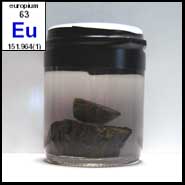
Europium photo
Basic properties
Atomic number63
Atomic weight151.9641 amu
Element familyN/A
Period6
Group2
Blocks-block
Discovery year1896
Isotope distribution
151Eu
47.8%
153Eu
52.2%
151Eu: 47.80%153Eu: 52.20%
151Eu (47.80%)
153Eu (52.20%)
Physical properties
Density 5.243 g/cm3 (STP)
Atomic hydrogen (H) 8.988E-5
Meitnerium (Mt) 28
Melting822 °C
Helium (He) -272.2
Carbon (C) 3675
Boiling1597 °C
Helium (He) -268.9
Tungsten (W) 5927
Chemical properties
Oxidation states
(less common)
+2, +3
(0)
First ionization potential 5.670 eV
Cesium (Cs) 3.894
Helium (He) 24.587
Electron affinity 0.116 eV
Nobelium (No) -2.33
Atomic chlorine (Cl) 3.612725
Electronegativity1.2
Cesium (Cs) 0.79
Atomic fluorine (F) 3.98
Atomic radius
Covalent radius 1.68 Å
Atomic hydrogen (H) 0.32
Francium (Fr) 2.6
Metallic radius 1.8 Å
Beryllium (Be) 1.12
Cesium (Cs) 2.65
63EuWebQC.OrgCovalentMetallic
Compounds
FormulaNameOxidation state
Eu(OH)2Europium(II) hydroxide+2
EuBr2Europium(II) bromide+2
EuCl2Europium(II) chloride+2
EuF2Europium(II) fluoride+2
EuH2Europium hydride+2
EuI2Europium(II) iodide+2
EuCl3Europium(III) chloride+3
Eu(CH3COO)3Europium(III) acetate+3
Eu(NO3)3Europium(III) nitrate+3
Eu(OH)3Europium(III) hydroxide+3
Eu2(C2O4)3Europium(III) oxalate+3
Eu2O3Europium(III) oxide+3
Electronic properties
Electrons per shell2, 8, 18, 25, 8, 2
Electronic configuration[Xe] 4f76s2
Bohr atom model
Bohr atom model
Orbital box diagram
Orbital box diagram
Valence electrons9
Lewis dot structure Europium Lewis dot structure
Orbital Visualization
🏠
▶️
📐
Electrons-

Europium (Eu): Periodic Table Element

Scientific Review Article | Chemistry Reference Series

Abstract

Europium (Eu, atomic number 63) represents a chemically distinctive lanthanide element characterized by unique electronic properties and luminescent behavior. With a standard atomic weight of 151.964 u, europium exhibits exceptional chemical reactivity among the rare-earth elements, manifesting both divalent and trivalent oxidation states under ambient conditions. The element demonstrates remarkable phosphorescent properties that have established its critical importance in modern display technology and optical applications. Europium occurs naturally as two isotopes, 151Eu and 153Eu, in approximately equal proportions. Industrial applications capitalize primarily on its luminescent characteristics in phosphor systems, particularly for color television displays and fluorescent lighting. The element's distinctive chemistry stems from its half-filled 4f7 electron configuration in the +2 oxidation state, providing exceptional stability and unique optical properties.

Introduction

Europium occupies a unique position within the lanthanide series as element 63 in the periodic table, distinguished by its unusual ability to form stable compounds in both the +2 and +3 oxidation states. Located in period 6, group 3 of the periodic table, europium exhibits electronic configuration [Xe] 4f7 6s2, which accounts for its distinctive chemical and optical properties. The element was discovered in 1896 by Eugène-Anatole Demarçay during spectroscopic analysis of samarium samples, subsequently isolated in 1901, and named after the European continent. Modern understanding of europium chemistry reveals its fundamental importance in luminescent materials and display technologies. The element's chemical behavior reflects both lanthanide contraction effects and unique f-orbital characteristics that distinguish it from neighboring rare-earth elements. Contemporary applications exploit europium's exceptional phosphorescent properties, particularly in electronic displays and energy-efficient lighting systems.

Physical Properties and Atomic Structure

Fundamental Atomic Parameters

Europium possesses atomic number 63 with electron configuration [Xe] 4f7 6s2, representing the midpoint of lanthanide f-orbital filling. The atomic radius measures approximately 180 pm, while the ionic radius varies significantly with oxidation state: Eu2+ exhibits 117 pm and Eu3+ demonstrates 95 pm in six-coordinate environments. This substantial ionic radius difference reflects the removal of different electronic shells and contributes to the element's unique chemistry. The effective nuclear charge increases across the lanthanide series due to poor f-orbital shielding, resulting in lanthanide contraction that affects europium's position relative to neighboring elements. First ionization energy measures 547.1 kJ/mol, second ionization energy reaches 1085 kJ/mol, and third ionization energy attains 2404 kJ/mol. These values reflect the stability of the half-filled f7 configuration in Eu2+, making the second ionization notably higher than expected based on periodic trends.

Macroscopic Physical Characteristics

Europium presents as a silvery-white metal with characteristic pale yellow tint, though samples rapidly develop dark oxide coatings upon air exposure. The element crystallizes in a body-centered cubic structure with lattice parameter a = 458.2 pm at room temperature. Density measures 5.244 g/cm3 at 25°C, making europium the least dense lanthanide element. Melting point occurs at 822°C (1095 K), while boiling point reaches 1529°C (1802 K), representing the second-lowest melting point in the lanthanide series after ytterbium. Heat of fusion equals 9.21 kJ/mol, and heat of vaporization measures 176 kJ/mol. Specific heat capacity demonstrates 27.66 J/(mol·K) at 25°C. The element exhibits ductile behavior with hardness comparable to lead, allowing deformation and cutting with conventional tools. Thermal conductivity measures 13.9 W/(m·K), while electrical resistivity reaches 90.0 μΩ·cm at room temperature. These properties reflect the element's metallic bonding characteristics modified by f-orbital participation.

Chemical Properties and Reactivity

Electronic Structure and Bonding Behavior

Europium's chemical reactivity stems from its unique electronic configuration featuring seven unpaired f electrons in the neutral atom. The element readily forms compounds in both +2 and +3 oxidation states, with the divalent state stabilized by the half-filled f7 configuration. Bond formation typically involves 6s and 5d orbitals, while 4f orbitals remain largely core-like with minimal involvement in bonding. Eu3+ ions demonstrate coordination numbers ranging from 6 to 9, preferentially binding oxygen-donor ligands in aqueous solutions. The ionic character dominates europium compounds, reflecting substantial electronegativity differences with most elements. Covalent bonding contributions appear primarily in organometallic complexes and some chalcogenide phases. Coordination complexes exhibit characteristic luminescent properties due to f-f electronic transitions that are Laporte-forbidden but become partially allowed through ligand field effects. Average Eu-O bond lengths measure 2.4-2.5 Å in typical oxide environments, while Eu-halogen bonds range from 2.7-3.2 Å depending on halide identity and coordination environment.

Electrochemical and Thermodynamic Properties

Electronegativity values for europium span 1.2 on the Pauling scale and 1.01 eV on the Mulliken scale, reflecting moderate electron-withdrawing capability consistent with metallic character. Successive ionization energies reveal the electronic structure significance: first ionization (547.1 kJ/mol), second ionization (1085 kJ/mol), and third ionization (2404 kJ/mol). The notably elevated second ionization energy reflects 4f7 half-shell stability in Eu2+. Standard reduction potentials demonstrate Eu3+/Eu2+ = -0.35 V and Eu2+/Eu = -2.81 V, indicating moderate reducing character for divalent europium. Electron affinity measures approximately 50 kJ/mol, characteristic of metals with partially filled f orbitals. Thermodynamic data for europium compounds reveal generally favorable formation enthalpies: Eu2O3 exhibits ΔHf° = -1651 kJ/mol, while EuO demonstrates ΔHf° = -594 kJ/mol. These values reflect strong ionic bonding character and substantial lattice energies in europium oxide phases.

Chemical Compounds and Complex Formation

Binary and Ternary Compounds

Europium forms extensive series of binary compounds spanning multiple oxidation states. Halide formation follows the general reaction 2 Eu + 3 X2 → 2 EuX3 (X = F, Cl, Br, I), producing white EuF3, yellow EuCl3, gray EuBr3, and colorless EuI3. Corresponding dihalides include yellow-green EuF2, colorless EuCl2, colorless EuBr2, and green EuI2. Oxide systems encompass EuO (black), Eu2O3 (white), and mixed-valence Eu3O4. Chalcogenide phases include EuS, EuSe, and EuTe, all exhibiting black coloration and semiconducting properties. Ternary compounds demonstrate extensive structural diversity, including phosphates, carbonates, and complex oxides. Europium incorporation into host lattices produces luminescent materials with applications ranging from phosphors to laser crystals.

Coordination Chemistry and Organometallic Compounds

Coordination complexes of europium typically feature coordination numbers between 8 and 9 for Eu3+, reflecting the large ionic radius and f-orbital availability. Common ligands include acetylacetonate, β-diketonates, and cryptand-based chelators that enhance solubility and modify luminescent properties. Aqueous Eu3+ exists predominantly as [Eu(H2O)9]3+ with characteristic pale pink coloration. Coordination geometries encompass square antiprism, dodecahedron, and tricapped trigonal prism arrangements depending on ligand constraints and electronic factors. Organometallic europium compounds remain limited due to the element's ionic character and high ionization potentials. Cyclopentadienyl complexes such as Eu(C5H5)2 demonstrate unusual sandwich structures with significant ionic contributions. Luminescent europium complexes exploit f-f transitions that become partially allowed through ligand field perturbations, producing characteristic red emission around 615 nm for Eu3+ and variable emission colors for Eu2+ depending on host environment.

Natural Occurrence and Isotopic Analysis

Geochemical Distribution and Abundance

Europium exhibits crustal abundance of approximately 2.0 ppm, ranking among the less abundant rare-earth elements in terrestrial environments. Geochemical behavior demonstrates strong affinity for silicate phases and preferential concentration in evolved igneous rocks through fractional crystallization processes. The europium anomaly, characterized by depletion relative to neighboring lanthanides in many mineral systems, results from stabilization of Eu2+ under reducing conditions and subsequent fractionation from trivalent rare earths. Primary mineral sources include bastnäsite [(REE)(CO3)F], monazite [(REE)PO4], xenotime [(Y,REE)PO4], and loparite [(REE,Na,Ca)(Ti,Nb)O3]. Bastnäsite deposits typically contain 0.1-0.2% europium by weight of rare-earth oxide content. Hydrothermal processes concentrate europium through preferential mobilization of divalent species, while magmatic differentiation produces variable europium/gadolinium ratios useful for petrogenetic interpretation.

Nuclear Properties and Isotopic Composition

Natural europium comprises two isotopes: 151Eu (47.8% abundance) and 153Eu (52.2% abundance). 153Eu demonstrates nuclear stability, while 151Eu undergoes alpha decay with half-life 5 × 10¹⁸ years, producing approximately one decay event per kilogram every two minutes. Nuclear properties include magnetic moments μ = +3.4718 μN for 151Eu and μ = +1.5267 μN for 153Eu, reflecting nuclear spin states I = 5/2 and I = 5/2 respectively. Artificial radioisotopes encompass mass numbers 130-170, with notable species including 150Eu (t1/2 = 36.9 years), 152Eu (t1/2 = 13.5 years), and 154Eu (t1/2 = 8.6 years). Neutron capture cross sections reach exceptional values: 5900 barns for 151Eu and 312 barns for 153Eu, classifying these isotopes as significant neutron poisons in reactor applications. Decay modes include electron capture for lighter isotopes and beta minus decay for heavier species, with primary decay products being samarium and gadolinium isotopes respectively.

Industrial Production and Technological Applications

Extraction and Purification Methodologies

Europium extraction begins with rare-earth ore processing, primarily from bastnäsite and monazite sources. Initial concentration involves roasting followed by acid leaching to dissolve rare-earth components while leaving silicate gangue. Separation exploits the unique Eu2+/Eu3+ redox chemistry through selective reduction using zinc amalgam or electrolytic methods at controlled potentials. Reduced europium(II) behaves chemically similar to alkaline earth metals, enabling precipitation as carbonate or coprecipitation with barium sulfate for initial separation from other trivalent lanthanides. Subsequent purification employs ion exchange chromatography using synthetic resin systems with carefully controlled pH and ionic strength. Solvent extraction techniques utilize organophosphorus compounds such as tributyl phosphate or di(2-ethylhexyl)phosphoric acid to achieve final purification. Metal production occurs through molten salt electrolysis of EuCl3 in eutectic NaCl-CaCl2 medium at 800-900°C using graphite electrodes. Global production centers include China's Bayan Obo deposit (36 million tonnes rare-earth reserves) and formerly California's Mountain Pass mine, with current annual europium production approximately 400 tonnes worldwide.

Technological Applications and Future Prospects

Primary applications exploit europium's exceptional luminescent properties in phosphor technology. Trivalent europium serves as the standard red phosphor activator in cathode-ray tube displays, flat-panel televisions, and fluorescent lighting systems. Y2O3:Eu3+ produces characteristic 615 nm emission corresponding to 5D07F2 transitions. Divalent europium in alkaline earth hosts generates tunable emission across the visible spectrum, with BaMgAl10O17:Eu2+ producing blue emission for tri-phosphor fluorescent lamps. Security applications utilize europium-based anti-counterfeiting phosphors in currency and documents, exploiting time-resolved luminescence for authentication. Nuclear applications investigate europium as neutron absorber material due to exceptional thermal neutron capture cross sections. Emerging technologies include quantum dot applications, biomedical imaging contrast agents, and organic light-emitting diode (OLED) development. Research frontiers encompass single-atom catalysis, spintronic materials exploiting Eu2+ magnetic properties, and advanced scintillator development for radiation detection. Environmental considerations focus on recycling phosphor waste and developing sustainable extraction technologies to reduce dependency on primary ore sources.

Historical Development and Discovery

Europium discovery traces to 1896 when French chemist Eugène-Anatole Demarçay observed unidentified spectral lines in samples presumed to contain only samarium. Systematic spectroscopic investigation led to provisional designation as element Σ before formal naming after Europe in 1901. Early isolation attempts proved challenging due to chemical similarity with other lanthanides and limited separation techniques available during the early 20th century. William Crookes contributed early spectroscopic characterization of europium phosphorescence, establishing foundations for understanding its optical properties. Herbert Newby McCoy developed crucial purification methods in the 1930s utilizing redox chemistry to separate europium from other rare earths, enabling Frank Spedding's later ion-exchange separation techniques. The 1960s marked revolutionary advancement with discovery of europium-activated yttrium vanadate red phosphor for color television, creating unprecedented demand for high-purity europium. Modern understanding evolved through neutron activation analysis, X-ray crystallography, and advanced spectroscopic techniques that revealed detailed electronic structure and chemical bonding characteristics. Contemporary research continues expanding fundamental knowledge of f-electron behavior and developing novel applications in quantum technologies and advanced materials science.

Conclusion

Europium's distinctive position among the lanthanides reflects its unique electronic structure and exceptional luminescent properties that have established its technological importance far beyond typical rare-earth applications. The element's ability to exist in both divalent and trivalent oxidation states provides unusual chemical versatility within the lanthanide series, while its phosphorescent characteristics have revolutionized display technology and continue driving innovation in optical materials. Future research directions encompass quantum applications, sustainable production methods, and novel phosphor systems for energy-efficient lighting. Understanding europium's fundamental chemistry remains crucial for advancing both theoretical f-electron science and practical luminescent material development.

Periodict table
Please let us know how we can improve this web app.
Menu Balance Molar mass Gas laws Units Chemistry tools Periodic table Chemical forum Symmetry Constants Contribute Contact us
How to cite?