Printed from https://www.webqc.org

Mercury @ Periodic Table of Chemical Elements

12345678 910111213141516 1718
IIIIIIbIVb VbVIbVIIbVIIIbIb IIbIIIIVVVI VIIVIII
1H
1.0079
2He
4.0026
3Li
6.9412
4Be
9.0121
5B
10.811
6C
12.010
7N
14.006
8O
15.999
9F
18.998
10Ne
20.179
11Na
22.989
12Mg
24.305
13Al
26.981
14Si
28.085
15P
30.973
16S
32.065
17Cl
35.453
18Ar
39.948
19K
39.098
20Ca
40.078
21Sc
44.955
22Ti
47.867
23V
50.941
24Cr
51.996
25Mn
54.938
26Fe
55.845
27Co
58.933
28Ni
58.693
29Cu
63.546
30Zn
65.409
31Ga
69.723
32Ge
72.641
33As
74.921
34Se
78.963
35Br
79.904
36Kr
83.798
37Rb
85.467
38Sr
87.621
39Y
88.905
40Zr
91.224
41Nb
92.906
42Mo
95.942
43Tc
98.906
44Ru
101.07
45Rh
102.90
46Pd
106.42
47Ag
107.86
48Cd
112.41
49In
114.81
50Sn
118.71
51Sb
121.76
52Te
127.60
53I
126.90
54Xe
131.29
55Cs
132.90
56Ba
137.32
57La
138.90
72Hf
178.49
73Ta
180.94
74W
183.84
75Re
186.20
76Os
190.23
77Ir
192.21
78Pt
195.08
79Au
196.96
80Hg
200.59
81Tl
204.38
82Pb
207.21
83Bi
208.98
84Po
208.98
85At
209.98
86Rn
222.01
87Fr
223.01
88Ra
226.02
89Ac
227.02
104Rf
261.10
105Db
262.11
106Sg
266.12
107Bh
264.12
108Hs
269
109Mt
278
110Ds
281
111Rg
282
112Cn
285
113Nh
286
114Fl
289
115Mc
290
116Lv
293
117Ts
294
118Og
294
Lanthanoids58Ce
140.11
59Pr
140.90
60Nd
144.24
61Pm
146.91
62Sm
150.36
63Eu
151.96
64Gd
157.25
65Tb
158.92
66Dy
162.50
67Ho
164.93
68Er
167.25
69Tm
168.93
70Yb
173.04
71Lu
174.96
Actinoids90Th
232.03
91Pa
231.03
92U
238.02
93Np
237.04
94Pu
244.06
95Am
243.06
96Cm
247.07
97Bk
247.07
98Cf
251.07
99Es
252.08
100Fm
257.09
101Md
258.09
102No
259.10
103Lr
260.10
Alkali metals Alkali earth metals Transition metals Other metals Metaloids Non-metals Halogens Noble gases
Element

80

Hg

Mercury

200.592

2
8
18
32
18
2
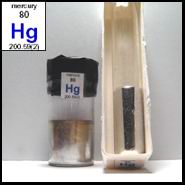
Mercury photo
Basic properties
Atomic number80
Atomic weight200.592 amu
Element familyTransition metals
Period6
Group2
Blocks-block
Discovery year1500 BC
Isotope distribution
196Hg
0.15%
198Hg
10.10%
199Hg
17.00%
200Hg
23.10%
201Hg
13.20%
202Hg
29.65%
204Hg
6.80%
198Hg: 10.10%199Hg: 17.00%200Hg: 23.10%201Hg: 13.20%202Hg: 29.65%204Hg: 6.80%
198Hg (10.10%)
199Hg (17.00%)
200Hg (23.10%)
201Hg (13.20%)
202Hg (29.65%)
204Hg (6.80%)
Physical properties
Density 13.5336 g/cm3 (STP)
Atomic hydrogen (H) 8.988E-5
Meitnerium (Mt) 28
Melting-38.72 °C
Helium (He) -272.2
Carbon (C) 3675
Boiling356.6 °C
Helium (He) -268.9
Tungsten (W) 5927
Chemical properties
Oxidation states
(less common)
+1, +2
(-2)
First ionization potential 10.438 eV
Cesium (Cs) 3.894
Helium (He) 24.587
Electron affinity -0.500 eV
Nobelium (No) -2.33
Atomic chlorine (Cl) 3.612725
Electronegativity2
Cesium (Cs) 0.79
Atomic fluorine (F) 3.98
Atomic radius
Covalent radius 1.33 Å
Atomic hydrogen (H) 0.32
Francium (Fr) 2.6
Van der Waals radius 1.55 Å
Atomic hydrogen (H) 1.2
Francium (Fr) 3.48
Metallic radius 1.51 Å
Beryllium (Be) 1.12
Cesium (Cs) 2.65
80HgWebQC.OrgCovalentMetallicVan der Waals
Compounds
FormulaNameOxidation state
Hg2Cl2Mercury(i) chloride+1
Hg2SO4Mercury(i) sulfate+1
Hg2CO3Mercury(I) carbonate+1
Hg2Cr2O7Mercury(I) dichromate+1
Hg2OMercury(I) oxide+1
Hg2SMercury(I) sulfide+1
HgOMercury(II) oxide+2
HgBr2Mercury(II) bromide+2
HgSMercury(II) sulfide+2
HgCl2Mercury(II) chloride+2
Hg(NO3)2Mercury(II) nitrate+2
HgF4Mercury(IV) fluoride+4
Electronic properties
Electrons per shell2, 8, 18, 32, 18, 2
Electronic configuration[Xe] 4f145d106s2
Bohr atom model
Bohr atom model
Orbital box diagram
Orbital box diagram
Valence electrons12
Lewis dot structure Mercury Lewis dot structure
Orbital Visualization
🏠
▶️
📐
Electrons-

Mercury (Hg): Periodic Table Element

Scientific Review Article | Chemistry Reference Series

Abstract

Mercury stands as the only metallic element exhibiting liquid state at standard temperature and pressure, distinguished by atomic number 80 and electron configuration [Xe] 4f14 5d10 6s2. The element demonstrates exceptional density of 13.579 g/cm3 at 20°C, melting point of −38.83°C, and boiling point of 356.73°C. Mercury exhibits primary oxidation states of +1 and +2, forming characteristic amalgams with numerous metals while resisting corrosion. Natural occurrence centers on cinnabar (HgS) deposits with crustal abundance of 0.08 ppm. Industrial applications span electrical instrumentation, fluorescent lighting, and catalytic processes, though toxicological concerns limit contemporary usage. The element's unique liquid metallic character results from relativistic effects and lanthanide contraction influencing electronic structure and metallic bonding behavior.

Introduction

Mercury occupies a singular position among metallic elements as the sole representative maintaining liquid phase under standard conditions. Located in Group 12 of the periodic table below zinc and cadmium, mercury exhibits properties fundamentally altered by relativistic quantum effects on its 6s orbital electrons. The element's Latin designation hydrargyrum, meaning "water-silver," reflects its distinctive fluid metallic character that has fascinated civilizations for millennia.

Mercury's electronic configuration [Xe] 4f14 5d10 6s2 demonstrates complete filling of d-orbitals characteristic of post-transition metals. The filled 4f shell introduces lanthanide contraction effects, while relativistic stabilization of the 6s orbital reduces participation in metallic bonding. These quantum mechanical phenomena collectively account for mercury's anomalous physical properties relative to lighter Group 12 homologs.

Industrial significance emerged prominently during Spanish colonial expansion when mercury enabled large-scale silver extraction through amalgamation processes. Contemporary applications leverage the element's high density, electrical conductivity, and precise thermal expansion characteristics, though environmental regulations increasingly restrict mercury usage due to established neurotoxic effects.

Physical Properties and Atomic Structure

Fundamental Atomic Parameters

Mercury possesses atomic number 80 with standard atomic weight 200.592 ± 0.003 u, corresponding to mass number 201 for the most abundant isotope 202Hg (29.86% natural abundance). The electronic configuration [Xe] 4f14 5d10 6s2 exhibits completely filled d-subshells and paired 6s electrons, creating closed-shell stability that contributes to chemical inertness.

Atomic radius measurements indicate 151 pm for metallic mercury, substantially contracted compared to the 134 pm expected without relativistic effects. Ionic radii demonstrate 119 pm for Hg+ and 102 pm for Hg2+ in six-coordinate environments. The effective nuclear charge experienced by valence electrons approaches 4.9, significantly higher than lighter Group 12 elements due to poor shielding by filled f-orbitals.

First ionization energy reaches 1007.1 kJ/mol, considerably elevated compared to zinc (906.4 kJ/mol) and cadmium (867.8 kJ/mol). Successive ionization energies proceed to 1810 kJ/mol for the second electron removal, reflecting increasing nuclear attraction as electron count decreases. These elevated ionization potentials stem from relativistic stabilization of the 6s orbital, requiring greater energy for electron abstraction.

Macroscopic Physical Characteristics

Mercury manifests as a brilliantly reflective, silvery-white liquid metal exhibiting exceptional surface tension of 0.4865 N/m at 20°C. The element demonstrates remarkable density of 13.579 g/cm3 in liquid state, increasing to 14.184 g/cm3 upon solidification with concurrent volume reduction of 3.59%. This density places mercury among the heaviest elements, exceeded only by osmium, iridium, platinum, and gold.

Thermal properties reveal melting point −38.83°C (234.32 K) and boiling point 356.73°C (629.88 K), representing the lowest values among all stable metals. Heat of fusion measures 2.29 kJ/mol while heat of vaporization reaches 59.11 kJ/mol. Specific heat capacity equals 0.1394 kJ/(kg·K) at 20°C, indicating relatively low thermal energy storage capability compared to other metals.

Mercury exhibits rhombohedral crystal structure in the solid state with space group R3̄m. The structure features slightly distorted face-centered cubic packing with nearest-neighbor distances of 300.5 pm and coordination number 12. Solid mercury demonstrates malleability and ductility, permitting cutting with conventional knives at sufficiently low temperatures.

Electrical conductivity approaches 1.044 × 10⁶ S/m at 20°C, qualifying mercury as a fair electrical conductor despite poor thermal conductivity of 8.69 W/(m·K). This disparity between electrical and thermal transport properties violates the Wiedemann-Franz law observed in conventional metals, reflecting mercury's unique electronic structure and liquid character.

Chemical Properties and Reactivity

Electronic Structure and Bonding Behavior

Mercury's chemical behavior emerges from the interplay between filled d-orbitals and relativistically contracted 6s electrons. The element readily forms covalent bonds through s-p hybridization while maintaining reluctance toward d-orbital participation due to core-like character of the filled 5d10 subshell. This electronic configuration produces linear molecular geometries in mercurous compounds and tetrahedral arrangements in mercuric complexes.

Common oxidation states include +1 (mercurous) and +2 (mercuric), with the mercurous state uniquely featuring dimeric Hg22+ cations rather than simple Hg+ ions. The Hg-Hg bond in Hg22+ measures 253 pm with bond energy approximately 96 kJ/mol, demonstrating moderate covalent character. Mercury rarely exhibits oxidation states above +2 due to prohibitive ionization energies for deeper electron removal.

Amalgam formation represents mercury's most characteristic chemical property, proceeding spontaneously with numerous metals including gold, silver, zinc, and aluminum. The amalgamation process involves electron transfer and metallic bonding without formal compound formation. Notable exceptions include iron, platinum, and tungsten, which resist amalgamation due to unfavorable thermodynamic factors.

Covalent bonding in mercury compounds typically involves sp3 hybridization producing tetrahedral geometries around Hg2+ centers. Mercury-ligand bond lengths range from 205 pm for Hg-Cl to 244 pm for Hg-I, reflecting increasing ionic radius down the halogen series. These bonds exhibit significant covalent character with substantial orbital overlap between mercury 6s6p and ligand orbitals.

Electrochemical and Thermodynamic Properties

Electronegativity values place mercury at 2.00 on the Pauling scale, 1.9 on the Mulliken scale, and 2.20 on the Allred-Rochow scale, indicating moderate electron-attracting ability comparable to carbon and sulfur. These intermediate values reflect mercury's position between metallic and metalloid character, contributing to its unique chemical versatility.

Standard reduction potentials demonstrate Hg22+/Hg couple at +0.789 V and Hg2+/Hg couple at +0.854 V versus standard hydrogen electrode. The Hg2+/Hg22+ couple measures +0.920 V, indicating thermodynamic instability of Hg+ toward disproportionation: 2Hg+ → Hg2+ + Hg. These positive reduction potentials classify mercury as a noble metal resistant to oxidation by atmospheric oxygen.

Electron affinity measurements yield 18.8 kJ/mol for mercury atom, substantially lower than main group elements but typical for transition metals. This modest electron affinity reflects the filled d-shell configuration and relativistic contraction effects reducing orbital overlap with incoming electrons.

Thermodynamic stability analysis reveals mercury compounds generally exhibit lower formation enthalpies compared to lighter Group 12 homologs. Mercury(II) oxide decomposes readily above 350°C according to HgO → Hg + ½O2, with standard enthalpy of decomposition +90.8 kJ/mol. This thermal instability reflects weak ionic bonding in mercury compounds relative to zinc and cadmium analogs.

Chemical Compounds and Complex Formation

Binary and Ternary Compounds

Mercury(II) sulfide represents the most thermodynamically stable binary compound, occurring naturally as cinnabar (α-HgS) and metacinnabar (β-HgS). Cinnabar adopts a layered hexagonal structure with space group P3221, featuring Hg-S bond lengths of 252 pm and coordination number 2+4. The compound exhibits remarkable stability with standard formation enthalpy −58.2 kJ/mol and negligible solubility in water (Ksp = 4 × 10−53).

Halide compounds demonstrate systematic trends across the halogen series. Mercury(II) fluoride crystallizes in the fluorite structure with ionic character predominating, while HgCl2, HgBr2, and HgI2 exhibit increasing covalent character and decreasing solubility. Mercury(II) chloride forms linear molecules in gas phase with Hg-Cl bond length 225 pm, transitioning to layered structures in crystalline state.

Mercury(I) compounds invariably contain the dimeric Hg22+ cation with metal-metal bond length 253 pm. Mercury(I) chloride (calomel) demonstrates low solubility and serves as a reference electrode in electrochemistry. Disproportionation reactions limit mercurous compound stability: Hg2Cl2 + Cl → HgCl2 + Hg + Cl.

Ternary oxide compounds include mercury(II) selenide (HgSe) and mercury(II) telluride (HgTe), both adopting zinc blende crystal structures. These compounds exhibit semiconductor properties with band gaps decreasing down the chalcogen series: HgS (2.1 eV), HgSe (0.3 eV), HgTe (−0.15 eV). The negative band gap in HgTe classifies it as a semimetal with applications in infrared detection systems.

Coordination Chemistry and Organometallic Compounds

Mercury demonstrates extensive coordination chemistry with preference for soft ligands according to Pearson hard-soft acid-base theory. Common coordination numbers include 2, 4, and 6, with geometries ranging from linear (CN=2) through tetrahedral and square planar (CN=4) to octahedral (CN=6). The 5d10 electronic configuration precludes crystal field stabilization effects, allowing flexible coordination geometries determined primarily by steric factors.

Typical coordination complexes include [HgCl4]2− with tetrahedral geometry, [Hg(CN)4]2− exhibiting square planar arrangement, and [Hg(NH3)4]2+ demonstrating tetrahedral coordination. Bond lengths correlate with ligand identity: Hg-N (cyanide) measures 205 pm while Hg-N (ammonia) extends to 214 pm, reflecting varying degrees of π-backbonding.

Organomercury chemistry encompasses compounds containing direct mercury-carbon bonds, typically exhibiting linear R-Hg-R′ geometries. Dimethylmercury represents the most studied organomercury compound with Hg-C bond length 207 pm and C-Hg-C angle 180°. These compounds demonstrate extreme toxicity through biomagnification and nervous system accumulation.

Metallocene chemistry remains limited for mercury due to the filled d-shell configuration preventing effective metal-ligand orbital overlap. However, mercury does form weak complexes with aromatic systems through van der Waals interactions and induced dipole effects. These interactions find application in mercury sensors based on fluorescence quenching mechanisms.

Natural Occurrence and Isotopic Analysis

Geochemical Distribution and Abundance

Mercury exhibits crustal abundance of approximately 0.08 ppm by mass, ranking 66th among naturally occurring elements. Concentration mechanisms in ore deposits can achieve enrichment factors exceeding 12,000 times average crustal abundance, with premium ores containing up to 2.5% mercury by mass. Economic deposits typically maintain minimum grades of 0.1% mercury for viable extraction operations.

Geochemical behavior reflects mercury's chalcophile character and volatile nature. The element concentrates in sulfide-rich environments associated with volcanic activity, hot springs, and hydrothermal systems. Transport occurs primarily through vapor-phase migration at elevated temperatures, with subsequent precipitation upon cooling or reaction with sulfide-bearing solutions.

Primary deposits cluster around active or extinct volcanic regions including the Circum-Pacific Ring of Fire and Mediterranean volcanic provinces. Major historical producing areas encompass Almadén (Spain), Huancavelica (Peru), Idrija (Slovenia), and Monte Amiata (Italy). Secondary occurrences result from weathering and transport of primary deposits, often concentrating in placer environments.

Mercury exhibits strong affinity for organic matter in sedimentary environments, with concentration ratios up to 1000 times background levels in black shales and petroleum-associated rocks. Atmospheric transport enables global distribution of anthropogenic mercury emissions, creating diffuse contamination in remote environments through wet and dry deposition processes.

Nuclear Properties and Isotopic Composition

Natural mercury comprises seven stable isotopes with mass numbers 196, 198, 199, 200, 201, 202, and 204. 202Hg dominates with 29.86% natural abundance, followed by 200Hg (23.10%), 199Hg (16.87%), and 201Hg (13.18%). The remaining isotopes contribute smaller fractions: 198Hg (9.97%), 204Hg (6.87%), and 196Hg (0.15%).

Nuclear magnetic resonance applications utilize 199Hg (I = 1/2) and 201Hg (I = 3/2) as NMR-active nuclei. 199Hg exhibits nuclear magnetic moment −0.5058854 μN and NMR frequency 71.910 MHz at 7.05 T field strength. 201Hg demonstrates nuclear magnetic moment −0.5602257 μN with quadrupole moment −0.387 × 10⁻²⁸ m2.

Radioactive isotopes span mass numbers from 175 to 210, with 194Hg exhibiting the longest half-life of 444 years. 203Hg serves as a medical radioisotope with half-life 46.612 days, decaying via beta emission to 203Tl. Natural radioactivity occurs through 206Hg formation in uranium decay chains, though concentrations remain negligible in normal environments.

Nuclear cross-sections for thermal neutron capture measure 372 ± 5 barns for 199Hg and 2.15 ± 0.05 barns for 202Hg, enabling isotopic modification through neutron irradiation. These cross-sections find application in nuclear reactor poisoning calculations and isotope production for research purposes.

Industrial Production and Technological Applications

Extraction and Purification Methodologies

Mercury extraction relies primarily on thermal decomposition of cinnabar through roasting in oxidizing atmospheres. The fundamental reaction HgS + O2 → Hg + SO2 proceeds at temperatures above 580°C with thermodynamic driving force ΔG° = −238.4 kJ/mol at 900°C. Industrial rotary kilns operate at 650-750°C to balance reaction kinetics with energy consumption while minimizing sulfur dioxide formation.

Furnace design incorporates multiple zones for ore preheating, reaction, and vapor condensation. Mercury vapor condenses in cooling towers maintaining temperatures below 100°C, achieving recovery efficiencies exceeding 95%. Residual mercury removal employs activated carbon adsorption or chemical scrubbing with iodine solutions to meet environmental discharge standards below 0.05 mg/m3.

Purification proceeds through triple distillation under controlled atmospheres to achieve 99.99% purity grades. Each distillation stage removes specific contaminant classes: volatile metals (zinc, cadmium) in the first stage, base metals in the second stage, and trace organics in the final stage. Electronic-grade mercury requires additional treatment through nitric acid washing and electrochemical refining.

Secondary recovery from industrial waste streams employs retorting processes for dental amalgam and switching devices. Thermal retorting at 500-600°C volatilizes mercury for subsequent condensation and purification. Recovery rates typically exceed 85% for well-maintained systems, contributing significantly to mercury supply while reducing environmental contamination.

Technological Applications and Future Prospects

Electrical applications capitalize on mercury's unique combination of conductivity and liquid character. Mercury-wetted relays provide arc-free switching for sensitive electronic circuits, while mercury switches offer position sensing without mechanical wear. Fluorescent lighting represents the largest contemporary application, utilizing mercury vapor excitation to generate ultraviolet radiation for phosphor activation with luminous efficacy approaching 100 lumens per watt.

Catalytic applications include vinyl chloride production through acetylene hydrochlorination over mercury(II) chloride catalysts supported on activated carbon. Reaction proceeds at 180-220°C with selectivity exceeding 98%, though environmental concerns drive development of mercury-free alternatives. Mercury catalysts also find use in oxymercuration-demercuration reactions for alkene hydration in fine chemical synthesis.

Scientific instrumentation leverages mercury's precise thermal expansion characteristics for temperature measurement and pressure sensing. Mercury manometers provide absolute pressure references with accuracy ±0.01% over wide temperature ranges. Liquid mercury telescopes utilize the metal's reflective properties and self-leveling behavior to create large-aperture astronomical mirrors with surface quality λ/20 at 632.8 nm wavelength.

Emerging applications explore mercury's high atomic number for radiation shielding and neutron detection systems. Mercury-filled chambers provide efficient thermal neutron detection through the 199Hg(n,γ)200Hg reaction with subsequent gamma spectroscopy. However, regulatory restrictions and toxicity concerns limit expansion of mercury-based technologies in favor of safer alternatives wherever technically feasible.

Historical Development and Discovery

Mercury knowledge spans human civilization from prehistoric times through modern industrial applications. Archaeological evidence reveals cinnabar usage as red pigment in cave paintings dating to 30,000 BCE, while Chinese texts from 2000 BCE describe mercury's liquid metallic properties and attempted medicinal applications. Egyptian tomb artifacts from 1500 BCE contain metallic mercury, demonstrating early extraction techniques from cinnabar ores through primitive roasting processes.

Classical civilizations recognized mercury's unique character, with Aristotle describing it as "liquid silver" and Theophrastus documenting cinnabar mining operations around 300 BCE. Roman engineers employed mercury for gold extraction through amalgamation, establishing industrial-scale operations in Spanish mines that continued for centuries. Medieval alchemists elevated mercury to fundamental status alongside sulfur and salt as universal principles underlying all matter transformation.

Renaissance metallurgy witnessed mercury's critical role in New World silver production beginning in 1558 with Bartolomé de Medina's patio process development. This technique enabled economic extraction of silver from low-grade ores through mercury amalgamation, transforming global economics and establishing Spanish colonial wealth. Huancavelica mercury mines in Peru supplied over 100,000 tons during three centuries of operation, while Almadén mines in Spain produced continuously from Roman times until closure in 2003.

Scientific revolution period brought systematic mercury studies by Robert Boyle, who investigated its chemical properties and vapor pressure relationships. Gabriel Fahrenheit's mercury thermometer invention in 1714 established temperature measurement standards lasting centuries. Antoine Lavoisier's oxygen theory development relied partly on mercury oxide decomposition experiments, demonstrating the metal's fundamental role in modern chemical understanding.

Industrial applications expanded dramatically during the 19th and 20th centuries. Chlor-alkali electrolysis using mercury cathodes dominated sodium and chlorine production from 1892 through environmental phase-out beginning in 1970s. Electrical applications proliferated with mercury-arc rectifiers for power conversion and fluorescent lighting for efficient illumination. However, recognition of mercury's environmental persistence and biological toxicity initiated comprehensive regulation beginning with the Minamata Convention in 2013, fundamentally altering mercury's technological trajectory toward sustainable alternatives.

Conclusion

Mercury occupies an exceptional position among metallic elements through its unique liquid character at ambient conditions, arising from relativistic quantum effects on electronic structure and metallic bonding. The element's combination of high density, electrical conductivity, and chemical versatility has enabled diverse technological applications spanning scientific instrumentation, electrical devices, and industrial catalysis. However, recognition of mercury's severe toxicological effects and environmental persistence has fundamentally transformed its role from widespread industrial usage toward specialized applications with stringent containment requirements.

Contemporary research focuses on mercury's fundamental chemistry and physics while developing safer alternatives for traditional applications. Advanced spectroscopic techniques continue revealing mercury's electronic structure details and relativistic effects, contributing to broader understanding of heavy element behavior. Environmental chemistry research addresses mercury cycling and remediation strategies, while analytical methods achieve unprecedented sensitivity for trace mercury determination in biological and environmental matrices.

Future mercury applications will likely emphasize its unique properties where alternatives cannot match performance requirements, particularly in precision instrumentation and specialized research applications. The element's historical significance in metallurgy, alchemy, and early industrial development ensures its continued study as a bridge between classical and modern chemistry, while its contemporary challenges exemplify the complex relationship between technological capability and environmental responsibility in the 21st century.

Periodict table
Please let us know how we can improve this web app.

Menu Balance Molar mass Gas laws Units Chemistry tools Periodic table Chemical forum Symmetry Constants Contribute Contact us
How to cite?