| Element | |
|---|---|
62SmSamarium150.3622
8 18 24 8 2 |
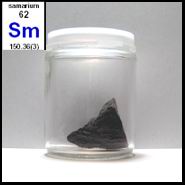
|
| Basic properties | |
|---|---|
| Atomic number | 62 |
| Atomic weight | 150.362 amu |
| Element family | N/A |
| Period | 6 |
| Group | 2 |
| Block | s-block |
| Discovery year | 1879 |
| Isotope distribution |
|---|
144Sm 3.1% 150Sm 7.4% 152Sm 26.7% 154Sm 22.7% |
144Sm (5.18%) 150Sm (12.35%) 152Sm (44.57%) 154Sm (37.90%) |
| Physical properties | |
|---|---|
| Density | 7.52 g/cm3 (STP) |
Atomic hydrogen (H) 8.988E-5 Meitnerium (Mt) 28 | |
| Melting | 1072 °C |
Helium (He) -272.2 Carbon (C) 3675 | |
| Boiling | 1778 °C |
Helium (He) -268.9 Tungsten (W) 5927 | |
| Chemical properties | |
|---|---|
| Oxidation states (less common) | +3 (0, +1, +2) |
| First ionization potential | 5.643 eV |
Cesium (Cs) 3.894 Helium (He) 24.587 | |
| Electron affinity | 0.162 eV |
Nobelium (No) -2.33 Atomic chlorine (Cl) 3.612725 | |
| Electronegativity | 1.17 |
Cesium (Cs) 0.79 Atomic fluorine (F) 3.98 | |
| Atomic radius | |
|---|---|
| Covalent radius | 1.72 Å |
Atomic hydrogen (H) 0.32 Francium (Fr) 2.6 | |
| Metallic radius | 1.8 Å |
Beryllium (Be) 1.12 Cesium (Cs) 2.65 | |
| Compounds | ||
|---|---|---|
| Formula | Name | Oxidation state |
| PtSm | Platinum–samarium | +2 |
| SmB6 | Samarium hexaboride | +2 |
| SmBr2 | Samarium(II) bromide | +2 |
| SmCl2 | Samarium(II) chloride | +2 |
| SmF2 | Samarium(II) fluoride | +2 |
| SmI2 | Samarium(II) iodide | +2 |
| Sm(CH3COO)3 | Samarium(III) acetate | +3 |
| Sm(NO3)3 | Samarium(III) nitrate | +3 |
| Sm(OH)3 | Samarium(III) hydroxide | +3 |
| Sm2(MoO4)3 | Samarium molybdate | +3 |
| Sm2O3 | Samarium(III) oxide | +3 |
| Sm2S3 | Samarium(III) sulfide | +3 |
| Electronic properties | |
|---|---|
| Electrons per shell | 2, 8, 18, 24, 8, 2 |
| Electronic configuration | [Xe] 4f6 |
|
Bohr atom model

| |
|
Orbital box diagram

| |
| Valence electrons | 8 |
| Lewis dot structure |
|
| Orbital Visualization | |
|---|---|
|
| |
| Electrons | - |
Samarium (Sm): Periodic Table Element
Abstract
Samarium is a lanthanide element with atomic number 62 and standard atomic weight 150.36 u. This silvery-white metal exhibits unique dual oxidation states (+2 and +3), distinguishing it among rare earth elements. Samarium demonstrates remarkable magnetic properties, particularly in samarium-cobalt permanent magnets that function effectively at elevated temperatures exceeding 700°C. The element possesses exceptional nuclear absorption characteristics with ¹⁴⁹Sm exhibiting a thermal neutron cross-section of 41,000 barns. Natural samarium occurs primarily in monazite and bastnäsite minerals with crustal abundance of approximately 7 ppm. Industrial applications encompass high-temperature permanent magnets, nuclear control systems, and radiopharmaceuticals. The element demonstrates complex polymorphism with rhombohedral, hexagonal, and cubic crystal modifications under varying temperature and pressure conditions. Samarium compounds exhibit distinctive optical properties with Sm³⁺ ions displaying characteristic yellow to pale green coloration and Sm²⁺ ions manifesting blood-red hues.
Introduction
Samarium occupies position 62 in the periodic table within the lanthanide series, representing the f-block elements characterized by progressive filling of 4f orbitals. The element exhibits electronic configuration [Xe]4f⁶6s², placing it in the middle region of the rare earth elements where magnetic and optical properties reach particular significance. Samarium's position in the lanthanide series confers distinctive characteristics including the accessibility of the +2 oxidation state, which occurs more readily than in neighboring elements due to favorable energetics of the half-filled f⁶ configuration in Sm²⁺. Discovery of samarium occurred in 1879 through the analytical work of French chemist Paul-Émile Lecoq de Boisbaudran, who spectroscopically identified the element in the mineral samarskite. The element derives its name from the mineral samarskite, itself named after Russian mining official Colonel Vassili Samarsky-Bykhovets, making samarium the first element named after a person, albeit indirectly. Pure samarium compounds were first isolated by Eugène-Anatole Demarçay in 1901, while metallic samarium was obtained by Wilhelm Muthmann in 1903. Modern applications of samarium center on its exceptional magnetic properties in permanent magnet alloys and its nuclear characteristics in reactor control systems.
Physical Properties and Atomic Structure
Fundamental Atomic Parameters
Samarium possesses atomic number 62 with electronic configuration [Xe]4f⁶6s², establishing its position among the lanthanide elements. The element exhibits an atomic radius of 238 pm, among the largest atomic radii in the periodic table, reflecting the characteristic lanthanide expansion followed by subsequent contraction. Ionic radii demonstrate systematic variation with coordination number and oxidation state: Sm³⁺ exhibits radius 95.8 pm in 6-coordinate environments and 107.9 pm in 8-coordinate geometries, while Sm²⁺ displays considerably larger radius of 119 pm reflecting the additional electron in the 4f orbital manifold. The effective nuclear charge experienced by valence electrons demonstrates screening effects from the intervening f electrons, resulting in relatively low ionization energies compared to d-block elements. First ionization energy measures 544.5 kJ/mol, second ionization energy reaches 1070 kJ/mol, while the third ionization energy increases substantially to 2260 kJ/mol due to removal of the stabilizing f⁶ configuration. The unique stability of the Sm²⁺ configuration with half-filled f orbitals manifests in electrochemical behavior and compound formation patterns.
Macroscopic Physical Characteristics
Metallic samarium appears as a silvery-white metal with lustrous appearance when freshly cut. The element exhibits complex polymorphism with temperature and pressure dependence. At room temperature, samarium crystallizes in rhombohedral structure (α-phase) with space group R-3m and lattice parameters a = 362.9 pm, c = 2620.7 pm. Upon heating to 731°C, transformation occurs to hexagonal close-packed structure (β-phase), while further heating to 922°C produces body-centered cubic modification (γ-phase). Under pressure conditions of approximately 40 kbar combined with 300°C temperature, formation of double-hexagonally close-packed structure occurs. Density varies with crystal form: rhombohedral phase exhibits density 7.52 g/cm³, while hexagonal phase demonstrates slightly higher density of 7.54 g/cm³. Melting point occurs at 1072°C (1345 K), considerably lower than transition metals, while boiling point reaches 1794°C (2067 K). Heat of fusion measures 8.62 kJ/mol, and heat of vaporization attains 165 kJ/mol. Specific heat capacity at 25°C equals 29.54 J/(mol·K). The metal demonstrates paramagnetic behavior with magnetic susceptibility 1.55 × 10⁻³ at room temperature, transitioning to antiferromagnetic ordering below 14.8 K.
Chemical Properties and Reactivity
Electronic Structure and Bonding Behavior
Samarium's chemical behavior derives from its 4f⁶6s² electronic configuration, enabling formation of compounds in both +2 and +3 oxidation states. The +3 oxidation state predominates under normal conditions, involving loss of two 6s electrons and one 4f electron to achieve [Xe]4f⁵ configuration. The +2 oxidation state, while less common, occurs more readily in samarium than in most other lanthanides due to the stability associated with half-filled f⁶ configuration in Sm²⁺. Standard reduction potential for the Sm³⁺/Sm²⁺ couple measures -1.55 V, indicating strong reducing nature of Sm²⁺ species. Chemical bonding in samarium compounds exhibits predominantly ionic character with limited orbital mixing between f orbitals and ligand orbitals due to radial contraction and shielding of 4f electrons. Coordination numbers in solid compounds typically range from 6 to 9, with preference for higher coordination geometries reflecting the large ionic radius and charge density considerations. Covalent contributions to bonding increase in organometallic compounds and with more polarizable ligands, though ionic character remains dominant in most samarium compounds.
Electrochemical and Thermodynamic Properties
Electronegativity of samarium on the Pauling scale measures 1.17, consistent with its metallic and electropositive character. The low electronegativity reflects weak ability to attract electrons in chemical bonds, typical of lanthanide elements. Successive ionization energies demonstrate progressive increase: first ionization requires 544.5 kJ/mol, second ionization demands 1070 kJ/mol, and third ionization increases dramatically to 2260 kJ/mol due to disruption of the stable f⁶ configuration. Standard electrode potential for Sm³⁺ + 3e⁻ → Sm equals -2.68 V, indicating strong reducing nature of metallic samarium. The Sm³⁺/Sm²⁺ couple exhibits potential -1.55 V, making Sm²⁺ among the strongest reducing agents in aqueous solution. Thermodynamic stability of samarium compounds varies significantly with oxidation state and ligand type. Sm₂O₃ demonstrates high thermal stability with melting point 2345°C and standard enthalpy of formation -1823 kJ/mol. Halides exhibit decreasing stability in the order fluoride > chloride > bromide > iodide, consistent with hard acid-hard base principles. Hydration energies of Sm³⁺ and Sm²⁺ ions measure -3540 kJ/mol and -1590 kJ/mol, respectively, reflecting the higher charge density of the trivalent species.
Chemical Compounds and Complex Formation
Binary and Ternary Compounds
Samarium forms a comprehensive series of binary compounds with main group elements. The principal oxide Sm₂O₃ crystallizes in cubic bixbyite structure with exceptional thermal stability, exhibiting melting point 2345°C and pale yellow coloration. Monoxide SmO adopts face-centered cubic structure with golden-yellow appearance and demonstrates semiconducting properties. Halide compounds encompass both +2 and +3 oxidation states: SmF₃ forms colorless crystals with tysonite structure, while SmF₂ adopts purple fluorite-type structure. Chlorides include SmCl₃ with yellow coloration and layer structure, and SmCl₂ displaying reddish-brown appearance. Sulfide SmS crystallizes in face-centered cubic structure with semiconducting behavior and 2.0 eV bandgap. Boride compounds demonstrate unusual electronic properties: SmB₆ exhibits Kondo insulator behavior with resistivity minimum around 15 K, while maintaining metallic conductivity at low temperatures. Carbides include SmC₂ with calcium carbide structure and metallic conductivity. Ternary compounds encompass various stoichiometries including perovskite-type oxides SmMO₃ where M represents transition metals, demonstrating magnetic and electronic properties dependent on composition.
Coordination Chemistry and Organometallic Compounds
Coordination complexes of samarium exhibit preference for high coordination numbers ranging from 6 to 10, consistent with large ionic radius and low charge density. Sm³⁺ complexes typically adopt coordination geometries including octahedral, square antiprismatic, and tricapped trigonal prismatic arrangements. Common ligands include oxygen donors (water, carboxylates, β-diketonates), nitrogen donors (amines, heterocycles), and phosphorus donors (phosphines, phosphites). Aquo complexes [Sm(H₂O)₉]³⁺ demonstrate rapid water exchange kinetics characteristic of lanthanides. β-diketonate complexes such as Sm(acac)₃ exhibit enhanced volatility and solubility in organic solvents. Cryptand complexes provide isolation of Sm²⁺ species from disproportionation reactions. Organometallic chemistry of samarium centers predominantly on Sm²⁺ derivatives due to appropriate ionic radius for carbon σ-bonding. Samarium(II) iodide SmI₂ serves as versatile single-electron reducing agent in organic synthesis, particularly for carbonyl coupling reactions and reductive eliminations. Cyclopentadienyl complexes include sandwich compounds SmCp₂ and SmCp₃ where Cp represents cyclopentadienyl ligands. Bis(cyclopentadienyl)samarium(II) demonstrates bent geometry with Cp-Sm-Cp angle approximately 140°, characteristic of f² electronic configuration.
Natural Occurrence and Isotopic Analysis
Geochemical Distribution and Abundance
Samarium exhibits crustal abundance of approximately 7.0 ppm, ranking as the 40th most abundant element in Earth's crust and fifth most abundant among rare earth elements. Geochemical behavior follows typical lanthanide patterns with strong lithophile character and preference for oxygen-rich environments. Primary concentration occurs in phosphate minerals, particularly monazite [(Ce,La,Nd,Th)PO₄] containing up to 2.8 weight percent samarium, and bastnäsite [(Ce,La)CO₃F] with variable samarium content. Secondary minerals include cerite, gadolinite, and samarskite, the latter serving as the eponymous mineral for element discovery. Placer deposits represent economically significant concentrations through weathering and hydraulic concentration of heavy resistant minerals. Beach sands in India, Australia, and Brazil contain monazite concentrations reaching several percent by weight. Ion-adsorption clays in southern China provide alternative sources through leaching of weathered granite. Seawater concentrations remain extremely low at approximately 0.5 ng/L, reflecting poor solubility of samarium compounds and preferential retention in continental reservoirs. Distribution coefficients between rock-forming minerals demonstrate preference for accessory phases over major silicate minerals, contributing to enrichment in late-stage magmatic processes.
Nuclear Properties and Isotopic Composition
Natural samarium comprises seven isotopes including five stable nuclides and two extremely long-lived radioisotopes. ¹⁵²Sm represents the most abundant isotope at 26.75% natural abundance, followed by ¹⁵⁴Sm at 22.75%, ¹⁴⁷Sm at 14.99%, ¹⁴⁹Sm at 13.82%, ¹⁴⁸Sm at 11.24%, ¹⁵⁰Sm at 7.38%, and ¹⁴⁴Sm at 3.07%. ¹⁴⁷Sm undergoes alpha decay with half-life 1.06 × 10¹¹ years, while ¹⁴⁸Sm demonstrates even greater stability with half-life 7 × 10¹⁵ years. Natural radioactivity of samarium measures approximately 127 Bq/g, primarily from ¹⁴⁷Sm decay. Nuclear properties include remarkable neutron absorption characteristics: ¹⁴⁹Sm exhibits thermal neutron absorption cross-section of 41,000 barns, among the highest known values. This property necessitates careful consideration in nuclear reactor design due to neutron poisoning effects. Artificial radioisotopes encompass numerous species with half-lives ranging from milliseconds to years. ¹⁵³Sm with half-life 46.3 hours finds application in nuclear medicine as beta-emitting radiopharmaceutical. Nuclear magnetic resonance active isotopes include ¹⁴⁷Sm and ¹⁴⁹Sm with nuclear spins 7/2 and 7/2, respectively, enabling spectroscopic investigations of samarium compounds.
Industrial Production and Technological Applications
Extraction and Purification Methodologies
Industrial production of samarium begins with mining of rare earth-bearing ores, primarily monazite and bastnäsite deposits. Monazite processing involves acid digestion with concentrated sulfuric acid at elevated temperatures, producing mixed rare earth sulfates requiring neutralization and precipitation as hydroxides or carbonates. Bastnäsite treatment utilizes roasting followed by hydrochloric acid leaching to obtain mixed chloride solutions. Separation of individual rare earth elements employs solvent extraction techniques utilizing organophosphoric acid extractants such as di(2-ethylhexyl)phosphoric acid (D2EHPA) in hydrocarbon diluents. Samarium separation occurs through multistage countercurrent extraction exploiting slight differences in distribution coefficients between adjacent lanthanides. Alternative separation methods include ion exchange chromatography using sulfonic acid resins with α-hydroxyisobutyric acid eluents. Purification to high-purity samarium compounds requires multiple extraction cycles and selective precipitation techniques. Metallic samarium production utilizes metallothermic reduction of Sm₂O₃ with calcium or lanthanum metals under inert atmosphere at temperatures exceeding 1000°C. Alternative electrochemical reduction occurs in molten fluoride electrolytes. Current world production of samarium reaches approximately 700 tonnes annually with China dominating global supply at over 80% market share. Economic considerations reflect relatively low market prices of approximately US$30/kg for Sm₂O₃, among the least expensive lanthanide oxides due to limited demand relative to cerium and lanthanum.
Technological Applications and Future Prospects
Primary technological application of samarium centers on permanent magnet production, specifically samarium-cobalt alloys SmCo₅ and Sm₂Co₁₇ representing second-strongest permanent magnets after neodymium-iron-boron systems. Samarium-cobalt magnets demonstrate superior high-temperature performance with operational stability exceeding 700°C, compared to 150°C maximum for neodymium magnets. Magnetic properties include energy products reaching 240 kJ/m³ for Sm₂Co₁₇ compositions with excellent corrosion resistance and temperature coefficients. Applications encompass aerospace actuators, high-performance motors, and precision instruments requiring magnetic stability under extreme conditions. Nuclear applications exploit the exceptional neutron absorption of ¹⁴⁹Sm in reactor control rod fabrication and neutron shielding systems. Medical applications utilize ¹⁵³Sm-labeled compounds for targeted radiotherapy of bone metastases, particularly samarium-153 lexidronam (Quadramet) for palliative treatment of painful skeletal lesions. Chemical applications include samarium(II) iodide as single-electron reducing agent in pharmaceutical synthesis, enabling formation of carbon-carbon bonds through reductive coupling mechanisms. Catalytic applications encompass polymerization reactions and selective organic transformations. Emerging applications investigate samarium-doped materials for optical amplifiers, scintillator crystals, and thermoelectric devices. Future prospects include development of samarium-based superconducting materials and quantum computing applications utilizing unique electronic properties of samarium compounds.
Historical Development and Discovery
Discovery of samarium occurred during the systematic investigation of rare earth minerals in the late 19th century. Paul-Émile Lecoq de Boisbaudran, working at his private laboratory in France, utilized spectroscopic analysis to identify previously unknown absorption lines in samples of the mineral didymium in 1879. The mineral samarskite, obtained from the Ilmen Mountains of Russia, provided the source material for this discovery. Boisbaudran's spectroscopic expertise, developed through years of studying gallium and other elements, enabled recognition of characteristic samarium absorption bands distinct from known rare earth signatures. Nomenclature derived from the mineral samarskite, itself named after Russian mining official Colonel Vassili Samarsky-Bykhovets, establishing samarium as the first element named after a person, though indirectly. Initial isolation efforts proved challenging due to chemical similarity among lanthanide elements and limited separation techniques available in the 19th century. Eugène-Anatole Demarçay achieved first preparation of relatively pure samarium compounds in 1901, obtaining Sm₂O₃ through fractional crystallization methods. Metallic samarium isolation required development of high-temperature reduction techniques, accomplished by Wilhelm Muthmann and Adolf Weiss in 1903 using sodium amalgam reduction. Early 20th century research established basic chemical properties and atomic weight determinations through careful analytical work. Recognition of magnetic properties occurred during systematic studies of lanthanide magnetism in the 1930s, leading to eventual development of samarium-cobalt permanent magnets in the 1960s. Nuclear properties gained attention during Manhattan Project investigations of neutron absorption characteristics, revealing exceptional cross-sections of certain samarium isotopes. Modern applications emerged through convergence of materials science advances and technological demands for high-performance magnetic and nuclear materials.
Conclusion
Samarium occupies a distinctive position among lanthanide elements through its accessible +2 oxidation state, exceptional magnetic properties, and unique nuclear characteristics. The element's dual oxidation state chemistry provides versatility in compound formation and reactivity patterns not commonly observed in neighboring rare earth elements. Industrial significance centers on high-temperature permanent magnet applications where samarium-cobalt alloys demonstrate superior performance compared to alternatives under extreme operating conditions. Nuclear applications exploit the remarkable neutron absorption properties of ¹⁴⁹Sm, contributing to reactor control and shielding technologies. Medical applications utilizing ¹⁵³Sm radiopharmaceuticals demonstrate continued expansion of samarium's role in targeted therapy approaches. Future research directions encompass development of novel magnetic materials, exploration of quantum properties in samarium-based systems, and investigation of catalytic applications utilizing unique redox chemistry. Understanding of samarium continues to evolve through advanced spectroscopic techniques and computational modeling, revealing deeper insights into electronic structure and bonding interactions. The element's combination of fundamental scientific interest and practical technological applications ensures continued relevance in modern chemistry and materials science research.

Please let us know how we can improve this web app.
