| Element | |
|---|---|
27CoCobalt58.93319552
8 15 2 |
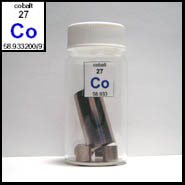
|
| Basic properties | |
|---|---|
| Atomic number | 27 |
| Atomic weight | 58.9331955 amu |
| Element family | Transition metals |
| Period | 4 |
| Group | 2 |
| Block | s-block |
| Discovery year | 1735 |
| Isotope distribution |
|---|
59Co 100% |
| Physical properties | |
|---|---|
| Density | 8.86 g/cm3 (STP) |
Atomic hydrogen (H) 8.988E-5 Meitnerium (Mt) 28 | |
| Melting | 1495 °C |
Helium (He) -272.2 Carbon (C) 3675 | |
| Boiling | 2870 °C |
Helium (He) -268.9 Tungsten (W) 5927 | |
| Chemical properties | |
|---|---|
| Oxidation states (less common) | +2, +3 (-3, -1, 0, +1, +4, +5) |
| First ionization potential | 7.881 eV |
Cesium (Cs) 3.894 Helium (He) 24.587 | |
| Electron affinity | 0.662 eV |
Nobelium (No) -2.33 Atomic chlorine (Cl) 3.612725 | |
| Electronegativity | 1.88 |
Cesium (Cs) 0.79 Atomic fluorine (F) 3.98 | |
| Atomic radius | |
|---|---|
| Covalent radius | 1.11 Å |
Atomic hydrogen (H) 0.32 Francium (Fr) 2.6 | |
| Metallic radius | 1.25 Å |
Beryllium (Be) 1.12 Cesium (Cs) 2.65 | |
| Compounds | ||
|---|---|---|
| Formula | Name | Oxidation state |
| CoSO4 | Cobalt(II) sulfate | +2 |
| CoCl2 | Cobalt(II) chloride | +2 |
| CoO | Cobalt(II) oxide | +2 |
| CoCO3 | Cobalt(II) carbonate | +2 |
| CoBr2 | Cobalt(II) bromide | +2 |
| CoS | Cobalt(II) sulfide | +2 |
| Co(NO3)3 | Cobalt(III) nitrate | +3 |
| Co(OH)3 | Cobalt(III) hydroxide | +3 |
| Co2O3 | Cobalt(III) oxide | +3 |
| CoCl3 | Cobalt(III) chloride | +3 |
| CoF3 | Cobalt(III) fluoride | +3 |
| Cs2CoF6 | Caesium hexafluorocobaltate(IV) | +4 |
| Electronic properties | |
|---|---|
| Electrons per shell | 2, 8, 15, 2 |
| Electronic configuration | [Ar] 3d7 |
|
Bohr atom model

| |
|
Orbital box diagram

| |
| Valence electrons | 9 |
| Lewis dot structure |
|
| Orbital Visualization | |
|---|---|
|
| |
| Electrons | - |
| Reactions |
|---|
| CO + O2 = CO2 |
Cobalt (Co): Periodic Table Element
Abstract
Cobalt constitutes a ferromagnetic transition metal with atomic number 27, exhibiting a standard atomic weight of 58.933194 ± 0.000003 u. The element demonstrates characteristic d-block chemistry with predominant oxidation states of +2 and +3, while displaying exceptional magnetic properties including a Curie temperature of 1115°C and magnetic moment of 1.6–1.7 Bohr magnetons per atom. Cobalt manifests dual crystallographic forms comprising hexagonal close-packed and face-centered cubic structures, with transition occurring at approximately 450°C. Industrial significance centers on lithium-ion battery applications, superalloy production, and permanent magnet manufacturing. The element occurs naturally as a single stable isotope, ⁵⁹Co, while the artificial radioisotope ⁶⁰Co provides essential applications in medical radiotherapy and industrial sterilization processes.
Introduction
Cobalt occupies position 27 in the periodic table, classified within the first transition series alongside neighboring elements iron and nickel. The electronic configuration [Ar] 3d⁷ 4s² establishes its characteristic chemical behavior, with partially filled d-orbitals conferring typical transition metal properties including variable oxidation states, colored compounds, and exceptional catalytic activity. Discovery by Swedish chemist Georg Brandt circa 1735 marked the first isolation of a new metallic element since antiquity, emerging from systematic investigation of problematic mineral ores that medieval miners termed "kobold ore" due to their toxic arsenic emissions during smelting operations.
Contemporary cobalt production exceeds 300,000 tonnes annually, with the Democratic Republic of Congo accounting for over 80% of global output. The element's strategic importance has intensified with expanding lithium-ion battery markets, while traditional applications in superalloys, permanent magnets, and catalytic systems maintain substantial industrial relevance. Natural occurrence remains limited to chemically combined forms within sulfide and arsenide minerals, except for trace quantities in meteoric iron alloys.
Physical Properties and Atomic Structure
Fundamental Atomic Parameters
Cobalt possesses an atomic number of 27, corresponding to 27 protons within the nucleus and an equivalent number of electrons in the neutral atom. The electronic configuration [Ar] 3d⁷ 4s² reflects the characteristic d-block filling pattern, with seven electrons occupying the 3d subshell according to Hund's rule. Atomic radius measures approximately 125 pm for the metallic element, while ionic radii vary according to oxidation state and coordination environment: Co²⁺ exhibits radius 0.65 Å in octahedral coordination, whereas Co³⁺ displays significantly smaller radius of 0.545 Å due to increased nuclear charge.
Effective nuclear charge increases progressively across the first transition series, with cobalt experiencing enhanced nuclear attraction compared to preceding elements due to poor shielding by d-electrons. Covalent radius measures 126 pm, positioned between iron (124 pm) and nickel (124 pm), demonstrating the contraction effect characteristic of transition metal series. Van der Waals radius extends to 192 pm, reflecting the spatial distribution of the outermost electron density.
Macroscopic Physical Characteristics
Metallic cobalt exhibits lustrous bluish-gray appearance with specific gravity of 8.9 g/cm³, positioning it among the dense transition metals. The element crystallizes in two distinct allotropic forms: hexagonal close-packed structure stable below 450°C and face-centered cubic structure predominating at elevated temperatures. Energy differences between these polymorphs remain minimal, resulting in random intergrowth and stacking faults within metallic samples.
Ferromagnetic properties manifest below the Curie temperature of 1115°C (1388 K), with magnetic moment measuring 1.6–1.7 Bohr magnetons per atom. Relative permeability achieves two-thirds the value observed for iron, establishing cobalt as a moderately strong ferromagnetic material. Mechanical properties include exceptional hardness and wear resistance, attributes that underlie its extensive application in tool steels and bearing alloys.
Chemical Properties and Reactivity
Electronic Structure and Bonding Behavior
The d⁷ electronic configuration of cobalt generates distinctive chemical behavior characterized by accessible oxidation states ranging from -3 to +5, though +2 and +3 predominate in common compounds. Cobalt(II) complexes typically adopt octahedral or tetrahedral geometries, with the former exhibiting characteristic pink coloration in aqueous solution as the hexaaqua complex [Co(H₂O)₆]²⁺. Tetrahedral coordination produces intensely blue species such as [CoCl₄]²⁻, demonstrating the profound influence of ligand field effects on electronic transitions and spectroscopic properties.
Cobalt(III) chemistry centers on kinetically inert octahedral complexes, with d⁶ low-spin configuration conferring exceptional substitutional stability. Crystal field stabilization energies favor low-spin arrangements in strong-field environments, while weak-field ligands promote high-spin configurations with enhanced paramagnetism. Bond formation involves extensive d-orbital participation, generating covalent character that exceeds purely ionic models, particularly in organometallic derivatives and coordination compounds with π-accepting ligands.
Electrochemical and Thermodynamic Properties
Electronegativity values span 1.88 (Pauling scale) to 1.84 (Allred-Rochow scale), reflecting moderate electron-attracting capability positioned between iron and nickel. Successive ionization energies demonstrate the increasing difficulty of electron removal: first ionization energy measures 7.881 eV, second ionization energy reaches 17.084 eV, and third ionization energy escalates to 33.50 eV. The substantial increase between second and third ionization energies reflects the greater stability of the Co²⁺ oxidation state relative to Co³⁺ in simple ionic environments.
Standard reduction potential for the Co³⁺/Co²⁺ couple registers +1.92 V, indicating powerful oxidizing capability of cobalt(III) species in aqueous solution. This high potential explains the relative instability of simple cobalt(III) salts in water, with spontaneous reduction occurring unless kinetic stabilization through coordination prevents facile electron transfer. Electron affinity measures approximately 63.7 kJ/mol, reflecting modest tendency for electron capture compared to main group elements.
Chemical Compounds and Complex Formation
Binary and Ternary Compounds
Cobalt forms an extensive series of binary oxides displaying diverse structural and magnetic properties. Cobalt(II) oxide (CoO) crystallizes in the rocksalt structure with antiferromagnetic ordering below 291 K (Néel temperature). Oxidation at 600-700°C produces cobalt(II,III) oxide (Co₃O₄), characterized by normal spinel structure containing both tetrahedral Co²⁺ and octahedral Co³⁺ sites. This mixed-valence oxide exhibits antiferromagnetic behavior below 40 K, analogous to magnetite but with significantly reduced Néel temperature.
Halide chemistry encompasses all common halogens with oxidation state dependency. Cobalt(II) fluoride (CoF₂) displays pink coloration and rutile structure, while cobalt(III) fluoride (CoF₃) forms through direct reaction with fluorine at 520 K. Chloride chemistry demonstrates marked color variations: anhydrous CoCl₂ appears blue, whereas the hexahydrate CoCl₂·6H₂O exhibits pink coloration due to octahedral aquo coordination. Thermodynamic stability generally decreases with increasing halogen atomic number, reflecting reduced lattice energies and increased covalent character.
Coordination Chemistry and Organometallic Compounds
Coordination complexes of cobalt span coordination numbers from four to eight, with octahedral geometry predominating for both oxidation states. Cobalt(II) complexes demonstrate significant ligand field sensitivity, transitioning between high-spin and low-spin configurations depending on ligand strength. Tetrahedral cobalt(II) species such as [CoCl₄]²⁻ invariably adopt high-spin arrangements, producing intense blue coloration through d-d electronic transitions in the visible region.
Cobalt(III) coordination chemistry emphasizes kinetic inertness arising from large crystal field stabilization energies in octahedral environments. Classical Werner-type complexes including [Co(NH₃)₆]³⁺ and [Co(en)₃]³⁺ demonstrate extraordinary substitutional stability, requiring harsh conditions for ligand exchange. Organometallic chemistry centers on carbonyl derivatives, particularly dicobalt octacarbonyl [Co₂(CO)₈], which serves as both synthetic precursor and industrial catalyst for carbonylation reactions.
Natural Occurrence and Isotopic Analysis
Geochemical Distribution and Abundance
Cobalt ranks 32nd in elemental abundance within the Earth's crust, with concentration averaging 25 parts per million by mass. Geochemical behavior follows siderophile and chalcophile tendencies, concentrating within sulfide deposits and iron-nickel alloy phases. Primary mineral associations include cobaltite (CoAsS), skutterudite (CoAs₃), and erythrite (Co₃(AsO₄)₂·8H₂O), with secondary minerals forming through weathering and oxidation processes.
Hydrothermal processes generate the majority of economically viable cobalt deposits, particularly within sediment-hosted copper-cobalt systems of the Central African Copperbelt. Magmatic sulfide deposits, exemplified by Sudbury and Norilsk complexes, constitute additional sources through nickel-copper extraction operations. Seawater contains approximately 0.6 parts per billion cobalt, while deep-sea manganese nodules accumulate cobalt through adsorption mechanisms, representing potential future resources.
Nuclear Properties and Isotopic Composition
Natural cobalt consists entirely of the stable isotope ⁵⁹Co, representing 100% isotopic abundance with nuclear spin quantum number I = 7/2. This property enables detection through nuclear magnetic resonance spectroscopy, providing analytical utility for coordination chemistry studies. Nuclear magnetic moment measures +4.627 nuclear magnetons, facilitating NMR applications in organometallic and coordination compound characterization.
Artificial radioisotopes span mass numbers from 50 to 73, with cobalt-60 possessing paramount commercial significance. ⁶⁰Co exhibits half-life of 5.2714 years, undergoing beta decay to stable ⁶⁰Ni with simultaneous emission of characteristic gamma rays at 1.17 and 1.33 MeV energies. Production occurs through neutron activation of ⁵⁹Co in nuclear reactors, generating specific activities approaching 1000 Ci/g for medical and industrial applications. Additional isotopes include ⁵⁷Co (half-life 271.8 days), utilized in Mössbauer spectroscopy investigations of iron-containing compounds.
Industrial Production and Technological Applications
Extraction and Purification Methodologies
Primary cobalt production occurs predominantly as a by-product of copper and nickel extraction operations, with specialized cobalt ores constituting minor sources. Pyrometallurgical processes begin with sulfide ore concentration through flotation techniques, followed by roasting operations to eliminate sulfur and arsenic constituents. High-temperature smelting produces matte containing cobalt, copper, and nickel phases, requiring subsequent separation through selective dissolution and precipitation protocols.
Hydrometallurgical refinement employs sulfuric acid leaching to solubilize cobalt, followed by solvent extraction using specialized organic reagents such as bis(2-ethylhexyl)phosphoric acid. Electrowinning provides final purification, depositing metallic cobalt with purity exceeding 99.8% at copper cathodes under carefully controlled current density and electrolyte composition. Alternative reduction methods utilize hydrogen gas or carbon monoxide at elevated temperatures, producing cobalt powder suitable for powder metallurgy applications.
Technological Applications and Future Prospects
Lithium-ion battery technology represents the largest contemporary application, with lithium cobalt oxide (LiCoO₂) cathodes enabling high energy density storage systems. Battery chemistry evolution toward nickel-manganese-cobalt (NMC) formulations has progressively reduced cobalt content from 33% in NMC 111 compositions to 10% in advanced NMC 811 variants, driven by cost considerations and supply chain security objectives.
Superalloy applications exploit cobalt's temperature stability and corrosion resistance in gas turbine engines, aerospace components, and industrial machinery operating under extreme conditions. Stellite alloys, containing 35-65% cobalt with chromium and tungsten additions, provide exceptional wear resistance for cutting tools and bearing surfaces. Permanent magnet technology utilizes samarium-cobalt compositions (SmCo₅ and Sm₂Co₁₇) offering superior temperature stability compared to neodymium-iron-boron alternatives, albeit with higher material costs.
Catalytic applications encompass petroleum refining processes, particularly hydrodesulfurization reactions removing sulfur compounds from crude oil fractions. Cobalt-molybdenum catalysts facilitate these transformations through synergistic effects between the two metals, enabling efficient operation under industrial conditions. Emerging technologies include Fischer-Tropsch synthesis for synthetic fuel production and water-splitting catalysts for hydrogen generation, positioning cobalt as essential for sustainable energy systems.
Historical Development and Discovery
The discovery of cobalt by Georg Brandt represents a pivotal moment in 18th-century metallurgy, marking the first isolation of a new metallic element since ancient civilizations identified the classical metals. Working at the Royal Mint of Sweden, Brandt systematically investigated troublesome ores that produced blue pigments but contained no recognizable metals. These materials, termed "kobold ore" by German miners in reference to mischievous mine spirits believed responsible for their problematic behavior, yielded toxic arsenic vapors during conventional smelting operations.
Brandt's methodical approach involved chemical analysis of mineral specimens from the Modums mines in Norway, where blue pigments had been extracted for ceramic applications. Through careful reduction experiments conducted around 1735, he isolated a new metallic substance exhibiting magnetic properties and distinctive chemical reactivity. Initial classification as a "semi-metal" reflected contemporary understanding of metallic categories, though subsequent investigations confirmed its status as a true metal with unique properties distinguishing it from iron and nickel.
The development of cobalt metallurgy progressed through industrial revolution advances in pyrometallurgy and analytical chemistry. Nineteenth-century developments included recognition of cobalt's role in vitamin B₁₂ and establishment of commercial production methods. Modern understanding encompasses electronic structure, magnetic theory, and coordination chemistry principles that explain cobalt's versatile chemical behavior and technological applications.
Conclusion
Cobalt occupies a distinctive position among transition metals through its combination of magnetic properties, chemical versatility, and technological significance. The d⁷ electronic configuration generates accessible oxidation states and coordination geometries that underlie diverse applications ranging from battery cathodes to catalytic systems. Future developments likely emphasize sustainable extraction methods, cobalt-reduced battery technologies, and expanded catalytic applications in renewable energy systems. Research frontiers include single-atom catalysts, quantum magnetic materials, and biocompatible alloys for medical implants, ensuring continued relevance across multiple technological domains.

Please let us know how we can improve this web app.
