Printed from https://www.webqc.org

Osmium @ Periodic Table of Chemical Elements

12345678 910111213141516 1718
IIIIIIbIVb VbVIbVIIbVIIIbIb IIbIIIIVVVI VIIVIII
1H
1.0079
2He
4.0026
3Li
6.9412
4Be
9.0121
5B
10.811
6C
12.010
7N
14.006
8O
15.999
9F
18.998
10Ne
20.179
11Na
22.989
12Mg
24.305
13Al
26.981
14Si
28.085
15P
30.973
16S
32.065
17Cl
35.453
18Ar
39.948
19K
39.098
20Ca
40.078
21Sc
44.955
22Ti
47.867
23V
50.941
24Cr
51.996
25Mn
54.938
26Fe
55.845
27Co
58.933
28Ni
58.693
29Cu
63.546
30Zn
65.409
31Ga
69.723
32Ge
72.641
33As
74.921
34Se
78.963
35Br
79.904
36Kr
83.798
37Rb
85.467
38Sr
87.621
39Y
88.905
40Zr
91.224
41Nb
92.906
42Mo
95.942
43Tc
98.906
44Ru
101.07
45Rh
102.90
46Pd
106.42
47Ag
107.86
48Cd
112.41
49In
114.81
50Sn
118.71
51Sb
121.76
52Te
127.60
53I
126.90
54Xe
131.29
55Cs
132.90
56Ba
137.32
57La
138.90
72Hf
178.49
73Ta
180.94
74W
183.84
75Re
186.20
76Os
190.23
77Ir
192.21
78Pt
195.08
79Au
196.96
80Hg
200.59
81Tl
204.38
82Pb
207.21
83Bi
208.98
84Po
208.98
85At
209.98
86Rn
222.01
87Fr
223.01
88Ra
226.02
89Ac
227.02
104Rf
261.10
105Db
262.11
106Sg
266.12
107Bh
264.12
108Hs
269
109Mt
278
110Ds
281
111Rg
282
112Cn
285
113Nh
286
114Fl
289
115Mc
290
116Lv
293
117Ts
294
118Og
294
Lanthanoids58Ce
140.11
59Pr
140.90
60Nd
144.24
61Pm
146.91
62Sm
150.36
63Eu
151.96
64Gd
157.25
65Tb
158.92
66Dy
162.50
67Ho
164.93
68Er
167.25
69Tm
168.93
70Yb
173.04
71Lu
174.96
Actinoids90Th
232.03
91Pa
231.03
92U
238.02
93Np
237.04
94Pu
244.06
95Am
243.06
96Cm
247.07
97Bk
247.07
98Cf
251.07
99Es
252.08
100Fm
257.09
101Md
258.09
102No
259.10
103Lr
260.10
Alkali metals Alkali earth metals Transition metals Other metals Metaloids Non-metals Halogens Noble gases
Element

76

Os

Osmium

190.233

2
8
18
32
14
2
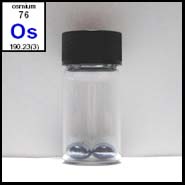
Osmium photo
Basic properties
Atomic number76
Atomic weight190.233 amu
Element familyTransition metals
Period6
Group2
Blocks-block
Discovery year1803
Isotope distribution
187Os
1.6%
188Os
13.3%
189Os
16.1%
190Os
26.4%
192Os
41.0%
187Os: 1.63%188Os: 13.52%189Os: 16.36%190Os: 26.83%192Os: 41.67%
187Os (1.63%)
188Os (13.52%)
189Os (16.36%)
190Os (26.83%)
192Os (41.67%)
Physical properties
Density 22.61 g/cm3 (STP)
Atomic hydrogen (H) 8.988E-5
Meitnerium (Mt) 28
Melting3027 °C
Helium (He) -272.2
Carbon (C) 3675
Boiling5027 °C
Helium (He) -268.9
Tungsten (W) 5927
Chemical properties
Oxidation states
(less common)
+4
(-4, -2, -1, 0, +1, +2, +3, +5, +6, +7, +8)
First ionization potential 8.706 eV
Cesium (Cs) 3.894
Helium (He) 24.587
Electron affinity 1.078 eV
Nobelium (No) -2.33
Atomic chlorine (Cl) 3.612725
Electronegativity2.2
Cesium (Cs) 0.79
Atomic fluorine (F) 3.98
Atomic radius
Covalent radius 1.29 Å
Atomic hydrogen (H) 0.32
Francium (Fr) 2.6
Metallic radius 1.35 Å
Beryllium (Be) 1.12
Cesium (Cs) 2.65
76OsWebQC.OrgCovalentMetallic
Compounds
FormulaNameOxidation state
OsCl2Osmium(II) chloride+2
OsBr3Osmium(III) bromide+3
OsCl3Osmium(III) chloride+3
Na2OsCl6Sodium hexachloroosmate+4
OsBr4Osmium tetrabromide+4
OsCl4Osmium(IV) chloride+4
OsCl5Osmium(V) chloride+5
OsF5Osmium pentafluoride+5
OsF6Osmium hexafluoride+6
OsF7Osmium heptafluoride+7
OsO4Osmium tetroxide+8
OsF8Osmium octafluoride+8
Electronic properties
Electrons per shell2, 8, 18, 32, 14, 2
Electronic configuration[Xe] 4f145d66s2
Bohr atom model
Bohr atom model
Orbital box diagram
Orbital box diagram
Valence electrons8
Lewis dot structure Osmium Lewis dot structure
Orbital Visualization
🏠
▶️
📐
Electrons-

Osmium (Os): Periodic Table Element

Scientific Review Article | Chemistry Reference Series

Abstract

Osmium (Os), atomic number 76, represents one of the platinum group metals with exceptional density characteristics. This transition metal exhibits the highest density of any stable element at 22.59 g/cm³, making it approximately twice as dense as lead. Osmium demonstrates remarkable chemical versatility, displaying oxidation states ranging from −4 to +8, with the +8 state being among the highest observed for any element. The element occurs naturally as trace amounts in platinum ores and forms significant industrial alloys with extreme durability properties. Osmium compounds, particularly osmium tetroxide, serve critical roles in organic synthesis and electron microscopy applications. Despite its limited abundance of 50 parts per trillion in Earth's crust, osmium maintains technological importance in specialized high-performance applications requiring exceptional hardness and chemical resistance.

Introduction

Osmium occupies position 76 in the periodic table, classified within the d-block transition metals and specifically belonging to the platinum group metals. Its electronic configuration [Xe] 4f¹⁴ 5d⁶ 6s² positions it in the third row of the d-block elements, exhibiting characteristic transition metal behavior with variable oxidation states and coordination complex formation. The element's discovery in 1803 by Smithson Tennant and William Hyde Wollaston emerged from systematic investigations of platinum ore residues, establishing osmium alongside iridium as components of the insoluble black residue remaining after platinum dissolution in aqua regia. Osmium's name derives from the Greek word "osme" meaning smell, referencing the characteristic odor of osmium tetroxide vapors produced during chemical reactions. The element demonstrates fundamental importance in understanding extreme density relationships among stable elements and provides unique applications in precision instrumentation and specialized catalytic processes.

Physical Properties and Atomic Structure

Fundamental Atomic Parameters

Osmium's atomic structure centers on the nuclear arrangement of 76 protons with naturally occurring isotopes containing between 110 and 116 neutrons. The electron configuration [Xe] 4f¹⁴ 5d⁶ 6s² indicates six electrons in the 5d orbital and two electrons in the 6s orbital available for chemical bonding. The atomic radius measures 135 pm for the metallic form, while ionic radii vary significantly depending on oxidation state and coordination environment, ranging from 52.5 pm for Os⁸⁺ to 88 pm for Os²⁺ in octahedral coordination. The effective nuclear charge experienced by valence electrons reaches approximately 4.9, contributing to the element's high ionization energies and dense electron cloud. Osmium exhibits characteristic d-block properties including multiple oxidation states, colored compound formation, and significant coordination chemistry capabilities through d-orbital participation in bonding.

Macroscopic Physical Characteristics

Osmium crystallizes in a hexagonal close-packed structure with lattice parameters a = 273.4 pm and c = 431.7 pm, producing a distinctive blue-gray metallic luster. The element maintains its position as the densest known stable element with a density of 22.587 g/cm³ at 20°C, marginally exceeding iridium's density of 22.562 g/cm³. This exceptional density results from efficient atomic packing combined with high atomic mass. Osmium demonstrates a melting point of 3306°C and boiling point of 5285°C, ranking fourth highest among all elements after carbon, tungsten, and rhenium. The heat of fusion reaches 57.85 kJ/mol, while the heat of vaporization measures 738 kJ/mol. The element exhibits extremely low compressibility with a bulk modulus between 395-462 GPa, rivaling diamond's resistance to deformation. Despite its hardness of approximately 4 GPa, osmium remains brittle and difficult to machine in its pure form, limiting practical applications of the pure metal.

Chemical Properties and Reactivity

Electronic Structure and Bonding Behavior

Osmium's chemical behavior stems from its d⁶ electronic configuration, enabling extensive oxidation state variation from −4 to +8. The most thermodynamically stable oxidation states include +2, +3, +4, and +8, with the +8 state representing one of the highest oxidation states achieved by any element. Lower oxidation states demonstrate stabilization through σ-donor ligands such as amines and π-acceptor ligands including nitrogen-containing heterocycles. Higher oxidation states require strong σ- and π-donor ligands like oxide (O²⁻) and nitride (N³⁻) ions for stabilization. The d⁶ configuration in the +2 oxidation state often adopts low-spin configurations in strong crystal fields, leading to kinetically inert octahedral complexes. Osmium forms extensive coordination compounds with coordination numbers typically ranging from 4 to 8, demonstrating preference for octahedral geometry in many complexes. Bond formation involves significant d-orbital participation, producing characteristic colored compounds and enabling diverse stereochemical arrangements.

Electrochemical and Thermodynamic Properties

Osmium exhibits electronegativity values of 2.2 on the Pauling scale, indicating moderate electron-attracting ability comparable to other platinum group metals. The successive ionization energies demonstrate the characteristic pattern of d-block elements: first ionization energy reaches 840 kJ/mol, with subsequent ionizations requiring progressively higher energies due to increased effective nuclear charge. Standard reduction potentials vary significantly with oxidation state and chemical environment, with the Os⁸⁺/Os⁶⁺ couple exhibiting high positive values reflecting the stability of lower oxidation states. Electron affinity data indicates minimal tendency for electron capture, consistent with metallic character. Thermodynamic stability of osmium compounds depends critically on oxidation state and ligand environment, with higher oxidation states requiring careful control of reaction conditions to prevent decomposition. The element demonstrates remarkable resistance to acid attack, remaining unaffected by most common acids including hydrochloric and sulfuric acid, though it reacts with hot concentrated nitric acid to form osmium tetroxide.

Chemical Compounds and Complex Formation

Binary and Ternary Compounds

Osmium forms extensive binary compounds across multiple oxidation states, with oxides representing the most significant class. Osmium tetroxide (OsO₄) serves as the most important osmium compound, exhibiting exceptional volatility and distinctive chlorine-like odor. This compound demonstrates tetrahedral molecular geometry with Os-O bond lengths of approximately 173 pm and exceptional thermal stability up to 400°C. Osmium dioxide (OsO₂) represents the +4 oxidation state with rutile-type crystal structure and significantly lower volatility compared to the tetroxide. Halide compounds include osmium hexafluoride (OsF₆) displaying octahedral geometry, while lower halides such as osmium tetrachloride (OsCl₄) and osmium tribromide (OsBr₃) demonstrate decreased stability with increasing halogen size. Ternary compounds encompass osmates such as potassium osmate (K₂[OsO₄(OH)₂]), formed through reaction of osmium tetroxide with alkaline solutions, exhibiting octahedral coordination around the osmium center.

Coordination Chemistry and Organometallic Compounds

Osmium coordination chemistry demonstrates exceptional diversity through formation of complexes with various donor atoms including nitrogen, phosphorus, sulfur, and carbon. Typical coordination geometries include octahedral arrangements in six-coordinate complexes, though square planar four-coordinate species occur with strong-field ligands. Notable coordination compounds include hexaammine osmium complexes [Os(NH₃)₆]²⁺ and [Os(NH₃)₆]³⁺ displaying characteristic low-spin d⁶ and d⁵ configurations respectively. Organometallic chemistry encompasses significant carbonyl cluster compounds, particularly triosmium dodecacarbonyl (Os₃(CO)₁₂) featuring triangular metal arrangement with bridging and terminal carbonyl ligands. Piano-stool complexes include arene osmium compounds with η⁶-coordination of aromatic rings, demonstrating remarkable thermal stability and diverse substitution chemistry. Cyclopentadienyl complexes exhibit extensive analogies to ruthenium chemistry while maintaining distinct reactivity patterns attributed to increased metal-ligand orbital overlap in the third transition series.

Natural Occurrence and Isotopic Analysis

Geochemical Distribution and Abundance

Osmium ranks among Earth's rarest stable elements with crustal abundance averaging 50 parts per trillion by mass, reflecting its chalcophile character and tendency to concentrate in sulfide phases during magmatic processes. The element exhibits strong correlation with other platinum group metals in magmatic sulfide deposits, particularly those associated with mafic and ultramafic intrusions. Primary osmium concentrations occur in layered intrusions such as the Bushveld Complex in South Africa, Norilsk-Talnakh deposits in Russia, and Sudbury Basin in Canada, where osmium associates with pentlandite and other sulfide minerals. Secondary concentrations develop in alluvial deposits derived from primary source erosion, notably in Colombia's Chocó region and Russia's Ural Mountains. Geochemical behavior during weathering demonstrates minimal mobility due to osmium's noble character, leading to residual enrichment in placer deposits. Cosmic abundance reaches approximately 675 parts per billion by mass, indicating nucleosynthetic production through s-process reactions in asymptotic giant branch stars.

Nuclear Properties and Isotopic Composition

Natural osmium comprises seven isotopes with mass numbers 184, 186, 187, 188, 189, 190, and 192, five of which exhibit nuclear stability under terrestrial conditions. ¹⁹²Os represents the most abundant isotope at 40.78% natural abundance, followed by ¹⁸⁸Os at 13.24% and ¹⁸⁹Os at 16.15%. ¹⁸⁶Os undergoes α-decay with extraordinarily long half-life of 2.0 × 10¹⁵ years, approximately 140,000 times the universe's age, rendering it practically stable for most purposes. ¹⁸⁴Os similarly demonstrates α-decay with half-life of 5.6 × 10¹³ years. Nuclear magnetic properties include ¹⁸⁷Os with nuclear spin I = 1/2 and magnetic moment μ = +0.0646 nuclear magnetons, though its low natural abundance of 1.96% complicates NMR spectroscopic applications. ¹⁸⁹Os exhibits I = 3/2 with magnetic moment μ = +0.659 nuclear magnetons. Artificial isotopes span mass numbers 160-203, with ¹⁹⁴Os representing the longest-lived radioactive isotope at 6-year half-life through electron capture decay.

Industrial Production and Technological Applications

Extraction and Purification Methodologies

Industrial osmium recovery occurs exclusively as byproduct during platinum group metal extraction from copper and nickel ores. Primary separation begins with anode slime collection during electrorefining operations, where osmium concentrates alongside other noble metals. Initial processing involves fusion with sodium peroxide at temperatures exceeding 500°C, converting metallic osmium to water-soluble osmate species. Subsequent dissolution in aqua regia separates osmium from base metals while leaving platinum group metals as insoluble residue. Osmium separation from iridium and ruthenium utilizes selective oxidation to osmium tetroxide under controlled atmospheric conditions, exploiting osmium's unique tendency to form volatile oxides. Distillation techniques recover osmium tetroxide at temperatures around 130°C, achieving separation efficiencies exceeding 95%. Final reduction employs hydrogen treatment of ammonium hexachloroosmate(IV) at 300-400°C, producing metallic osmium powder with purities typically above 99.9%. Annual global production estimates range from several hundred to few thousand kilograms, reflecting limited demand and specialized applications.

Technological Applications and Future Prospects

Osmium applications center on specialized high-performance requirements exploiting its exceptional density, hardness, and chemical resistance. Fountain pen nib tipping represents the largest volume application, where osmium-iridium alloys provide superior wear resistance and writing quality compared to steel alternatives. Electrical contact materials utilize osmium alloys in precision instruments requiring minimal contact resistance and extended operational life under demanding conditions. Historical applications included phonograph stylus tips during the transition from 78 rpm to LP records, where osmium provided intermediate durability between steel and diamond options. Scientific instrumentation employs osmium tetroxide as primary fixative in electron microscopy, cross-linking lipid membranes while providing electron density contrast essential for biological imaging. Organic synthesis utilizes osmium tetroxide and derivative osmates in stereoselective dihydroxylation reactions, particularly in pharmaceutical intermediate production. Emerging applications investigate osmium's potential in hydrogen storage systems, exploiting its ability to absorb hydrogen atoms in crystalline lattice sites, though economic considerations currently limit practical implementation. Future prospects include specialized coating applications for space-based UV spectroscopy, despite oxidation challenges in atomic oxygen environments.

Historical Development and Discovery

Osmium's discovery emerged from systematic investigation of platinum ore processing residues conducted by British chemists Smithson Tennant and William Hyde Wollaston during 1803-1804. Their research addressed the persistent presence of black, insoluble residues remaining after platinum dissolution in aqua regia, initially attributed to graphite contamination by Joseph Louis Proust. French chemists Victor Collet-Descotils, Antoine François de Fourcroy, and Louis Nicolas Vauquelin observed similar residues but lacked sufficient material for comprehensive analysis. Tennant's methodical approach involved treatment of larger residue quantities with alternating alkali and acid solutions, ultimately isolating volatile compounds exhibiting distinctive odors. Chemical characterization revealed two previously unknown elements: osmium, named for its characteristic smell resembling chlorine and garlic, and iridium, designated for its rainbow-colored salt solutions. Tennant's announcement to the Royal Society on June 21, 1804, established both elements' discovery and provided initial chemical property descriptions. Early industrial applications centered on Carl Bosch's utilization of osmium as catalyst in the Haber process for ammonia synthesis around 1906, though iron-based catalysts soon replaced osmium due to cost considerations. The Osram company name, established in 1906, commemorates osmium and tungsten (wolfram) elements used in incandescent lamp filament development, reflecting osmium's brief but significant role in lighting technology advancement.

Conclusion

Osmium maintains a unique position in the periodic table as the densest stable element while demonstrating exceptional chemical versatility through its extensive range of oxidation states. Its specialized applications in precision instrumentation, electron microscopy, and organic synthesis underscore the element's continued technological relevance despite limited natural abundance. The remarkable combination of extreme density, chemical resistance, and catalytic properties positions osmium for potential expansion in advanced materials applications, particularly in environments requiring exceptional performance under demanding conditions. Future research directions likely encompass enhanced recovery methods from existing ore processing streams and development of osmium-based materials for specialized coating and catalytic applications in emerging technologies.

Periodict table
Please let us know how we can improve this web app.

Menu Balance Molar mass Gas laws Units Chemistry tools Periodic table Chemical forum Symmetry Constants Contribute Contact us
How to cite?