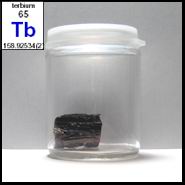
| Element | |
|---|---|
65TbTerbium158.9253522
8 18 27 8 2 |
|
| Basic properties | |
|---|---|
| Atomic number | 65 |
| Atomic weight | 158.925352 amu |
| Element family | N/A |
| Period | 6 |
| Group | 2 |
| Block | s-block |
| Discovery year | 1843 |
| Isotope distribution |
|---|
159Tb 100% |
| Physical properties | |
|---|---|
| Density | 8.229 g/cm3 (STP) |
Atomic hydrogen (H) 8.988E-5 Meitnerium (Mt) 28 | |
| Melting | 1357 °C |
Helium (He) -272.2 Carbon (C) 3675 | |
| Boiling | 3041 °C |
Helium (He) -268.9 Tungsten (W) 5927 | |
| Chemical properties | |
|---|---|
| Oxidation states (less common) | +3 (0, +1, +2, +4) |
| First ionization potential | 5.864 eV |
Cesium (Cs) 3.894 Helium (He) 24.587 | |
| Electron affinity | 0.131 eV |
Nobelium (No) -2.33 Atomic chlorine (Cl) 3.612725 | |
| Electronegativity | 1.1 |
Cesium (Cs) 0.79 Atomic fluorine (F) 3.98 | |
| Atomic radius | |
|---|---|
| Covalent radius | 1.68 Å |
Atomic hydrogen (H) 0.32 Francium (Fr) 2.6 | |
| Metallic radius | 1.77 Å |
Beryllium (Be) 1.12 Cesium (Cs) 2.65 | |
| Compounds | ||
|---|---|---|
| Formula | Name | Oxidation state |
| Tb(CH3COO)3 | Terbium acetate | +3 |
| Tb(NO3)3 | Terbium(III) nitrate | +3 |
| Tb(OH)3 | Terbium(III) hydroxide | +3 |
| Tb2O3 | Terbium(III) oxide | +3 |
| TbBr3 | Terbium(III) bromide | +3 |
| TbCl3 | Terbium(III) chloride | +3 |
| TbF3 | Terbium(III) fluoride | +3 |
| TbI3 | Terbium(III) iodide | +3 |
| TbP | Terbium phosphide | +3 |
| TbF4 | Terbium(IV) fluoride | +4 |
| TbO2 | Terbium(IV) oxide | +4 |
| TbSi2 | Terbium silicide | +4 |
| Electronic properties | |
|---|---|
| Electrons per shell | 2, 8, 18, 27, 8, 2 |
| Electronic configuration | [Xe] 4f9 |
|
Bohr atom model
| |
|
Orbital box diagram
| |
| Valence electrons | 11 |
| Lewis dot structure |
|
| Orbital Visualization | |
|---|---|
|
| |
| Electrons | - |
Terbium (Tb): Periodic Table Element
Abstract
Terbium, a silvery-white rare earth metal with atomic number 65, stands as the ninth member of the lanthanide series. This element exhibits exceptional luminescent properties, particularly its brilliant fluorescence in the trivalent oxidation state, which generates an intense lemon-yellow emission. Terbium demonstrates characteristic electropositive behavior, readily oxidizing in ambient conditions and reacting with water to evolve hydrogen gas. The element displays two crystalline allotropes with transformation occurring at 1289°C. Its electron configuration [Xe]4f96s2 provides the foundation for its magnetic properties, including ferromagnetic ordering below 219 K and helical antiferromagnetic behavior at intermediate temperatures. Terbium compounds find extensive applications in phosphor technology, optical devices, and magnetostrictive materials. The element was discovered by Carl Gustaf Mosander in 1843 through spectroscopic analysis of yttrium oxide impurities. Industrial production relies on ion exchange separation techniques due to the element's natural occurrence exclusively in mineral associations rather than as native metal. Current applications encompass green phosphors for display technologies, optical isolators, and specialized alloys exhibiting remarkable magnetostrictive properties.
Introduction
Terbium occupies position 65 in the periodic table, situated within the f-block as the ninth lanthanide element. Its position between gadolinium (Z=64) and dysprosium (Z=66) places it in the middle region of the lanthanide contraction series, where systematic decreases in ionic radius occur due to imperfect shielding of nuclear charge by 4f electrons. The element's electronic configuration [Xe]4f96s2 establishes its fundamental chemical properties, with the partially filled f-subshell contributing to its distinctive magnetic and optical characteristics.
The discovery and isolation of terbium represents a significant chapter in rare earth chemistry. Carl Gustaf Mosander's identification of this element in 1843 through careful analysis of yttrium-containing minerals established the foundation for understanding the complex chemistry of the middle lanthanides. The element's name derives from the Swedish village Ytterby, sharing this etymology with yttrium, erbium, and ytterbium, reflecting the historical importance of Swedish mineral deposits in rare earth element discovery.
Contemporary applications of terbium demonstrate the element's unique position in materials science and technology. Its exceptional luminescent properties drive applications in phosphor technology, while its magnetic characteristics enable specialized applications in magnetostrictive devices. The growing demand for energy-efficient lighting and advanced magnetic materials continues to expand terbium's technological significance.
Physical Properties and Atomic Structure
Fundamental Atomic Parameters
Terbium exhibits atomic number 65, corresponding to 65 protons in the nucleus and an equivalent number of electrons in the neutral atom. The electron configuration [Xe]4f96s2 indicates nine electrons occupying the 4f subshell and two electrons in the 6s orbital. This configuration results in a ground state electronic term of 6H15/2, reflecting the high spin multiplicity characteristic of lanthanide elements with unpaired f electrons.
The atomic radius of terbium measures 177 pm, while the trivalent ionic radius (Tb3+) equals 92.3 pm for six-coordinate environments. This ionic radius demonstrates the lanthanide contraction effect, being smaller than the preceding gadolinium ion (93.8 pm) and larger than the subsequent dysprosium ion (91.2 pm). The effective nuclear charge experienced by the outer electrons increases progressively across the lanthanide series due to incomplete screening by 4f electrons.
Successive ionization energies for terbium exhibit the characteristic pattern expected for lanthanide elements. The first ionization energy measures 565.8 kJ mol-1, the second 1110 kJ mol-1, and the third 2114 kJ mol-1. The relatively modest increase between second and third ionization energies reflects the stability of the Tb3+ configuration, while the substantial jump to the fourth ionization energy (3839 kJ mol-1) demonstrates the exceptional stability of the half-filled 4f7 configuration.
Macroscopic Physical Characteristics
Terbium appears as a silvery-white metal exhibiting malleability and ductility sufficient to permit cutting with a sharp blade. The element demonstrates relatively good stability in dry air compared to lighter lanthanides, though oxidation occurs readily under humid conditions. Two crystalline allotropes exist: the α-phase adopts hexagonal close-packed structure at room temperature, while the β-phase exhibits body-centered cubic structure above 1289°C.
Thermodynamic properties of terbium reflect its metallic character and electronic structure. The melting point measures 1356°C (1629 K), while the boiling point reaches 3230°C (3503 K). The enthalpy of fusion equals 10.15 kJ mol-1, and the enthalpy of vaporization measures 293.2 kJ mol-1. These values position terbium within the typical range for lanthanide metals, though somewhat lower than the early lanthanides.
The density of terbium at room temperature equals 8.219 g cm-3, placing it among the denser lanthanide elements. This high density results from efficient atomic packing combined with the substantial atomic mass (158.93 u). The specific heat capacity measures 0.182 J g-1 K-1 at 25°C, reflecting the vibrational modes available to the metallic lattice and electronic contributions from unpaired f electrons.
Chemical Properties and Reactivity
Electronic Structure and Bonding Behavior
The chemical behavior of terbium stems primarily from its electronic configuration and the accessibility of multiple oxidation states. The most stable and common oxidation state is +3, achieved through loss of the two 6s electrons and one 4f electron, resulting in the configuration [Xe]4f8. This configuration provides considerable stability while maintaining magnetic properties through unpaired electrons in the f subshell.
Terbium exhibits electropositive character typical of lanthanide metals, readily forming ionic compounds with electronegative elements. The ionic bonding predominates in most terbium compounds, though some degree of covalent character appears in bonds with highly electronegative elements or in coordination complexes with soft donor atoms. Bond lengths in terbium compounds reflect the ionic radius of the Tb3+ ion, with typical Tb-O distances measuring 2.2-2.4 Å in oxide environments.
The coordination chemistry of terbium demonstrates preference for high coordination numbers, typically 8-9 in aqueous solution and crystalline hydrates. This behavior stems from the large size of the Tb3+ ion and the primarily electrostatic nature of its bonding interactions. Coordination geometries range from square antiprism to tricapped trigonal prism, depending on ligand constraints and crystal packing requirements.
Electrochemical and Thermodynamic Properties
Electrochemical properties of terbium reflect its position in the electrochemical series and the stability of its various oxidation states. The standard reduction potential for the Tb3+/Tb couple measures -2.28 V versus the standard hydrogen electrode, indicating strong reducing character of the metallic element. This value positions terbium among the more electropositive elements, consistent with its ready oxidation in aqueous environments.
Electronegativity values for terbium vary according to the scale employed. The Pauling electronegativity equals 1.2, while the Mulliken electronegativity measures approximately 1.1. These low values reflect the ease with which terbium loses electrons to form positive ions, supporting the predominantly ionic character of its compounds.
Thermodynamic stability considerations reveal the exceptional stability of Tb3+ compounds compared to other oxidation states. The formation enthalpy of Tb2O3 measures -1865.2 kJ mol-1, indicating substantial thermodynamic driving force for oxide formation. Standard entropy values reflect the magnetic contributions from unpaired f electrons, with metallic terbium exhibiting S° = 73.2 J mol-1 K-1.
Chemical Compounds and Complex Formation
Binary and Ternary Compounds
Terbium forms an extensive array of binary compounds demonstrating the element's versatility in chemical combination. The most important oxide, Tb2O3 (terbia), appears as a dark brown solid exhibiting slight hygroscopicity. This compound adopts the cubic bixbyite structure common to sesquioxides of the heavier lanthanides, with Tb3+ ions occupying two distinct crystallographic sites.
Halide compounds of terbium exhibit systematic trends related to halogen electronegativity and size. Terbium trifluoride (TbF3) crystallizes in the tysonite structure, demonstrating high thermal stability and minimal solubility in water. The tetrafluoride TbF4 represents one of the few stable compounds containing tetravalent terbium, exhibiting strong oxidizing properties and serving as a useful fluorinating agent. Terbium trichloride (TbCl3) adopts the UCl3 structure type and shows considerable hygroscopicity, readily forming hydrated complexes in atmospheric moisture.
Chalcogenide compounds include the monosulfide TbS with the rock salt structure, the sesquisulfide Tb2S3 exhibiting the Th2S3 structure type, and the selenide TbSe adopting the NaCl structure. These compounds display semiconductor properties and magnetic ordering at low temperatures. The phosphide TbP crystallizes in the rock salt structure and exhibits metallic conductivity along with ferromagnetic ordering.
Coordination Chemistry and Organometallic Compounds
Coordination complexes of terbium demonstrate the element's preference for high coordination numbers and hard donor ligands. Aqueous terbium solutions contain the nonahydrate complex [Tb(H2O)9]3+, exhibiting tricapped trigonal prismatic geometry. The Tb-O bond distances measure approximately 2.44 Å, reflecting the purely electrostatic nature of the metal-ligand interactions.
Chelating ligands form particularly stable complexes with terbium due to the chelate effect and the element's preference for multiple coordination. Ethylenediaminetetraacetate (EDTA) forms a highly stable 1:1 complex with formation constant log K = 17.93, while other polyaminocarboxylate ligands exhibit similarly high stability constants. These complexes find applications in analytical chemistry and biochemical research.
Organometallic chemistry of terbium remains limited compared to transition metals due to the predominantly ionic character of lanthanide-carbon bonds. Cyclopentadienyl complexes such as Tb(C5H5)3 exhibit characteristic lanthanide bonding patterns with primarily electrostatic metal-ligand interactions. Recent developments have demonstrated the existence of divalent terbium organometallic complexes under strongly reducing conditions, expanding the accessible oxidation state chemistry of this element.
Natural Occurrence and Isotopic Analysis
Geochemical Distribution and Abundance
Terbium exhibits a crustal abundance of approximately 1.2 mg kg-1, positioning it among the less abundant lanthanide elements. This concentration reflects the cosmic abundance of elements with atomic numbers in the vicinity of 65 and the geochemical processes that concentrate or disperse lanthanide elements during terrestrial differentiation.
The element occurs naturally in association with other rare earth elements in various mineral phases. Principal mineral sources include monazite [(Ce,La,Th,Nd,Y)PO4] containing up to 0.03% terbium by mass, xenotime (YPO4) with variable terbium content, and euxenite [(Y,Ca,Er,La,Ce,U,Th)(Nb,Ta,Ti)2O6] containing 1% or greater terbium concentrations. The ion-adsorption clays of southern China represent the richest commercial sources of terbium, with concentrates containing approximately 1% Tb2O3 by weight.
Geochemical behavior of terbium follows patterns typical of the heavy lanthanides, exhibiting preferential partitioning into phases with small coordination sites. During magmatic processes, terbium tends to remain in the melt relative to lighter lanthanides, leading to enrichment in evolved igneous rocks. Weathering processes mobilize terbium along with other lanthanides, resulting in secondary concentration in clay minerals and phosphate deposits.
Nuclear Properties and Isotopic Composition
Natural terbium consists entirely of the isotope 159Tb, making it a monoisotopic element. This isotope contains 65 protons and 94 neutrons, providing a mass number of 159 and an atomic mass of 158.925354 u. The nuclear spin equals 3/2, resulting from the unpaired proton and neutron configurations in the nuclear structure.
Artificial radioisotopes of terbium span mass numbers from 135 to 174, with the most stable being 158Tb (half-life 180 years) and 157Tb (half-life 71 years). These isotopes undergo electron capture to produce gadolinium isotopes, while heavier isotopes typically undergo beta minus decay to yield dysprosium isotopes. The isotope 149Tb, with a half-life of 4.1 hours, shows promise for medical applications in targeted alpha therapy and positron emission tomography.
Nuclear magnetic resonance properties of 159Tb include a magnetic moment of +2.014 nuclear magnetons and a quadrupole moment of +1.432 barns. These properties reflect the nuclear structure and enable NMR spectroscopic studies of terbium-containing compounds, though the quadrupole moment complicates spectral interpretation in asymmetric environments.
Industrial Production and Technological Applications
Extraction and Purification Methodologies
Industrial extraction of terbium begins with processing of rare earth-containing ores through acid digestion methods. Crushed mineral concentrates undergo treatment with concentrated sulfuric acid at elevated temperatures, converting rare earth oxides to water-soluble sulfate salts. The resulting solution requires pH adjustment to 3-4 using sodium hydroxide, precipitating thorium and other interfering elements as hydroxides.
Separation of terbium from other lanthanides employs ion exchange chromatography using specialized resins. The process exploits subtle differences in ionic radius and complexation behavior among lanthanide ions. Elution with α-hydroxyisobutyric acid or similar complexing agents provides selective separation, with terbium emerging in intermediate fractions between gadolinium and dysprosium. Multiple cycles typically achieve the purity levels required for commercial applications.
Metallic terbium production utilizes metallothermic reduction of anhydrous terbium fluoride or chloride with calcium metal at temperatures approaching 1200°C in inert atmosphere. The reaction proceeds according to the equation: 2 TbF3 + 3 Ca → 2 Tb + 3 CaF2. Subsequent purification involves vacuum distillation to remove calcium impurities and zone melting to achieve high-purity metal suitable for specialized applications.
Technological Applications and Future Prospects
Phosphor technology represents the largest consumer of global terbium production, with applications spanning fluorescent lighting, cathode-ray tube displays, and modern LED systems. Terbium-activated phosphors produce brilliant green emission through 4f-4f electronic transitions, particularly the 5D4 → 7F5 transition at 544 nm. These phosphors demonstrate high quantum efficiency and excellent color purity, making them essential components in trichromatic lighting systems that combine blue, green, and red emissions.
Magnetostrictive applications utilize terbium in the Terfenol-D alloy system (Tb0.3Dy0.7Fe2), which exhibits the highest room-temperature magnetostriction of any known material. This property enables applications in high-precision actuators, sonar systems, and vibration control devices. The magnetostrictive coefficient reaches 2000 × 10-6 under moderate magnetic fields, providing mechanical displacements far exceeding those achievable with piezoelectric materials.
Optical applications exploit terbium's magneto-optical properties, particularly the large Verdet constant in terbium-doped glasses and crystals. Faraday rotators incorporating terbium-doped materials enable optical isolation in fiber-optic communication systems and laser applications. The Verdet constant for heavily doped terbium glass reaches -32 rad T-1 m-1, facilitating compact optical isolator designs with superior performance characteristics.
Historical Development and Discovery
The discovery of terbium intertwines with the broader history of rare earth element chemistry and the development of spectroscopic analysis techniques. Carl Gustaf Mosander, working at the Karolinska Institute in Stockholm, initiated systematic studies of yttrium-containing minerals in the early 1840s. His meticulous approach to fractional precipitation and crystallization revealed the complex composition of materials previously assumed to contain only yttrium.
Mosander's work culminated in 1843 with the identification of three distinct components in yttrium oxide preparations. He designated these fractions as yttria (white), erbia (rose-colored), and terbia (yellow). The confusion regarding nomenclature arose from subsequent spectroscopic studies by Marc Delafontaine, who inadvertently switched the names of erbium and terbium-containing fractions. This nomenclature reversal became embedded in the literature and persists to the present day.
Isolation of pure terbium compounds remained problematic throughout the 19th century due to the extreme similarity of lanthanide properties. Fractional crystallization methods developed by various researchers achieved partial separations, but complete purification awaited the development of ion exchange chromatography in the mid-20th century. The advent of these separation techniques finally enabled production of terbium compounds with the purity levels necessary for scientific study and technological application.
Conclusion
Terbium occupies a distinctive position among the lanthanide elements through its combination of exceptional luminescent properties, unique magnetic characteristics, and technological significance. The element's electron configuration [Xe]4f96s2 provides the foundation for its chemical behavior while enabling the optical and magnetic properties that drive contemporary applications. From its discovery by Mosander in 1843 through modern applications in advanced materials, terbium demonstrates the evolution from fundamental scientific discovery to technological implementation. Current research directions focus on expanding magnetostrictive applications, developing more efficient phosphor materials, and exploring potential medical applications of radioactive isotopes. The growing demand for energy-efficient technologies and advanced optical systems ensures continued significance of terbium in materials science and engineering applications.

Please let us know how we can improve this web app.