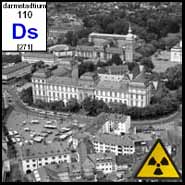
| Element | |
|---|---|
110DsDarmstadtium2812
8 18 32 32 16 2 |
|
| Basic properties | |
|---|---|
| Atomic number | 110 |
| Atomic weight | 281 amu |
| Element family | Transition metals |
| Period | 7 |
| Group | 2 |
| Block | s-block |
| Discovery year | 1994 |
| Isotope distribution |
|---|
| None |
| Physical properties | |
|---|---|
| Density | 27 g/cm3 (STP) |
Atomic hydrogen (H) 8.988E-5 Meitnerium (Mt) 28 | |
| Chemical properties | |
|---|---|
| Oxidation states (less common) | (+2, +4, +6) |
| Atomic radius | |
|---|---|
| Covalent radius | 1.28 Å |
Atomic hydrogen (H) 0.32 Francium (Fr) 2.6 | |
| Electronic properties | |
|---|---|
| Electrons per shell | 2, 8, 18, 32, 32, 16, 2 |
| Electronic configuration | [Rn] 5f14 |
|
Bohr atom model
| |
|
Orbital box diagram
| |
| Valence electrons | 10 |
| Lewis dot structure |
|
| Orbital Visualization | |
|---|---|
|
| |
| Electrons | - |
Darmstadtium (Ds): Periodic Table Element
Abstract
Darmstadtium (symbol Ds, atomic number 110) represents one of the most challenging synthetic superheavy elements in modern nuclear chemistry. This extremely radioactive transactinide element occupies position 110 in the periodic table as the eighth member of the 6d transition metal series and belongs to group 10 alongside nickel, palladium, and platinum. First synthesized at the GSI Helmholtz Centre for Heavy Ion Research in Darmstadt, Germany in 1994, darmstadtium exists only in the form of artificially created isotopes with exceptionally short half-lives. The most stable known isotope, 281Ds, exhibits a half-life of approximately 14 seconds. Despite its transient existence, theoretical calculations predict darmstadtium would demonstrate chemical properties similar to platinum, potentially forming compounds such as darmstadtium hexafluoride and exhibiting noble metal characteristics with preferential oxidation states of +2, +4, and +6.
Introduction
Darmstadtium occupies a unique position within the superheavy element regime, representing the culmination of decades of research into the synthesis and characterization of transactinide elements. Located in period 7, group 10 of the periodic table, this synthetic element bridges the gap between the established transition metals and the theoretical predictions of the island of stability. The element's atomic number of 110 places it firmly within the superheavy element category, where the delicate balance between nuclear binding energy and Coulombic repulsion determines the fleeting existence of these exotic atomic species.
The significance of darmstadtium extends beyond its position as a mere addition to the periodic table. As the eighth member of the 6d series, it provides crucial insights into the electronic structure and chemical behavior of superheavy elements under extreme relativistic effects. These relativistic influences profoundly alter the electronic configurations and chemical properties compared to lighter homologues, making darmstadtium a fascinating subject for both theoretical predictions and experimental verification of quantum mechanical models at the limits of atomic stability.
Physical Properties and Atomic Structure
Fundamental Atomic Parameters
Darmstadtium possesses an atomic number of 110, indicating 110 protons within its nucleus and, for neutral atoms, an equal number of electrons distributed across its electronic shells. The element's electronic configuration is predicted to be [Rn] 5f14 6d8 7s2, following the Aufbau principle despite platinum's anomalous 5d9 6s1 configuration. This adherence to expected electron filling patterns results from the relativistic stabilization of the 7s2 electron pair throughout the seventh period, preventing the promotion of 7s electrons to the 6d orbital that characterizes platinum's ground state.
The atomic radius of darmstadtium is calculated to be approximately 132 pm, placing it between the ionic radii of its lighter group 10 congeners. Relativistic effects significantly influence these dimensions, with the contraction of s and p orbitals balanced by the expansion of d and f orbitals. The effective nuclear charge experienced by valence electrons increases substantially due to incomplete shielding by inner electrons, particularly the filled 5f14 subshell, which provides relatively poor screening compared to d electrons.
Macroscopic Physical Characteristics
Theoretical predictions indicate darmstadtium would manifest as a dense, metallic solid under standard conditions. Unlike its lighter homologues nickel, palladium, and platinum, which crystallize in face-centered cubic structures, darmstadtium is expected to adopt a body-centered cubic crystal lattice due to altered electron charge distributions arising from relativistic effects. This structural divergence demonstrates the profound influence of relativistic phenomena on bulk material properties in superheavy elements.
The calculated density of darmstadtium ranges from 26 to 27 g/cm3, substantially exceeding that of osmium (22.61 g/cm3), currently the densest naturally occurring element. This exceptional density reflects the extremely compact nuclear structure and the relativistic contraction of atomic dimensions characteristic of superheavy elements. Thermodynamic properties remain entirely theoretical, with no experimental determinations of melting point, boiling point, or heat capacities possible given the element's extraordinarily short half-life and limited production quantities.
Chemical Properties and Reactivity
Electronic Structure and Bonding Behavior
The 6d8 7s2 electronic configuration of darmstadtium determines its fundamental chemical behavior and bonding characteristics. The availability of d electrons for bonding suggests the element would exhibit variable oxidation states, with the +2, +4, and +6 states predicted as most stable based on analogies with platinum chemistry. However, relativistic effects significantly modify the energy levels and availability of these electrons for chemical bonding compared to lighter group 10 elements.
Theoretical calculations indicate that darmstadtium would preferentially remain in lower oxidation states in aqueous solution, with the neutral state predicted as thermodynamically most favorable. This tendency contrasts with platinum's well-established +2 and +4 chemistry in solution. The formation of coordination complexes would likely involve similar geometries to platinum compounds, with square planar configurations expected for the +2 oxidation state and octahedral arrangements for higher oxidation states.
Electrochemical and Thermodynamic Properties
The electrochemical behavior of darmstadtium remains largely theoretical, with calculations suggesting a standard reduction potential for the Ds2+/Ds couple of approximately 1.7 V. This value indicates strongly noble character, exceeding even platinum's nobility and suggesting exceptional resistance to oxidation under standard conditions. Successive ionization energies follow the expected trend of increasing values with progressive electron removal, though relativistic effects compress the energy differences between successive ionizations compared to lighter elements.
Electron affinity values and electronegativity estimates place darmstadtium among the more electronegative transition metals, though precise values remain computationally challenging due to the complex interplay of relativistic effects and electron correlation in heavy atoms. The element's position in group 10 suggests electronegativity values intermediate between platinum and its theoretical heavier congener, ununnilium (element 118 if it existed in this group).
Chemical Compounds and Complex Formation
Binary and Ternary Compounds
Theoretical investigations predict several potentially stable darmstadtium compounds, with darmstadtium hexafluoride (DsF6) receiving the most detailed computational attention. This compound is expected to exhibit remarkable similarity to platinum hexafluoride, sharing similar molecular geometry, electronic structure, and volatility characteristics. The octahedral coordination geometry predicted for DsF6 reflects the d8 electron configuration in the +6 oxidation state.
Additional predicted binary compounds include darmstadtium tetrachloride (DsCl4) and darmstadtium carbide (DsC), both anticipated to demonstrate properties analogous to their platinum counterparts. The formation of oxides remains theoretically possible, though the extreme instability of darmstadtium isotopes prevents experimental verification of oxide stability or stoichiometry. Thermodynamic calculations suggest that higher oxidation states would be more accessible in the gas phase than in condensed phases or aqueous solution.
Coordination Chemistry and Organometallic Compounds
The coordination chemistry of darmstadtium is predicted to diverge from platinum in several significant aspects due to relativistic effects and the altered electronic structure. Unlike platinum, which readily forms Pt(CN)2 complexes in the +2 oxidation state, darmstadtium is calculated to preferentially form [Ds(CN)2]2- complexes while maintaining its neutral oxidation state. This preference indicates stronger Ds-C bond formation with enhanced multiple bond character compared to platinum-carbon interactions.
The theoretical organometallic chemistry of darmstadtium would likely encompass compounds with various carbon-based ligands, including carbonyl complexes and alkyl derivatives. However, the extreme synthetic challenges associated with producing sufficient quantities of darmstadtium atoms preclude experimental investigation of these potentially fascinating molecular systems. Computational studies suggest that organometallic darmstadtium compounds would exhibit enhanced stability compared to their platinum analogues due to stronger metal-carbon bonding interactions.
Natural Occurrence and Isotopic Analysis
Geochemical Distribution and Abundance
Darmstadtium exhibits no natural occurrence on Earth, existing exclusively as a laboratory-synthesized element produced through artificial nuclear reactions. The element's complete absence from terrestrial and extraterrestrial samples reflects the fundamental instability of all known darmstadtium isotopes, which undergo rapid radioactive decay processes that prevent accumulation in any natural environment. Crustal abundance values are effectively zero, with no detectable quantities found in geological surveys or meteoritic analyses.
The absence of darmstadtium from stellar nucleosynthesis processes results from the extremely high neutron densities and specific reaction conditions required for superheavy element formation. While theoretical models suggest possible superheavy element synthesis during explosive stellar events such as supernovae or neutron star mergers, the rapid decay of these species prevents their survival and incorporation into planetary systems or interstellar media.
Nuclear Properties and Isotopic Composition
Eleven radioactive isotopes of darmstadtium have been synthesized and characterized, with mass numbers ranging from 267 to 281. No stable isotopes exist, and all known isotopes undergo radioactive decay primarily through alpha particle emission, with some heavier isotopes also exhibiting spontaneous fission decay modes. The most stable isotope, 281Ds, possesses a half-life of approximately 14 seconds, representing the longest-lived darmstadtium species currently known.
The isotopic pattern reveals the complex nuclear physics governing superheavy element stability. Lighter isotopes such as 269Ds and 271Ds display half-lives on the order of microseconds to milliseconds, while progression toward neutron-rich isotopes generally increases stability. Metastable nuclear states have been identified for 270Ds, 271Ds, and possibly 281Ds, indicating complex nuclear structure effects in these extreme nuclei. Theoretical predictions suggest that even heavier, currently unknown isotopes such as 294Ds might achieve substantially longer half-lives, potentially reaching hundreds of years due to shell closure effects at neutron number 184.
Industrial Production and Technological Applications
Extraction and Purification Methodologies
Darmstadtium production relies exclusively on nuclear synthesis techniques employing heavy-ion accelerators and specialized target preparation methodologies. The primary synthetic route involves bombardment of lead-208 targets with accelerated nickel-62 projectiles, producing 269Ds through single neutron evaporation. Alternative production pathways include lead-208 bombardment with nickel-64 ions to generate 271Ds, and thorium-232 bombardment with calcium-48 to produce neutron-rich isotopes 276Ds and 277Ds.
Production rates remain extraordinarily low, with typical synthesis experiments yielding only a few atoms per hour or even per day of continuous bombardment. The GSI Helmholtz Centre detection of three darmstadtium atoms over an eight-day period in 1994 illustrates the minute quantities involved in superheavy element research. Purification techniques are entirely unnecessary given the immediate detection and identification of individual atoms through sophisticated particle detection systems that monitor alpha decay signatures and correlate them with known daughter product decay patterns.
Technological Applications and Future Prospects
Current applications of darmstadtium remain limited to fundamental nuclear physics research and the advancement of superheavy element synthesis techniques. The element serves as a crucial stepping stone in the quest to reach the predicted island of stability, where longer-lived superheavy isotopes might enable practical applications. Research involving darmstadtium contributes to the refinement of nuclear models, the understanding of relativistic effects in heavy atoms, and the development of more efficient particle accelerator technologies.
Future prospects for darmstadtium applications hinge entirely on the potential discovery of significantly more stable isotopes. Should theoretical predictions prove accurate and isotopes with half-lives measured in hours, days, or longer be synthesized, darmstadtium might find applications in specialized catalysis, nuclear medicine, or advanced materials science. However, these possibilities remain highly speculative and dependent on substantial advances in nuclear synthesis capabilities and the confirmation of enhanced stability in neutron-rich superheavy nuclei.
Historical Development and Discovery
The discovery of darmstadtium culminated from decades of research into superheavy element synthesis pioneered by institutions worldwide. The successful creation of element 110 occurred on November 9, 1994, at the GSI Helmholtz Centre for Heavy Ion Research in Darmstadt, Germany, under the direction of Sigurd Hofmann, with key contributions from Peter Armbruster and Gottfried Münzenberg. This achievement involved the detection of a single 269Ds atom produced through the fusion reaction 208Pb + 62Ni → 269Ds + n.
Prior attempts at element 110 synthesis had occurred at various international laboratories throughout the 1980s and early 1990s, including efforts at the Joint Institute for Nuclear Research in Dubna and Lawrence Berkeley National Laboratory. The German team's success followed systematic optimization of beam energies, target preparation, and detection systems. Subsequent confirmation experiments produced additional darmstadtium isotopes, solidifying the discovery and enabling detailed nuclear property measurements. The International Union of Pure and Applied Chemistry officially recognized the GSI team's discovery in 2001, leading to the adoption of the name "darmstadtium" in honor of the city where the element was first created.
Conclusion
Darmstadtium represents a remarkable achievement in synthetic chemistry and nuclear physics, demonstrating humanity's ability to create and study atomic species that exist nowhere naturally in the universe. Its position as the heaviest confirmed group 10 element provides invaluable insights into the behavior of matter under extreme conditions and validates theoretical models of superheavy element chemistry. While current research remains limited to nuclear property measurements and theoretical predictions, darmstadtium serves as a crucial waypoint toward understanding the chemical landscape of the superheavy element regime.
Future investigations into darmstadtium chemistry await the development of more efficient synthesis methods and the potential discovery of longer-lived isotopes. The element's role in advancing our understanding of relativistic effects in heavy atoms, nuclear structure at the limits of stability, and the theoretical boundaries of the periodic table ensures its continued importance in fundamental chemical research. As experimental techniques evolve and theoretical models become more sophisticated, darmstadtium will undoubtedly continue to reveal new insights into the nature of matter at the extremes of nuclear stability.

Please let us know how we can improve this web app.