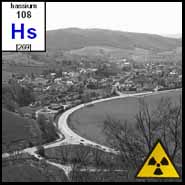
| Element | |
|---|---|
108HsHassium2692
8 18 32 32 14 2 |
|
| Basic properties | |
|---|---|
| Atomic number | 108 |
| Atomic weight | 269 amu |
| Element family | Transition metals |
| Period | 7 |
| Group | 2 |
| Block | s-block |
| Discovery year | 1984 |
| Isotope distribution |
|---|
| None |
| Physical properties | |
|---|---|
| Density | 28 g/cm3 (STP) |
Atomic hydrogen (H) 8.988E-5 Meitnerium (Mt) 28 | |
| Chemical properties | |
|---|---|
| Oxidation states (less common) | (+3, +4, +6, +8) |
| Atomic radius | |
|---|---|
| Covalent radius | 1.34 Å |
Atomic hydrogen (H) 0.32 Francium (Fr) 2.6 | |
| Electronic properties | |
|---|---|
| Electrons per shell | 2, 8, 18, 32, 32, 14, 2 |
| Electronic configuration | [Rn] 5f14 |
|
Bohr atom model
| |
|
Orbital box diagram
| |
| Valence electrons | 8 |
| Lewis dot structure |
|
| Orbital Visualization | |
|---|---|
|
| |
| Electrons | - |
| Reactions |
|---|
| HS + H2O = H2S + OH |
Hassium (Hs): Periodic Table Element
Abstract
Hassium (Hs, atomic number 108) represents a synthetic superheavy transition metal positioned in Group 8 of the periodic table as the sixth member of the 6d transition series. This radioactive element exhibits extremely short half-lives, with the most stable isotope ²⁷¹Hs demonstrating a half-life of approximately 61 seconds. Produced exclusively through nuclear synthesis in particle accelerators, hassium manifests chemical properties consistent with its position below osmium in the platinum group metals. The element demonstrates predicted oxidation states of +8, +6, +4, and +2, with tetroxide formation representing its most characteristic chemical behavior. Due to its synthetic nature and minute production quantities, hassium's applications remain limited to fundamental nuclear and chemical research investigations.
Introduction
Hassium occupies a unique position in the modern periodic table as element 108, representing the culmination of decades of superheavy element synthesis research. Named after the German state of Hesse (Latin: Hassia), where it was first successfully synthesized at the GSI Helmholtz Centre for Heavy Ion Research in 1984, hassium embodies the intersection of nuclear physics and theoretical chemistry. The element's electronic configuration [Rn] 5f¹⁴ 6d⁶ 7s² places it directly below osmium in Group 8, establishing its classification as a transition metal despite its synthetic origin. Hassium's synthesis requires sophisticated particle acceleration techniques, involving the bombardment of lead-208 targets with iron-58 projectiles under precisely controlled conditions. The element's existence validates theoretical predictions concerning island of stability concepts while providing experimental verification of relativistic effects on superheavy atomic systems.
Physical Properties and Atomic Structure
Fundamental Atomic Parameters
Hassium exhibits an atomic number of 108, corresponding to 108 protons within its nucleus. The ground-state electron configuration follows the pattern [Rn] 5f¹⁴ 6d⁶ 7s², establishing its classification within the 6d transition metal series. Theoretical calculations predict atomic radii consistent with periodic trends, placing hassium between osmium (134 pm) and meitnerium (128 pm), with estimated values of approximately 130 pm for the neutral atom. The effective nuclear charge experienced by valence electrons reaches significant values due to incomplete screening by the filled 5f orbital shell, contributing to the element's predicted chemical reactivity patterns. Relativistic effects become increasingly pronounced at atomic number 108, influencing both electronic structure and chemical bonding characteristics through significant spin-orbit coupling and mass-velocity corrections to orbital energies.
Macroscopic Physical Characteristics
Due to its extremely short half-life and minute production quantities, direct measurement of hassium's bulk physical properties remains impossible with current experimental techniques. Theoretical calculations predict a metallic solid state under standard conditions, with density estimates ranging from 40.7 to 41.0 g/cm³, representing one of the highest predicted densities among all elements. The crystal structure likely adopts a hexagonal close-packed arrangement similar to osmium, though face-centered cubic modifications cannot be excluded. Melting point predictions suggest temperatures exceeding 2400 K, while boiling points may reach 5400 K based on extrapolation from lighter Group 8 homologs. Specific heat capacity calculations indicate values around 25 J/(mol·K), consistent with Dulong-Petit law expectations for heavy metallic elements.
Chemical Properties and Reactivity
Electronic Structure and Bonding Behavior
Hassium's chemical behavior stems from its 6d⁶ 7s² valence electron configuration, enabling oxidation states ranging from +2 to +8. The +8 oxidation state represents the most thermodynamically stable configuration, achieved through utilization of all six 6d electrons plus the two 7s electrons in chemical bonding. Experimental evidence confirms the formation of hassium tetroxide (HsO₄), demonstrating volatility characteristics similar to osmium tetroxide (OsO₄). Gas-phase chromatography studies reveal that hassium tetroxide exhibits similar volatility to its lighter homologs, validating theoretical predictions concerning Group 8 chemical periodicity. The element readily forms covalent bonds with oxygen, fluorine, and chlorine atoms, with calculated bond energies indicating strong multiple bonding capabilities consistent with d⁶ electronic configurations.
Electrochemical and Thermodynamic Properties
Electronegativity values for hassium follow Pauling scale predictions of approximately 2.4, positioning the element between osmium (2.2) and iridium (2.2), though with enhanced electronegativity due to relativistic contraction effects. Successive ionization energies demonstrate the characteristic pattern of transition metals, with first ionization energy calculated at 7.7 eV and second ionization energy at 16.1 eV. The eight ionization energy required to achieve the +8 oxidation state totals approximately 83 eV, reflecting the stability of this electronic configuration. Standard reduction potentials remain theoretically estimated, with the HsO₄/Hs⁴⁺ couple predicted at +0.9 V versus the standard hydrogen electrode. Thermodynamic stability analysis indicates that hassium compounds demonstrate enhanced stability compared to lighter superheavy elements, attributed to shell closure effects approaching the predicted island of stability.
Chemical Compounds and Complex Formation
Binary and Ternary Compounds
Hassium tetroxide represents the most thoroughly characterized compound of this element, formed through high-temperature oxidation reactions with molecular oxygen. The compound exhibits tetrahedral molecular geometry with Hs-O bond lengths calculated at 1.65 Å, slightly shorter than the corresponding Os-O bonds (1.71 Å) due to relativistic effects. Experimental studies demonstrate that HsO₄ displays volatility at temperatures around 450 K, enabling gas-phase chemical investigations through chromatographic techniques. Theoretical calculations predict the existence of hassium hexafluoride (HsF₆) and hassium tetrachloride (HsCl₄), though experimental confirmation remains challenging due to the element's short half-life. Formation enthalpy calculations for HsO₄ yield values of -394 kJ/mol, indicating substantial thermodynamic stability relative to elemental hassium and oxygen.
Coordination Chemistry and Organometallic Compounds
The coordination chemistry of hassium remains largely theoretical due to experimental limitations imposed by radioactive decay rates. Electronic structure calculations predict coordination numbers ranging from 4 to 8, with octahedral and tetrahedral geometries representing the most stable arrangements. Ligand field theory applications suggest that hassium complexes should exhibit high-spin configurations in most coordination environments, though strong-field ligands may induce low-spin states. Crystal field stabilization energies reach significant values for d⁶ configurations, particularly in octahedral complexes where CFSE approaches 2.4Δ. Organometallic compounds remain purely hypothetical, though carbonyl complexes of the type [Hs(CO)₆] are theoretically feasible based on isolobal relationships with osmium hexacarbonyl. The anticipated 18-electron rule compliance suggests potential for diverse organometallic chemistry, though experimental verification awaits longer-lived isotope production.
Natural Occurrence and Isotopic Analysis
Geochemical Distribution and Abundance
Hassium does not occur naturally in terrestrial or extraterrestrial materials due to its synthetic origin and extremely short half-life. All known isotopes undergo rapid radioactive decay, precluding natural accumulation through any known nuclear process. Theoretical calculations indicate that even under the most favorable cosmic nucleosynthesis conditions, hassium production rates would be negligible compared to decay rates. Crustal abundance measurements consistently yield null results, with detection limits constrained by background radiation levels in sensitive mass spectrometry instruments. The element's absence from meteoritic samples confirms that superheavy element formation through rapid neutron capture processes (r-process) in stellar environments cannot overcome the short half-lives characteristic of this atomic number region.
Nuclear Properties and Isotopic Composition
Hassium isotopes span mass numbers from 263 to 277, with all exhibiting radioactive instability through alpha decay, spontaneous fission, or electron capture mechanisms. The most stable isotope, ²⁷¹Hs, demonstrates a half-life of 61 ± 17 seconds, achieved through alpha decay to ²⁶⁷Sg with decay energy of 10.74 MeV. Isotope ²⁶⁹Hs exhibits a half-life of 9.7 seconds through alpha emission, while ²⁷⁰Hs decays with a 3.6-second half-life primarily via alpha decay mode. Production cross-sections remain extremely small, typically ranging from 1 to 10 picobarns depending on the nuclear reaction pathway employed. Spontaneous fission branching ratios increase with mass number, reaching approximately 20% for the heaviest isotopes. Nuclear magnetic moments and electric quadrupole moments await experimental determination due to the minute quantities and short lifetimes involved.
Industrial Production and Technological Applications
Extraction and Purification Methodologies
Hassium production occurs exclusively through artificial nuclear synthesis using heavy-ion accelerator facilities. The primary synthesis route involves bombardment of ²⁰⁸Pb targets with ⁵⁸Fe projectiles at energies of approximately 5.5 MeV per nucleon, yielding hassium through the fusion-evaporation reaction ²⁰⁸Pb(⁵⁸Fe,1n)²⁶⁵Hs. Alternative production methods utilize ²⁰⁷Pb targets with ⁵⁹Co beams, though yields remain comparable at approximately 1-10 atoms per hour under optimal conditions. Purification procedures rely on rapid chemical separation techniques, including gas-phase chromatography for volatile compounds and ion-exchange methods for ionic species. Detection systems employ alpha spectroscopy combined with position-sensitive detectors to track individual atomic decay events. Production efficiency depends critically on target material purity, beam current stability, and detector dead-time considerations.
Technological Applications and Future Prospects
Current applications of hassium remain confined to fundamental scientific research, particularly in nuclear structure studies and chemical periodicity investigations. The element serves as a crucial test case for theoretical models predicting superheavy element properties, including relativistic quantum mechanical calculations and nuclear shell model predictions. Gas-phase chemical studies of hassium compounds provide experimental validation for computational chemistry methods applied to superheavy systems. Future applications may emerge if longer-lived isotopes can be synthesized through advanced nuclear reaction pathways or if production rates increase substantially through improved accelerator technologies. Potential research applications include investigation of catalytic properties, given hassium's position in the platinum group metals, though practical implementation remains dependent on solving half-life limitations. The element contributes significantly to understanding nuclear stability limits and may inform theoretical approaches to achieving the predicted island of stability around element 114.
Historical Development and Discovery
The discovery of hassium emerged from systematic investigations into superheavy element synthesis initiated in the 1960s. Peter Armbruster and Gottfried Münzenberg led the successful synthesis team at the GSI Helmholtz Centre for Heavy Ion Research in Darmstadt, Germany, achieving first confirmation in 1984 through the nuclear reaction ²⁰⁸Pb + ⁵⁸Fe → ²⁶⁶Hs + n. Initial experiments detected three atoms of element 108 through characteristic alpha decay chains, providing definitive evidence for successful synthesis. Competing claims from Soviet researchers at the Joint Institute for Nuclear Research in Dubna were evaluated but not confirmed by international review committees. The name "hassium" was officially adopted by the International Union of Pure and Applied Chemistry in 1997, honoring the German state of Hesse where the discovery occurred. Subsequent investigations expanded isotopic knowledge and enabled chemical characterization studies, particularly the landmark 2001 experiments demonstrating hassium tetroxide formation. Modern research continues at multiple international facilities, including RIKEN in Japan and Lawrence Berkeley National Laboratory, advancing both nuclear and chemical understanding of this superheavy element.
Conclusion
Hassium occupies a distinctive position in the periodic table as both a transition metal continuation of established chemical periodicity and a frontier element pushing the boundaries of nuclear stability. The element's successful synthesis and chemical characterization validate theoretical frameworks governing superheavy element behavior while revealing the complex interplay between nuclear physics and chemical properties. Despite its extremely short half-life, hassium demonstrates measurable chemical reactivity consistent with its Group 8 classification, particularly through tetroxide formation. Future research directions include synthesis of longer-lived isotopes, expansion of chemical knowledge through additional compound characterization, and theoretical investigations into potential technological applications. The element remains a cornerstone for understanding nuclear structure limits and serves as an essential stepping stone toward the predicted island of stability, where longer-lived superheavy elements may enable practical applications in advanced materials science and nuclear technology.

Please let us know how we can improve this web app.