Printed from https://www.webqc.org

Tantalum @ Periodic Table of Chemical Elements

12345678 910111213141516 1718
IIIIIIbIVb VbVIbVIIbVIIIbIb IIbIIIIVVVI VIIVIII
1H
1.0079
2He
4.0026
3Li
6.9412
4Be
9.0121
5B
10.811
6C
12.010
7N
14.006
8O
15.999
9F
18.998
10Ne
20.179
11Na
22.989
12Mg
24.305
13Al
26.981
14Si
28.085
15P
30.973
16S
32.065
17Cl
35.453
18Ar
39.948
19K
39.098
20Ca
40.078
21Sc
44.955
22Ti
47.867
23V
50.941
24Cr
51.996
25Mn
54.938
26Fe
55.845
27Co
58.933
28Ni
58.693
29Cu
63.546
30Zn
65.409
31Ga
69.723
32Ge
72.641
33As
74.921
34Se
78.963
35Br
79.904
36Kr
83.798
37Rb
85.467
38Sr
87.621
39Y
88.905
40Zr
91.224
41Nb
92.906
42Mo
95.942
43Tc
98.906
44Ru
101.07
45Rh
102.90
46Pd
106.42
47Ag
107.86
48Cd
112.41
49In
114.81
50Sn
118.71
51Sb
121.76
52Te
127.60
53I
126.90
54Xe
131.29
55Cs
132.90
56Ba
137.32
57La
138.90
72Hf
178.49
73Ta
180.94
74W
183.84
75Re
186.20
76Os
190.23
77Ir
192.21
78Pt
195.08
79Au
196.96
80Hg
200.59
81Tl
204.38
82Pb
207.21
83Bi
208.98
84Po
208.98
85At
209.98
86Rn
222.01
87Fr
223.01
88Ra
226.02
89Ac
227.02
104Rf
261.10
105Db
262.11
106Sg
266.12
107Bh
264.12
108Hs
269
109Mt
278
110Ds
281
111Rg
282
112Cn
285
113Nh
286
114Fl
289
115Mc
290
116Lv
293
117Ts
294
118Og
294
Lanthanoids58Ce
140.11
59Pr
140.90
60Nd
144.24
61Pm
146.91
62Sm
150.36
63Eu
151.96
64Gd
157.25
65Tb
158.92
66Dy
162.50
67Ho
164.93
68Er
167.25
69Tm
168.93
70Yb
173.04
71Lu
174.96
Actinoids90Th
232.03
91Pa
231.03
92U
238.02
93Np
237.04
94Pu
244.06
95Am
243.06
96Cm
247.07
97Bk
247.07
98Cf
251.07
99Es
252.08
100Fm
257.09
101Md
258.09
102No
259.10
103Lr
260.10
Alkali metals Alkali earth metals Transition metals Other metals Metaloids Non-metals Halogens Noble gases
Element

73

Ta

Tantalum

180.94791

2
8
18
32
11
2
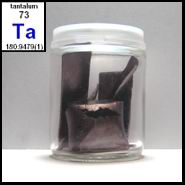
Tantalum photo
Basic properties
Atomic number73
Atomic weight180.94791 amu
Element familyTransition metals
Period6
Group2
Blocks-block
Discovery year1802
Isotope distribution
181Ta
99.988%
Physical properties
Density 16.654 g/cm3 (STP)
Atomic hydrogen (H) 8.988E-5
Meitnerium (Mt) 28
Melting2996 °C
Helium (He) -272.2
Carbon (C) 3675
Boiling5425 °C
Helium (He) -268.9
Tungsten (W) 5927
Chemical properties
Oxidation states
(less common)
+5
(-3, -1, 0, +1, +2, +3, +4)
First ionization potential 7.887 eV
Cesium (Cs) 3.894
Helium (He) 24.587
Electron affinity 0.323 eV
Nobelium (No) -2.33
Atomic chlorine (Cl) 3.612725
Electronegativity1.5
Cesium (Cs) 0.79
Atomic fluorine (F) 3.98
Atomic radius
Covalent radius 1.46 Å
Atomic hydrogen (H) 0.32
Francium (Fr) 2.6
Metallic radius 1.46 Å
Beryllium (Be) 1.12
Cesium (Cs) 2.65
73TaWebQC.OrgCovalentMetallic
Compounds
FormulaNameOxidation state
TaAl3Tantalum trialuminide+3
TaAsTantalum arsenide+3
TaCl3Tantalum(III) chloride+3
TaNTantalum nitride+3
TaCTantalum carbide+4
Ta4HfC5Tantalum hafnium carbide+4
TaS2Tantalum(IV) sulfide+4
TaSe2Tantalum diselenide+4
Ta2O5Tantalum(V) oxide+5
NdTaO4Neodymium tantalate+5
TaCl5Tantalum(V) chloride+5
TaF5Tantalum pentafluoride+5
Electronic properties
Electrons per shell2, 8, 18, 32, 11, 2
Electronic configuration[Xe] 4f145d36s2
Bohr atom model
Bohr atom model
Orbital box diagram
Orbital box diagram
Valence electrons5
Lewis dot structure Tantalum Lewis dot structure
Orbital Visualization
🏠
▶️
📐
Electrons-

Tantalum (Ta): Periodic Table Element

Scientific Review Article | Chemistry Reference Series

Abstract

Tantalum (Ta, atomic number 73) represents a remarkable transition metal characterized by exceptional corrosion resistance, extreme hardness, and extraordinary high-temperature stability. With a melting point of 3017°C and density of 16.65 g/cm³, tantalum exhibits superior mechanical properties and chemical inertness that distinguish it among refractory metals. The element manifests predominantly pentavalent oxidation states in its compounds, demonstrates body-centered cubic crystal structure, and occurs naturally alongside niobium in minerals such as tantalite and columbite. Industrial applications span electronic capacitors, surgical implants, chemical processing equipment, and aerospace components, reflecting tantalum's unique combination of biocompatibility, thermal stability, and electrochemical properties.

Introduction

Tantalum occupies position 73 in the periodic table as a member of Group 5 (vanadium group) and the third transition series. The element's electron configuration [Xe] 4f¹⁴ 5d³ 6s² establishes its chemical characteristics through partially filled d-orbitals, enabling multiple oxidation states and complex formation. Tantalum exhibits exceptional resistance to chemical attack below 150°C, surpassing most metals in corrosion resistance except under specific conditions involving hydrofluoric acid or alkaline fusion. The element's discovery by Anders Ekeberg in 1802 initiated extensive research into its separation from the chemically similar niobium, a challenge that persisted for decades due to their nearly identical chemical properties. Modern applications exploit tantalum's unique combination of mechanical strength, biocompatibility, and electronic properties.

Physical Properties and Atomic Structure

Fundamental Atomic Parameters

Tantalum possesses atomic number 73 with standard atomic weight 180.94788 ± 0.00002 u, reflecting the predominant occurrence of the stable isotope ¹⁸¹Ta (99.988% natural abundance). The atomic radius measures 146 pm, while ionic radii vary with coordination number and oxidation state: Ta⁵⁺ exhibits 64 pm in octahedral coordination. Effective nuclear charge calculations indicate substantial shielding effects from inner electrons, particularly the filled 4f subshell, influencing chemical bonding patterns. The first ionization energy of 761 kJ/mol reflects moderate electron removal difficulty, whereas successive ionization energies increase substantially (1500, 2300, 3400, and 5100 kJ/mol), demonstrating the stability of core electronic configurations.

Macroscopic Physical Characteristics

Tantalum exhibits distinctive blue-gray metallic appearance with brilliant luster when polished. The metal crystallizes in body-centered cubic structure (space group Im3m) with lattice parameter a = 0.33029 nm at 20°C. Density measurements yield 16.65 g/cm³, positioning tantalum among the densest elements. Thermal properties include melting point 3017°C, boiling point 5458°C, heat of fusion 36.6 kJ/mol, and heat of vaporization 753 kJ/mol. Specific heat capacity equals 0.140 J/(g·K) at 25°C. A metastable beta phase exists with tetragonal structure, exhibiting higher hardness (1000-1300 HN) compared to the alpha phase (200-400 HN). Electrical resistivity measures 15-60 μΩ·cm for alpha tantalum, increasing to 170-210 μΩ·cm for the beta phase.

Chemical Properties and Reactivity

Electronic Structure and Bonding Behavior

The d³ electronic configuration in tantalum's outer shell facilitates oxidation states ranging from -3 to +5, with +5 being most prevalent in compounds. Tantalum demonstrates remarkable chemical inertness attributed to formation of protective oxide layers, primarily Ta₂O₅. Bond formation involves d-orbital participation, enabling coordination numbers from 4 to 8 in various compounds. Covalent bond energies vary significantly: Ta-O bonds (799 kJ/mol), Ta-C bonds (575 kJ/mol), and Ta-Ta bonds (390 kJ/mol) in metallic phase. Hybridization patterns in compounds typically involve d²sp³ arrangements for octahedral geometries. The element's electronegativity (Pauling scale: 1.5) indicates moderate electron-attracting capability, facilitating diverse bonding interactions.

Electrochemical and Thermodynamic Properties

Tantalum exhibits electronegativity values of 1.5 (Pauling), 1.8 (Mulliken), and 3.6 (Allred-Rochow), indicating moderate electronegativity characteristics. Standard reduction potentials demonstrate thermodynamic stability: Ta₂O₅/Ta (-0.75 V), TaF₆⁻/Ta (-0.45 V). Electron affinity measurements yield 31 kJ/mol, reflecting weak electron acceptance tendency. Successive ionization energies progress systematically, with the fifth ionization (9370 kJ/mol) required to achieve the common +5 oxidation state. Thermodynamic calculations reveal negative Gibbs free energy of formation for major compounds: Ta₂O₅ (-2046 kJ/mol), TaC (-184 kJ/mol), confirming thermodynamic stability under standard conditions.

Chemical Compounds and Complex Formation

Binary and Ternary Compounds

Tantalum pentoxide (Ta₂O₅) represents the most significant binary oxide, exhibiting polymorphic behavior with multiple crystal structures including orthorhombic and hexagonal forms. The compound demonstrates exceptional thermal stability and chemical inertness, properties exploited in high-temperature ceramics. Tantalum halides span multiple oxidation states: TaF₅ (colorless solid, mp 97°C), TaCl₅ (yellow solid existing as dimeric Ta₂Cl₁₀), and lower halides TaX₄ and TaX₃ featuring metal-metal bonds. Tantalum carbide (TaC) exhibits face-centered cubic structure with exceptional hardness (Vickers 1800-2000) and melting point exceeding 4000°C. Nitride compounds include TaN with cubic structure and Ta₃N₅ demonstrating semiconductor properties. Ternary compounds encompass tantalates such as LiTaO₃ (lithium tantalate) with perovskite structure utilized in piezoelectric applications.

Coordination Chemistry and Organometallic Compounds

Tantalum coordination complexes typically exhibit coordination numbers 6-8, with octahedral geometry predominating in Ta(V) species. The heptafluorotantalate anion [TaF₇]²⁻ demonstrates pentagonal bipyramidal geometry, utilized industrially for tantalum-niobium separation. Oxofluoride complexes such as [TaOF₅]²⁻ exhibit distorted octahedral structures. Organometallic chemistry encompasses pentamethyltantalum Ta(CH₃)₅, alkylidene complexes featuring Ta=CHR bonds, and cyclopentadienyl derivatives Cp₂TaX₃. Carbonyl complexes include the anionic species [Ta(CO)₆]⁻ and substituted derivatives with isocyanides. Catalytic applications exploit tantalum alkylidene complexes in olefin metathesis reactions, demonstrating synthetic utility in organic transformations.

Natural Occurrence and Isotopic Analysis

Geochemical Distribution and Abundance

Tantalum abundance in Earth's crust averages approximately 1-2 ppm by weight, concentrated primarily in granitic rocks and pegmatites. Geochemical behavior involves fractionation from niobium during crystallization processes, though separation remains limited due to similar ionic radii and chemical properties. Principal minerals include tantalite [(Fe,Mn)Ta₂O₆], columbite-tantalite series [(Fe,Mn)(Nb,Ta)₂O₆], microlite [(Na,Ca)₂Ta₂O₆(O,OH,F)], and wodginite [(Mn,Fe)SnTa₂O₈]. Placer deposits result from weathering and transport of primary pegmatite sources. Global distribution encompasses Australia, Democratic Republic of Congo, Rwanda, Brazil, and Canada, with production shifting significantly toward African sources since 2000.

Nuclear Properties and Isotopic Composition

Natural tantalum consists principally of ¹⁸¹Ta (99.988% abundance) and trace amounts of ¹⁸⁰ᵐTa (0.012% abundance). The metastable isotope ¹⁸⁰ᵐTa represents the rarest primordial nuclide, with theoretical decay predicted through three pathways: isomeric transition to ¹⁸⁰Ta, beta decay to ¹⁸⁰W, or electron capture to ¹⁸⁰Hf. Experimental half-life determinations establish lower limits exceeding 2.9×10¹⁷ years, indicating extraordinary stability. Nuclear spin states include I = 7/2 for ¹⁸¹Ta and I = 9 for ¹⁸⁰ᵐTa. Artificial isotopes range from ¹⁵⁶Ta to ¹⁹⁰Ta, with half-lives varying from microseconds to decades. Neutron cross-sections indicate thermal capture probability of 20.6 barns for ¹⁸¹Ta, relevant to nuclear reactor applications.

Industrial Production and Technological Applications

Extraction and Purification Methodologies

Industrial tantalum extraction begins with mineral concentration through gravity separation, exploiting density differences between tantalum-bearing minerals and gangue materials. Primary processing involves digestion with hydrofluoric acid and sulfuric acid, converting oxides to soluble fluoride complexes: Ta₂O₅ + 14HF → 2H₂[TaF₇] + 5H₂O. Solvent extraction employs organic solvents including methyl isobutyl ketone, cyclohexanone, or octanol to selectively extract tantalum fluoride complexes from aqueous solutions. Separation from niobium exploits differential behavior under varying acid concentrations, with niobium forming oxyfluoride species H₂[NbOF₅] preferentially partitioning to aqueous phases. Purification culminates in precipitation of hydrated tantalum oxide through ammonia neutralization, followed by calcination to Ta₂O₅. Metal production involves reduction with sodium at 800°C: K₂[TaF₇] + 5Na → Ta + 5NaF + 2KF.

Technological Applications and Future Prospects

Electronic applications dominate tantalum consumption, primarily through capacitor manufacturing utilizing sintered tantalum powder as anodes. Tantalum capacitors achieve superior capacitance-to-volume ratios due to thin dielectric layers of Ta₂O₅, enabling miniaturization in portable electronics. Superalloy applications exploit tantalum's refractory properties in jet engine components, chemical processing equipment, and high-temperature furnace components. Surgical implants utilize tantalum's biocompatibility and osseointegration capabilities, particularly in orthopedic and dental applications. Chemical processing industries employ tantalum-lined reactors and heat exchangers for corrosive environments. Emerging applications include quantum computing resonators, sputter targets for semiconductor fabrication, and additive manufacturing powders. Research directions focus on tantalum-based catalysts for green chemistry applications and advanced energy storage systems.

Historical Development and Discovery

Anders Ekeberg discovered tantalum in 1802 while analyzing mineral samples from Sweden and Finland, initially naming the element after the Greek mythological figure Tantalus due to its "incapacity to absorb acid" when immersed in chemical solutions. Early confusion arose when William Hyde Wollaston concluded in 1809 that tantalum and columbium (niobium) were identical elements, based on similar oxide densities. This misconception persisted until Heinrich Rose demonstrated in 1844 the existence of distinct elements, proposing names niobium and pelopium for components within tantalite samples. Definitive proof of tantalum-niobium distinction emerged through work by Christian Wilhelm Blomstrand, Henri Sainte-Claire Deville, and Louis Troost in 1864-1866. Jean Charles Galissard de Marignac produced metallic tantalum through hydrogen reduction of tantalum chloride in 1864. Commercial purification methods evolved from fractional crystallization of potassium heptafluorotantalate to modern solvent extraction techniques. Werner von Bolton achieved pure ductile tantalum production in 1903, enabling early applications including incandescent lamp filaments before tungsten replacement.

Conclusion

Tantalum represents a technologically crucial element whose unique combination of chemical inertness, mechanical strength, and electronic properties ensures continued relevance in advanced applications. The element's position in Group 5 of the periodic table, characterized by d³ electronic configuration, enables diverse oxidation states and complex formation patterns essential to its industrial utility. Future research directions encompass sustainable extraction methodologies, novel biomedical applications exploiting osseointegration properties, and advanced electronic applications in quantum technologies. Environmental considerations regarding mining practices and conflict mineral sources drive development of alternative supply chains and recycling technologies. Tantalum's exceptional properties position it as an indispensable material for emerging technologies requiring extreme performance under demanding conditions.

Periodict table
Please let us know how we can improve this web app.

Menu Balance Molar mass Gas laws Units Chemistry tools Periodic table Chemical forum Symmetry Constants Contribute Contact us
How to cite?