| Element | |
|---|---|
46PdPalladium106.4212
8 18 18 0 |
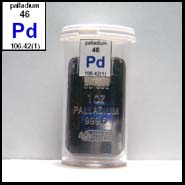
|
| Basic properties | |
|---|---|
| Atomic number | 46 |
| Atomic weight | 106.421 amu |
| Element family | Transition metals |
| Period | 5 |
| Group | 0 |
| Block | s-block |
| Discovery year | 1802 |
| Isotope distribution |
|---|
102Pd 1.020% 104Pd 11.14% 105Pd 22.33% 106Pd 27.33% 108Pd 26.46% 110Pd 11.72% |
102Pd (1.02%) 104Pd (11.14%) 105Pd (22.33%) 106Pd (27.33%) 108Pd (26.46%) 110Pd (11.72%) |
| Physical properties | |
|---|---|
| Density | 12.02 g/cm3 (STP) |
Atomic hydrogen (H) 8.988E-5 Meitnerium (Mt) 28 | |
| Melting | 1552 °C |
Helium (He) -272.2 Carbon (C) 3675 | |
| Boiling | 3140 °C |
Helium (He) -268.9 Tungsten (W) 5927 | |
| Chemical properties | |
|---|---|
| Oxidation states (less common) | 0, +2, +4 (+1, +3, +5) |
| First ionization potential | 8.337 eV |
Cesium (Cs) 3.894 Helium (He) 24.587 | |
| Electron affinity | 0.562 eV |
Nobelium (No) -2.33 Atomic chlorine (Cl) 3.612725 | |
| Electronegativity | 2.2 |
Cesium (Cs) 0.79 Atomic fluorine (F) 3.98 | |
| Atomic radius | |
|---|---|
| Covalent radius | 1.2 Å |
Atomic hydrogen (H) 0.32 Francium (Fr) 2.6 | |
| Van der Waals radius | 1.63 Å |
Atomic hydrogen (H) 1.2 Francium (Fr) 3.48 | |
| Metallic radius | 1.37 Å |
Beryllium (Be) 1.12 Cesium (Cs) 2.65 | |
| Compounds | ||
|---|---|---|
| Formula | Name | Oxidation state |
| PdCl2 | Palladium(II) chloride | +2 |
| Pd(NO3)2 | Palladium(II) nitrate | +2 |
| Na2PdCl4 | Sodium tetrachloropalladate | +2 |
| Pd(CN)2 | Palladium dicyanide | +2 |
| PdBr2 | Palladium(II) bromide | +2 |
| PdF2 | Palladium(II) fluoride | +2 |
| PdI2 | Palladium(II) iodide | +2 |
| PdO | Palladium(II) oxide | +2 |
| PdS | Palladium(II) sulfide | +2 |
| PdF4 | Palladium tetrafluoride | +4 |
| PdF6 | Palladium hexafluoride | +6 |
| Electronic properties | |
|---|---|
| Electrons per shell | 2, 8, 18, 18, 0 |
| Electronic configuration | [Kr] 4d10 |
|
Bohr atom model

| |
|
Orbital box diagram

| |
| Valence electrons | 10 |
| Lewis dot structure |
|
| Orbital Visualization | |
|---|---|
|
| |
| Electrons | - |
Palladium (Pd): Periodic Table Element
Abstract
Palladium is a rare transition metal element with atomic number 46 and symbol Pd, characterized by its distinctive silvery-white lustrous appearance and exceptional catalytic properties. As a member of the platinum group metals, palladium exhibits unique electronic structure with a completely filled 4d10 configuration and empty 5s orbital, making it the lightest and least dense of the platinum group elements. The element demonstrates remarkable chemical versatility, existing predominantly in oxidation states 0 and +2, with extensive coordination chemistry and organometallic applications. Palladium's extraordinary hydrogen absorption capacity, superior catalytic activity in cross-coupling reactions, and resistance to corrosion establish its critical importance in automotive catalytic converters, electronics manufacturing, chemical synthesis, and hydrogen purification technologies.
Introduction
Palladium occupies a distinctive position in the periodic table as element 46, belonging to group 10 and period 5 among the transition metals. Within the platinum group metals (PGMs), palladium exhibits the lowest melting point at 1828.05 K and the lowest density of 12.023 g/cm³, distinguishing it from its heavier congeners platinum, rhodium, ruthenium, iridium, and osmium. The element's electronic configuration [Kr] 4d10 represents an exceptional case among period 5 elements, where the 5s orbital remains completely vacant while the 4d subshell achieves complete filling according to Hund's rule optimization. This electronic arrangement confers unique chemical and physical properties that have revolutionized catalytic chemistry since William Hyde Wollaston's discovery in 1802. Modern palladium applications span automotive exhaust treatment, semiconductor manufacturing, fine chemical synthesis, and emerging hydrogen economy technologies, with global annual production reaching approximately 210,000 kg.
Physical Properties and Atomic Structure
Fundamental Atomic Parameters
Palladium exhibits atomic number Z = 46 with standard atomic mass 106.42 ± 0.01 u, placing it centrally within the second-row transition metal series. The ground-state electronic configuration [Kr] 4d10 deviates from Aufbau principle predictions, with complete 4d orbital occupancy and vacant 5s level representing the most thermodynamically stable arrangement. This configuration yields atomic radius 137 pm and ionic radius 86 pm for Pd2+, consistent with lanthanide contraction effects. Effective nuclear charge calculations indicate Zeff ≈ 16.2 for 4d electrons, with screening constants reflecting inner-shell electron shielding. The unique 5s0 4d10 configuration makes palladium the heaviest element possessing only one incomplete electron shell, with all higher-energy orbitals remaining unoccupied.
Macroscopic Physical Characteristics
Palladium crystallizes in face-centered cubic structure with lattice parameter a = 3.8907 Å at ambient conditions, exhibiting metallic bonding through delocalized d-electron interactions. The element displays characteristic silvery-white metallic luster with high reflectivity across visible wavelengths. Thermal properties include melting point 1828.05 K, boiling point 3236 K, heat of fusion 16.74 kJ/mol, and heat of vaporization 358.1 kJ/mol. Density measurements yield 12.023 g/cm³ at 293 K, with thermal expansion coefficient 11.8 × 10⁻⁶ K-1. Specific heat capacity reaches 25.98 J/(mol·K) at standard conditions. Mechanical properties demonstrate considerable ductility and malleability when annealed, with hardness increasing substantially upon cold working through dislocation multiplication mechanisms. Electrical conductivity measures 9.5 × 10⁶ S/m with thermal conductivity 71.8 W/(m·K), reflecting efficient electron transport through the metallic lattice.
Chemical Properties and Reactivity
Electronic Structure and Bonding Behavior
The filled d10 configuration of palladium governs its chemical behavior through d-orbital availability for back-bonding and ligand field interactions. Common oxidation states include Pd(0) in organometallic complexes and Pd(II) in coordination compounds, with Pd(IV) species exhibiting thermodynamic instability under ambient conditions. Bond formation involves dsp3 and dsp2 hybridization patterns, yielding tetrahedral and square planar geometries respectively. Palladium-carbon bonds demonstrate lengths 1.95-2.10 Å with dissociation energies 180-220 kJ/mol, facilitating oxidative addition and reductive elimination processes central to catalytic cycles. Coordination chemistry predominantly features square planar Pd(II) complexes with coordination numbers 4, exhibiting strong-field ligand preferences and pronounced trans effects in substitution reactions.
Electrochemical and Thermodynamic Properties
Electrochemical behavior of palladium reflects its position in the electrochemical series with standard reduction potential E°(Pd2+/Pd) = +0.987 V, indicating noble metal character and resistance to oxidation. Successive ionization energies measure 804.4 kJ/mol (first) and 1870 kJ/mol (second), consistent with d-electron removal energetics. Electronegativity values span 2.20 (Pauling scale) and 1.35 (Mulliken scale), reflecting moderate electron-withdrawing capacity. Electron affinity reaches 54.24 kJ/mol, indicating weak tendency for electron capture. Thermodynamic stability manifests through positive standard formation enthalpies for most palladium compounds, with oxide formation requiring elevated temperatures above 1073 K. Redox chemistry involves facile Pd(0)/Pd(II) interconversion in organic media, enabling catalytic turnover in cross-coupling reactions.
Chemical Compounds and Complex Formation
Binary and Ternary Compounds
Palladium binary compounds encompass oxides, halides, chalcogenides, and intermetallic phases with diverse structural motifs and bonding characteristics. Palladium(II) oxide PdO crystallizes in tetragonal symmetry with Pd-O distances 2.02 Å, formed through thermal oxidation above 1073 K with ΔHf° = -85.4 kJ/mol. Halide series includes PdF2, PdCl2, PdBr2, and PdI2, exhibiting increasing ionic character with decreasing electronegativity difference. Palladium(II) chloride exists in α and β polymorphs, with α-PdCl2 featuring infinite chains and β-PdCl2 displaying discrete dimeric units. Chalcogenide compounds PdS, PdSe, and PdTe adopt tetragonal structures with metallic conductivity. Ternary compounds include palladides with stoichiometry RPd3 where R represents rare earth elements, exhibiting ordered intermetallic arrangements.
Coordination Chemistry and Organometallic Compounds
Palladium coordination complexes demonstrate extensive ligand diversity with phosphines, nitrogen donors, carbenes, and π-system ligands forming thermodynamically stable species. Square planar geometry predominates for Pd(II) complexes following crystal field stabilization principles, with ligand field splitting Δ ≈ 2.1 eV for strong-field ligands. Representative complexes include [PdCl2(PPh3)2] and [Pd(en)2]Cl2, exhibiting Pd-P distances 2.28 Å and Pd-N distances 2.04 Å respectively. Organometallic chemistry encompasses σ-alkyl, π-allyl, and η2-alkene complexes with carbon-palladium bonds ranging 2.0-2.2 Å. N-heterocyclic carbene ligands form particularly robust Pd-C bonds with dissociation energies exceeding 250 kJ/mol, providing thermal stability for catalytic applications. Zero-valent complexes Pd(PPh3)4 and Pd2(dba)3 serve as precatalysts with tetrahedral and trigonal coordination geometries.
Natural Occurrence and Isotopic Analysis
Geochemical Distribution and Abundance
Palladium exhibits extremely low crustal abundance of 15 ppb, concentrating primarily in ultramafic igneous complexes through magmatic differentiation processes. The element associates geochemically with platinum group metals in layered intrusions, with major deposits occurring in the Bushveld Complex (South Africa), Norilsk-Talnakh (Russia), Stillwater Complex (Montana), and Sudbury Basin (Ontario). Chalcophile behavior during magmatic processes leads to concentration in sulfide-rich zones, with palladium-bearing minerals including cooperite (PtS), braggite ((Pt,Pd,Ni)S), and polarite (Pd(Bi,Pb)). Geochemical mobility remains limited under surface conditions due to noble metal stability, with placer concentrations forming through mechanical weathering and transport of primary deposits.
Nuclear Properties and Isotopic Composition
Natural palladium comprises six stable isotopes with mass numbers 102, 104, 105, 106, 108, and 110, exhibiting abundances 1.02%, 11.14%, 22.33%, 27.33%, 26.46%, and 11.72% respectively. Nuclear properties include zero nuclear spin for even-even isotopes and spin-½ for 105Pd with magnetic moment +0.642 μN. Radioactive isotopes encompass mass range 91-123, with 107Pd displaying longest half-life 6.5 × 10⁶ years through electron capture decay. Nuclear cross-sections for thermal neutron absorption range 2.9-3.2 barns for major isotopes, with 108Pd exhibiting highest absorption coefficient. Fission product yield of 107Pd from 235U reaches 0.15%, contributing to nuclear waste palladium content in spent reactor fuel.
Industrial Production and Technological Applications
Extraction and Purification Methodologies
Industrial palladium extraction employs pyrometallurgical and hydrometallurgical techniques optimized for platinum group metal recovery from low-grade ores. Primary extraction involves high-temperature smelting at 1773-1873 K to produce sulfide mattes enriched in PGMs, followed by pressure oxidation leaching with sulfuric acid at 473 K and 2-4 bar oxygen pressure. Solvent extraction utilizes specialized organic phases including dibutyl carbitol and Alamine 336 for selective palladium recovery with >95% efficiency. Purification proceeds through precipitation as palladium(II) diamminedichloride, followed by hydrogen reduction at 773 K to yield metallic palladium with 99.95% purity. Annual global production reaches 210,000 kg, with Russia (42%), South Africa (38%), Canada (8%), and United States (6%) dominating supply chains.
Technological Applications and Future Prospects
Catalytic converter applications consume approximately 80% of palladium production, utilizing the element's exceptional ability to catalyze hydrocarbon oxidation, carbon monoxide conversion, and nitrogen oxide reduction at exhaust temperatures 573-1073 K. Three-way catalysts achieve >90% pollutant conversion through simultaneous oxidation and reduction reactions on palladium surfaces. Electronic applications encompass multi-layer ceramic capacitors with palladium electrodes providing stable electrical properties and soldering resistance. Hydrogen purification membranes exploit palladium's selective permeability, with hydrogen diffusivity 1.6 × 10⁻⁷ m2/s at 773 K enabling ultra-high purity production. Emerging applications include fuel cell electrodes, biomedical implants, and nanocatalysis for sustainable chemical processes. Market dynamics project continued growth driven by automotive emission regulations, electronic device miniaturization, and hydrogen economy development.
Historical Development and Discovery
William Hyde Wollaston announced palladium discovery in July 1802 during systematic analysis of South American platinum ore residues, employing dissolution in aqua regia followed by selective precipitation techniques. The naming convention honored asteroid 2 Pallas, discovered months earlier and representing the largest of the then-known celestial bodies. Initial skepticism from Richard Chenevix, who proposed palladium as a platinum-mercury alloy, generated scientific controversy resolved through Wollaston's anonymous reward offer for synthetic palladium preparation. Chenevix's failure to reproduce alleged alloy composition vindicated elemental palladium status, with subsequent spectroscopic and crystallographic analyses confirming unique metallic properties. Industrial applications emerged during World War II as strategic platinum substitutes, followed by revolutionary developments in homogeneous catalysis during the 1960s. The 2010 Nobel Prize in Chemistry recognized palladium-catalyzed cross-coupling reactions, establishing the element's central role in modern synthetic chemistry.
Conclusion
Palladium represents a singular element within the periodic table, combining exceptional catalytic activity with unique electronic structure and chemical versatility. The element's filled d10 configuration and noble metal characteristics enable diverse applications spanning environmental protection, advanced materials synthesis, and energy technology. Current research directions encompass single-atom catalysis, hydrogen storage optimization, and biomedical applications, positioning palladium as essential for sustainable technology development. Supply security considerations and recycling initiatives will determine future availability, while fundamental research continues expanding understanding of palladium's catalytic mechanisms and coordination chemistry. The element's scientific significance extends beyond immediate applications to represent fundamental principles of transition metal chemistry and heterogeneous catalysis.

Please let us know how we can improve this web app.
