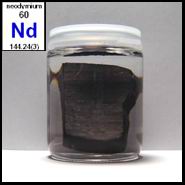
| Element | |
|---|---|
60NdNeodymium144.24232
8 18 22 8 2 |
|
| Basic properties | |
|---|---|
| Atomic number | 60 |
| Atomic weight | 144.2423 amu |
| Element family | N/A |
| Period | 6 |
| Group | 2 |
| Block | s-block |
| Discovery year | 1885 |
| Isotope distribution |
|---|
142Nd 27.13% 143Nd 12.18% 145Nd 8.30% 146Nd 17.19% 148Nd 5.76% |
142Nd (38.45%) 143Nd (17.26%) 145Nd (11.76%) 146Nd (24.36%) 148Nd (8.16%) |
| Physical properties | |
|---|---|
| Density | 7.007 g/cm3 (STP) |
Atomic hydrogen (H) 8.988E-5 Meitnerium (Mt) 28 | |
| Melting | 1016 °C |
Helium (He) -272.2 Carbon (C) 3675 | |
| Boiling | 3127 °C |
Helium (He) -268.9 Tungsten (W) 5927 | |
| Chemical properties | |
|---|---|
| Oxidation states (less common) | +3 (0, +2, +4) |
| First ionization potential | 5.525 eV |
Cesium (Cs) 3.894 Helium (He) 24.587 | |
| Electron affinity | 0.097 eV |
Nobelium (No) -2.33 Atomic chlorine (Cl) 3.612725 | |
| Electronegativity | 1.14 |
Cesium (Cs) 0.79 Atomic fluorine (F) 3.98 | |
| Atomic radius | |
|---|---|
| Covalent radius | 1.74 Å |
Atomic hydrogen (H) 0.32 Francium (Fr) 2.6 | |
| Metallic radius | 1.81 Å |
Beryllium (Be) 1.12 Cesium (Cs) 2.65 | |
| Compounds | ||
|---|---|---|
| Formula | Name | Oxidation state |
| NdBr2 | Neodymium(II) bromide | +2 |
| NdCl2 | Neodymium(II) chloride | +2 |
| NdH2 | Neodymium(II) hydride | +2 |
| NdI2 | Neodymium(II) iodide | +2 |
| Nd(ClO4)3 | Neodymium(III) perchlorate | +3 |
| Nd(NO3)3 | Neodymium nitrate | +3 |
| Nd(OH)3 | Neodymium(III) hydroxide | +3 |
| Nd(ReO4)3 | Neodymium perrhenate | +3 |
| Nd2(C2O4)3 | Neodymium(III) oxalate | +3 |
| Nd2(CO3)3 | Neodymium(III) carbonate | +3 |
| Nd2(MoO4)3 | Neodymium molybdate | +3 |
| Nd2(SO4)3 | Neodymium(III) sulfate | +3 |
| Electronic properties | |
|---|---|
| Electrons per shell | 2, 8, 18, 22, 8, 2 |
| Electronic configuration | [Xe] 4f4 |
|
Bohr atom model
| |
|
Orbital box diagram
| |
| Valence electrons | 6 |
| Lewis dot structure |
|
| Orbital Visualization | |
|---|---|
|
| |
| Electrons | - |
Neodymium (Nd): Periodic Table Element
Abstract
Neodymium (Nd), atomic number 60, represents the fourth member of the lanthanide series and constitutes one of the most industrially significant rare-earth metals. This silvery-white metal exhibits exceptional magnetic properties when alloyed with iron and boron, forming the strongest known permanent magnets. Neodymium demonstrates unique optical characteristics through sharp absorption bands that create distinctive coloration in glass and laser applications. With a melting point of 1024°C and boiling point of 3074°C, neodymium maintains structural stability under diverse industrial conditions. The element exhibits predominantly +3 oxidation states, though +2 and +4 states occur under specific conditions. Crustal abundance reaches approximately 41 mg/kg, comparable to copper and nickel. Primary commercial extraction occurs from bastnäsite and monazite minerals, with China dominating global production. Applications span high-performance permanent magnets in electric vehicles, wind turbines, and electronic devices, alongside specialized laser systems and optical filters.
Introduction
Neodymium occupies position 60 in the periodic table, residing between praseodymium and promethium within the lanthanide series. The element's discovery in 1885 by Carl Auer von Welsbach marked a crucial advancement in rare-earth chemistry, emerging from the separation of didymium into neodymium and praseodymium components. Electronic configuration [Xe]4f46s2 defines the fundamental chemical behavior, with four unpaired 4f electrons contributing to its complex spectroscopic properties and magnetic characteristics. Industrial significance centers upon permanent magnet technology, where neodymium-iron-boron compositions achieve unparalleled magnetic field strengths. Optical applications exploit the element's sharp f-f electronic transitions, producing distinctive absorption spectra utilized in laser gain media and specialized glass formulations. Global strategic importance emerges from concentrated production sources and essential roles in renewable energy technologies, electric vehicle systems, and advanced electronics.
Physical Properties and Atomic Structure
Fundamental Atomic Parameters
Neodymium exhibits atomic number 60 with standard atomic weight 144.242±0.003 u. Electronic configuration [Xe]4f46s2 places four unpaired electrons in the 4f subshell, creating the foundation for its distinctive magnetic and optical properties. Atomic radius measures 185 pm, while the Nd3+ ionic radius reaches 98.3 pm in octahedral coordination. Effective nuclear charge experienced by valence electrons reflects the poor shielding capacity of 4f orbitals, resulting in gradual atomic contraction across the lanthanide series. First ionization energy equals 533.1 kJ/mol, second ionization energy 1040 kJ/mol, and third ionization energy 2130 kJ/mol, with the significant increase reflecting removal from the highly shielded 4f subshell. Electronegativity on the Pauling scale measures 1.14, indicating electropositive character typical of lanthanide metals.
Macroscopic Physical Characteristics
Metallic neodymium presents a bright silvery-white appearance with characteristic metallic luster that tarnishes rapidly upon air exposure. Crystal structure transitions from double hexagonal close-packed at room temperature to body-centered cubic above 863°C. Density reaches 7.007 g/cm3 at 20°C, positioning neodymium among the lighter lanthanides. Melting point occurs at 1024°C (1297 K), while boiling point reaches 3074°C (3347 K), demonstrating substantial thermal stability. Heat of fusion measures 7.14 kJ/mol, heat of vaporization equals 289 kJ/mol, and specific heat capacity reaches 27.45 J/(mol·K) at 298 K. Thermal expansion coefficient equals 9.6×10⁻⁶ K-1 at room temperature. Magnetic properties include paramagnetic behavior above 20 K, with antiferromagnetic ordering below this temperature accompanied by complex spin arrangements and extended relaxation times characteristic of frustrated magnetic systems.
Chemical Properties and Reactivity
Electronic Structure and Bonding Behavior
Chemical reactivity derives primarily from the availability of 4f and 6s electrons, though bonding predominantly involves s and d orbitals due to the contracted nature of 4f functions. The +3 oxidation state dominates neodymium chemistry, achieved through loss of both 6s electrons and one 4f electron, forming the stable Nd3+ configuration with [Xe]4f3 arrangement. Less common +2 and +4 oxidation states occur under specific conditions, with Nd2+ exhibiting [Xe]4f4 configuration and enhanced stability due to half-filled f subshell characteristics. Coordination chemistry typically involves coordination numbers between 8 and 12, reflecting the large ionic radius and minimal directional bonding requirements. Bond energies in Nd-O systems average 703 kJ/mol, while Nd-F bonds reach approximately 590 kJ/mol. Ionic bonding predominates in most compounds, with limited covalent character arising from minimal orbital overlap between 4f and ligand orbitals.
Electrochemical and Thermodynamic Properties
Standard reduction potential for Nd3+/Nd couple equals -2.431 V, establishing neodymium as a strong reducing agent comparable to other early lanthanides. Successive ionization energies of 533.1, 1040, and 2130 kJ/mol reflect the increasing difficulty of electron removal from progressively more stable configurations. Electronegativity value of 1.14 on the Pauling scale indicates pronounced electropositive character and strong affinity for electronegative elements including oxygen, fluorine, and chlorine. Electron affinity measurements remain uncertain due to experimental difficulties, though theoretical calculations suggest slightly positive values. Thermodynamic stability of Nd3+ compounds exceeds that of alternative oxidation states under ambient conditions, with formation enthalpies for common oxides and halides ranging from -600 to -1800 kJ/mol depending upon anion identity and crystal structure. Aqueous solution chemistry involves extensive hydration, forming [Nd(H2O)9]3+ complexes with characteristic lilac coloration.
Chemical Compounds and Complex Formation
Binary and Ternary Compounds
Neodymium(III) oxide (Nd2O3) represents the most thermodynamically stable binary compound, adopting the hexagonal A-type rare-earth oxide structure with space group P3̄m1. Formation occurs readily through air oxidation at elevated temperatures according to the reaction 4Nd + 3O2 → 2Nd2O3, with standard formation enthalpy -1807.9 kJ/mol. Halide compounds include NdF3 (melting point 1377°C), NdCl3 (melting point 758°C), NdBr3 (melting point 682°C), and NdI3 (melting point 787°C), each exhibiting distinctive coloration ranging from violet to green depending upon halide identity. Binary compounds with chalcogens include Nd2S3 and Nd2Se3, both adopting complex layered structures with mixed coordination environments. Ternary compounds encompass various categories including perovskites, garnets, and complex oxides such as NdFeO3 and Nd3Al5O12, many exhibiting ferromagnetic or ferrimagnetic behavior at low temperatures.
Coordination Chemistry and Organometallic Compounds
Coordination complexes typically exhibit coordination numbers between 8 and 12, reflecting the large ionic radius of Nd3+ and absence of crystal field stabilization effects. Common geometries include dodecahedral, tricapped trigonal prismatic, and icosahedral arrangements depending upon ligand steric requirements and electronic preferences. Aqueous coordination involves nine water molecules in [Nd(H2O)9]3+ complexes, though coordination numbers vary with solution conditions and competing ligands. Organometallic chemistry centers upon cyclopentadienyl derivatives, including Nd(C5H5)3 and related substituted complexes exhibiting typical lanthanide characteristics of high ionic character and limited π-backbonding capability. Alkyl and aryl derivatives demonstrate thermal instability and high reactivity toward air and moisture, limiting practical applications. Recent developments include metallocene catalysts for olefin polymerization, exploiting the large ionic radius and high electrophilicity of neodymium centers.
Natural Occurrence and Isotopic Analysis
Geochemical Distribution and Abundance
Crustal abundance of neodymium reaches approximately 41 mg/kg (41 ppm), establishing it among the more abundant rare-earth elements and comparable to common metals including copper, nickel, and cobalt. Geochemical behavior follows typical lithophile patterns, concentrating in silicate phases and exhibiting strong affinity for oxygen-bearing minerals. Primary mineral hosts include bastnäsite [(Ce,La,Nd,Pr)CO3F], monazite [(Ce,La,Nd,Th)PO4], and xenotime [YPO4], though neodymium rarely dominates mineral compositions except in specialized occurrences. Concentration mechanisms involve magmatic differentiation, hydrothermal alteration, and weathering processes that separate light from heavy rare-earth elements. Marine geochemistry utilizes neodymium isotope ratios as paleoceanographic tracers, reflecting water mass mixing and thermohaline circulation patterns. Continental distribution shows highest concentrations in alkaline igneous complexes, carbonatites, and placer deposits derived from these primary sources.
Nuclear Properties and Isotopic Composition
Natural neodymium comprises seven isotopes including five stable nuclides (142Nd, 143Nd, 145Nd, 146Nd, 148Nd) and two extremely long-lived radioisotopes (144Nd, 150Nd). Isotopic abundances are 142Nd (27.2%), 143Nd (12.2%), 144Nd (23.8%), 145Nd (8.3%), 146Nd (17.2%), 148Nd (5.7%), and 150Nd (5.6%). The 144Nd isotope undergoes alpha decay with half-life 2.29×10¹⁵ years, while 150Nd exhibits double beta decay with half-life approximately 9×10¹⁸ years. Nuclear spin values include I=0 for even-even isotopes and various half-integer values for odd-mass nuclides. Magnetic moments range from 0 for even-even isotopes to -1.065 nuclear magnetons for 143Nd. Cross-sections for thermal neutron capture vary significantly among isotopes, with 143Nd exhibiting particularly high absorption (324 barns), making isotopic composition crucial for nuclear applications. Artificial isotopes include 147Nd (half-life 10.98 days) and numerous shorter-lived species produced in accelerator facilities.
Industrial Production and Technological Applications
Extraction and Purification Methodologies
Commercial neodymium production begins with mining of bastnäsite and monazite ores, predominantly in Chinese deposits accounting for approximately 85% of global supply. Initial processing involves acid cracking using concentrated sulfuric acid at temperatures exceeding 200°C, liberating rare-earth elements from mineral matrices while generating toxic byproducts including hydrogen fluoride and radioactive thorium compounds. Separation employs solvent extraction techniques utilizing tributyl phosphate or bis(2-ethylhexyl)phosphoric acid in hydrocarbon diluents, exploiting subtle differences in extraction coefficients among lanthanides. Sequential extraction stages achieve purities exceeding 99.9% through careful pH control and multiple extraction-stripping cycles. Ion exchange methods provide alternative purification routes for highest-purity applications, utilizing selective resins and carefully controlled elution gradients. Metal production occurs through molten salt electrolysis of anhydrous neodymium chloride at temperatures near 1000°C, yielding metallic neodymium with purities suitable for permanent magnet production. Annual global production reaches approximately 7000 tonnes, with demand projected to increase substantially due to expanding clean energy applications.
Technological Applications and Future Prospects
Permanent magnet applications dominate neodymium consumption, with Nd2Fe14B compositions achieving maximum energy products exceeding 50 MGOe and coercivities approaching 3 Tesla. Electric vehicle motors require approximately 1 kg neodymium per vehicle, while wind turbine generators utilize 150-600 kg depending upon design specifications and power ratings. Consumer electronics applications include hard disk drives, headphones, loudspeakers, and smartphone components where miniaturization demands maximum magnetic field strengths per unit volume. Laser technology exploits neodymium-doped crystals and glasses, particularly Nd:YAG and Nd:YVO4 systems generating coherent radiation at 1064 nm wavelength with applications in industrial cutting, medical procedures, and scientific research. Glass coloration utilizes neodymium oxide additions to produce distinctive purple hues that shift color under different illumination conditions, finding applications in specialty glass, welding safety equipment, and astronomical filters. Emerging applications include magnetic refrigeration systems, high-temperature superconductor flux pinning, and advanced battery technologies. Supply security concerns drive research into alternative magnet compositions, recycling technologies, and extraction from unconventional sources including deep-sea nodules and electronic waste streams.
Historical Development and Discovery
The discovery of neodymium traces to systematic investigations of rare-earth elements during the late 19th century. In 1751, Axel Fredrik Cronstedt identified cerite mineral from Bastnäs mine, though its complex rare-earth composition remained unknown. Carl Scheele's analysis in 1751 failed to identify new elements within the sample. Significant progress occurred in 1803 when Wilhelm Hisinger and Jöns Jacob Berzelius isolated ceria (cerium oxide) from cerite, simultaneously with Martin Heinrich Klaproth's independent work in Germany. Carl Gustaf Mosander's investigations between 1839-1843 revealed ceria's composite nature, separating lanthana and didymia fractions through fractional precipitation techniques. The crucial breakthrough came in 1885 when Carl Auer von Welsbach successfully separated didymia into two components using ammonium nitrate fractional crystallization methods. Spectroscopic analysis confirmed the presence of two distinct elements, which Welsbach named neodymium (new twin) and praseodymium (green twin) based upon their characteristic colors. Pure metallic neodymium remained elusive until 1925, when improved electrolytic techniques enabled isolation of substantial quantities. Commercial applications emerged gradually, beginning with glass coloration in 1927 and expanding dramatically with permanent magnet development in the 1980s.
Conclusion
Neodymium's unique combination of magnetic, optical, and chemical properties establishes its critical importance in modern technology and sustainable energy systems. The element's position within the lanthanide series provides distinctive 4f electronic configurations that generate unparalleled permanent magnet performance when alloyed with iron and boron, enabling miniaturization and efficiency improvements across numerous applications. Industrial significance extends from renewable energy infrastructure through electric vehicle propulsion to advanced laser systems and specialized optical devices. Continued research focuses upon addressing supply chain vulnerabilities through alternative sources, improved recycling methods, and substitute materials development. Future applications may expand into quantum technologies, advanced energy storage, and next-generation computing systems, maintaining neodymium's strategic importance for decades to come.

Please let us know how we can improve this web app.