| Element | |
|---|---|
91PaProtactinium231.0358822
8 18 32 20 9 2 |
|
| Basic properties | |
|---|---|
| Atomic number | 91 |
| Atomic weight | 231.035882 amu |
| Element family | Actinoids |
| Period | 7 |
| Group | 2 |
| Block | s-block |
| Discovery year | 1913 |
| Isotope distribution |
|---|
| None |
| Physical properties | |
|---|---|
| Density | 15.37 g/cm3 (STP) |
Atomic hydrogen (H) 8.988E-5 Meitnerium (Mt) 28 | |
| Melting | 1600 °C |
Helium (He) -272.2 Carbon (C) 3675 | |
| Boiling | 4030 °C |
Helium (He) -268.9 Tungsten (W) 5927 | |
| Chemical properties | |
|---|---|
| Oxidation states (less common) | +5 (+2, +3, +4) |
| First ionization potential | 5.887 eV |
Cesium (Cs) 3.894 Helium (He) 24.587 | |
| Electron affinity | 0.550 eV |
Nobelium (No) -2.33 Atomic chlorine (Cl) 3.612725 | |
| Electronegativity | 1.5 |
Cesium (Cs) 0.79 Atomic fluorine (F) 3.98 | |
| Electronic properties | |
|---|---|
| Electrons per shell | 2, 8, 18, 32, 20, 9, 2 |
| Electronic configuration | [Rn] 5f2 |
|
Bohr atom model

| |
|
Orbital box diagram

| |
| Valence electrons | 5 |
| Lewis dot structure |
|
| Orbital Visualization | |
|---|---|
|
| |
| Electrons | - |
Protactinium (Pa): Periodic Table Element
Abstract
Protactinium (Pa, Z=91) represents a dense, radioactive actinide metal with atomic mass 231.036 u. This silvery-gray metal crystallizes in body-centered tetragonal structure at room temperature and demonstrates paramagnetic behavior with superconductivity below 1.4 K. The element exhibits primary oxidation states of +4 and +5, forming numerous compounds including oxides, halides, and organometallic complexes. Protactinium occurs naturally at concentrations of 0.3-3 parts per million in uraninite ores, arising through uranium-235 decay with a half-life of 32,760 years. Despite its position between thorium and uranium in the periodic table, protactinium finds no commercial applications due to its scarcity, high radioactivity (0.048 Ci/g), and toxicity. Current research applications focus on radiometric dating of sediments up to 175,000 years old and paleoceanographic studies. The element's discovery involved multiple researchers between 1913-1918, with Lise Meitner and Otto Hahn receiving primary credit for identifying the stable ²³¹Pa isotope.
Introduction
Protactinium occupies a unique position in the periodic table as element 91, situated between thorium (Z=90) and uranium (Z=92) within the actinide series. The element's discovery fulfilled Dmitri Mendeleev's 1871 prediction of an element between thorium and uranium, completing a significant gap in early periodic table formulations. Protactinium exhibits electronic configuration [Rn]5f²6d¹7s² and demonstrates characteristic actinide properties including multiple oxidation states and complex coordination chemistry. Natural protactinium exists primarily as ²³¹Pa, formed through α-decay of uranium-235 with production rate of approximately 7.4 × 10⁻¹⁸ g per gram of natural uranium annually. The element's rarity, with crustal abundance of 1.4 × 10⁻¹² g/g, combined with its radioactive nature, presents significant challenges for chemical investigation and technological development.
Physical Properties and Atomic Structure
Fundamental Atomic Parameters
Protactinium exhibits atomic number 91 with electronic configuration [Rn]5f²6d¹7s², placing two electrons in the 5f orbital and one in the 6d orbital. The atomic radius measures 161 pm, intermediate between thorium (179 pm) and uranium (156 pm), reflecting progressive actinide contraction. Ionic radii vary with oxidation state: Pa⁴⁺ measures 104 pm while Pa⁵⁺ contracts to 92 pm, consistent with increased nuclear charge effects. The first ionization energy equals 568 kJ/mol, lower than thorium (608 kJ/mol) but higher than uranium (598 kJ/mol). Successive ionization energies increase to 1128, 1814, 2991, and 4174 kJ/mol for the second through fifth electrons, with the fifth ionization corresponding to 5f⁰ electronic configuration. Electronegativity measures 1.5 on the Pauling scale, reflecting moderate electron-attracting capability typical of early actinides.
Macroscopic Physical Characteristics
Protactinium crystallizes in body-centered tetragonal structure (space group I4/mmm) at ambient conditions with lattice parameters a = 392.5 pm and c = 323.8 pm. The structure remains stable under compression up to 53 GPa, demonstrating exceptional mechanical rigidity. Phase transition to face-centered cubic occurs at approximately 1200°C during cooling from high temperature. Density equals 15.37 g/cm³, positioning it between thorium (11.72 g/cm³) and uranium (19.05 g/cm³). The melting point reaches 1568°C while the boiling point extends to approximately 4000°C, though precise values remain uncertain due to experimental difficulties. Thermal expansion coefficient measures 9.9 × 10⁻⁶/°C between room temperature and 700°C for the tetragonal phase. Heat capacity approximates 99.1 J/(mol·K) at 298 K, with thermal conductivity estimated at 47 W/(m·K).
Chemical Properties and Reactivity
Electronic Structure and Bonding Behavior
Protactinium demonstrates complex redox chemistry with stable oxidation states ranging from +2 to +5, though +4 and +5 predominate in chemical compounds. The +5 oxidation state corresponds to the favorable 5f⁰ electronic configuration, achieved through loss of both 5f electrons plus the 6d and two 7s electrons. Standard reduction potentials indicate Pa⁵⁺/Pa⁴⁺ couple at approximately +0.3 V in acidic solution, while Pa⁴⁺/Pa⁰ measures -1.34 V. Chemical bonding involves significant covalent character, particularly in higher oxidation states, due to orbital overlap between 5f, 6d, and ligand orbitals. Coordination numbers typically range from 6 to 8 in solid compounds, with higher coordination numbers observed in fluoride complexes. Bond lengths in Pa-O compounds measure approximately 2.15 Å for Pa⁵⁺ and 2.25 Å for Pa⁴⁺, reflecting ionic radius differences.
Electrochemical and Thermodynamic Properties
Protactinium exhibits electronegativity of 1.5 on the Pauling scale, intermediate between thorium (1.3) and uranium (1.7), reflecting its position in the actinide contraction series. Electron affinity measures approximately 53 kJ/mol, indicating moderate tendency to accept electrons. Standard electrode potentials demonstrate Pa⁵⁺/Pa⁰ = -1.4 V and Pa⁴⁺/Pa⁰ = -1.34 V in acidic aqueous solution, confirming strong reducing character of metallic protactinium. Hydrolysis constants for protactinium ions indicate extensive hydrolysis: Pa⁵⁺ species predominately exist as Pa(OH)₄⁺ and Pa(OH)₃²⁺ in neutral to weakly acidic solutions. Thermodynamic stability of protactinium compounds follows the order: fluorides > oxides > chlorides > bromides > iodides, consistent with hard acid-hard base interactions. Formation enthalpies for major compounds include: PaF₅ (-1898 kJ/mol), Pa₂O₅ (-2178 kJ/mol), and PaCl₅ (-1145 kJ/mol).
Chemical Compounds and Complex Formation
Binary and Ternary Compounds
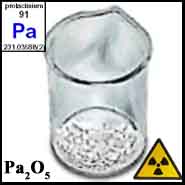
Protactinium oxide chemistry encompasses three primary phases: PaO (rocksalt structure), PaO₂ (fluorite structure), and Pa₂O₅ (cubic structure). The white pentoxide Pa₂O₅ represents the most stable oxide phase, obtained by igniting protactinium hydroxide at 500°C in air. Crystal structure exhibits cubic symmetry (space group Fm3̄m) with lattice parameter 547.6 pm and density 10.96 g/cm³. The black dioxide PaO₂ forms through hydrogen reduction of the pentoxide at 1550°C, crystallizing in face-centered cubic structure with a = 550.5 pm. Fluoride compounds include PaF₄ (monoclinic) and PaF₅ (tetragonal), with the pentafluoride being isostructural to β-UF₅. Chloride phases encompass PaCl₄ (tetragonal, green-yellow) and PaCl₅ (monoclinic, yellow) with polymeric structures involving seven-coordinate protactinium centers. Ternary compounds demonstrate extensive formation with alkali metals, producing phases like APaO₃ (perovskite), A₃PaO₄, and A₇PaO₆ structures.
Coordination Chemistry and Organometallic Compounds
Protactinium demonstrates remarkable coordination versatility with coordination numbers ranging from 6 to 14 depending on ligand size and electronic requirements. Fluoride complexes exhibit the highest coordination numbers, with Na₃PaF₈ containing eight-coordinate protactinium in nearly cubic geometry. Aqueous chemistry involves extensive hydrolysis producing Pa(OH)₃⁺, Pa(OH)₂²⁺, Pa(OH)₃⁺, and Pa(OH)₄ species, all colorless in solution. Coordination complexes with organic ligands include the remarkable Pa(BH₄)₄ borohydride featuring 14-coordinate protactinium surrounded by six BH₄⁻ ligands in polymeric helical chains. Organometallic chemistry encompasses tetrakis(cyclopentadienyl)protactinium(IV) Pa(C₅H₅)₄ with tetrahedral geometry, and the golden-yellow protactinocene Pa(C₈H₈)₂ featuring sandwich structure analogous to uranocene. These compounds demonstrate significant covalent bonding character with extensive orbital mixing between metal f, d orbitals and ligand π systems.
Natural Occurrence and Isotopic Analysis
Geochemical Distribution and Abundance
Protactinium ranks among the rarest naturally occurring elements with average crustal abundance of approximately 1.4 × 10⁻¹² g/g (1.4 ppt by mass). Primary occurrence in uraninite (pitchblende) deposits ranges from 0.3 to 3 parts per million, with typical concentrations closer to 0.3 ppm. Exceptional deposits in the Democratic Republic of Congo contain up to 3 ppm protactinium. Distribution in natural materials reflects geochemical behavior: sandy soils contain approximately 500 times higher concentrations than associated water, while ratios exceed 2000 in loam soils and bentonite clays. Ocean water protactinium concentrations measure approximately 2 × 10⁻¹⁵ g/g with radioactivity levels of 0.1 picocuries per gram. Geochemical cycling involves coprecipitation with thorium-bearing minerals due to similar charge-to-radius ratios and chemical behavior. Continental shelf sediments accumulate protactinium through scavenging processes with residence times of several thousand years in marine environments.
Nuclear Properties and Isotopic Composition
Thirty radioisotopes of protactinium span mass numbers from ²¹⁰Pa to ²³⁹Pa, with ²³¹Pa representing the sole long-lived and naturally abundant isotope (t₁/₂ = 32,650 years). Nuclear properties include ground-state spin-parity 3/2⁻ for ²³¹Pa with magnetic moment +2.01 nuclear magnetons. Natural isotopic composition consists essentially of 100% ²³¹Pa formed through α-decay of ²³⁵U via the actinium decay series. Minor natural isotopes include ²³⁴Pa (t₁/₂ = 6.7 hours) and the metastable isomer ²³⁴ᵐPa (t₁/₂ = 1.16 minutes) from ²³⁸U decay. Artificial isotope ²³³Pa (t₁/₂ = 27 days) forms in thorium-fueled nuclear reactors through neutron capture by ²³²Th followed by β⁻ decay of ²³³Th. Nuclear fission properties indicate threshold energies above 1 MeV for both ²³¹Pa and ²³³Pa, with fission cross sections remaining relatively small compared to fissile actinides.
Industrial Production and Technological Applications
Extraction and Purification Methodologies
Industrial protactinium production historically relied on processing uranium ores through multi-stage separation procedures. The 1961 United Kingdom Atomic Energy Authority campaign processed 60 tonnes of waste material through a 12-stage procedure, yielding 127 grams of 99.9% pure ²³¹Pa at approximately $500,000 cost. Modern production centers on nuclear reactor operations where ²³³Pa forms as intermediate in thorium fuel cycles. Extraction procedures involve initial acid leaching of irradiated thorium, followed by solvent extraction using tributyl phosphate or ion-exchange chromatography. Metallic protactinium preparation employs reduction of protactinium tetrafluoride with calcium, lithium, or barium at 1300-1400°C under inert atmosphere. The van Arkel-de Boer process converts protactinium oxides to volatile halides, subsequently reduced on heated metallic filaments: 2PaI₅ → 2Pa + 5I₂. Current availability remains extremely limited, with Oak Ridge National Laboratory historically supplying research quantities at approximately $280 per gram.
Technological Applications and Future Prospects
Protactinium applications remain restricted to scientific research due to extreme scarcity, high radioactivity, and toxicity concerns. Primary research application involves radiometric dating using ²³¹Pa/²³⁰Th ratios for sediments up to 175,000 years old. This technique proves particularly valuable in paleoceanographic studies, reconstructing ancient ocean circulation patterns during glacial periods. The double-isotope method improves measurement accuracy while minimizing sensitivity to spatial distribution inhomogeneities. Nuclear applications once considered ²³¹Pa for potential weapons material, but critical mass calculations exceeding 750 kg and subsequent criticality analyses ruled out practical fissile applications. Future research directions focus on understanding actinide chemistry fundamentals, developing separation technologies for thorium fuel cycles, and expanding paleoclimatic applications. Environmental monitoring applications may emerge for tracking uranium decay products in contaminated sites.
Historical Development and Discovery
Protactinium discovery involved multiple researchers across several years, beginning with William Crookes' 1900 isolation of intensely radioactive material from uranium, designated uranium X but uncharacterized as new element. Kasimir Fajans and Oswald Helmuth Göhring achieved first identification in 1913 during uranium-238 decay chain studies, discovering the short-lived isotope ²³⁴ᵐPa with 1.16-minute half-life. They named the element "brevium" reflecting the brief existence of their isotope. Concurrent work by John Arnold Cranston with Frederick Soddy and Ada Hitchins identified the long-lived ²³¹Pa isotope in 1915, though military service delayed announcement. Definitive characterization occurred in 1917-1918 through independent work by Lise Meitner and Otto Hahn in Germany, and Soddy's group in Britain. Meitner renamed the element "protactinium" meaning "precursor of actinium" since ²³¹Pa decays to produce ²²⁷Ac. The International Union of Pure and Applied Chemistry confirmed this nomenclature in 1949, crediting Meitner and Hahn as discoverers. Aristid von Grosse achieved first metallic protactinium isolation in 1934 from 0.1 mg Pa₂O₅, establishing foundation for subsequent chemical investigations.
Conclusion
Protactinium occupies a distinctive position among actinide elements, combining fascinating chemical properties with extreme practical limitations. Its intermediate placement between thorium and uranium provides valuable insights into actinide electronic structure and periodic trends, while its unique nuclear properties contribute to geochronological and paleoclimatic research. The element's complex coordination chemistry, diverse oxidation states, and organometallic compounds demonstrate the rich chemical behavior characteristic of 5f elements. However, severe constraints including natural scarcity, intense radioactivity, and biological toxicity preclude commercial applications. Future research opportunities encompass fundamental actinide science, advanced separation technologies for nuclear fuel cycles, and expanded paleoceanographic applications. The continuing study of protactinium chemistry advances understanding of heavy element behavior and provides crucial data for theoretical models of superheavy element properties.

Please let us know how we can improve this web app.
