| Element | |
|---|---|
50SnTin118.71072
8 18 18 4 |
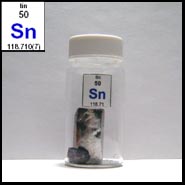
|
| Basic properties | |
|---|---|
| Atomic number | 50 |
| Atomic weight | 118.7107 amu |
| Element family | Other metals |
| Period | 5 |
| Group | 14 |
| Block | p-block |
| Discovery year | 3500 BC |
| Isotope distribution |
|---|
112Sn 0.97% 114Sn 0.65% 115Sn 0.34% 116Sn 14.54% 117Sn 7.68% 118Sn 24.22% 119Sn 8.58% 120Sn 32.59% 122Sn 4.63% 124Sn 5.79% |
112Sn (0.97%) 114Sn (0.65%) 116Sn (14.54%) 117Sn (7.68%) 118Sn (24.22%) 119Sn (8.58%) 120Sn (32.59%) 122Sn (4.63%) 124Sn (5.79%) |
| Physical properties | |
|---|---|
| Density | 7.287 g/cm3 (STP) |
Atomic hydrogen (H) 8.988E-5 Meitnerium (Mt) 28 | |
| Melting | 232.06 °C |
Helium (He) -272.2 Carbon (C) 3675 | |
| Boiling | 2270 °C |
Helium (He) -268.9 Tungsten (W) 5927 | |
| Chemical properties | |
|---|---|
| Oxidation states (less common) | -4, +2, +4 (-3, -2, -1, 0, +1, +3) |
| First ionization potential | 7.344 eV |
Cesium (Cs) 3.894 Helium (He) 24.587 | |
| Electron affinity | 1.112 eV |
Nobelium (No) -2.33 Atomic chlorine (Cl) 3.612725 | |
| Electronegativity | 1.96 |
Cesium (Cs) 0.79 Atomic fluorine (F) 3.98 | |
| Atomic radius | |
|---|---|
| Covalent radius | 1.4 Å |
Atomic hydrogen (H) 0.32 Francium (Fr) 2.6 | |
| Van der Waals radius | 2.17 Å |
Atomic hydrogen (H) 1.2 Francium (Fr) 3.48 | |
| Compounds | ||
|---|---|---|
| Formula | Name | Oxidation state |
| SnF2 | Tin(II) fluoride | +2 |
| SnCl2 | Tin(II) chloride | +2 |
| SnO | Tin(II) oxide | +2 |
| SnSO4 | Tin(II) sulfate | +2 |
| SnC2O4 | Tin(II) oxalate | +2 |
| C18H36SnO2 | Tin(II) stearate | +2 |
| SnO2 | Tin(IV) oxide | +4 |
| SnCl4 | Tin(IV) chloride | +4 |
| Sn(CH3COO)4 | Tin(IV) acetate | +4 |
| Sn(NO3)4 | Tin(IV) nitrate | +4 |
| SnBr4 | Tin(IV) bromide | +4 |
| SnF4 | Tin(IV) fluoride | +4 |
| Electronic properties | |
|---|---|
| Electrons per shell | 2, 8, 18, 18, 4 |
| Electronic configuration | [Kr] 4d10 |
|
Bohr atom model

| |
|
Orbital box diagram

| |
| Valence electrons | 4 |
| Lewis dot structure |
|
| Orbital Visualization | |
|---|---|
|
| |
| Electrons | - |
Tin (Sn): Periodic Table Element
Abstract
Tin (Sn), atomic number 50, represents a post-transition metal in Group 14 of the periodic table with atomic weight 118.710 ± 0.007. This element exhibits unique structural polymorphism between white tin (β-tin) with body-centered tetragonal crystal structure at ambient conditions and gray tin (α-tin) with diamond cubic structure stable below 13.2°C. Tin demonstrates primary oxidation states of +2 and +4, with the +4 state exhibiting slightly greater thermodynamic stability. The element possesses ten stable isotopes, the highest number for any element, attributed to its magic number nuclear configuration. Industrial applications center on solder production, tin plating for corrosion protection, and bronze alloy formation. Historical significance stems from its essential role in Bronze Age metallurgy beginning around 3000 BC, obtained primarily from cassiterite (SnO₂) ores through reduction processes.
Introduction
Tin occupies position 50 in the periodic table, residing in Group 14 alongside carbon, silicon, germanium, and lead. The electronic configuration [Kr] 4d¹⁰ 5s² 5p² establishes tin's chemical behavior as a post-transition metal with variable oxidation states. The element's significance in modern chemistry derives from its unique polymorphic behavior, extensive isotopic diversity, and fundamental role in metallurgical applications. Tin's position in the carbon group produces intermediate metallic character between the semiconducting properties of silicon and germanium and the predominantly metallic behavior of lead.
The nuclear stability of tin originates from its atomic number coinciding with a magic number in nuclear physics, resulting in exceptional isotopic abundance. Modern industrial consumption approaches 250,000 tonnes annually, with primary applications in electronic soldering, protective coatings, and alloy formation. The element's low toxicity in inorganic forms combined with excellent corrosion resistance maintains its importance in food packaging and electronic applications despite replacement by lead-free alternatives in many traditional uses.
Physical Properties and Atomic Structure
Fundamental Atomic Parameters
Tin's atomic structure contains 50 protons and typically 68-70 neutrons in stable isotopes, generating an electronic configuration of [Kr] 4d¹⁰ 5s² 5p². The filled 4d subshell provides additional nuclear shielding, influencing atomic radius and ionization behavior. Effective nuclear charge calculations indicate reduced shielding efficiency compared to lighter Group 14 elements, contributing to tin's intermediate position between semiconducting and metallic behavior.
Atomic radius measurements reveal systematic trends within Group 14, with tin exhibiting values intermediate between germanium and lead. Ionic radii vary significantly between oxidation states, with Sn²⁺ ions measuring approximately 1.18 Å and Sn⁴⁺ ions measuring 0.69 Å. The substantial difference reflects the increased effective nuclear charge upon removal of two additional electrons from the 5s orbital.
Macroscopic Physical Characteristics
Tin exhibits remarkable structural polymorphism with two primary allotropic forms. White tin (β-tin) represents the thermodynamically stable form above 13.2°C, crystallizing in a body-centered tetragonal structure with lattice parameters a = b = 5.831 Å and c = 3.181 Å. This metallic form demonstrates silvery-white luster, malleability, and ductility characteristic of metallic bonding.
Gray tin (α-tin) becomes stable below 13.2°C, adopting a diamond cubic crystal structure identical to silicon and germanium. This allotrope exhibits semiconducting properties with a bandgap of approximately 0.08 eV at room temperature. The α-tin form appears as a dull gray, brittle powder due to its covalent bonding network. The allotropic transformation from β-tin to α-tin, known as "tin disease" or "tin pest," proceeds slowly at low temperatures but can cause complete disintegration of metallic objects.
Additional high-pressure phases include γ-tin stable above 161°C under pressure and σ-tin existing at several gigapascals pressure. Melting point occurs at 232.0°C (505.2 K), representing the lowest melting point in Group 14. Boiling point reaches 2602°C (2875 K), indicating moderate intermolecular forces in the liquid phase. Heat of fusion measures 7.03 kJ/mol, while heat of vaporization equals 296.1 kJ/mol. Density of β-tin equals 7.287 g/cm³ at 20°C, while α-tin exhibits lower density at 5.769 g/cm³.
Chemical Properties and Reactivity
Electronic Structure and Bonding Behavior
Tin's chemical reactivity derives from its [Kr] 4d¹⁰ 5s² 5p² electronic configuration, which permits oxidation states ranging from -4 to +4, with +2 and +4 states exhibiting greatest stability. The 5s² electron pair demonstrates inert pair effect, contributing to the stability of the +2 oxidation state relative to lighter Group 14 elements. The +4 oxidation state predominates in most chemical compounds due to improved lattice energy and covalent bonding contributions.
Covalent bonding in tin compounds exhibits significant ionic character, particularly in +4 oxidation state compounds. Bond energies decrease systematically from Sn-F (414 kJ/mol) through Sn-Cl (323 kJ/mol) to Sn-I (235 kJ/mol), reflecting electronegativity differences and orbital overlap efficiency. Tin-carbon bonds in organotin compounds demonstrate moderate stability with bond energies around 210 kJ/mol.
Coordination chemistry reveals preferred coordination numbers of 4 for Sn⁴⁺ and 6 for Sn²⁺ ions. Tetrahedral geometry predominates for Sn⁴⁺ complexes, while Sn²⁺ exhibits distorted octahedral arrangements due to lone pair effects. Hybridization patterns include sp³ for tetrahedral Sn⁴⁺ and sp³d² for octahedral Sn²⁺ complexes, with some compounds exhibiting sp² hybridization leading to bent molecular geometries.
Electrochemical and Thermodynamic Properties
Electronegativity values demonstrate tin's intermediate metallic character, measuring 1.96 on the Pauling scale and 1.72 on the Allred-Rochow scale. These values position tin between germanium (2.01 Pauling) and lead (1.87 Pauling), reflecting its post-transition metal classification.
Successive ionization energies reveal electronic structure characteristics: first ionization energy equals 708.6 kJ/mol, second ionization energy measures 1411.8 kJ/mol, third ionization energy reaches 2943.0 kJ/mol, and fourth ionization energy equals 3930.3 kJ/mol. The significant increase between second and third ionization energies reflects removal of electrons from the filled 4d subshell.
Standard reduction potentials provide thermodynamic insight into redox behavior. The Sn²⁺/Sn couple exhibits E° = -0.137 V, while Sn⁴⁺/Sn²⁺ demonstrates E° = +0.154 V. These values indicate that metallic tin reduces readily to Sn²⁺, but further oxidation to Sn⁴⁺ requires mild oxidizing conditions. The positive potential for the Sn⁴⁺/Sn²⁺ couple explains the slightly greater stability of the +4 oxidation state.
Chemical Compounds and Complex Formation
Binary and Ternary Compounds
Tin oxide chemistry demonstrates the element's variable oxidation behavior. Stannous oxide (SnO) forms as a blue-black solid through controlled oxidation of metallic tin in oxygen-limited conditions. This compound exhibits amphoteric properties, dissolving in both acids and strong bases. Thermal decomposition occurs above 300°C, yielding metallic tin and stannic oxide.
Stannic oxide (SnO₂) represents the thermodynamically stable oxide, crystallizing in the rutile structure with space group P4₂/mnm. This white solid demonstrates exceptional chemical inertness and finds applications in gas sensors and transparent conducting films when doped with indium. Formation proceeds through direct combustion of tin in air or thermal decomposition of hydrated stannic acid. The compound exhibits n-type semiconductor behavior with bandgap energy of 3.6 eV.
Halide chemistry reveals systematic trends across the halogen series. Tin(IV) fluoride (SnF₄) forms ionic crystals with high melting point (442°C), while tin(IV) chloride (SnCl₄) exists as a covalent liquid at room temperature (bp 114.1°C). This trend reflects decreasing electronegativity difference and increasing covalent character down the halogen group.
Tin(II) halides demonstrate different structural preferences. Tin(II) chloride (SnCl₂) adopts a bent molecular geometry in the gas phase due to lone pair effects, while solid-state structures exhibit layered arrangements. These compounds function as reducing agents due to the relative ease of oxidation from +2 to +4 oxidation states.
Sulfide compounds include tin(II) sulfide (SnS) with orthorhombic crystal structure and tin(IV) sulfide (SnS₂) exhibiting layered cadmium iodide structure. The latter compound, known as "mosaic gold," demonstrates golden-colored metallic luster and historical use as a pigment. Both sulfides exhibit semiconductor properties with applications in photovoltaic cells and thermoelectric devices.
Coordination Chemistry and Organometallic Compounds
Coordination complexes of tin demonstrate diverse structural motifs depending on oxidation state and ligand characteristics. Tin(IV) complexes typically adopt tetrahedral or octahedral geometries, with examples including hexafluorostannate(SnF₆²⁻) and tetrachlorostannate(SnCl₄²⁻) ions. These complexes exhibit thermodynamic stability due to favorable ligand field effects and ionic bonding contributions.
Tin(II) coordination compounds demonstrate more complex stereochemistry due to the stereochemically active lone pair. Typical coordination numbers range from 3 to 6, with pyramidal, seesaw, and distorted octahedral geometries observed. The tin(II) acetate dimer exemplifies this behavior, featuring bridging acetate ligands and bent Sn-O-C angles.
Organotin chemistry encompasses a vast array of compounds with applications in catalysis, polymerization, and materials science. Tetraorganostannanes (R₄Sn) demonstrate tetrahedral geometry around tin with Sn-C bond lengths typically 2.14-2.16 Å. These compounds exhibit thermal stability up to 200-250°C depending on the organic substituents.
Triorganostannanes (R₃SnX) and diorganostannanes (R₂SnX₂) form through partial substitution reactions, with halide or other anionic ligands completing the coordination sphere. Mixed organostannanes demonstrate applications as polymer stabilizers and catalysts for esterification reactions. Bond dissociation energies for Sn-C bonds range from 190-220 kJ/mol, providing sufficient stability for synthetic applications while permitting controlled reactivity.
Natural Occurrence and Isotopic Analysis
Geochemical Distribution and Abundance
Tin exhibits crustal abundance of approximately 2.3 ppm, ranking as the 49th most abundant element in Earth's crust. This relatively low abundance necessitates concentration mechanisms for economic extraction. Geochemical behavior places tin in the lithophile element category, though some chalcophile tendencies appear in sulfide-bearing ore deposits.
Primary tin mineralization occurs in high-temperature hydrothermal environments associated with granitic intrusions. Cassiterite (SnO₂) represents the dominant ore mineral, exhibiting specific gravity of 6.8-7.1 g/cm³ and hardness of 6-7 on the Mohs scale. The mineral crystallizes in the tetragonal crystal system with excellent chemical stability under surface conditions.
Secondary mineralization includes stannite (Cu₂FeSnS₄) and other sulfide minerals, typically requiring more complex metallurgical processing. Placer deposits form through weathering of primary tin-bearing rocks, with cassiterite concentration occurring via density separation during sedimentary transport. Major tin-producing regions include Southeast Asia, South America, and parts of Africa, with Bolivia, China, Indonesia, and Peru leading global production.
Environmental distribution demonstrates tin's tendency to remain in the solid phase under most natural conditions. Dissolved tin concentrations in natural waters rarely exceed 0.1 ppb due to low solubility of oxide and hydroxide species at neutral pH. Biogeochemical cycling involves limited biological uptake, though some organisms concentrate tin in specific tissues.
Nuclear Properties and Isotopic Composition
Tin possesses ten stable isotopes, the largest number for any element, with mass numbers 112, 114, 115, 116, 117, 118, 119, 120, 122, and 124. Natural abundances vary significantly: ¹²⁰Sn comprises 32.58%, ¹¹⁸Sn represents 24.22%, ¹¹⁶Sn accounts for 14.54%, ¹¹⁹Sn makes up 8.59%, ¹¹⁷Sn contributes 7.68%, ¹¹²Sn equals 0.97%, ¹¹⁴Sn measures 0.66%, ¹¹⁵Sn comprises 0.34%, ¹²²Sn accounts for 4.63%, and ¹²⁴Sn represents 5.79%.
The exceptional isotopic diversity stems from tin's atomic number equaling 50, a magic number in nuclear shell theory. This nuclear configuration provides enhanced binding energy and stability against radioactive decay. Even-mass isotopes exhibit zero nuclear spin, while odd-mass isotopes (¹¹⁵Sn, ¹¹⁷Sn, ¹¹⁹Sn) demonstrate nuclear spin I = 1/2.
Radioactive isotopes span mass numbers from 99 to 137, with half-lives ranging from milliseconds to thousands of years. ¹²⁶Sn exhibits the longest half-life among radioactive isotopes at approximately 230,000 years. Several isotopes find applications in nuclear medicine and research, particularly ¹¹³Sn (t₁/₂ = 115.1 days) for radiopharmaceutical labeling.
Nuclear cross-sections reveal significant variation among isotopes. ¹¹⁵Sn demonstrates thermal neutron capture cross-section of 30 barns, while ¹¹⁷Sn and ¹¹⁹Sn exhibit values near 2.3 and 2.2 barns, respectively. These properties influence applications in nuclear reactor coolant systems and neutron shielding applications.
Industrial Production and Technological Applications
Extraction and Purification Methodologies
Primary tin production begins with cassiterite ore concentration through gravity separation, magnetic separation, and flotation techniques. The high specific gravity of cassiterite (6.8-7.1 g/cm³) enables effective separation from gangue minerals through shaking tables, spirals, and centrifugal concentrators. Typical ore grades range from 0.5-2.0% tin content, requiring concentration to 60-70% SnO₂ for efficient smelting.
Pyrometallurgical reduction employs carbon as the reducing agent in reverberatory or electric arc furnaces operating at 1200-1300°C. The reduction reaction proceeds according to: SnO₂ + 2C → Sn + 2CO. Alternative reducing agents include hydrogen or carbon monoxide under controlled atmospheric conditions. Fuel consumption typically ranges from 1.2-1.5 tons of coal per ton of tin metal produced.
Purification processes remove iron, lead, copper, and other metallic impurities through selective oxidation and slag formation. Fire refining involves controlled oxidation at 400-500°C to remove base metals while retaining tin metal. Electrolytic refining provides high-purity tin (99.95-99.99%) through electrodeposition from acid electrolyte solutions containing Sn²⁺ or Sn⁴⁺ ions.
Global production statistics indicate annual output approaching 300,000 tonnes, with China contributing approximately 40% of world production. Indonesia, Peru, and Bolivia represent other major producers, collectively accounting for an additional 35-40% of global supply. Economic factors include energy costs, environmental regulations, and ore quality variations affecting production economics.
Technological Applications and Future Prospects
Solder applications consume approximately 50% of tin production, utilizing eutectic and near-eutectic alloy compositions for electronic assembly. Traditional tin-lead solder (63% Sn, 37% Pb) exhibits melting point of 183°C and excellent wetting characteristics on copper substrates. Environmental regulations have driven adoption of lead-free alternatives, including SAC alloys (tin-silver-copper) with compositions such as 96.5% Sn, 3.0% Ag, 0.5% Cu.
Tin plating provides corrosion protection for steel substrates, particularly in food packaging applications. Electroplating processes deposit tin coatings 0.5-2.5 μm thick, forming a passive oxide layer that prevents iron corrosion. Annual consumption for tin plating approaches 60,000-70,000 tonnes globally, though aluminum and polymer alternatives continue to reduce market share.
Bronze alloys maintain traditional applications in bearings, bushings, and marine hardware where corrosion resistance and wear properties prove essential. Typical bronze compositions contain 8-12% tin in copper matrix, providing enhanced strength and reduced friction coefficients compared to pure copper. Specialized bronzes include bell metal (22% Sn) and naval brass applications.
Emerging applications include transparent conducting films utilizing indium tin oxide (ITO) for display technologies, photovoltaic cells, and smart windows. Tin-based perovskite materials demonstrate potential for next-generation solar cell applications, while tin anodes for lithium-ion batteries offer theoretical capacity advantages over graphite alternatives.
Chemical applications encompass organostannane catalysts for polyurethane production, esterification reactions, and silicone curing systems. Annual consumption for chemical applications reaches 15,000-20,000 tonnes, with growth driven by expanding polymer and materials industries in developing economies.
Historical Development and Discovery
Archaeological evidence indicates tin utilization beginning approximately 3000 BC during early Bronze Age civilizations in the Middle East and Mediterranean regions. Initial discovery likely occurred through smelting polymetallic copper ores containing cassiterite impurities, producing bronze alloys with superior mechanical properties compared to pure copper implements.
Ancient civilizations developed tin trade networks spanning considerable distances, with Cornwall (England), Bohemia, and parts of Spain serving as primary tin sources for Mediterranean bronze production. The element's scarcity relative to copper necessitated extensive trade relationships and contributed to economic development of tin-producing regions.
Metallurgical understanding advanced during Roman periods, with techniques for tin extraction and purification documented by Pliny the Elder and other contemporary writers. Medieval periods witnessed expansion of tin mining operations in Cornwall, Saxony, and other European locations, with water-powered stamp mills enabling more efficient ore processing.
Scientific characterization began during the 18th century with systematic chemical analysis by Antoine Lavoisier and contemporaries. Atomic weight determination by Jöns Jakob Berzelius in 1818 established tin's position among metallic elements. Modern understanding of crystal structure, electronic configuration, and nuclear properties developed throughout the 20th century through X-ray crystallography, spectroscopic methods, and nuclear physics research.
Industrial development paralleled technological advances in extraction and purification methods. Introduction of electric furnaces, flotation concentration, and electrolytic refining improved production efficiency and product quality. Contemporary research focuses on sustainable extraction methods, recycling technologies, and novel applications in renewable energy and electronic systems.
Conclusion
Tin occupies a distinctive position in the periodic table through its unique combination of polymorphic behavior, exceptional isotopic stability, and intermediate metallic character. The element's ten stable isotopes, attributable to its magic number nuclear configuration, distinguish tin from all other elements and contribute to its nuclear applications. Structural transitions between metallic β-tin and semiconducting α-tin demonstrate the subtle energetic balance between metallic and covalent bonding in post-transition elements.
Industrial significance stems from tin's corrosion resistance, soldering properties, and alloy formation characteristics that have supported technological development from Bronze Age metallurgy through modern electronics manufacturing. Environmental considerations and resource sustainability drive continued research into recycling technologies, alternative extraction methods, and novel applications in renewable energy systems. Future developments likely emphasize tin's role in advanced battery technologies, semiconductor applications, and sustainable materials chemistry as global technology transitions toward lower environmental impact alternatives.

Please let us know how we can improve this web app.
