| Element | |
|---|---|
3LiLithium6.94122
1 |
|
| Basic properties | |
|---|---|
| Atomic number | 3 |
| Atomic weight | 6.9412 amu |
| Element family | Alkali metals |
| Period | 2 |
| Group | 1 |
| Block | s-block |
| Discovery year | 1817 |
| Isotope distribution |
|---|
6Li 7.5% 7Li 92.5% |
6Li (7.50%) 7Li (92.50%) |
| Physical properties | |
|---|---|
| Density | 0.534 g/cm3 (STP) |
Atomic hydrogen (H) 8.988E-5 Meitnerium (Mt) 28 | |
| Melting | 180.7 °C |
Helium (He) -272.2 Carbon (C) 3675 | |
| Boiling | 1317 °C |
Helium (He) -268.9 Tungsten (W) 5927 | |
| Chemical properties | |
|---|---|
| Oxidation states (less common) | +1 (-1) |
| First ionization potential | 5.391 eV |
Cesium (Cs) 3.894 Helium (He) 24.587 | |
| Electron affinity | 0.618 eV |
Nobelium (No) -2.33 Atomic chlorine (Cl) 3.612725 | |
| Electronegativity | 0.98 |
Cesium (Cs) 0.79 Atomic fluorine (F) 3.98 | |
| Electronic properties | |
|---|---|
| Electrons per shell | 2, 1 |
| Electronic configuration | [He] 2s1 |
|
Bohr atom model

| |
|
Orbital box diagram

| |
| Valence electrons | 1 |
| Lewis dot structure |
|
| Orbital Visualization | |
|---|---|
|
| |
| Electrons | - |
Lithium (Li): Periodic Table Element
Abstract
Lithium exhibits fundamental properties that distinguish it as the lightest metallic element and the first member of the alkali metal family. With atomic number 3 and atomic mass 6.94 u, lithium displays a density of 0.534 g/cm³ at standard conditions, making it less dense than water. The element manifests exceptional nuclear instability among light elements, with both stable isotopes ⁶Li and ⁷Li demonstrating remarkably low binding energies per nucleon. Lithium's unique position stems from its electronic configuration [He]2s¹, which confers distinctive chemical reactivity patterns and enables diverse technological applications ranging from energy storage systems to nuclear physics applications. Industrial significance derives primarily from lithium-ion battery technology, representing approximately 75% of global lithium consumption.
Introduction
Lithium occupies position 3 in the periodic table as the initial member of Group 1, the alkali metals. The element derives its name from the Greek word "lithos," meaning stone, reflecting its mineral origins in pegmatitic deposits. Johan August Arfwedson discovered lithium in 1817 during analysis of petalite from Utö, Sweden. Electronic structure analysis reveals lithium's [He]2s¹ configuration, wherein the single valence electron experiences minimal shielding from the 1s electrons, resulting in the smallest ionic radius among alkali metals. This configuration establishes periodic trends observable throughout Group 1, including decreasing ionization energy, increasing atomic radius, and enhanced metallic character with increasing atomic number. Lithium's exceptional properties include the highest specific heat capacity among all solid elements at 3.58 kJ/(kg·K), superconductivity below 0.4 mK, and the highest electrochemical potential of any metal at -3.04 V versus standard hydrogen electrode.
Physical Properties and Atomic Structure
Fundamental Atomic Parameters
Lithium exhibits atomic number Z = 3 with electron configuration [He]2s¹ in spectroscopic notation. The atomic radius measures 152 pm, while the ionic radius of Li⁺ equals 90 pm, demonstrating significant contraction upon ionization. Effective nuclear charge experienced by the valence electron equals approximately 1.3, accounting for partial shielding by the 1s² electrons. First ionization energy amounts to 520.2 kJ/mol, the highest among alkali metals due to the proximity of the valence electron to the nucleus. Successive ionization energies exhibit dramatic increases: second ionization energy reaches 7,298 kJ/mol, and third ionization energy attains 11,815 kJ/mol, reflecting removal of electrons from the stable helium-like core. Comparison with neighboring elements reveals lithium's unique position: beryllium demonstrates higher ionization energies due to increased nuclear charge, while sodium shows reduced ionization energy owing to increased shielding effects.
Macroscopic Physical Characteristics
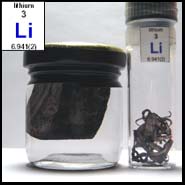
Lithium crystallizes in a body-centered cubic structure at room temperature with lattice parameter a = 351 pm. The metal exhibits a silvery-white appearance when freshly cut but rapidly tarnishes in air to form lithium oxide and nitride coatings. Density equals 0.534 g/cm³ at 20°C, making lithium the least dense solid element under standard conditions. Melting point occurs at 180.5°C (453.7 K), while boiling point reaches 1,342°C (1,615 K). Heat of fusion measures 3.00 kJ/mol, and heat of vaporization equals 147.1 kJ/mol. Thermal conductivity amounts to 84.8 W/(m·K) at room temperature. The coefficient of thermal expansion measures 46 × 10⁻⁶ K⁻¹, approximately twice that of aluminum and four times that of iron. At liquid helium temperatures below 4.2 K, lithium undergoes phase transitions to rhombohedral crystal structure with nine-layer stacking sequence. Multiple allotropic forms emerge under high pressure conditions, including face-centered cubic and complex structures with increased coordination numbers.
Chemical Properties and Reactivity
Electronic Structure and Bonding Behavior
Lithium's reactivity stems from the facile loss of its single 2s valence electron, forming Li⁺ cations with exceptional thermodynamic stability. Standard electrode potential equals -3.04 V versus the standard hydrogen electrode, representing the most negative potential among all elements. Oxidation state +1 dominates lithium chemistry, though rare higher oxidation states occur in specialized organometallic compounds under extreme conditions. Covalent bonding characteristics manifest in organolithium compounds, where lithium forms polar covalent bonds with carbon through sp³ hybridization. Bond lengths in lithium hydride measure 2.04 Å, while Li-C bond lengths in methyllithium average 2.31 Å. Coordination chemistry demonstrates preference for tetrahedral geometry in simple compounds, though higher coordination numbers occur in complex ions and solid-state structures. Experimental evidence from X-ray crystallography confirms tetrahedral coordination in lithium tetrafluoroborate and related salts.
Electrochemical and Thermodynamic Properties
Electronegativity values for lithium span 0.98 on the Pauling scale and 0.97 on the Mulliken scale, representing the lowest electronegativity among elements excluding francium. Successive ionization energies reveal the electronic structure: first ionization (520.2 kJ/mol) corresponds to 2s electron removal, second ionization (7,298 kJ/mol) involves 1s electron extraction from the lithium core. Electron affinity measurements indicate negative values (-59.6 kJ/mol), confirming lithium's preference for electron loss rather than gain. Standard reduction potential Li⁺/Li = -3.04 V establishes lithium's position as the most reducing metal under standard conditions. Thermodynamic stability analysis of lithium compounds demonstrates high lattice energies: lithium fluoride exhibits lattice energy of 1,037 kJ/mol, among the highest values for alkali halides. Redox behavior in aqueous media involves immediate reaction with water, forming lithium hydroxide and hydrogen gas through the reaction: 2Li + 2H₂O → 2LiOH + H₂, with ΔH°reaction = -445.6 kJ/mol.
Chemical Compounds and Complex Formation
Binary and Ternary Compounds
Lithium oxide (Li₂O) forms through direct combination of elements at elevated temperatures, crystallizing in the antifluorite structure with exceptional thermal stability. Lithium hydride (LiH) exhibits ionic character with Li⁺ and H⁻ ions in sodium chloride structure, serving as a reducing agent and hydrogen storage medium. Halide compounds demonstrate decreasing lattice energies with increasing halide size: LiF (1,037 kJ/mol), LiCl (853 kJ/mol), LiBr (807 kJ/mol), and LiI (761 kJ/mol). Formation mechanisms involve direct synthesis from elements or metathesis reactions from lithium carbonate. Crystal structures adopt rock salt arrangement for all lithium halides except fluoride, which crystallizes in wurtzite structure due to significant size difference between Li⁺ and F⁻ ions. Ternary compounds include lithium carbonate (Li₂CO₃), prepared industrially from spodumene through sulfuric acid digestion followed by precipitation. Lithium nitride (Li₃N) represents the only alkali metal nitride stable under ambient conditions, forming through direct combination at temperatures above 400°C with ΔH°f = -197.3 kJ/mol.
Coordination Chemistry and Organometallic Compounds
Coordination complexes of lithium typically exhibit tetrahedral or octahedral geometries depending on ligand size and electronic requirements. Crown ethers demonstrate exceptional selectivity for lithium ions: 12-crown-4 forms stable 1:1 complexes with association constants exceeding 10⁴ M⁻¹ in nonpolar solvents. Electronic configurations in these complexes maintain Li⁺ as a closed-shell cation with no d-electrons, resulting in primarily electrostatic bonding interactions. Spectroscopic properties include characteristic ⁷Li NMR signals with chemical shifts ranging from -2 to +3 ppm depending on coordination environment. Organometallic chemistry encompasses diverse compounds including methyllithium (CH₃Li), which exists as tetrameric clusters in nonpolar solvents through bridging methyl groups. Bond characteristics involve polarized Li-C bonds with significant ionic character, confirmed by bond lengths of 2.31 Å and vibrational frequencies around 500 cm⁻¹ for Li-C stretching modes. Catalytic applications include stereoselective organic synthesis where lithium enolates serve as nucleophilic reagents in aldol condensations and alkylation reactions.
Natural Occurrence and Isotopic Analysis
Geochemical Distribution and Abundance
Crustal abundance of lithium averages 20 mg/kg (20 ppm), positioning lithium as the 31st most abundant element in Earth's continental crust. Geochemical behavior reflects lithium's high ionic potential (charge/radius ratio = 11.1), leading to preferential incorporation into late-stage magmatic processes. Concentration mechanisms operate through fractional crystallization in granitic pegmatites, where lithium substitutes for magnesium and iron in micas and pyroxenes. Major mineral associations include spodumene (LiAlSi₂O₆), petalite (LiAlSi₄O₁₀), and lepidolite (K(Li,Al)₃(Al,Si,Rb)₄O₁₀(F,OH)₂). Distribution in different geological environments varies significantly: basaltic rocks contain 3-15 ppm lithium, granitic rocks range from 20-40 ppm, while pegmatites reach concentrations exceeding 1,000 ppm. Supporting geochemical data from mass spectrometry analysis confirm these values with precision typically ±5% for rock samples and ±2% for mineral concentrates.
Nuclear Properties and Isotopic Composition
Natural lithium comprises two stable isotopes: ⁶Li (7.59% abundance) and ⁷Li (92.41% abundance). Nuclear properties reveal ⁶Li with nuclear spin I = 1, magnetic moment μ = 0.822 μN, and quadrupole moment Q = -0.0008 × 10⁻²⁴ cm². ⁷Li exhibits nuclear spin I = 3/2, magnetic moment μ = 3.256 μN, and quadrupole moment Q = -0.040 × 10⁻²⁴ cm². Radioactive isotopes include ⁸Li (half-life 838 ms), ⁹Li (half-life 178 ms), and shorter-lived species. Decay modes involve β⁻ emission for neutron-rich isotopes and proton emission for neutron-deficient species like ⁴Li (half-life 7.6 × 10⁻²³ s). Nuclear cross-sections demonstrate ⁶Li thermal neutron absorption cross-section of 940 barns for the ⁶Li(n,α)³H reaction, fundamental to nuclear physics applications. Both stable isotopes exhibit anomalously low binding energies per nucleon: 5.33 MeV for ⁶Li and 5.61 MeV for ⁷Li, reflecting nuclear instability relative to neighboring elements. Applications in research include neutron detection using ⁶LiF scintillators and isotope separation via laser isotope separation for nuclear fuel cycle applications.
Industrial Production and Technological Applications
Extraction and Purification Methodologies
Industrial lithium production operates through two primary pathways: hard-rock mining of spodumene ore and brine extraction from salt lakes. Hard-rock processing involves crushing spodumene concentrate followed by roasting at 1,100°C to convert α-spodumene to β-spodumene, increasing lithium extractability. Acid digestion using sulfuric acid at 250°C produces lithium sulfate solutions, followed by precipitation as lithium carbonate through sodium carbonate addition. Thermodynamic considerations include ΔG°reaction = -89.2 kJ/mol for the conversion reaction, ensuring favorable equilibrium at industrial temperatures. Brine extraction utilizes solar evaporation ponds to concentrate lithium-bearing brines from 0.025% to 6% Li₂CO₃ equivalent over 12-18 months. Purification techniques employ selective precipitation to remove magnesium, calcium, and boron impurities. Efficiency measures reach 90-95% lithium recovery from high-grade ores and 40-60% from brines. Production statistics indicate Chile leads global production at 26,000 tonnes annually, followed by Australia at 21,000 tonnes. Environmental considerations include water consumption of 500-2,000 m³ per tonne of lithium carbonate produced, varying by extraction method and local conditions.
Technological Applications and Future Prospects
Battery technology dominates lithium consumption at approximately 75% of global demand, driven by lithium-ion cell proliferation in portable electronics and electric vehicles. Underlying principles involve lithium intercalation/deintercalation in layered cathode materials such as lithium cobalt oxide (LiCoO₂) with theoretical capacity 274 mAh/g. Glass and ceramics applications utilize lithium's low thermal expansion properties: addition of 2-8% lithium oxide to aluminosilicate glasses produces near-zero thermal expansion coefficients. Aluminum production employs lithium carbonate as Hall-Héroult process flux, reducing cell voltage by 0.3-0.5 V and increasing current efficiency to 95%. Nuclear applications encompass tritium breeding in fusion reactors through ⁶Li(n,α)³H reactions and lithium deuteride as fusion fuel in thermonuclear weapons. Emerging technologies include lithium-air batteries with theoretical specific energy of 11,140 Wh/kg, solid-state electrolytes based on lithium superionic conductors, and lithium extraction from geothermal brines. Economic significance approaches $3.2 billion annually for lithium compounds, with projected growth of 8-12% per year through 2030. Environmental considerations drive development of lithium recycling technologies with target recovery rates exceeding 95% for end-of-life batteries.
Historical Development and Discovery
Lithium's discovery occurred in 1817 when Johan August Arfwedson analyzed petalite mineral samples from the Utö iron mine in Sweden. Initial identification involved flame test observations revealing a characteristic crimson coloration, distinct from previously known alkali metals sodium and potassium. Humphry Davy achieved first metallic lithium isolation in 1821 through electrolysis of lithium oxide, employing techniques similar to his earlier sodium and potassium isolations. Methodological advances included William Thomas Brande's improved electrolytic procedures in 1821 and Robert Bunsen's development of lithium chloride electrolysis in 1855. Quantitative atomic weight determinations by Theodore William Richards in 1901 established precise atomic mass values through silver lithium chloride precipitation studies. Paradigm shifts included recognition of lithium's nuclear properties during Ernest Rutherford's 1932 artificial transmutation experiments, where lithium bombardment with protons produced alpha particles in the first fully artificial nuclear reaction. Spectroscopic developments encompassed identification of lithium spectral lines in stellar atmospheres, contributing to understanding of stellar nucleosynthesis and the cosmological lithium problem. Modern understanding emerged through quantum mechanical descriptions of lithium's electronic structure, nuclear magnetic resonance applications, and development of lithium-based energy storage technologies beginning in the 1970s.
Conclusion
Lithium's position as the lightest metallic element establishes its fundamental importance in modern chemistry and technology. The element's unique combination of lowest density among solid elements, highest specific heat capacity, and most negative electrode potential creates exceptional opportunities for energy storage applications and nuclear physics research. Technological significance continues expanding through lithium-ion battery development, with global demand projected to increase fivefold by 2030. Areas for future research include solid-state battery technologies, sustainable extraction methodologies, and advanced recycling processes to address supply chain challenges. Lithium's role in emerging fusion energy systems and quantum computing applications positions the element as essential for next-generation technologies requiring precise control of atomic and nuclear properties.

Please let us know how we can improve this web app.
