| Element | |
|---|---|
51SbAntimony121.76012
8 18 18 5 |
|
| Basic properties | |
|---|---|
| Atomic number | 51 |
| Atomic weight | 121.7601 amu |
| Element family | Metaloids |
| Period | 5 |
| Group | 15 |
| Block | p-block |
| Discovery year | 815 |
| Isotope distribution |
|---|
121Sb 57.21% 123Sb 42.79% |
121Sb (57.21%) 123Sb (42.79%) |
| Physical properties | |
|---|---|
| Density | 6.685 g/cm3 (STP) |
Atomic hydrogen (H) 8.988E-5 Meitnerium (Mt) 28 | |
| Melting | 630.9 °C |
Helium (He) -272.2 Carbon (C) 3675 | |
| Boiling | 1750 °C |
Helium (He) -268.9 Tungsten (W) 5927 | |
| Chemical properties | |
|---|---|
| Oxidation states (less common) | -3, +3, +5 (-2, -1, 0, +1, +2, +4) |
| First ionization potential | 8.644 eV |
Cesium (Cs) 3.894 Helium (He) 24.587 | |
| Electron affinity | 1.047 eV |
Nobelium (No) -2.33 Atomic chlorine (Cl) 3.612725 | |
| Electronegativity | 2.05 |
Cesium (Cs) 0.79 Atomic fluorine (F) 3.98 | |
| Atomic radius | |
|---|---|
| Covalent radius | 1.4 Å |
Atomic hydrogen (H) 0.32 Francium (Fr) 2.6 | |
| Van der Waals radius | 2.06 Å |
Atomic hydrogen (H) 1.2 Francium (Fr) 3.48 | |
| Compounds | ||
|---|---|---|
| Formula | Name | Oxidation state |
| InSb | Indium antimonide | -3 |
| AlSb | Aluminium antimonide | -3 |
| GaSb | Gallium antimonide | -3 |
| PrSb | Praseodymium antimonide | -3 |
| ZnSb | Zinc antimonide | -2 |
| Sb2O3 | Antimony trioxide | +3 |
| SbCl3 | Antimony(III) chloride | +3 |
| SbH3 | Antimony hydride | +3 |
| SbBr3 | Antimony(III) bromide | +3 |
| SbF5 | Antimony pentafluoride | +5 |
| SbCl5 | Antimony pentachloride | +5 |
| Sb2S5 | Pentasulfide antimony | +5 |
| Electronic properties | |
|---|---|
| Electrons per shell | 2, 8, 18, 18, 5 |
| Electronic configuration | [Kr] 4d10 |
|
Bohr atom model

| |
|
Orbital box diagram

| |
| Valence electrons | 5 |
| Lewis dot structure |
|
| Orbital Visualization | |
|---|---|
|
| |
| Electrons | - |
Antimony (Sb): Periodic Table Element
Abstract
Antimony (symbol Sb, atomic number 51) represents a metalloid element of group 15 (pnictogens) in the periodic table with distinctive chemical and physical properties. This lustrous gray metalloid exhibits an atomic mass of 121.760 u and demonstrates amphoteric behavior in its oxide chemistry. Antimony occurs naturally primarily as the sulfide mineral stibnite (Sb₂S₃) with a crustal abundance of approximately 0.2 parts per million. The element manifests two stable isotopes, ¹²¹Sb (57.36%) and ¹²³Sb (42.64%), and displays common oxidation states of +3 and +5. Industrial applications encompass flame retardants, lead-acid battery additives, semiconductor doping agents, and specialized alloys. The element's toxicological profile parallels arsenic, necessitating careful handling protocols in industrial and laboratory applications.
Introduction
Antimony occupies a unique position in group 15 of the periodic table, exhibiting intermediate metallic and nonmetallic characteristics that classify it as a metalloid. The element's significance in modern chemistry stems from its amphoteric oxide behavior, ability to form stable alloys with lead and tin, and utility as a semiconductor dopant. Antimony's electron configuration [Kr]4d¹⁰5s²5p³ places it between arsenic and bismuth, resulting in distinctive electrochemical properties with an electronegativity of 2.05 on the Pauling scale. Historical records indicate antimony compound usage dates to ancient civilizations, particularly as antimony sulfide for cosmetic applications. The metallic form was first isolated by Vannoccio Biringuccio in 1540, establishing fundamental extraction methodologies that persist in modified forms today. Modern industrial production exceeds 100,000 tonnes annually, with China accounting for approximately 54.5% of global output through the Xikuangshan Mine and related facilities.
Physical Properties and Atomic Structure
Fundamental Atomic Parameters
Antimony possesses atomic number 51 with an electron configuration of [Kr]4d¹⁰5s²5p³, placing three electrons in the outer p-subshell that govern its chemical behavior. The atomic radius measures 145 pm while the ionic radii vary significantly with oxidation state: Sb³⁺ exhibits 76 pm and Sb⁵⁺ demonstrates 60 pm. Effective nuclear charge calculations indicate substantial screening by inner electrons, particularly the filled 4d subshell that contributes to antimony's intermediate metallic character. First ionization energy reaches 834 kJ/mol, followed by second ionization at 1594.9 kJ/mol and third ionization at 2440 kJ/mol, reflecting the progressive difficulty of electron removal from increasingly stable configurations. Electron affinity measures 103.2 kJ/mol, indicating moderate tendency to accept electrons in compound formation. Covalent radius spans 139 pm for single bonds, with van der Waals radius extending to 206 pm, influencing intermolecular interactions and crystal packing arrangements.
Macroscopic Physical Characteristics
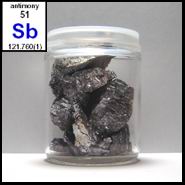
Antimony manifests as a lustrous, silvery-gray metalloid with brittle mechanical properties and Mohs hardness of 3.0, insufficient for practical applications requiring durability. The stable allotrope adopts a trigonal crystal structure (space group R3̄m No. 166) characterized by layered arrangements of fused six-membered rings with weak interlayer bonding contributing to brittleness. Density measures 6.697 g/cm³ at standard conditions, reflecting efficient atomic packing within the crystalline lattice. Melting point occurs at 630.63°C (903.78 K), while boiling point reaches 1587°C (1860 K) under standard atmospheric pressure. Heat of fusion equals 19.79 kJ/mol, and heat of vaporization measures 165.76 kJ/mol, indicating moderate intermolecular forces. Specific heat capacity at 25°C equals 25.23 J/(mol·K), facilitating thermal calculations in industrial processes. Electrical conductivity demonstrates temperature dependence with resistivity of approximately 4.17 × 10⁻⁷ Ω·m at room temperature. Thermal conductivity reaches 24.4 W/(m·K), enabling heat dissipation in electronic applications. An amorphous black allotrope forms upon rapid cooling of antimony vapor but remains stable only as thin films, transforming spontaneously to the metallic form in thicker deposits.
Chemical Properties and Reactivity
Electronic Structure and Bonding Behavior
Chemical reactivity patterns arise from antimony's 5s²5p³ valence electron configuration, enabling formation of compounds with oxidation states ranging from −3 to +5, with +3 and +5 predominating in stable compounds. The element demonstrates amphoteric behavior, reacting with both acids and bases to form distinct compound classes. Covalent bonding dominates antimony chemistry, with polarization effects influencing bond character particularly in compounds with electropositive elements. Hybridization patterns include sp³ in pyramidal SbX₃ compounds and sp³d in trigonal bipyramidal SbX₅ species, with lone pair effects contributing to molecular geometry deviations from ideal arrangements. Bond energies vary systematically: Sb-H bonds measure approximately 255 kJ/mol, Sb-C bonds reach 230 kJ/mol, and Sb-halogen bonds span 248-315 kJ/mol depending on halogen identity. Coordination chemistry encompasses coordination numbers from 3 to 6, with preference for distorted octahedral geometries in higher coordination states due to lone pair repulsion effects.
Electrochemical and Thermodynamic Properties
Electronegativity values span multiple scales: Pauling scale registers 2.05, Mulliken scale indicates 2.06, and Allred-Rochow scale measures 1.82, positioning antimony between arsenic and bismuth in electron-attracting ability. Standard reduction potentials provide quantitative measure of redox behavior: Sb³⁺/Sb couple exhibits E° = +0.20 V, while SbO⁺/Sb measures E° = +0.152 V under standard conditions. The Sb³⁺/Sb⁵⁺ system demonstrates potential dependence on pH and complexing agents, with antimony(V) species thermodynamically favored in oxidizing environments. Electron affinity reaches 103.2 kJ/mol, indicating moderate tendency for anion formation under specific conditions. Thermodynamic stability of various oxidation states depends strongly on environmental conditions: antimony(III) predominates in neutral and reducing media, while antimony(V) becomes stable in strongly oxidizing conditions. Disproportionation reactions occur under specific pH conditions, particularly for antimony(IV) species that readily convert to antimony(III) and antimony(V) forms. Standard enthalpies of formation for common compounds include: Sb₂O₃ (-1440.6 kJ/mol), SbCl₃ (-382.2 kJ/mol), and Sb₂S₃ (-174.9 kJ/mol), reflecting relative stability trends.
Chemical Compounds and Complex Formation
Binary and Ternary Compounds
Oxide chemistry encompasses three primary compounds with distinct structural and chemical characteristics. Antimony trioxide (Sb₂O₃) forms upon combustion in air, exhibiting molecular formula Sb₄O₆ in gaseous phase but polymerizing upon condensation into extended cubic or orthorhombic structures. This amphoteric oxide dissolves in strong acids producing antimony(III) salts and reacts with strong bases yielding antimonite anions. Antimony pentoxide (Sb₂O₅, more accurately Sb₄O₁₀) requires oxidation with concentrated nitric acid for synthesis and demonstrates exclusively acidic character, forming antimonate salts upon base treatment. Mixed-valence antimony tetroxide (Sb₂O₄) contains both Sb(III) and Sb(V) centers in ordered crystalline arrangements. Halide chemistry displays systematic trends across the halogen series. Trihalides (SbF₃, SbCl₃, SbBr₃, SbI₃) adopt trigonal pyramidal geometries with lone pair effects, exhibiting Lewis acid behavior and forming complex anions such as SbF₄⁻ and SbF₆³⁻. Pentahalides exist for fluorine and chlorine only: SbF₅ demonstrates exceptional Lewis acidity, forming superacidic systems with HF, while SbCl₅ exhibits trigonal bipyramidal geometry in gaseous phase but polymerizes in condensed phases. Sulfide chemistry centers on stibnite (Sb₂S₃), the primary naturally occurring antimony mineral, alongside synthetic antimony pentasulfide (Sb₂S₅) containing both Sb(III) centers and disulfide linkages.
Coordination Chemistry and Organometallic Compounds
Coordination complexes span diverse geometries and oxidation states, with antimony(III) favoring pyramidal arrangements due to lone pair effects while antimony(V) adopts octahedral coordination. Common ligands include halides, oxygen donors, and nitrogen donors, with hard ligands generally preferring antimony(V) and soft ligands favoring antimony(III). Thioantimonide complexes such as [Sb₆S₁₀]²⁻ and [Sb₈S₁₃]²⁻ demonstrate extended cluster structures with potential applications in materials science. Organoantimony chemistry encompasses both Sb(III) and Sb(V) centers with systematic synthetic approaches via Grignard reagents and organolithium compounds. Triarylstibines (R₃Sb) exhibit pyramidal geometries and moderate air stability, while pentaarylantimony compounds (R₅Sb) demonstrate trigonal bipyramidal arrangements with axial-equatorial ligand distinction. Mixed organo-halide compounds provide synthetic versatility for specialized applications. Catalytic applications of organoantimony compounds remain limited compared to analogous phosphorus and arsenic systems due to reduced thermal stability and increased toxicity concerns. Stibine (SbH₃) represents the simplest organometallic compound, exhibiting positive enthalpy of formation and consequent thermodynamic instability, decomposing spontaneously at room temperature to metallic antimony and hydrogen gas.
Natural Occurrence and Isotopic Analysis
Geochemical Distribution and Abundance
Crustal abundance of antimony measures approximately 0.2 parts per million by weight, ranking it as the 63rd most abundant element in Earth's crust, comparable to thallium (0.5 ppm) and silver (0.07 ppm). Geochemical behavior demonstrates chalcophile character with strong affinity for sulfur-bearing environments, concentrating in hydrothermal deposits and sedimentary formations. Primary mineral associations include stibnite (Sb₂S₃) as the dominant ore mineral, accompanied by native antimony, valentinite (Sb₂O₃), and complex sulfide phases such as jamesonite (Pb₄FeSb₆S₁₄) and tetrahedrite ((Cu,Fe)₁₂Sb₄S₁₃). Hydrothermal processes concentrate antimony through temperature-dependent solubility variations and sulfur fugacity effects, creating economic deposits in specific geological environments. Major producing regions include the Xikuangshan deposit in China's Hunan Province, containing world's largest reserves, alongside significant deposits in Russia, Tajikistan, and Bolivia. Seawater concentrations average 0.15 μg/L, reflecting limited solubility of antimony species under marine conditions. Soil concentrations vary geographically from 0.2 to 10 mg/kg, with elevated levels near mining operations and industrial facilities due to anthropogenic inputs.
Nuclear Properties and Isotopic Composition
Natural antimony comprises two stable isotopes with well-defined abundance ratios: ¹²¹Sb constitutes 57.36% of natural antimony with nuclear spin I = 5/2 and magnetic moment μ = +3.3634 nuclear magnetons, while ¹²³Sb represents 42.64% with nuclear spin I = 7/2 and magnetic moment μ = +2.5498 nuclear magnetons. Both isotopes exhibit quadrupole moments enabling NMR spectroscopy applications for structural determination. Radioisotopes encompass 35 known species with half-lives spanning microseconds to years. ¹²⁵Sb represents the longest-lived radioisotope with half-life of 2.75 years, undergoing beta-minus decay to ¹²⁵Te, finding application in radiochemical research and neutron activation analysis. ¹²⁴Sb (half-life 60.2 days) serves as neutron source material when combined with beryllium, producing photoneutrons through gamma-ray induced photodisintegration with average neutron energy of 24 keV. Nuclear cross-sections for thermal neutrons include: ¹²¹Sb (σ = 5.4 barns), ¹²³Sb (σ = 4.0 barns), enabling neutron activation analysis applications. Alpha decay occurs only in light antimony isotopes, making antimony the lightest element exhibiting natural alpha emission pathways, excluding beryllium-8 and similar short-lived species.
Industrial Production and Technological Applications
Extraction and Purification Methodologies
Industrial extraction begins with stibnite ore processing through concentration techniques including froth flotation for lower-grade deposits and thermal separation at 500-600°C for higher-grade materials, exploiting stibnite's relatively low melting point for gangue separation. Primary reduction proceeds via two established pathways: carbothermic reduction of antimony oxide (2 Sb₂O₃ + 3 C → 4 Sb + 3 CO₂) requiring temperatures above 850°C in electric furnaces, and direct iron reduction of stibnite (Sb₂S₃ + 3 Fe → 2 Sb + 3 FeS) operating at 600-700°C with scrap iron addition. Roasting operations convert sulfide to oxide through controlled oxidation at 500-650°C, producing antimony trioxide as intermediate product requiring subsequent reduction. Purification techniques involve volatilization of crude antimony at 1200°C under reducing atmosphere, exploiting vapor pressure differences between antimony and contaminants. Electrolytic refining provides highest purity material through electrolysis in alkaline solutions with antimony trioxide dissolution. Production statistics indicate annual global output of approximately 110,000 tonnes, with China dominating at 54.5%, followed by Russia (18.2%) and Tajikistan (15.5%). Economic factors include ore grade requirements exceeding 3% antimony content for economic viability and environmental compliance costs affecting production feasibility in developed nations.
Technological Applications and Future Prospects
Flame retardant applications consume approximately 48% of global antimony production, primarily as antimony trioxide combined with halogenated organic compounds in synergistic flame suppression systems. The mechanism involves formation of volatile antimony halides that interfere with combustion chain reactions through free radical scavenging. Applications encompass textiles, electronics housings, and automotive components requiring fire safety compliance. Lead-acid battery manufacturing accounts for 33% of consumption, where antimony additions improve lead alloy hardness and charging characteristics while reducing grid corrosion in automotive and stationary applications. Alloy applications utilize antimony's hardening effect in lead-tin systems for bearings, pipes, and specialized casting applications. Semiconductor technology employs antimony as n-type dopant in silicon wafers and in compound semiconductors, particularly indium antimonide (InSb) for infrared detectors operating in 3-5 μm atmospheric window. Emerging applications include phase-change memory materials utilizing Ge₂Sb₂Te₅ alloys for data storage applications with rapid switching capabilities. Glass manufacturing uses antimony compounds as fining agents to eliminate microscopic bubbles in high-quality optical and electronic display applications. Future prospects encompass expanded semiconductor applications in quantum computing systems and thermoelectric materials research for energy conversion applications, balanced against environmental and toxicity concerns driving substitution efforts in consumer applications.
Historical Development and Discovery
Archaeological evidence indicates antimony sulfide utilization in cosmetic applications dates to approximately 3100 BC in predynastic Egypt, where kohl preparations provided eye decoration and therapeutic applications. Ancient Mesopotamian artifacts containing antimony metal date to 3000 BC, though questions remain regarding intentional preparation versus natural occurrence. Roman scholar Pliny the Elder documented antimony sulfide preparation methods in Natural History (77 AD), distinguishing between "male" and "female" forms corresponding to sulfide and metallic varieties. Greek physician Pedanius Dioscorides described roasting procedures that likely produced metallic antimony through thermal decomposition. Medieval alchemical texts, including the Summa Perfectionis attributed to Pseudo-Geber, contain systematic descriptions of antimony chemistry and metallurgy. Vannoccio Biringuccio's 1540 treatise De la pirotechnia provided the first definitive isolation procedure for metallic antimony, predating Georg Agricola's more widely cited but later De re metallica (1556). The spurious Currus Triumphalis Antimonii, attributed to fictitious Basilius Valentinus but likely authored by Johann Thölde around 1604, promoted antimony-based medicines despite toxicological concerns. Scientific understanding advanced through Andreas Libavius's 1615 systematic investigations and Anton von Swab's 1783 discovery of native antimony deposits in Sweden's Sala Silver Mine, establishing the first authenticated natural occurrence. Modern chemical symbol Sb derives from Latin stibium, standardized by Jöns Jakob Berzelius in early 19th century chemical nomenclature reforms.
Conclusion
Antimony maintains a distinctive position among group 15 elements through its intermediate metallic-nonmetallic character and diverse applications spanning traditional metallurgy to advanced semiconductor technologies. The element's amphoteric oxide behavior, multiple stable oxidation states, and capacity for complex formation underpin its technological versatility. Industrial significance persists in flame retardant formulations and lead alloy applications, while emerging applications in electronic materials and energy storage systems indicate continued relevance. However, toxicological concerns parallel to arsenic necessitate ongoing research into safer alternatives and improved handling protocols. Future developments likely encompass expanded roles in quantum computing materials and thermoelectric systems, balanced against environmental and health considerations driving regulatory changes in consumer applications. Research priorities include fundamental studies of antimony's role in materials science applications and development of sustainable extraction and recycling technologies to address supply chain vulnerabilities in critical applications.

Please let us know how we can improve this web app.
