| Element | |
|---|---|
39YYttrium88.9058522
8 18 9 2 |
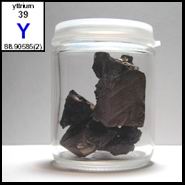
|
| Basic properties | |
|---|---|
| Atomic number | 39 |
| Atomic weight | 88.905852 amu |
| Element family | Transition metals |
| Period | 5 |
| Group | 2 |
| Block | s-block |
| Discovery year | 1794 |
| Isotope distribution |
|---|
89Y 100% |
| Physical properties | |
|---|---|
| Density | 4.469 g/cm3 (STP) |
Atomic hydrogen (H) 8.988E-5 Meitnerium (Mt) 28 | |
| Melting | 1526 °C |
Helium (He) -272.2 Carbon (C) 3675 | |
| Boiling | 3337 °C |
Helium (He) -268.9 Tungsten (W) 5927 | |
| Chemical properties | |
|---|---|
| Oxidation states (less common) | +3 (0, +1, +2) |
| First ionization potential | 6.218 eV |
Cesium (Cs) 3.894 Helium (He) 24.587 | |
| Electron affinity | 0.307 eV |
Nobelium (No) -2.33 Atomic chlorine (Cl) 3.612725 | |
| Electronegativity | 1.22 |
Cesium (Cs) 0.79 Atomic fluorine (F) 3.98 | |
| Atomic radius | |
|---|---|
| Covalent radius | 1.63 Å |
Atomic hydrogen (H) 0.32 Francium (Fr) 2.6 | |
| Metallic radius | 1.8 Å |
Beryllium (Be) 1.12 Cesium (Cs) 2.65 | |
| Compounds | ||
|---|---|---|
| Formula | Name | Oxidation state |
| YO | Yttrium(II) oxide | +2 |
| Y2O3 | Yttrium(III) oxide | +3 |
| YBa2Cu3O7 | Yttrium barium copper oxide | +3 |
| Y3Al5O12 | Yttrium aluminium garnet | +3 |
| YVO4 | Yttrium orthovanadate | +3 |
| YF3 | Yttrium(III) fluoride | +3 |
| Y2S3 | Yttrium(III) sulfide | +3 |
| Y(ClO4)3 | Yttrium perchlorate | +3 |
| Y(NO3)3 | Yttrium(III) nitrate | +3 |
| Y(OH)3 | Yttrium hydroxide | +3 |
| Y3Fe5O12 | Yttrium iron garnet | +3 |
| YAl3(BO3)4 | Nd:YAB | +3 |
| Electronic properties | |
|---|---|
| Electrons per shell | 2, 8, 18, 9, 2 |
| Electronic configuration | [Kr] 4d1 |
|
Bohr atom model

| |
|
Orbital box diagram

| |
| Valence electrons | 3 |
| Lewis dot structure |
|
| Orbital Visualization | |
|---|---|
|
| |
| Electrons | - |
Yttrium (Y): Periodic Table Element
Abstract
Yttrium (Y, atomic number 39) is a silvery-white transition metal belonging to group 3 of the periodic table, with atomic mass 88.906 u and electron configuration [Kr] 4d¹ 5s². The element exhibits primarily trivalent behavior, forming stable Y³⁺ compounds, and displays remarkable chemical similarity to the lanthanides despite being a d-block element. Yttrium occurs naturally only as the isotope ⁸⁹Y, found associated with rare-earth minerals at crustal abundances of 31 ppm. Industrial significance stems from applications in phosphor technology, laser systems, high-temperature superconductors, and advanced ceramics. The element demonstrates exceptional thermal stability, forming protective oxide films, and manifests unique properties that bridge transition metal and rare-earth element chemistry. Production involves complex separation processes from mixed rare-earth ores, yielding approximately 7,000 tonnes of yttrium oxide annually for global applications.
Introduction
Yttrium occupies a distinctive position in the periodic table as the first d-block element of the fifth period, exhibiting chemical properties that closely resemble the lanthanide series rather than its group 3 congener scandium. The element's electron configuration [Kr] 4d¹ 5s² provides three valence electrons, resulting in predominantly trivalent chemistry with Y³⁺ ions demonstrating colorless character due to the absence of unpaired d or f electrons. Discovered in 1789 by Johan Gadolin through analysis of the mineral ytterbite from Ytterby, Sweden, yttrium represents a historically significant element in the development of rare-earth chemistry. The element's unique properties arise from the lanthanide contraction effect, which positions yttrium's ionic radius between gadolinium and erbium, explaining its consistent co-occurrence with heavy lanthanides in natural deposits. Modern applications exploit yttrium's thermal stability, optical properties, and electronic characteristics in technologies ranging from energy-efficient lighting to quantum materials research.
Physical Properties and Atomic Structure
Fundamental Atomic Parameters
Yttrium exhibits atomic number 39 with nuclear composition of 39 protons and 50 neutrons in the naturally occurring isotope ⁸⁹Y. The electron configuration [Kr] 4d¹ 5s² establishes yttrium as a d¹ transition metal, though chemical behavior deviates from typical d-block patterns due to preferential loss of all three valence electrons. Atomic radius measures approximately 180 pm, while the Y³⁺ ionic radius spans 90.0 pm in six-coordinate environments, closely matching heavy lanthanide ionic radii. Effective nuclear charge calculations indicate significant shielding effects from inner electron shells, contributing to the element's lanthanide-like chemical properties. Nuclear spin quantum number I = 1/2 characterizes the ground state of ⁸⁹Y, with magnetic moment μ = -0.1374 nuclear magnetons reflecting the nuclear magnetic properties essential for NMR spectroscopic analysis.
Macroscopic Physical Characteristics
Yttrium crystallizes in hexagonal close-packed structure with lattice parameters a = 364.74 pm and c = 573.06 pm at room temperature, exhibiting metallic bonding characteristic of transition metals. Density reaches 4.472 g/cm³ at 298 K, while thermal expansion coefficient measures 10.6 × 10⁻⁶ K⁻¹. Melting point occurs at 1799 K (1526°C), followed by boiling at 3609 K (3336°C), demonstrating substantial thermal stability. Heat of fusion equals 11.4 kJ/mol, while heat of vaporization reaches 365 kJ/mol, reflecting strong metallic bonding interactions. Specific heat capacity measures 0.298 J/(g·K) at 298 K. The metal exhibits silvery-white metallic luster with moderate electrical conductivity, showing electrical resistivity of 596 nΩ·m at 293 K. Thermal conductivity reaches 17.2 W/(m·K), indicating moderate heat transport properties compared to other transition metals.
Chemical Properties and Reactivity
Electronic Structure and Bonding Behavior
Yttrium demonstrates predominantly ionic bonding characteristics in its compounds, contrasting with typical d-block transition metals that exhibit significant covalent character. The d¹ electron configuration results in complete removal of valence electrons to achieve the stable [Kr] noble gas configuration in Y³⁺ compounds. Oxidation state +3 dominates yttrium chemistry, though unusual +2 and +1 states have been observed in specialized environments such as molten chloride media and gas-phase oxide clusters. Coordination numbers typically range from 6 to 9, with eight-coordinate geometry particularly common in crystalline compounds. Covalent bonding manifests primarily in organometallic complexes, where yttrium exhibits η⁷-hapticity with carboranyl ligands and forms stable metal-carbon bonds in controlled atmospheres. Bond enthalpies with common ligands reflect moderate Lewis acid character, with Y-O bonds exhibiting energies around 715 kJ/mol and Y-F bonds reaching 670 kJ/mol.
Electrochemical and Thermodynamic Properties
Electronegativity values place yttrium at 1.22 on the Pauling scale, significantly lower than typical d-block elements and comparable to alkaline earth metals. Successive ionization energies demonstrate the characteristic pattern expected for group 3 elements: first ionization energy 600 kJ/mol, second ionization energy 1180 kJ/mol, and third ionization energy 1980 kJ/mol, with the relatively low values facilitating trivalent ion formation. Electron affinity remains essentially zero, consistent with metallic character and tendency toward cation formation. Standard reduction potential E°(Y³⁺/Y) = -2.372 V versus standard hydrogen electrode indicates strong reducing character and thermodynamic stability of Y³⁺ in aqueous solution. Hydration enthalpy of Y³⁺ reaches -3620 kJ/mol, reflecting strong ion-dipole interactions with water molecules. Lattice energies of yttrium compounds correlate with ionic radii, with Y₂O₃ exhibiting lattice energy 15,200 kJ/mol and YF₃ showing 4850 kJ/mol.
Chemical Compounds and Complex Formation
Binary and Ternary Compounds
Yttrium oxide Y₂O₃ represents the most thermodynamically stable binary compound, crystallizing in the cubic bixbyite structure with exceptional thermal stability up to 2683 K. The oxide demonstrates amphoteric character, dissolving in strong acids to form Y³⁺ aqua complexes and reacting with concentrated alkali at elevated temperatures. Yttrium trihalides YF₃, YCl₃, and YBr₃ form through direct reaction with halogens above 473 K, exhibiting ionic character and high melting points. YF₃ adopts the fluorite structure with remarkable chemical inertness, while YCl₃ and YBr₃ demonstrate hygroscopic behavior and ready hydrolysis. Ternary compounds include Y₂O₂S (yttrium oxysulfide) used in phosphor applications, and YPO₄ (yttrium phosphate) occurring naturally in xenotime mineral. Carbide formation produces YC₂, Y₂C, and Y₃C phases under reducing conditions at elevated temperatures, with acetylide YC₂ demonstrating calcium carbide-like reactivity with water.
Coordination Chemistry and Organometallic Compounds
Yttrium forms extensive coordination complexes with oxygen-donor ligands, particularly chelating agents such as acetylacetonate, oxalate, and EDTA. Coordination numbers of 8 and 9 predominate due to the large ionic radius of Y³⁺, with square antiprism and tricapped trigonal prism geometries commonly observed. Aqueous solution chemistry involves formation of [Y(H₂O)₈]³⁺ complexes with rapid water exchange kinetics. Organometallic chemistry encompasses cyclopentadienyl derivatives YCp₃ and alkyl complexes stabilized by bulky ligands, though such compounds require strict anaerobic conditions due to high oxophilicity. Notable examples include bis(cyclooctatetraenyl)yttrium exhibiting formal oxidation state +2 and carborane complexes demonstrating unprecedented η⁷-hapticity bonding modes. Catalytic applications exploit organometallic yttrium compounds in olefin polymerization and hydrogenation reactions, where the large ionic radius facilitates formation of cationic active species.
Natural Occurrence and Isotopic Analysis
Geochemical Distribution and Abundance
Yttrium exhibits crustal abundance of 31 ppm, ranking as the 43rd most abundant element in the Earth's crust and exceeding the abundance of lead, tin, and mercury. Geochemical behavior closely parallels the heavy rare-earth elements due to similar ionic radii and charge-to-radius ratios, resulting in consistent fractionation patterns during magmatic and hydrothermal processes. Soil concentrations range from 10 to 150 ppm with dry-weight average of 23 ppm, while seawater contains 9 parts per trillion reflecting the element's low solubility in carbonate-buffered marine environments. Lunar rock samples collected during Apollo missions demonstrate elevated yttrium concentrations compared to terrestrial basalts, suggesting differentiated accumulation processes during lunar formation. Sedimentary rocks, particularly shales, contain yttrium concentrations averaging 27 ppm, while granitic rocks reach 40 ppm and mafic rocks typically contain 20 ppm. Hydrothermal alteration and weathering processes concentrate yttrium in secondary minerals and ion-absorption clay deposits.
Nuclear Properties and Isotopic Composition
Natural yttrium consists exclusively of the isotope ⁸⁹Y with 100% natural abundance, making it one of 22 monoisotopic elements. The nucleus contains 39 protons and 50 neutrons, with the neutron number corresponding to a magic number that contributes to nuclear stability. Nuclear magnetic resonance active nucleus exhibits nuclear spin I = 1/2 with magnetic moment μ = -0.1374 μₙ, enabling ⁸⁹Y NMR spectroscopy for structural studies. At least 32 artificial isotopes have been synthesized with mass numbers ranging from 76 to 108, though most exhibit extremely short half-lives. ⁸⁸Y represents the most stable artificial isotope with half-life 106.629 days, produced through neutron activation of ⁸⁹Y or decay of ⁸⁸Sr. Medically significant ⁹⁰Y possesses half-life 64.1 hours, undergoing pure β⁻ decay to ⁹⁰Zr with maximum β-energy 2.28 MeV, making it valuable for radiotherapeutic applications. Nuclear cross-sections include thermal neutron capture cross-section 1.28 barns for ⁸⁹Y(n,γ)⁹⁰Y reaction and resonance integral 1.0 barns.
Industrial Production and Technological Applications
Extraction and Purification Methodologies
Industrial yttrium production begins with rare-earth mineral processing, primarily from bastnäsite, monazite, xenotime, and ion-absorption clay deposits. Initial ore treatment involves acid leaching with concentrated sulfuric acid or hydrochloric acid to dissolve rare-earth values, followed by selective precipitation and redissolution cycles to remove thorium, iron, and other impurities. Separation of yttrium from lanthanides utilizes ion-exchange chromatography with cation-exchange resins loaded with rare-earth chlorides or nitrates, exploiting subtle differences in ionic radii and complexation behavior. Alternatively, solvent extraction employs tributyl phosphate or di(2-ethylhexyl)phosphoric acid in kerosene diluents, with yttrium preferentially extracting into organic phases under controlled pH conditions. Precipitation as yttrium oxalate Y₂(C₂O₄)₃·9H₂O followed by calcination at 1073 K yields high-purity Y₂O₃ with 99.999% purity. Metallic yttrium production requires reduction of anhydrous YF₃ with calcium-magnesium alloys in evacuated vessels at temperatures exceeding 1873 K, producing metallic sponge subsequently remelted in arc furnaces.
Technological Applications and Future Prospects
Phosphor applications constitute the largest consumption segment, with yttrium compounds serving as host matrices for lanthanide activators in energy-efficient lighting systems. Yttrium aluminum garnet doped with cerium Y₃Al₅O₁₂:Ce³⁺ functions as the primary yellow phosphor in white light-emitting diodes, converting blue emission to broad-spectrum white light with luminous efficacy exceeding 150 lumens per watt. Laser technology exploits neodymium-doped yttrium aluminum garnet Nd:Y₃Al₅O₁₂ for high-power solid-state lasers operating at 1064 nm wavelength, with applications in industrial cutting, welding, and medical procedures. High-temperature superconductor YBa₂Cu₃O₇-δ achieved critical temperature 93 K, above liquid nitrogen boiling point, enabling practical applications in power transmission cables, magnetic levitation systems, and superconducting quantum interference devices. Advanced ceramics incorporate yttria-stabilized zirconia for thermal barrier coatings in gas turbine engines, oxygen sensors, and solid oxide fuel cells, exploiting exceptional chemical stability and ionic conductivity at elevated temperatures. Emerging applications include lithium iron yttrium phosphate batteries offering enhanced thermal stability and cycle life, quantum dot technologies, and magnetic refrigeration systems utilizing yttrium-gadolinium alloys.
Historical Development and Discovery
The discovery of yttrium traces to 1787 when Carl Axel Arrhenius identified an unusually heavy black mineral in a quarry near Ytterby, Sweden, initially believing it contained tungsten and naming it ytterbite. Johan Gadolin at the Royal Academy of Åbo systematically analyzed the mineral in 1789, identifying a previously unknown earth that he termed yttria, representing the first rare-earth oxide discovered. Anders Gustaf Ekeberg confirmed Gadolin's findings in 1797 and established the name yttria for the new oxide, though the chemical element concept remained undefined according to Lavoisier's framework. Friedrich Wöhler achieved the first isolation of metallic yttrium in 1828 through potassium reduction of what he believed to be yttrium chloride, though the product contained significant impurities. Carl Gustaf Mosander's systematic investigations in the 1840s revealed that crude yttria contained multiple rare-earth oxides, leading to the discovery of terbium and erbium from the original yttrium-bearing mineral. The complexity of rare-earth separation delayed production of pure yttrium compounds until the development of ion-exchange chromatography in the 1940s. Modern understanding of yttrium's unique position between transition metals and lanthanides emerged with electronic structure theories and X-ray crystallographic studies in the mid-20th century. The technological revolution began with yttrium-90 medical applications in the 1960s, followed by phosphor applications in color television, and culminated with the discovery of high-temperature superconductivity in yttrium barium copper oxide in 1987.
Conclusion
Yttrium occupies a singular position in the periodic table, bridging d-block transition metal chemistry with f-block lanthanide behavior through the manifestation of unique electronic and structural properties. The element's trivalent chemistry, governed by [Kr] noble gas core stability, generates compounds with exceptional thermal and chemical stability that enable diverse technological applications from energy-efficient lighting to superconducting materials. Industrial significance continues expanding as quantum technologies and sustainable energy systems demand materials with precisely controlled optical, electronic, and magnetic properties. Future research directions encompass development of novel yttrium-based quantum materials, enhancement of battery technologies through yttrium-doped cathode materials, and exploration of single-atom catalysts utilizing yttrium's unique coordination chemistry. The element's role in advancing green technologies, particularly through phosphor-converted LED systems and high-temperature superconductors, positions yttrium as a critical component in global sustainability initiatives.

Please let us know how we can improve this web app.
