| Element | |
|---|---|
96CmCurium247.07032
8 18 32 25 9 2 |
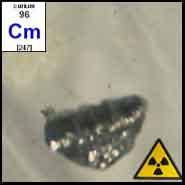
|
| Basic properties | |
|---|---|
| Atomic number | 96 |
| Atomic weight | 247.0703 amu |
| Element family | Actinoids |
| Period | 7 |
| Group | 2 |
| Block | s-block |
| Discovery year | 1944 |
| Isotope distribution |
|---|
| None |
| Physical properties | |
|---|---|
| Density | 13.51 g/cm3 (STP) |
Atomic hydrogen (H) 8.988E-5 Meitnerium (Mt) 28 | |
| Melting | 1067 °C |
Helium (He) -272.2 Carbon (C) 3675 | |
| Boiling | 3110 °C |
Helium (He) -268.9 Tungsten (W) 5927 | |
| Chemical properties | |
|---|---|
| Oxidation states (less common) | +3 (+4, +5, +6) |
| First ionization potential | 6.021 eV |
Cesium (Cs) 3.894 Helium (He) 24.587 | |
| Electron affinity | 0.280 eV |
Nobelium (No) -2.33 Atomic chlorine (Cl) 3.612725 | |
| Electronegativity | 1.28 |
Cesium (Cs) 0.79 Atomic fluorine (F) 3.98 | |
| Electronic properties | |
|---|---|
| Electrons per shell | 2, 8, 18, 32, 25, 9, 2 |
| Electronic configuration | [Rn] 5f7 |
|
Bohr atom model

| |
|
Orbital box diagram

| |
| Valence electrons | 10 |
| Lewis dot structure |
|
| Orbital Visualization | |
|---|---|
|
| |
| Electrons | - |
| Reactions |
|---|
| Cm + O2 = CmO2 |
| 2 Cm + 3 I2 = 2 CmI3 |
Curium (Cm): Periodic Table Element
Abstract
Curium (Cm) is a synthetic transuranium actinide element with atomic number 96, characterized by its distinctive purple luminescence and complex electronic structure featuring seven 5f electrons. This radioactive element demonstrates remarkable nuclear properties with its most stable isotope ²⁴⁷Cm exhibiting a half-life of 15.6 million years. Curium manifests primarily trivalent oxidation states in aqueous solutions, displaying strong fluorescent properties under ultraviolet irradiation. The element exhibits significant applications in space exploration through α-particle X-ray spectrometry and potential use in radioisotope thermoelectric generators. Its production through neutron bombardment of uranium and plutonium in nuclear reactors yields approximately 20 grams per tonne of spent nuclear fuel, making it one of the rarest synthetic elements available for scientific research.
Introduction
Curium occupies position 96 in the periodic table within the actinide series, representing the seventh member of the 5f electron block. The element's electronic configuration exhibits seven unpaired 5f electrons, establishing direct analogy with gadolinium's seven 4f electrons in the lanthanide series. This electronic arrangement fundamentally determines curium's magnetic behavior, coordination chemistry, and spectroscopic properties. The element was synthesized in 1944 through α-particle bombardment of ²³⁹Pu at the University of California, Berkeley, marking a crucial advancement in transuranium element chemistry. Curium's significance extends beyond fundamental research through its specialized applications in planetary exploration and nuclear technology, where its unique nuclear characteristics provide capabilities unavailable from naturally occurring elements.
Physical Properties and Atomic Structure
Fundamental Atomic Parameters
Curium exhibits atomic number 96 with electron configuration [Rn] 5f⁷ 6d¹ 7s², establishing its position in the actinide series. The atomic radius measures approximately 174 pm, while the ionic radius of Cm³⁺ spans 97 pm in octahedral coordination. The effective nuclear charge experienced by valence electrons reaches approximately 3.2, with substantial shielding from core electrons reducing the full nuclear attraction. Seven unpaired 5f electrons create significant magnetic moments and determine the element's paramagnetic behavior at ambient temperatures. The 5f orbitals demonstrate greater spatial extension compared to 4f orbitals in lanthanides, resulting in enhanced covalent character in chemical bonding and distinct coordination geometries.
Macroscopic Physical Characteristics
Curium presents as a hard, dense metal with silvery-white appearance when freshly prepared, though surface oxidation rapidly occurs upon air exposure. The metal exhibits distinctive purple luminescence in darkness due to ionization of surrounding air by emitted α-particles. Crystal structure analysis reveals hexagonal symmetry under ambient conditions (α-Cm phase) with space group P6₃/mmc and lattice parameters a = 365 pm, c = 1182 pm. The double-hexagonal close packing arrangement (ABAC layer sequence) transforms under pressure to face-centered cubic (β-Cm) above 23 GPa and orthorhombic (γ-Cm) above 43 GPa. Density reaches 13.52 g/cm³ at room temperature, reflecting the heavy atomic mass and compact metallic structure. Thermal properties include melting point 1344°C and boiling point 3556°C, with specific heat capacity demonstrating temperature dependence typical of actinide metals.
Chemical Properties and Reactivity
Electronic Structure and Bonding Behavior
Chemical reactivity derives primarily from the accessibility of three valence electrons for bond formation, with the +3 oxidation state demonstrating exceptional stability in aqueous solutions. The seven 5f electrons remain largely non-bonding but contribute to magnetic properties and spectroscopic characteristics. Curium forms predominantly ionic bonds with electropositive partners, though covalent contributions become significant in organometallic complexes and with soft donor ligands. Coordination chemistry typically exhibits nine-fold coordination geometries, with tricapped trigonal prismatic arrangements most common in crystalline compounds. The element readily forms complexes with oxygen-, nitrogen-, and halogen-containing ligands, displaying coordination behavior intermediate between lanthanides and lighter actinides. Bond formation involves minimal 5f orbital participation, contrasting with 6d and 7s orbital hybridization observed in transition metals.
Electrochemical and Thermodynamic Properties
Electrochemical behavior reflects the stability of the +3 oxidation state, with standard reduction potential Cm³⁺/Cm⁰ measuring approximately -2.06 V versus standard hydrogen electrode. Successive ionization energies demonstrate progressive increase from first (581 kJ/mol) through third (1949 kJ/mol), with fourth ionization requiring substantially higher energy (3547 kJ/mol). Electron affinity measurements indicate minimal tendency for anion formation, consistent with metallic character and electropositive behavior. The +4 oxidation state achieves stabilization in solid fluoride and oxide phases, though disproportionation occurs readily in aqueous media. Thermodynamic stability calculations predict formation of stable +6 oxidation states under highly oxidizing conditions, manifested in curyl ion CmO₂²⁺ chemistry. Redox behavior in various media demonstrates pH dependence and sensitivity to ligand coordination effects.
Chemical Compounds and Complex Formation
Binary and Ternary Compounds
Oxide chemistry encompasses several stoichiometries with Cm₂O₃ representing the most thermodynamically stable phase under ambient conditions. The sesquioxide crystallizes in hexagonal or cubic structures depending on preparation conditions and exhibits white to pale yellow coloration. CmO₂ forms as a black crystalline solid with fluorite structure, demonstrating the accessibility of +4 oxidation states in oxide lattices. Halide formation proceeds readily with all halogens, producing CmF₃, CmCl₃, CmBr₃, and CmI₃ as predominant species. The tetrafluoride CmF₄ manifests as a brown crystalline material with monoclinic structure, representing one of the few stable +4 compounds. Ternary compounds include various phosphates, sulfates, and carbonates, with CmPO₄ demonstrating particular importance in nuclear waste immobilization strategies.
Coordination Chemistry and Organometallic Compounds
Coordination complexes exhibit preferential formation with hard donor ligands including carboxylates, phosphonates, and multidentate nitrogen-containing molecules. Nine-coordinate geometries predominate in crystalline complexes, with tricapped trigonal prismatic arrangements most frequently observed. Ligand field effects produce characteristic spectroscopic signatures in the visible and near-infrared regions, with sharp absorption bands corresponding to f-f electronic transitions. Fluorescence properties manifest strongly in coordination compounds, with quantum yields reaching 40-60% for optimized ligand environments. The complexes demonstrate remarkable photophysical stability under continuous illumination, making them valuable for analytical applications. Organometallic chemistry remains limited due to the radioactive nature and scarcity of curium, though cyclopentadienyl and related π-bonded complexes have been synthesized and characterized structurally.
Natural Occurrence and Isotopic Analysis
Geochemical Distribution and Abundance
Curium does not occur naturally in the Earth's crust due to the absence of stable isotopes and the relatively short half-lives of all known radioisotopes compared to geological timescales. Trace quantities may form temporarily through natural nuclear reactions in uranium ore deposits, particularly those with high neutron flux densities, but these concentrations remain below detection limits for conventional analytical methods. Crustal abundance effectively equals zero, with production restricted to artificial synthesis in nuclear reactors and particle accelerators. The element's geochemical behavior would theoretically resemble other trivalent actinides, with preference for coordination with oxygen-containing minerals and potential incorporation into phosphate, carbonate, and silicate lattices if natural occurrence were possible.
Nuclear Properties and Isotopic Composition
The isotopic landscape of curium spans mass numbers 233 through 251, encompassing nineteen distinct radioisotopes and seven nuclear isomers. ²⁴⁷Cm demonstrates maximum stability with a half-life of 15.6 million years through α-decay to ²⁴³Am. ²⁴⁸Cm exhibits 348,000-year half-life with predominantly α-decay and minor spontaneous fission branching. ²⁴⁵Cm provides significant nuclear cross-sections for thermal neutron fission (2145 barns) and capture (369 barns), making it valuable for nuclear reactor applications. ²⁴⁴Cm demonstrates 18.11-year half-life with convenient handling characteristics for research applications. Nuclear spin states range from 0 to 9/2, with magnetic moments reflecting the unpaired 5f electron configurations. Spontaneous fission becomes dominant for heavier isotopes, with ²⁵⁰Cm exhibiting 86% spontaneous fission probability.
Industrial Production and Technological Applications
Extraction and Purification Methodologies
Production of curium occurs exclusively through neutron irradiation of actinide targets in high-flux nuclear reactors, with ²³⁹Pu and ²⁴¹Am serving as primary precursors. The multi-step nuclear transmutation process involves successive neutron capture and β-decay reactions, requiring extensive irradiation periods spanning several years for significant yields. Separation and purification employ sophisticated ion-exchange chromatography using α-hydroxyisobutyric acid or similar complexing agents that exploit minor differences in ionic radii and coordination preferences among actinides. Solvent extraction techniques utilize tributyl phosphate and related organophosphorus compounds to achieve separation factors sufficient for high-purity isolation. Production yields approximate 20 grams per tonne of heavily irradiated nuclear fuel, with recovery efficiency dependent on processing methodology and decay time considerations. Purification to greater than 99% purity requires multiple chromatographic cycles and careful management of radioactive decay products.
Technological Applications and Future Prospects
Space exploration applications utilize curium-244 as the α-particle source in X-ray spectrometers deployed on Mars exploration vehicles including Sojourner, Spirit, Opportunity, and Curiosity rovers. The Philae lander employed similar curium-based instrumentation for surface composition analysis of comet 67P/Churyumov-Gerasimenko. Nuclear applications encompass radioisotope thermoelectric generators for spacecraft power systems, where curium's high specific activity and manageable radiation profile provide advantages over plutonium alternatives. Critical mass calculations indicate potential use as fissile material in compact nuclear reactors, though practical implementation remains limited by availability and cost considerations. Future prospects include superheavy element synthesis, where curium isotopes serve as target materials for creating elements beyond atomic number 100. Advanced fluorescence-based analytical techniques exploit curium's exceptional photophysical properties for trace-level detection and environmental monitoring applications.
Historical Development and Discovery
The discovery of curium in 1944 emerged from systematic investigations of transuranium elements at the University of California, Berkeley, under the leadership of Glenn T. Seaborg. The research team, including Ralph A. James and Albert Ghiorso, achieved the first synthesis through α-particle bombardment of ²³⁹Pu using the 60-inch cyclotron facility. Initial chemical identification occurred at the Metallurgical Laboratory, University of Chicago, where separation techniques distinguished curium from other actinide elements based on oxidation state chemistry and coordination behavior. The element's name honors Marie and Pierre Curie, recognizing their foundational contributions to radioactivity research and nuclear chemistry. Wartime secrecy delayed public announcement until November 1947, despite the successful synthesis three years earlier. Subsequent decades witnessed progressive understanding of curium's electronic structure, with theoretical predictions of 5f electron behavior confirmed through spectroscopic and magnetic measurements. Modern synthesis techniques have enabled production of gram quantities sufficient for detailed chemical characterization and technological applications.
Conclusion
Curium represents a paradigmatic transuranium element whose unique combination of nuclear, electronic, and photophysical properties establishes its significance in both fundamental actinide chemistry and specialized technological applications. The element's position in the middle of the actinide series, with seven 5f electrons, provides crucial insights into f-block electronic structure and bonding theory. Its exceptional fluorescence characteristics and nuclear properties enable applications impossible with naturally occurring elements, particularly in space exploration and advanced analytical instrumentation. Future research directions encompass enhanced production methodologies, novel coordination chemistry investigations, and expanded technological implementations in nuclear energy and space science. The continuing availability of curium through nuclear fuel reprocessing ensures its role in advancing understanding of actinide chemistry and supporting specialized technological requirements in the nuclear age.

Please let us know how we can improve this web app.
