| Element | |
|---|---|
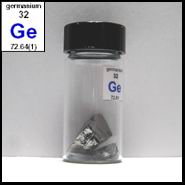
32GeGermanium72.6412
8 18 4 |
|
| Basic properties | |
|---|---|
| Atomic number | 32 |
| Atomic weight | 72.641 amu |
| Element family | Metaloids |
| Period | 4 |
| Group | 14 |
| Block | p-block |
| Discovery year | 1886 |
| Isotope distribution |
|---|
70Ge 20.5% 72Ge 27.4% 73Ge 7.8% 74Ge 36.5% 76Ge 7.8% |
70Ge (20.50%) 72Ge (27.40%) 73Ge (7.80%) 74Ge (36.50%) 76Ge (7.80%) |
| Physical properties | |
|---|---|
| Density | 5.323 g/cm3 (STP) |
Atomic hydrogen (H) 8.988E-5 Meitnerium (Mt) 28 | |
| Melting | 938.3 °C |
Helium (He) -272.2 Carbon (C) 3675 | |
| Boiling | 2830 °C |
Helium (He) -268.9 Tungsten (W) 5927 | |
| Chemical properties | |
|---|---|
| Oxidation states (less common) | -4, +2, +4 (-3, -2, -1, 0, +1, +3) |
| First ionization potential | 7.897 eV |
Cesium (Cs) 3.894 Helium (He) 24.587 | |
| Electron affinity | 1.233 eV |
Nobelium (No) -2.33 Atomic chlorine (Cl) 3.612725 | |
| Electronegativity | 2.01 |
Cesium (Cs) 0.79 Atomic fluorine (F) 3.98 | |
| Atomic radius | |
|---|---|
| Covalent radius | 1.21 Å |
Atomic hydrogen (H) 0.32 Francium (Fr) 2.6 | |
| Van der Waals radius | 2.11 Å |
Atomic hydrogen (H) 1.2 Francium (Fr) 3.48 | |
| Compounds | ||
|---|---|---|
| Formula | Name | Oxidation state |
| GeH4 | Germane | -4 |
| GeBr2 | Germanium(II) bromide | +2 |
| GeCl2 | Germanium(II) chloride | +2 |
| GeF2 | Germanium(II) fluoride | +2 |
| GeI2 | Germanium(II) iodide | +2 |
| GeO | Germanium(II) oxide | +2 |
| GeS | Germanium(II) sulfide | +2 |
| GeO2 | Germanium(IV) oxide | +4 |
| GeCl4 | Germanium(IV) chloride | +4 |
| GeS2 | Germanium(IV) sulfide | +4 |
| GeF4 | Germanium(IV) fluoride | +4 |
| GeBr4 | Germanium(IV) bromide | +4 |
| Electronic properties | |
|---|---|
| Electrons per shell | 2, 8, 18, 4 |
| Electronic configuration | [Ar] 3d10 |
|
Bohr atom model

| |
|
Orbital box diagram

| |
| Valence electrons | 4 |
| Lewis dot structure |
|
| Orbital Visualization | |
|---|---|
|
| |
| Electrons | - |
Germanium (Ge): Periodic Table Element
Abstract
Germanium (Ge), atomic number 32, occupies a unique position in Group 14 of the periodic table as a metalloid semiconductor with electron configuration [Ar] 3d10 4s2 4p2. This element exhibits a grayish-white lustrous appearance with density 5.35 g/cm3, melting point 1211 K, and characteristic diamond cubic crystal structure. Germanium demonstrates diverse oxidation states including +4, +2, and −4, forming numerous inorganic compounds with distinct chemical properties. The element's natural abundance of 1.6 ppm in Earth's crust occurs primarily in zinc ores and coal deposits. Five stable isotopes exist, with 74Ge comprising the most abundant natural form. Germanium's semiconductor properties, including its indirect band gap and high-purity crystalline structure, have established its significance in electronic applications. The element exhibits amphoteric behavior, reacting with both acids and bases under specific conditions, while demonstrating thermal expansion characteristics similar to silicon and diamond.
Introduction
Germanium stands as a pivotal element in the carbon family, bridging metallic and nonmetallic properties within the fourth period of the periodic table. This metalloid's significance extends beyond its historical role as the first predicted element to be subsequently discovered, representing a triumph of Mendeleev's periodic law. Positioned between silicon and tin in Group 14, germanium exhibits intermediate properties that reflect the characteristic trends of increasing metallic character down the group. The element's electron configuration of [Ar] 3d10 4s2 4p2 establishes its tetrahedral bonding preferences and explains its semiconductor behavior. Modern applications capitalize on germanium's unique electronic properties, particularly in infrared optics and high-frequency electronics where its properties surpass those of silicon. The element's chemical versatility manifests through multiple oxidation states and compound formation patterns that demonstrate systematic relationships with neighboring elements carbon and silicon.
Physical Properties and Atomic Structure
Fundamental Atomic Parameters
The atomic structure of germanium centers on its nuclear charge of +32 and corresponding electron configuration [Ar] 3d10 4s2 4p2. This configuration places two electrons in the outermost 4p orbital, establishing the foundation for its chemical bonding behavior. The effective nuclear charge experienced by valence electrons equals approximately 4.7, accounting for shielding effects of the inner electrons. Atomic radius measurements yield 122 pm for the covalent radius and 125 pm for the metallic radius. The ionic radius varies significantly with oxidation state: Ge4+ exhibits 0.53 Å while Ge2+ measures 0.73 Å. These radial parameters position germanium between silicon (smaller) and tin (larger) in accordance with periodic trends. The filled 3d10 subshell provides additional nuclear shielding, contributing to the contraction observed in fourth-period elements. Crystal field stabilization energy in tetrahedral environments reflects the d10 configuration's spherical symmetry, influencing coordination geometry preferences in germanium compounds.
Macroscopic Physical Characteristics
Germanium crystallizes in the diamond cubic structure with lattice parameter a = 5.658 Å at 298 K, identical to the carbon and silicon allotropes. This arrangement creates a three-dimensional network of tetrahedral coordination, contributing to the material's hardness and brittleness. The α-germanium phase exhibits metallic luster and grayish-white coloration, contrasting with the high-pressure β-phase that adopts metallic properties above 120 kbar. Density measurements confirm 5.35 g/cm3 at standard conditions, representing a compromise between atomic mass and crystal packing efficiency. Thermal properties include melting point 1211.40 K, boiling point 3106 K, and heat of fusion 36.94 kJ/mol. The heat of vaporization reaches 334 kJ/mol, reflecting strong interatomic bonding in the crystalline state. Specific heat capacity equals 0.320 J/g·K at 298 K, demonstrating typical values for covalently bonded solids. Thermal expansion coefficient measures 5.9 × 10⁻⁶ K−1, exhibiting the unusual property of expansion upon solidification shared with silicon, bismuth, and water.
Chemical Properties and Reactivity
Electronic Structure and Bonding Behavior
The electronic configuration [Ar] 3d10 4s2 4p2 establishes germanium's preference for tetrahedral coordination through sp3 hybridization. This hybridization scheme accommodates four equivalent bonds with typical Ge-Ge bond length 2.44 Å and bond energy 188 kJ/mol. The filled 3d subshell contributes to core electron density while remaining chemically inert under normal conditions. Oxidation states range from −4 in germanides (such as Mg2Ge) through +2 and +4 oxidation states in various compounds. The +4 oxidation state predominates in most germanium chemistry, achieved through complete utilization of the 4s and 4p electrons. Coordination numbers vary from four in tetrahedral GeCl4 to six in octahedral complexes like GeCl62−. Covalent bonding dominates in germanium compounds, though ionic character increases with electronegativity differences. The polarizability of germanium atoms enables π-bonding interactions in appropriate molecular environments, contributing to the stability of certain organometallic derivatives.
Electrochemical and Thermodynamic Properties
Electronegativity values position germanium at 2.01 on the Pauling scale, intermediate between silicon (1.90) and carbon (2.55), reflecting its metalloid character. The Mulliken electronegativity scale yields 4.6 eV, consistent with the element's position in Group 14. Successive ionization energies demonstrate progressive increases: first ionization 7.90 eV, second ionization 15.93 eV, third ionization 34.22 eV, and fourth ionization 45.71 eV. These values reflect increasing difficulty in electron removal as nuclear charge effects intensify. Electron affinity measurements indicate 1.23 eV for the reaction Ge(g) + e− → Ge−(g), suggesting moderate tendency to accept electrons. Standard reduction potentials vary with solution conditions: Ge4+/Ge2+ (+0.24 V), Ge2+/Ge (−0.118 V), and Ge4+/Ge (−0.013 V) in aqueous media. These potentials indicate germanium's stability in moderate oxidation states while explaining its resistance to reduction in acidic solutions. Thermodynamic data for germanium compounds reveal generally negative formation enthalpies, with GeO2 exhibiting ΔHf° = −580.0 kJ/mol, demonstrating thermodynamic stability.
Chemical Compounds and Complex Formation
Binary and Ternary Compounds
Germanium forms extensive series of binary compounds across multiple oxidation states, with GeO2 representing the most thermodynamically stable oxide. This dioxide adopts rutile or quartz-like structures depending on formation conditions, exhibiting amphoteric behavior through reactions with both acids and bases. The tetragonal form predominates at high temperatures while hexagonal modifications appear under specific synthetic conditions. Germanium tetrachloride (GeCl4) serves as a crucial precursor in germanium chemistry, displaying tetrahedral geometry with Ge-Cl bond length 2.113 Å and boiling point 356.6 K. Other halides including GeF4, GeBr4, and GeI4 exhibit similar structural features with systematic bond length increases following halogen size trends. Sulfide compounds GeS and GeS2 demonstrate layered structures characteristic of chalcogenide materials, with applications in photonic devices. Ternary compounds include germanates (containing GeO44− units), thiogermanates, and complex halides like K2GeCl6, extending structural diversity through additional coordination environments.
Coordination Chemistry and Organometallic Compounds
Coordination complexes of germanium demonstrate versatility through variable coordination numbers and ligand arrangements. Tetrahedral complexes predominate in Ge(IV) chemistry, exemplified by GeCl4 and related species with monodentate ligands. Octahedral coordination appears in hexahalogermate(IV) anions such as GeCl62− and GeF62−, achieved through expanded coordination spheres. Chelating ligands form stable rings with germanium centers, particularly in germanium(II) complexes where lone pair effects influence molecular geometry. Organogermanium chemistry encompasses tetraorganogermanes R4Ge, organogermanium halides RnGeX4−n, and heterocyclic compounds containing Ge-C bonds. These compounds exhibit Ge-C bond lengths averaging 1.95 Å with tetrahedral geometry around germanium centers. π-Bonding interactions occur in organogermanium species containing unsaturated organic ligands, contributing to enhanced stability through back-donation mechanisms. Catalytic applications utilize germanium complexes in polymerization reactions and organic transformations, though less extensively than corresponding silicon or tin analogs.
Natural Occurrence and Isotopic Analysis
Geochemical Distribution and Abundance
Germanium's crustal abundance averages 1.6 parts per million, ranking it as the 50th most abundant element in Earth's crust. This relatively low concentration reflects germanium's lithophile character and tendency to substitute for silicon in aluminosilicate minerals. Primary germanium minerals remain rare, with argyrodite (Ag8GeS6) representing the most significant naturally occurring germanium-bearing phase. Industrial recovery relies predominantly on zinc ore processing, particularly from sphalerite (ZnS) where germanium concentrates through isomorphous substitution for zinc. Coal deposits exhibit unusual germanium enrichment, with some formations containing up to 1600 ppm in associated ash residues. This enrichment mechanism involves hydrothermal processes and organic matter complexation during coal formation. Ocean water contains approximately 0.05 μg/L germanium, primarily as germanic acid species. Geothermal springs demonstrate elevated germanium concentrations through rock-water interactions at elevated temperatures. Sedimentary processes concentrate germanium in specific environments, particularly in phosphatic and organic-rich sequences where complexation reactions promote accumulation.
Nuclear Properties and Isotopic Composition
Natural germanium comprises five stable isotopes: 70Ge (20.38%), 72Ge (27.31%), 73Ge (7.76%), 74Ge (36.72%), and 76Ge (7.83%). These isotopic abundances remain essentially constant across terrestrial samples, indicating minimal fractionation during geochemical processes. Nuclear properties include nuclear spins ranging from 0 (70Ge, 72Ge, 74Ge, 76Ge) to 9/2 (73Ge), with magnetic moments measured precisely for the odd-mass isotope. Thermal neutron capture cross-sections vary significantly among isotopes: 70Ge (3.0 barns), 74Ge (0.14 barns), and others showing intermediate values. Twenty-seven artificial radioisotopes exist with mass numbers from 58 to 89, displaying characteristic decay patterns through electron capture, β+ emission, or β− decay depending on neutron-to-proton ratios. 68Ge represents the longest-lived artificial isotope with half-life 270.95 days, decaying through electron capture to produce 68Ga. This decay pathway finds application in positron emission tomography through 68Ge/68Ga generator systems. Nuclear data demonstrate systematic trends correlating with nuclear shell structure and binding energy considerations across the isotopic series.
Industrial Production and Technological Applications
Extraction and Purification Methodologies
Industrial germanium production relies primarily on zinc ore processing, where germanium concentrates in flue dusts during zinc smelting operations. Initial concentration involves leaching procedures using sulfuric acid solutions to solubilize germanium values while precipitating iron and other impurities. Subsequent purification employs distillation of germanium tetrachloride, exploiting its volatility (boiling point 356.6 K) for separation from less volatile metal chlorides. Zone refining techniques achieve ultra-high purity levels necessary for semiconductor applications, reducing impurity concentrations to parts-per-billion levels through progressive crystallization and melting cycles. Alternative production routes include recovery from coal ash through alkaline leaching followed by ion exchange purification. Hydrolysis of purified GeCl4 yields germanium dioxide, which undergoes hydrogen reduction at elevated temperatures to produce metallic germanium. Crystal growth utilizes Czochralski pulling or float-zone methods to generate single-crystal ingots with controlled crystallographic orientation. Production statistics indicate annual global output approximating 120 metric tons, with primary production centers in China, Russia, and Belgium. Economic factors include energy costs for high-temperature processing and the specialized equipment requirements for achieving semiconductor-grade purity standards.
Technological Applications and Future Prospects
Semiconductor applications exploit germanium's electronic properties, particularly its high electron and hole mobilities exceeding those of silicon. Infrared optics represent the largest application sector, utilizing germanium's transparency in the 2-12 μm wavelength range for thermal imaging systems and night vision equipment. The refractive index of 4.0 at 10 μm wavelength enables efficient optical designs for infrared applications. Photovoltaic cells incorporate germanium substrates for high-efficiency multi-junction solar cells used in space applications, where radiation resistance and temperature stability provide advantages over conventional silicon devices. Fiber optic communications employ germanium-doped silica glasses to modify refractive index profiles in optical waveguides. Germanium dioxide serves as a catalyst in polyethylene terephthalate production, facilitating polymerization reactions through coordination chemistry mechanisms. Emerging applications include spintronics research where germanium's electronic structure offers potential advantages for quantum computing applications. Nuclear detection systems utilize high-purity germanium crystals for gamma-ray spectroscopy, exploiting the material's excellent energy resolution capabilities. Future technological developments focus on germanium nanowires for advanced electronic devices and integration with silicon-based technologies. Environmental considerations address recycling opportunities from electronic waste streams and development of more sustainable extraction processes.
Historical Development and Discovery
The discovery of germanium represents one of chemistry's most celebrated examples of successful theoretical prediction followed by experimental confirmation. Dmitri Mendeleev predicted the element's existence in 1869 as "ekasilicon," positioned below silicon in his periodic table with remarkably accurate property predictions. His theoretical framework anticipated atomic weight 72, density 5.5 g/cm3, gray metallic appearance, and specific chemical behaviors including oxide formation and chloride volatility. Clemens Winkler achieved experimental discovery on February 6, 1886, during analysis of the mineral argyrodite from the Himmelsfürst mine near Freiberg, Saxony. Initial quantitative analysis revealed discrepancies in total mass balance, leading Winkler to hypothesize the presence of an unknown element comprising approximately 7% of the mineral's composition. Systematic chemical separation and purification yielded sufficient material for comprehensive characterization. The element's properties matched Mendeleev's predictions with extraordinary accuracy: atomic weight 72.59 (predicted 72), density 5.35 g/cm3 (predicted 5.5), and gray metallic luster as anticipated. Winkler named the element "germanium" honoring his homeland, Germany. Subsequent investigations throughout the late 19th and early 20th centuries established the element's chemistry and compounds, culminating in the development of high-purity crystalline germanium for semiconductor applications in the mid-20th century. This historical progression illustrates the evolution from theoretical prediction through discovery to technological implementation across more than a century of chemical research.
Conclusion
Germanium occupies a distinctive position within the periodic table as a metalloid semiconductor whose properties bridge metallic and nonmetallic behavior. Its electron configuration [Ar] 3d10 4s2 4p2 establishes fundamental chemical characteristics including tetrahedral bonding preferences, multiple oxidation states, and semiconductor electronic properties. The element's significance in modern technology stems from its unique infrared optical properties and electronic characteristics that complement silicon-based technologies. Industrial applications continue expanding through developments in photovoltaics, fiber optics, and emerging quantum technologies. Future research opportunities include exploration of germanium nanostructures, advanced semiconductor heterostructures, and sustainable production methodologies. The element's historical importance as Mendeleev's first successfully predicted element demonstrates the power of periodic relationships in chemical science, while its continuing technological relevance ensures ongoing research interest across multiple scientific disciplines.

Please let us know how we can improve this web app.
