| Element | |
|---|---|
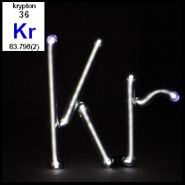
36KrKrypton83.79822
8 18 8 |
|
| Basic properties | |
|---|---|
| Atomic number | 36 |
| Atomic weight | 83.7982 amu |
| Element family | Nobel gases |
| Period | 4 |
| Group | 18 |
| Block | p-block |
| Discovery year | 1898 |
| Isotope distribution |
|---|
80Kr 2.25% 82Kr 11.6% 83Kr 11.5% 84Kr 57.0% 86Kr 17.3% |
80Kr (2.26%) 82Kr (11.64%) 83Kr (11.54%) 84Kr (57.20%) 86Kr (17.36%) |
| Physical properties | |
|---|---|
| Density | 0.003733 g/cm3 (STP) |
Atomic hydrogen (H) 8.988E-5 Meitnerium (Mt) 28 | |
| Melting | -157.22 °C |
Helium (He) -272.2 Carbon (C) 3675 | |
| Boiling | -152.3 °C |
Helium (He) -268.9 Tungsten (W) 5927 | |
| Chemical properties | |
|---|---|
| Oxidation states (less common) | +2 (+1) |
| First ionization potential | 14.000 eV |
Cesium (Cs) 3.894 Helium (He) 24.587 | |
| Electron affinity | -1.000 eV |
Nobelium (No) -2.33 Atomic chlorine (Cl) 3.612725 | |
| Electronegativity | 3 |
Cesium (Cs) 0.79 Atomic fluorine (F) 3.98 | |
| Atomic radius | |
|---|---|
| Covalent radius | 1.17 Å |
Atomic hydrogen (H) 0.32 Francium (Fr) 2.6 | |
| Van der Waals radius | 2.02 Å |
Atomic hydrogen (H) 1.2 Francium (Fr) 3.48 | |
| Compounds | ||
|---|---|---|
| Formula | Name | Oxidation state |
| KrF2 | Krypton difluoride | +2 |
| Electronic properties | |
|---|---|
| Electrons per shell | 2, 8, 18, 8 |
| Electronic configuration | [Ar] 3d10 |
|
Bohr atom model

| |
|
Orbital box diagram

| |
| Valence electrons | 8 |
| Lewis dot structure |
|
| Orbital Visualization | |
|---|---|
|
| |
| Electrons | - |
Krypton (Kr): Periodic Table Element
Abstract
Krypton (Kr, atomic number 36) is a noble gas belonging to Group 18 of the periodic table. This colorless, odorless gas exhibits minimal chemical reactivity under standard conditions, yet forms stable compounds under extreme conditions. With an atomic mass of 83.7982 u and electron configuration [Ar]3d¹⁰4s²4p⁶, krypton demonstrates the characteristic properties of completed electron shells. The element boils at -152.3°C and melts at -157.22°C, maintaining gaseous phase behavior comparable to other noble gases. Krypton's five stable isotopes comprise natural atmospheric abundance of approximately 1 ppm. Industrial applications center on specialized lighting systems, high-energy laser technologies, and advanced materials science applications where its unique spectral properties and chemical stability provide significant advantages.
Introduction
Krypton represents the fourth member of the noble gas family, occupying position 36 in the periodic table with significant implications for both theoretical chemistry and technological applications. The element's discovery in 1898 by William Ramsay and Morris Travers established fundamental understanding of atmospheric composition and noble gas behavior. Located in Period 4, Group 18, krypton exhibits electronic configuration [Ar]3d¹⁰4s²4p⁶, demonstrating complete filling of all available orbitals through the 4p sublevel. This electronic arrangement confers exceptional chemical stability, though recent advances have demonstrated formation of stable krypton compounds under specific thermodynamic conditions. The element's position between bromine and rubidium reflects periodic trends in atomic radius, ionization energy, and electronegativity that characterize the transition from halogen reactivity to alkali metal behavior.
Physical Properties and Atomic Structure
Fundamental Atomic Parameters
Krypton exhibits atomic number 36 with standard atomic weight 83.7982 ± 0.002 u, positioning it as the heaviest naturally occurring noble gas after xenon. The electronic configuration [Ar]3d¹⁰4s²4p⁶ demonstrates complete filling of the fourth electron shell, resulting in eight valence electrons arranged in the 4s²4p⁶ configuration. Atomic radius measurements indicate 1.10 Å for covalent radius and 2.02 Å for van der Waals radius, reflecting the closed-shell electronic structure's influence on interatomic interactions. Effective nuclear charge calculations yield Z*eff = 8.8 for the outermost electrons, indicating substantial nuclear shielding from inner electron shells. The first ionization energy measures 14.00 eV, considerably higher than preceding transition metals but lower than preceding halogen fluorine, demonstrating periodic trends in electron binding energies across Period 4.
Macroscopic Physical Characteristics
Under standard conditions, krypton exists as a colorless, odorless gas with density 0.003733 g/cm³. The element exhibits distinctive spectral characteristics when excited, producing brilliant whitish luminescence with prominent green and yellow emission lines. Phase transition temperatures include melting point -157.22°C (115.93 K) and boiling point -152.3°C (120.85 K), with correspondingly narrow liquid range of 4.92°C reflecting weak intermolecular forces characteristic of noble gases. In solid state, krypton adopts face-centered cubic crystal structure with lattice parameter 5.72 Å at 58 K. Heat of vaporization measures 9.08 kJ/mol, while heat of fusion equals 1.64 kJ/mol, both values significantly lower than preceding transition metals. Specific heat capacity at constant pressure equals 0.248 J/(g·K), and thermal conductivity at 273 K measures 9.43 × 10⁻³ W/(m·K).
Chemical Properties and Reactivity
Electronic Structure and Bonding Behavior
Krypton's electronic structure fundamentally governs its chemical behavior through complete occupation of all available orbitals through 4p⁶. The closed-shell configuration creates exceptionally high activation barriers for chemical reaction, requiring extreme conditions to achieve compound formation. Primary oxidation state +2 reflects the removal of two 4p electrons, though thermodynamic stability calculations indicate this process requires substantial energy input. Covalent bonding in krypton compounds typically involves electron-deficient species or highly electronegative atoms such as fluorine. Bond formation mechanisms proceed through three-center, four-electron bonding arrangements where krypton contributes minimal electron density while providing geometric stability. Hybridization patterns in verified compounds suggest sp³d² orbital mixing, though experimental evidence for these hybridization schemes remains limited to extreme pressure and temperature conditions.
Electrochemical and Thermodynamic Properties
Electronegativity values for krypton measure 3.00 on the Pauling scale, positioning it between bromine (2.96) and fluorine (3.98) in electron-withdrawing capability. Successive ionization energies demonstrate the characteristic pattern of noble gases: first ionization (14.00 eV), second ionization (24.36 eV), third ionization (36.95 eV), reflecting progressive removal of electrons from increasingly stable configurations. Electron affinity remains effectively zero due to the stable closed-shell configuration, consistent with noble gas reluctance to accept additional electrons. Standard reduction potential data for krypton remains limited due to compound instability under aqueous conditions. Thermodynamic stability of KrF₂ under standard conditions reflects formation enthalpy ΔH°f = -60.2 kJ/mol, though kinetic barriers prevent spontaneous formation at ambient temperature and pressure.
Chemical Compounds and Complex Formation
Binary and Ternary Compounds
Krypton difluoride (KrF₂) represents the most stable and well-characterized krypton compound, synthesized through direct reaction of krypton and fluorine at temperatures above 400°C under UV irradiation or electrical discharge conditions. The compound exhibits linear molecular geometry with Kr-F bond lengths of 1.89 Å, significantly longer than typical fluorine bonds due to the three-center bonding arrangement. Crystal structure analysis reveals orthorhombic symmetry with space group Pnma, demonstrating intermolecular interactions dominated by van der Waals forces. Thermal decomposition occurs above 0°C, limiting practical applications to low-temperature systems. Reports of krypton tetrafluoride (KrF₄) have been contested, with current evidence suggesting mistaken identification of other fluoride species. Ternary compounds include Kr(OTeF₅)₂, formed through reaction of KrF₂ with tellurium oxyfluoride species, though stability remains extremely limited.
Coordination Chemistry and Organometallic Compounds
Coordination complexes involving krypton remain exceptionally rare due to the element's reluctance to form stable coordinate bonds. The cationic species [HCN-Kr-F]⁺ demonstrates krypton's capacity for linear coordination when stabilized by highly electronegative ligands at cryogenic temperatures below -50°C. Krypton hydride species Kr(H₂)₄ forms under extreme pressure conditions above 5 GPa, exhibiting face-centered cubic structure where krypton atoms occupy octahedral sites surrounded by molecular hydrogen. This compound represents a van der Waals complex rather than true covalent bonding, with stability dependent on maintenance of high-pressure conditions. Mixed noble gas species such as KrXe⁺ have been detected in mass spectrometric studies, though isolation and characterization remain challenging due to thermal instability. Theoretical calculations predict potential stability of organokrypton compounds such as HKrCN, though experimental verification has proven elusive except under highly specialized matrix isolation conditions.
Natural Occurrence and Isotopic Analysis
Geochemical Distribution and Abundance
Krypton maintains atmospheric concentration of approximately 1.14 ppm by volume, corresponding to mass concentration of 1.7 mg/m³ under standard temperature and pressure conditions. The element's crustal abundance remains extremely low at 0.4 ppb by mass, reflecting its volatile nature and inability to form stable mineral phases under terrestrial conditions. Atmospheric krypton derives primarily from primordial noble gas trapped during planetary accretion, with minimal contribution from radioactive decay processes. Solubility in water measures 0.026 g/L at 0°C, enabling modest concentration in hydrological systems though biological incorporation remains negligible. Volcanic emissions contribute trace quantities through degassing of mantle-derived volatiles, while meteoritic sources provide minimal atmospheric input. Geochemical fractionation processes favor retention of heavier isotopes in condensed phases, leading to slight isotopic variations between atmospheric and mantle-derived krypton samples.
Nuclear Properties and Isotopic Composition
Natural krypton comprises five stable isotopes with the following abundances: ⁸⁰Kr (2.25%), ⁸²Kr (11.6%), ⁸³Kr (11.5%), ⁸⁴Kr (57.0%), and ⁸⁶Kr (17.3%). Additionally, ⁷⁸Kr exhibits exceptionally long half-life (9.2 × 10²¹ years) through double electron capture to ⁷⁸Se, classifying it as effectively stable for practical purposes. Nuclear magnetic moments vary across isotopes: ⁸³Kr possesses nuclear spin I = 9/2 with magnetic moment μ = -0.970 μN, enabling NMR spectroscopic applications. Radioactive isotope ⁸⁵Kr (half-life 10.76 years) results from uranium fission processes, serving as atmospheric tracer for nuclear weapons testing and reactor operations. Neutron capture cross-sections remain small for most isotopes, with ⁸³Kr exhibiting thermal neutron capture cross-section σ = 185 barns. Mass spectrometric analysis reveals isotopic fractionation effects in various terrestrial reservoirs, providing insights into atmospheric evolution and geochemical processes over geological timescales.
Industrial Production and Technological Applications
Extraction and Purification Methodologies
Commercial krypton production relies exclusively on fractional distillation of liquid air, exploiting the element's intermediate boiling point between oxygen and xenon. Industrial air separation plants concentrate krypton through multi-stage distillation columns operating at cryogenic temperatures, achieving purities exceeding 99.99% through successive separation steps. Initial air liquefaction occurs at -196°C, followed by fractional distillation to separate major components. Krypton concentration increases through selective volatilization, with separation efficiency enhanced by precise temperature and pressure control throughout the distillation cascade. Annual global production approximates 8 metric tons, with unit costs exceeding $400/L due to complex processing requirements and limited demand. Major producing regions include the United States, Russia, and Ukraine, where large-scale air separation facilities operate continuously to supply industrial gas requirements. Environmental impact remains minimal due to noble gas chemical inertness, though energy consumption for cryogenic processing represents the primary environmental consideration.
Technological Applications and Future Prospects
Krypton finds specialized application in high-performance lighting systems where its spectral characteristics provide advantages over conventional alternatives. Photography applications utilize krypton flash tubes for high-speed imaging, exploiting the element's ability to produce intense, brief light pulses with excellent color temperature characteristics. Energy-efficient fluorescent lamps incorporate krypton-argon mixtures to reduce power consumption while maintaining luminous output, though increased costs limit widespread adoption. Krypton fluoride excimer lasers operate at 248 nm wavelength, providing essential capabilities for semiconductor manufacturing, materials processing, and medical applications requiring precise UV irradiation. High-end window manufacturing employs krypton as insulating gas between panes, reducing thermal conductivity compared to air-filled systems while maintaining optical clarity. Emerging applications include space propulsion systems where krypton serves as propellant for electric thrusters, offering superior performance compared to xenon alternatives. Research frontiers explore krypton's potential in quantum computing applications, medical imaging contrast enhancement, and advanced materials synthesis under controlled atmospheric conditions.
Historical Development and Discovery
Krypton's discovery in 1898 by William Ramsay and Morris Travers at University College London marked the culmination of systematic investigation into atmospheric composition following earlier noble gas discoveries. The researchers employed fractional distillation of liquid air, identifying krypton through spectroscopic analysis of residual gases after removal of known atmospheric components. The element's name derives from the Greek word "kryptos" meaning hidden, reflecting the difficulty encountered in its isolation and identification. Ramsay's systematic approach to noble gas chemistry earned him the 1904 Nobel Prize in Chemistry, establishing the theoretical framework for understanding periodic relationships among inert gases. Early twentieth-century research focused on spectroscopic characterization, with krypton's emission lines serving as wavelength standards for precision measurements. The 1960 definition of the meter based on krypton-86 emission lines represented a significant milestone in metrological science, though subsequent redefinition in terms of light velocity superseded this standard in 1983. Modern research emphasizes compound formation under extreme conditions, challenging earlier assumptions about noble gas chemical inertness and opening new avenues for fundamental and applied investigations.
Conclusion
Krypton occupies a distinctive position among the noble gases, combining characteristic chemical inertness with unique physical properties that enable specialized technological applications. The element's electronic structure governs its fundamental behavior while recent discoveries of stable compounds under extreme conditions expand understanding of noble gas chemistry. Industrial applications in lighting, laser technology, and advanced materials continue to drive demand despite limited natural abundance and complex extraction requirements. Future research directions promise enhanced understanding of krypton's role in atmospheric evolution, potential quantum applications, and expanded compound chemistry under non-standard conditions. The element's contribution to precision measurement standards and emerging technologies ensures continued scientific and technological relevance in advancing chemical understanding and industrial innovation.

Please let us know how we can improve this web app.
