| Element | |
|---|---|
12MgMagnesium24.305062
8 2 |
|
| Basic properties | |
|---|---|
| Atomic number | 12 |
| Atomic weight | 24.30506 amu |
| Element family | Alkali earth metals |
| Period | 3 |
| Group | 2 |
| Block | s-block |
| Discovery year | 1755 |
| Isotope distribution |
|---|
24Mg 78.99% 25Mg 10.00% 26Mg 11.01% |
24Mg (78.99%) 25Mg (10.00%) 26Mg (11.01%) |
| Physical properties | |
|---|---|
| Density | 1.738 g/cm3 (STP) |
Atomic hydrogen (H) 8.988E-5 Meitnerium (Mt) 28 | |
| Melting | 650 °C |
Helium (He) -272.2 Carbon (C) 3675 | |
| Boiling | 1107 °C |
Helium (He) -268.9 Tungsten (W) 5927 | |
| Chemical properties | |
|---|---|
| Oxidation states (less common) | +2 (0, +1) |
| First ionization potential | 7.646 eV |
Cesium (Cs) 3.894 Helium (He) 24.587 | |
| Electron affinity | -0.400 eV |
Nobelium (No) -2.33 Atomic chlorine (Cl) 3.612725 | |
| Electronegativity | 1.31 |
Cesium (Cs) 0.79 Atomic fluorine (F) 3.98 | |
| Atomic radius | |
|---|---|
| Covalent radius | 1.39 Å |
Atomic hydrogen (H) 0.32 Francium (Fr) 2.6 | |
| Van der Waals radius | 1.73 Å |
Atomic hydrogen (H) 1.2 Francium (Fr) 3.48 | |
| Metallic radius | 1.6 Å |
Beryllium (Be) 1.12 Cesium (Cs) 2.65 | |
| Compounds | ||
|---|---|---|
| Formula | Name | Oxidation state |
| MgCl2 | Magnesium chloride | +2 |
| MgSO4 | Magnesium sulfate | +2 |
| Mg(OH)2 | Magnesium hydroxide | +2 |
| MgO | Magnesium oxide | +2 |
| Mg3(PO4)2 | Magnesium phosphate | +2 |
| MgCO3 | Magnesium carbonate | +2 |
| Mg3N2 | Magnesium nitride | +2 |
| MgI2 | Magnesium iodide | +2 |
| Mg(ClO4)2 | Magnesium perchlorate | +2 |
| Mg2Si | Magnesium silicide | +2 |
| C4H8MgN2O4 | Magnesium glycinate | +2 |
| MgO2 | Magnesium peroxide | +4 |
| Electronic properties | |
|---|---|
| Electrons per shell | 2, 8, 2 |
| Electronic configuration | [Ne] 3s2 |
|
Bohr atom model

| |
|
Orbital box diagram

| |
| Valence electrons | 2 |
| Lewis dot structure |
|
| Orbital Visualization | |
|---|---|
|
| |
| Electrons | - |
Magnesium (Mg): Periodic Table Element
Abstract
Magnesium (Mg, atomic number 12) represents the second element in Group 2 of the periodic table, exhibiting the characteristic properties of alkaline earth metals. With a standard atomic weight of 24.305 ± 0.002 u, magnesium displays a hexagonal close-packed crystal structure and demonstrates significant chemical reactivity, forming predominantly ionic compounds with the +2 oxidation state. The element constitutes approximately 13% of Earth's crust by mass, ranking as the eighth most abundant element. Magnesium exhibits exceptional structural utility in lightweight alloys, particularly when combined with aluminum, yielding materials with superior strength-to-weight ratios. The element's electronic configuration [Ne]3s² underlies its chemical behavior, including rapid oxidation in atmospheric conditions and the formation of a protective oxide layer. Industrial applications span aerospace, automotive, and electronics sectors, where magnesium's density of 1.74 g/cm³ provides critical weight reduction advantages while maintaining structural integrity.
Introduction
Magnesium occupies position 12 in the periodic table, situated in the second period of Group 2 alkaline earth metals. The element's significance in modern chemistry and industry derives from its unique combination of low density, high strength when alloyed, and characteristic metallic reactivity patterns. The [Ne]3s² electron configuration establishes magnesium's chemical identity, with the two valence electrons readily ionized to form the stable Mg²⁺ cation. This electronic arrangement generates the element's distinctive properties, including electropositive character, ionic bonding tendencies, and systematic trends in atomic and ionic radii compared to neighboring elements beryllium and calcium.
Discovered through the systematic investigation of mineral salts in the early 19th century, magnesium's industrial significance emerged through the development of electrolytic production methods. The element's natural abundance, representing the fourth most common element in Earth overall after iron, oxygen, and silicon, ensures sustainable availability for technological applications. Modern understanding of magnesium chemistry encompasses its role in biological systems, structural materials science, and advanced metallurgical processes, establishing the element as fundamental to contemporary chemical industry.
Physical Properties and Atomic Structure
Fundamental Atomic Parameters
Magnesium exhibits atomic number 12, corresponding to twelve protons and, in neutral atoms, twelve electrons. The ground-state electron configuration [Ne]3s² positions the two valence electrons in the 3s orbital, resulting in a closed-shell noble gas core configuration with two easily ionizable outer electrons. Spectroscopic measurements establish the first ionization energy at 7.646 eV and second ionization energy at 15.035 eV, reflecting the stability of the Mg²⁺ ion and the significant energy barrier to achieving the +3 oxidation state.
The atomic radius of magnesium measures approximately 150 pm, while the ionic radius of Mg²⁺ contracts to 72 pm in octahedral coordination. This substantial reduction upon ionization reflects the removal of the 3s electrons and increased effective nuclear charge experienced by the remaining electron shells. Comparative analysis with neighboring alkaline earth elements demonstrates systematic trends: beryllium (112 pm atomic radius, 45 pm ionic radius) and calcium (197 pm atomic radius, 100 pm ionic radius) exhibit the expected periodic variations in size.
Macroscopic Physical Characteristics
Magnesium crystallizes in the hexagonal close-packed (hcp) structure at ambient conditions, characterized by the space group P6₃/mmc. The crystal structure exhibits lattice parameters a = 3.209 Å and c = 5.211 Å, yielding a c/a ratio of 1.624, close to the ideal hcp value of 1.633. This arrangement produces a coordination number of twelve, with each magnesium atom surrounded by twelve nearest neighbors at equivalent distances.
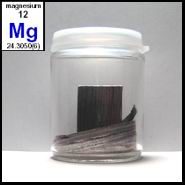
The element displays a characteristic shiny grey metallic appearance with high reflectivity when freshly cut or polished. However, atmospheric exposure rapidly generates a thin oxide coating that imparts a somewhat duller surface finish. Magnesium exhibits a melting point of 923 K (650°C), boiling point of 1363 K (1090°C), and density of 1.74 g/cm³ at room temperature. The relatively low density, approximately two-thirds that of aluminum, contributes significantly to magnesium's utility in weight-critical applications. Specific heat capacity measures 1.023 kJ/(kg·K) at 298 K, while thermal conductivity reaches 156 W/(m·K), reflecting the element's metallic bonding and free electron availability.
Chemical Properties and Reactivity
Electronic Structure and Bonding Behavior
The electronic configuration [Ne]3s² fundamentally determines magnesium's chemical behavior through the availability of two valence electrons for bonding interactions. These electrons occupy the same principal quantum level, resulting in minimal shielding between them and facilitating the formation of divalent ionic species. Bond formation primarily proceeds through electron transfer mechanisms, generating the stable Mg²⁺ cation with its complete noble gas electronic configuration.
Magnesium demonstrates predominantly ionic bonding character in most compounds, particularly with electronegative elements such as oxygen, halogens, and chalcogens. The large electronegativity difference between magnesium (χ = 1.31 on the Pauling scale) and typical anion-forming elements drives complete electron transfer rather than covalent sharing. However, organometallic compounds exhibit more covalent character, particularly Grignard reagents (RMgX), where carbon-magnesium bonds display partial covalent nature due to smaller electronegativity differences.
Coordination chemistry reveals magnesium's preference for octahedral geometry in aqueous solution, typically forming [Mg(H₂O)₆]²⁺ complexes. The small size and high charge density of Mg²⁺ create strong electrostatic interactions with ligands, particularly those containing oxygen or nitrogen donor atoms. Bond lengths in magnesium complexes typically range from 2.0-2.1 Å for Mg-O bonds and slightly longer for Mg-N interactions, reflecting the ionic nature of these coordinate bonds.
Electrochemical and Thermodynamic Properties
Magnesium exhibits an electronegativity value of 1.31 on the Pauling scale, positioning it among the more electropositive elements. This value reflects the element's tendency to lose electrons readily, consistent with its metallic character and position in Group 2. The Mulliken electronegativity, calculated from ionization energy and electron affinity data, yields similar values, confirming the element's electron-donating capacity.
Successive ionization energies demonstrate the electronic structure influence on chemical behavior. The first ionization energy (737.7 kJ/mol) represents the energy required to remove one 3s electron, while the second ionization energy (1450.7 kJ/mol) corresponds to removing the second 3s electron from the Mg⁺ ion. The dramatic increase to the third ionization energy (7732.7 kJ/mol) reflects the stability of the Ne core configuration and explains why magnesium virtually never exceeds the +2 oxidation state in chemical compounds.
Standard electrode potentials establish magnesium's position in the electrochemical series, with E°(Mg²⁺/Mg) = -2.372 V relative to the standard hydrogen electrode. This highly negative value indicates strong reducing character and explains magnesium's tendency to corrode in aqueous environments. The element's thermodynamic stability varies significantly depending on the chemical environment, with oxides and hydroxides generally exhibiting high lattice energies and formation enthalpies.
Chemical Compounds and Complex Formation
Binary and Ternary Compounds
Magnesium oxide (MgO) represents the most thermodynamically stable binary compound, forming spontaneously upon exposure of metallic magnesium to atmospheric oxygen. The compound crystallizes in the rock salt structure with a lattice parameter of 4.213 Å and exhibits exceptional thermal stability, melting at 3125 K. The formation reaction proceeds exothermically: 2Mg(s) + O₂(g) → 2MgO(s), ΔH°f = -1203.6 kJ/mol, establishing the driving force for magnesium's atmospheric reactivity.
Halide compounds demonstrate systematic trends reflecting periodic table relationships. Magnesium fluoride (MgF₂) adopts the rutile structure and exhibits limited aqueous solubility due to high lattice energy, while magnesium chloride (MgCl₂), bromide (MgBr₂), and iodide (MgI₂) crystallize in layered structures and display increasing solubility down the halogen group. These compounds serve as precursors for electrolytic magnesium production, particularly MgCl₂ in the Dow process.
Sulfide formation yields magnesium sulfide (MgS) with the rock salt structure, though the compound hydrolyzes readily in aqueous solution to produce hydrogen sulfide gas. Nitride formation requires elevated temperatures and yields Mg₃N₂, which adopts the anti-bixbyite structure. Ternary compounds include carbonates such as dolomite [CaMg(CO₃)₂], representing one of the most abundant magnesium-containing minerals in Earth's crust.
Coordination Chemistry and Organometallic Compounds
Magnesium's coordination chemistry centers on the formation of octahedral complexes with oxygen and nitrogen donor ligands. The hexaaquamagnesium(II) ion [Mg(H₂O)₆]²⁺ predominates in aqueous solution, exhibiting rapid water exchange kinetics due to the relatively weak electrostatic interactions. Chelating ligands such as ethylenediaminetetraacetic acid (EDTA) form stable complexes through multiple coordination sites, effectively sequestering magnesium ions in analytical and biological applications.
Crown ether complexes demonstrate magnesium's interaction with macrocyclic ligands, though the small ionic radius of Mg²⁺ creates less favorable geometry compared to larger alkaline earth cations. The coordination number typically remains six in these complexes, with ligand atoms occupying octahedral positions around the central magnesium ion. Stability constants vary significantly depending on ligand denticity and donor atom characteristics.
Organometallic chemistry encompasses the famous Grignard reagents (RMgX), where R represents an organic group and X denotes a halide. These compounds exhibit carbon-magnesium bonds with mixed ionic and covalent character, serving as powerful nucleophilic reagents in organic synthesis. The C-Mg bond length typically measures 2.15-2.20 Å, intermediate between purely ionic and covalent extremes. Grignard formation proceeds through radical mechanisms: RX + Mg → RMgX, requiring anhydrous conditions due to the high reactivity toward protic solvents.
Natural Occurrence and Isotopic Analysis
Geochemical Distribution and Abundance
Magnesium constitutes approximately 13% of Earth's crust by mass, establishing it as the eighth most abundant element in crustal rocks. This abundance corresponds to roughly 23,000 ppm in average crustal composition, reflecting the element's incorporation into numerous rock-forming minerals during geological processes. The geochemical behavior of magnesium involves both primary mineral formation in igneous rocks and secondary processes including weathering, transport, and sedimentation.
Primary magnesium minerals include olivine [(Mg,Fe)₂SiO₄], pyroxenes, and micas, where magnesium substitutes for iron in solid solution series. These ferromagnesian minerals represent the dominant magnesium reservoirs in mafic and ultramafic rocks. Secondary minerals form through weathering and metamorphic processes, including talc [Mg₃Si₄O₁₀(OH)₂], serpentine group minerals, and chlorites. Sedimentary environments yield carbonate minerals, particularly magnesite (MgCO₃) and the double carbonate dolomite [CaMg(CO₃)₂].
Seawater contains magnesium as the third most abundant dissolved element at approximately 1290 ppm, corresponding to 0.129% by mass. This concentration establishes seawater as a virtually unlimited industrial source, extracted primarily through precipitation as magnesium hydroxide followed by conversion to chloride for electrolytic processing. Evaporite deposits preserve ancient seawater compositions, yielding concentrated magnesium salts including carnallite (KMgCl₃·6H₂O) and kieserite (MgSO₄·H₂O).
Nuclear Properties and Isotopic Composition
Natural magnesium exhibits three stable isotopes with distinct mass numbers and abundances. Magnesium-24 (²⁴Mg) represents approximately 79% of natural abundance, containing 12 neutrons alongside the characteristic 12 protons. The nucleus exhibits zero nuclear spin, rendering it NMR-silent but contributing to the element's nuclear stability through the favorable neutron-to-proton ratio.
Magnesium-25 (²⁵Mg) comprises approximately 10% natural abundance and contains 13 neutrons. This isotope possesses nuclear spin I = 5/2, making it accessible to nuclear magnetic resonance spectroscopy. The magnetic moment μ = -0.85544 nuclear magnetons enables ²⁵Mg NMR applications in structural chemistry and materials science, though sensitivity limitations restrict routine analytical use.
Magnesium-26 (²⁶Mg) accounts for roughly 11% natural abundance with 14 neutrons per nucleus. This isotope holds particular significance in cosmochemistry and isotope geology as the stable daughter product of ²⁶Al radioactive decay. The ²⁶Al-²⁶Mg chronometer system provides dating capabilities for early solar system events, including meteorite formation and planetary differentiation processes. Variations in ²⁶Mg/²⁴Mg ratios preserve records of extinct ²⁶Al distribution, enabling precise chronological constraints on nebular and planetary processes.
Artificial radioisotopes include ²⁸Mg with a half-life of 21 hours, produced through nuclear reactions for research applications. The isotope decays through beta-minus emission to form ²⁸Al, though practical applications remain limited due to the short half-life and availability of stable isotopes for most purposes.
Industrial Production and Technological Applications
Extraction and Purification Methodologies
Industrial magnesium production employs two primary methodologies: electrolytic processes and thermal reduction methods. The electrolytic approach, exemplified by the Dow process, utilizes magnesium chloride as feedstock obtained from seawater or underground brines. The process begins with seawater treatment using lime [Ca(OH)₂] to precipitate magnesium hydroxide: Mg²⁺ + Ca(OH)₂ → Mg(OH)₂ + Ca²⁺. Subsequent treatment with hydrochloric acid converts the hydroxide to anhydrous magnesium chloride: Mg(OH)₂ + 2HCl → MgCl₂ + 2H₂O.
Electrolysis occurs in steel cells lined with refractory materials, operating at temperatures near 973 K to maintain molten salt conditions. The cell design incorporates graphite anodes and steel cathodes, with current densities typically ranging from 0.8-1.2 A/cm². The fundamental electrolytic reaction proceeds: MgCl₂(l) → Mg(l) + Cl₂(g), requiring approximately 18-20 kWh/kg of theoretical energy consumption, though practical energy requirements reach 35-40 kWh/kg due to process inefficiencies.
Thermal reduction methods, particularly the Pidgeon process, utilize magnesium oxide reduction with silicon at elevated temperatures: 2MgO + Si → 2Mg + SiO₂. The reaction requires temperatures exceeding 1473 K under reduced pressure to favor magnesium volatilization and removal from the equilibrium system. Dolomite calcination provides the magnesium oxide feedstock: CaMg(CO₃)₂ → CaO + MgO + 2CO₂. This approach typically achieves lower energy consumption compared to electrolytic methods, though capital costs remain substantial due to high-temperature processing requirements.
Technological Applications and Future Prospects
Aerospace applications exploit magnesium's exceptional strength-to-weight ratio when incorporated into aluminum alloys. The AZ series alloys (containing aluminum and zinc additions) exhibit yield strengths exceeding 200 MPa while maintaining densities below 1.8 g/cm³. These properties enable significant weight reduction in aircraft structural components, engine casings, and interior elements where every kilogram saved translates to substantial fuel economy improvements throughout operational lifetimes.
Automotive industry applications focus on powertrain components, wheels, and structural elements where weight reduction directly impacts fuel efficiency and performance. Magnesium die-casting alloys, particularly AZ91D, demonstrate excellent castability combined with adequate mechanical properties for engine blocks, transmission housings, and instrument panel structures. Advanced alloy development incorporating rare earth elements (WE series) extends operating temperature ranges and improves corrosion resistance for demanding automotive environments.
Electronics manufacturing utilizes magnesium alloys for laptop computer cases, mobile device housings, and camera bodies where lightweight construction must be balanced against electromagnetic shielding requirements. The element's electrical conductivity, while lower than aluminum, proves adequate for many applications while providing superior machinability and surface finish characteristics. Emerging applications include 5G telecommunications equipment where weight constraints drive material selection toward magnesium-based solutions.
Future technological developments emphasize biodegradable magnesium alloys for medical implant applications, exploiting the element's biocompatibility and natural dissolution in physiological environments. Research directions include controlled corrosion rate modification through alloying additions and surface treatments, potentially revolutionizing temporary implant technology. Energy storage applications investigate magnesium-based battery systems as alternatives to lithium-ion technology, offering higher volumetric energy density and improved safety characteristics through non-flammable electrolyte systems.
Historical Development and Discovery
The systematic chemical investigation of magnesium compounds began in the late 18th century through the work of Joseph Black, who distinguished magnesia alba (magnesium carbonate) from lime (calcium carbonate) through thermal decomposition studies. Black's recognition that these compounds yielded different alkaline earths upon heating established the foundation for subsequent elemental isolation attempts. The term "magnesium" derives from Magnesia, a region in ancient Greece where magnesite deposits provided early sources of magnesia alba.
Sir Humphry Davy achieved the first isolation of metallic magnesium in 1808 through electrolytic reduction of moist magnesia using a mercury cathode. The amalgam formation enabled separation of magnesium from the highly reactive metallic state, though pure magnesium remained elusive due to rapid oxidation in atmospheric conditions. Davy's electrolytic approach established the fundamental principle underlying modern magnesium production methods, demonstrating the necessity of avoiding aqueous systems due to competitive hydrogen evolution.
Antoine Bussy developed improved isolation procedures in 1831 through thermal reduction of anhydrous magnesium chloride with metallic potassium: MgCl₂ + 2K → Mg + 2KCl. This method produced coherent metallic magnesium samples suitable for property determination and chemical characterization. Bussy's work established magnesium's position among the alkaline earth metals and confirmed its divalent nature through compound stoichiometry analysis.
Industrial development accelerated during World War I when magnesium's military applications in incendiary devices and tracer ammunition drove production scaling efforts. The Dow Chemical Company pioneered large-scale electrolytic production from seawater in the 1940s, establishing the technological foundation for modern magnesium metallurgy. Post-war development focused on structural alloy applications, culminating in contemporary aerospace and automotive technologies where magnesium's unique property combination enables advanced engineering solutions previously unattainable with conventional materials.
Conclusion
Magnesium's unique position in the periodic table, combining low atomic mass with divalent metallic character, establishes its fundamental importance in both chemical science and technological applications. The element's [Ne]3s² electron configuration drives its characteristic chemical behavior, including predominant +2 oxidation state formation, ionic bonding tendencies, and rapid atmospheric oxidation. These properties, combined with exceptional strength-to-weight ratios in alloy systems, position magnesium as essential for weight-critical applications spanning aerospace, automotive, and electronics industries.
Current research trajectories emphasize sustainable production methods, advanced alloy development with improved corrosion resistance, and emerging applications in biodegradable medical devices and next-generation energy storage systems. The element's abundant natural occurrence, particularly in seawater resources, ensures long-term availability for expanding technological applications. Future developments will likely focus on overcoming traditional limitations including atmospheric reactivity and limited elevated-temperature performance, potentially expanding magnesium's role in high-performance engineering applications while maintaining its position as the lightest structural metallic element available for industrial use.

Please let us know how we can improve this web app.
