| Element | |
|---|---|
74WTungsten183.8412
8 18 32 12 2 |
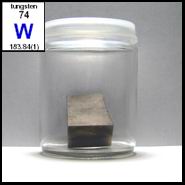
|
| Basic properties | |
|---|---|
| Atomic number | 74 |
| Atomic weight | 183.841 amu |
| Element family | Transition metals |
| Period | 6 |
| Group | 2 |
| Block | s-block |
| Discovery year | 1781 |
| Isotope distribution |
|---|
180W 0.130% 182W 26.30% 186W 28.60% |
182W (47.79%) 186W (51.97%) |
| Physical properties | |
|---|---|
| Density | 19.25 g/cm3 (STP) |
Atomic hydrogen (H) 8.988E-5 Meitnerium (Mt) 28 | |
| Melting | 3407 °C |
Helium (He) -272.2 Carbon (C) 3675 | |
| Boiling | 5927 °C |
Helium (He) -268.9 Tungsten (W) 5927 | |
| Chemical properties | |
|---|---|
| Oxidation states (less common) | +4, +6 (-4, -2, -1, 0, +1, +2, +3, +5) |
| First ionization potential | 7.980 eV |
Cesium (Cs) 3.894 Helium (He) 24.587 | |
| Electron affinity | 0.816 eV |
Nobelium (No) -2.33 Atomic chlorine (Cl) 3.612725 | |
| Electronegativity | 2.36 |
Cesium (Cs) 0.79 Atomic fluorine (F) 3.98 | |
| Atomic radius | |
|---|---|
| Covalent radius | 1.37 Å |
Atomic hydrogen (H) 0.32 Francium (Fr) 2.6 | |
| Metallic radius | 1.39 Å |
Beryllium (Be) 1.12 Cesium (Cs) 2.65 | |
| Compounds | ||
|---|---|---|
| Formula | Name | Oxidation state |
| WC | Tungsten carbide | +2 |
| WSi2 | Tungsten disilicide | +2 |
| W2O3 | Tungsten(III) oxide | +3 |
| WI3 | Tungsten(III) iodide | +3 |
| WBr4 | Tungsten(IV) bromide | +4 |
| WCl4 | Tungsten(IV) chloride | +4 |
| WF4 | Tungsten(IV) fluoride | +4 |
| WO2 | Tungsten(IV) oxide | +4 |
| WBr5 | Tungsten(V) bromide | +5 |
| WF6 | Tungsten(VI) fluoride | +6 |
| WCl6 | Tungsten(VI) chloride | +6 |
| H2WO4 | Tungstic acid | +6 |
| Electronic properties | |
|---|---|
| Electrons per shell | 2, 8, 18, 32, 12, 2 |
| Electronic configuration | [Xe] 4f14 |
|
Bohr atom model

| |
|
Orbital box diagram

| |
| Valence electrons | 6 |
| Lewis dot structure |
|
| Orbital Visualization | |
|---|---|
|
| |
| Electrons | - |
Tungsten (W): Periodic Table Element
Abstract
Tungsten (W, atomic number 74) represents the most refractory metallic element in the periodic table, exhibiting the highest melting point (3695 K) and boiling point (6203 K) of all known elements. With a density of 19.25 g/cm³, tungsten demonstrates exceptional structural stability and resistance to thermal deformation. The element's electron configuration [Xe] 4f¹⁴ 5d⁴ 6s² places it in group 6 of the transition metals, conferring unique bonding characteristics and oxidation states ranging from -2 to +6. Tungsten's primary industrial applications center on tungsten carbide production and high-temperature alloys. Natural occurrence is limited to wolframite and scheelite minerals, with global production concentrated in strategic deposits. The element's bioactivity remains minimal, though certain extremophile organisms utilize tungsten-containing enzymes in specialized metabolic pathways.
Introduction
Tungsten occupies a distinctive position in modern materials science as the element possessing the most extreme thermal properties among all metals. Located in period 6, group 6 of the periodic table, tungsten exhibits electronic structure characteristics typical of third-row transition metals while maintaining unique physical properties that distinguish it from neighboring elements. The element's atomic number of 74 corresponds to a nuclear configuration supporting exceptional atomic stability.
Discovery of tungsten occurred through systematic analysis of wolframite minerals in 1781, with subsequent isolation of the metallic form achieved in 1783. The element demonstrates remarkable resistance to chemical attack under standard conditions, requiring specialized extraction techniques for commercial production. Industrial significance stems primarily from applications demanding extreme hardness, high density, and thermal stability, positioning tungsten as a critical material in advanced manufacturing and defense applications.
Physical Properties and Atomic Structure
Fundamental Atomic Parameters
Tungsten exhibits atomic number 74 with a standard atomic weight of 183.84 ± 0.01 u. The electronic configuration follows the pattern [Xe] 4f¹⁴ 5d⁴ 6s², placing four electrons in the 5d orbital sublevel and two in the 6s orbital. This configuration results in significant orbital overlap and strong metallic bonding characteristics.
Atomic radius measurements indicate a metallic radius of 139 pm, with covalent radius values of 162 pm for single bonds. The effective nuclear charge experiences substantial screening from inner electron shells, though the 5d electrons participate actively in bonding interactions. Ionization energies demonstrate the progressive difficulty of electron removal: first ionization energy of 770 kJ/mol, second ionization energy of 1700 kJ/mol, and subsequent values increasing rapidly due to core electron involvement.
Macroscopic Physical Characteristics
Pure tungsten exhibits a distinctive grayish-white metallic luster with exceptional surface reflectivity. Crystal structure analysis reveals a body-centered cubic (bcc) lattice at standard conditions, with lattice parameter a = 3.165 Å. The bcc structure provides optimal atomic packing efficiency for the tungsten atomic dimensions while maintaining structural stability across broad temperature ranges.
Thermal properties establish tungsten's position as the most refractory metallic element. Melting occurs at 3695 K (3422°C), representing the highest melting point among all elements. Boiling point reaches 6203 K (5930°C), similarly representing the maximum value for elemental substances. Heat of fusion measures 52.31 kJ/mol, while heat of vaporization reaches 806.7 kJ/mol. Specific heat capacity at 298 K equals 24.27 J/(mol·K).
Density measurements yield 19.25 g/cm³ at standard conditions, placing tungsten among the densest naturally occurring elements. This density approaches that of gold (19.32 g/cm³) while exceeding platinum (21.45 g/cm³). Temperature-dependent density variations follow typical metallic expansion patterns, with linear expansion coefficient of 4.5 × 10⁻⁶ K⁻¹.
Chemical Properties and Reactivity
Electronic Structure and Bonding Behavior
Chemical reactivity of tungsten stems from the availability of 5d⁴ 6s² electrons for bonding interactions. The element exhibits variable oxidation states from -2 to +6, with +4 and +6 representing the most thermodynamically stable configurations. Lower oxidation states occur primarily in organometallic complexes or reduced compound environments.
Covalent bonding characteristics involve extensive d-orbital participation, resulting in directional bond formation and complex geometries. Bond energies for tungsten-carbon interactions reach 627 kJ/mol in tungsten carbide, representing some of the strongest metal-carbon bonds known. Metal-metal bonding in tungsten clusters demonstrates exceptional strength, with W-W bond distances ranging from 2.2 to 2.8 Å depending on coordination environment.
Hybridization patterns in tungsten compounds involve d²sp³ configurations for octahedral geometries and d³s configurations for tetrahedral arrangements. The extensive d-orbital manifold allows formation of multiple bonds with suitable ligands, particularly oxo and imido functionalities.
Electrochemical and Thermodynamic Properties
Electronegativity values place tungsten at 2.36 on the Pauling scale and 4.40 eV on the Mulliken scale, indicating moderate electron-attracting ability relative to other transition metals. This intermediate electronegativity enables formation of both ionic and covalent compounds depending on the bonding partner.
Ionization energy progression demonstrates typical transition metal behavior: first ionization requires 770 kJ/mol, second ionization 1700 kJ/mol, third ionization 2300 kJ/mol, and fourth ionization 3400 kJ/mol. Electron affinity measurements indicate minimal tendency for anion formation, with values near zero or slightly positive.
Standard reduction potentials vary significantly with oxidation state and pH conditions. The W⁶⁺/W couple exhibits E° = -0.090 V in acidic solution, while W³⁺/W demonstrates E° = -0.11 V. These negative potentials indicate thermodynamic stability of the metallic form under standard conditions. pH-dependent behavior follows Pourbaix diagram predictions, with oxide formation favored under oxidizing conditions.
Chemical Compounds and Complex Formation
Binary and Ternary Compounds
Tungsten oxide compounds represent the most extensively studied binary systems. Tungsten trioxide (WO₃) forms the principal oxide phase, crystallizing in multiple polymorphic modifications. The most stable form exhibits a distorted ReO₃-type structure with W-O distances of 1.78-2.41 Å. Formation occurs through direct oxidation at elevated temperatures, with thermodynamic stability extending to 1900 K.
Tungsten dioxide (WO₂) demonstrates lower oxidation state chemistry, forming through reduction of trioxide under hydrogen atmosphere. Crystal structure analysis reveals rutile-type arrangement with metallic conductivity properties. Intermediate oxidation phases including W₂O₅ and W₃O₈ exist under specific temperature and pressure conditions.
Halide compounds follow predictable oxidation state patterns. Tungsten hexafluoride (WF₆) represents the highest halide oxidation state, existing as volatile yellow solid with octahedral molecular geometry. Hexachloride and hexabromide analogs demonstrate similar structural features with progressively reduced thermal stability. Lower halides including WCl₄ and WBr₄ adopt polymeric structures with metal-metal bonding.
Tungsten carbide (WC) constitutes the most industrially significant binary compound. Crystal structure exhibits hexagonal close-packed tungsten arrays with carbon atoms occupying octahedral interstices. W-C bond lengths of 2.06 Å contribute to exceptional hardness (2600-3000 HV) and thermal stability. Formation requires high-temperature processing above 2000 K in carbon-rich environments.
Coordination Chemistry and Organometallic Compounds
Coordination complexes of tungsten span oxidation states from 0 to +6, with geometries ranging from octahedral to tetrahedral depending on d-electron count and ligand requirements. Hexacarbonyl tungsten (W(CO)₆) exemplifies zero-valent coordination chemistry, adopting perfect octahedral geometry with W-C distances of 2.058 Å.
Oxo complexes represent prevalent coordination motifs in higher oxidation states. Tungstate anions including WO₄²⁻ and polytungstates demonstrate tetrahedral and octahedral coordination respectively. Polyoxometalate chemistry enables formation of complex cluster anions with intricate three-dimensional architectures.
Organometallic chemistry encompasses alkylidene and alkylidyne complexes featuring multiple metal-carbon bonds. Schrock-type carbene complexes with tungsten centers demonstrate exceptional activity in olefin metathesis reactions. W=CR₂ functionality exhibits bond lengths near 1.90 Å with significant double-bond character. Alkylidyne species W≡CR demonstrate even shorter bonds (1.78 Å) with formal triple-bond characteristics.
Natural Occurrence and Isotopic Analysis
Geochemical Distribution and Abundance
Tungsten demonstrates limited crustal abundance, measuring approximately 1.25 ppm in average continental crust compositions. This scarcity places tungsten among the less abundant transition metals, though concentrated deposits exist in specific geological environments. Geochemical behavior reflects the high charge-to-radius ratio of tungsten cations, promoting complex formation and precipitation under hydrothermal conditions.
Primary ore minerals include wolframite ((Fe,Mn)WO₄) and scheelite (CaWO₄), with wolframite representing the dominant global source. Wolframite deposits form through hydrothermal processes associated with granite intrusions, particularly in greisen and skarn environments. Scheelite occurs in higher-temperature metamorphic deposits and contact aureoles.
Global distribution patterns concentrate tungsten resources in specific geological provinces. China dominates production with approximately 80% of global output, followed by Vietnam, Russia, and Bolivia. Significant deposits occur in the South China tungsten belt, where granite-related mineralization has produced world-class ore bodies with grades ranging from 0.1% to 1.5% WO₃.
Nuclear Properties and Isotopic Composition
Natural tungsten consists of five stable isotopes with the following abundance distribution: ¹⁸⁰W (0.12%), ¹⁸²W (26.50%), ¹⁸³W (14.31%), ¹⁸⁴W (30.64%), and ¹⁸⁶W (28.43%). This isotopic composition reflects nucleosynthesis processes in stellar environments, with mass numbers spanning six units around the peak abundance region.
Nuclear spin values vary among isotopes: ¹⁸³W exhibits nuclear spin I = 1/2, enabling NMR spectroscopic studies, while even-mass isotopes possess I = 0. Magnetic moments for the odd-mass isotope measure 0.117784 nuclear magnetons. These nuclear properties facilitate isotopic analysis through mass spectrometry and nuclear magnetic resonance techniques.
Radioactive isotopes demonstrate varied half-lives and decay modes. ¹⁷⁹W undergoes electron capture with t₁/₂ = 37.05 minutes, while ¹⁸¹W exhibits similar decay characteristics with t₁/₂ = 121.2 days. These isotopes find applications in nuclear medicine and radiochemical research. Neutron cross-sections for tungsten isotopes range from 18.3 barns (¹⁸²W) to 37.9 barns (¹⁸⁶W), influencing behavior in nuclear reactor environments.
Industrial Production and Technological Applications
Extraction and Purification Methodologies
Commercial tungsten production begins with concentration of tungsten ores through gravity separation and flotation techniques. Wolframite ores undergo magnetic separation to remove iron-bearing gangue minerals, while scheelite processing relies on flotation chemistry optimized for calcium tungstate recovery. Concentrate grades typically reach 65-75% WO₃ content.
Chemical processing converts tungsten concentrates to ammonium paratungstate (APT) through alkaline decomposition and crystallization. Sodium carbonate fusion at 1100 K dissolves tungstate minerals, followed by acidification and precipitation of tungstic acid. Ion exchange purification removes molybdenum and other contaminants before APT crystallization.
Metallic tungsten production employs hydrogen reduction of tungsten trioxide at temperatures exceeding 1100 K. The reduction proceeds through intermediate oxide phases: WO₃ → WO₂.₉ → WO₂ → W. Particle size control and atmosphere composition critically influence powder characteristics and subsequent consolidation behavior.
Powder metallurgy techniques enable consolidation of tungsten powders into dense forms. Press-and-sinter processing at 2400-2600 K achieves near-theoretical density while maintaining fine grain structure. Alternative approaches including chemical vapor deposition and plasma processing provide specialized tungsten products for electronic applications.
Technological Applications and Future Prospects
Tungsten carbide applications dominate global tungsten consumption, accounting for approximately 50% of total usage. Cemented carbides combine tungsten carbide with cobalt or nickel binders, producing cutting tools and wear-resistant components. These materials enable high-speed machining operations and extend tool life in demanding manufacturing environments.
Incandescent lighting filaments represent traditional tungsten applications, though LED technology has reduced this market segment. Tungsten's high melting point and low vapor pressure maintain relevance in specialized lighting applications including halogen lamps and high-intensity discharge systems.
Aerospace applications utilize tungsten's density and thermal properties in rocket nozzles, radiation shielding, and kinetic energy penetrators. Military applications capitalize on density characteristics for armor-piercing projectiles and counterweight systems. Electronic applications include X-ray tube targets and electron emitters in vacuum devices.
Emerging applications focus on tungsten's role in fusion reactor technology, where plasma-facing materials must withstand extreme thermal and radiation environments. Research continues on tungsten-based composite materials and nanostructured forms for next-generation energy systems. Additive manufacturing techniques are expanding tungsten processing capabilities for complex geometric applications.
Historical Development and Discovery
Tungsten discovery emerged from systematic investigations of heavy mineral phases in 18th-century European mining regions. Carl Wilhelm Scheele identified a new acid from scheelite mineral in 1781, while Juan José and Fausto Elhuyar successfully isolated metallic tungsten from wolframite in 1783. These parallel discoveries established tungsten as a distinct element with unique properties.
Early metallurgical investigations revealed tungsten's exceptional hardness and thermal stability, though technical limitations prevented large-scale applications until the late 19th century. Development of electric lighting created the first major tungsten market, with Edison and subsequent inventors recognizing tungsten filament advantages over carbon alternatives.
World War I and II periods highlighted tungsten's strategic importance in armor and ammunition applications. Competition for tungsten resources influenced geopolitical relationships, particularly regarding Portuguese wolframite deposits. Post-war industrial expansion drove development of tungsten carbide tools and cemented carbide technology.
Modern tungsten science has evolved through advances in powder metallurgy, crystal growth techniques, and surface modification processes. Understanding of tungsten's nuclear properties has enabled specialized applications in medical isotope production and nuclear reactor components. Current research directions emphasize nanostructured tungsten materials and composite systems for extreme environment applications.
Conclusion
Tungsten maintains a distinctive position among transition metals through its combination of extreme thermal properties, high density, and diverse oxidation state chemistry. The element's unique characteristics enable critical applications spanning manufacturing, aerospace, electronics, and energy systems. Strategic importance continues to drive research into sustainable tungsten resources and recycling technologies.
Future developments in tungsten science will likely emphasize nanostructured materials, advanced manufacturing techniques, and specialized applications in emerging energy technologies. The element's role in fusion reactor systems and next-generation nuclear applications positions tungsten as increasingly important for sustainable energy infrastructure. Continued investigation of tungsten's fundamental properties and processing methodologies will support expanding technological applications.

Please let us know how we can improve this web app.
