Printed from https://www.webqc.org

Berkelium @ Periodic Table of Chemical Elements

12345678 910111213141516 1718
IIIIIIbIVb VbVIbVIIbVIIIbIb IIbIIIIVVVI VIIVIII
1H
1.0079
2He
4.0026
3Li
6.9412
4Be
9.0121
5B
10.811
6C
12.010
7N
14.006
8O
15.999
9F
18.998
10Ne
20.179
11Na
22.989
12Mg
24.305
13Al
26.981
14Si
28.085
15P
30.973
16S
32.065
17Cl
35.453
18Ar
39.948
19K
39.098
20Ca
40.078
21Sc
44.955
22Ti
47.867
23V
50.941
24Cr
51.996
25Mn
54.938
26Fe
55.845
27Co
58.933
28Ni
58.693
29Cu
63.546
30Zn
65.409
31Ga
69.723
32Ge
72.641
33As
74.921
34Se
78.963
35Br
79.904
36Kr
83.798
37Rb
85.467
38Sr
87.621
39Y
88.905
40Zr
91.224
41Nb
92.906
42Mo
95.942
43Tc
98.906
44Ru
101.07
45Rh
102.90
46Pd
106.42
47Ag
107.86
48Cd
112.41
49In
114.81
50Sn
118.71
51Sb
121.76
52Te
127.60
53I
126.90
54Xe
131.29
55Cs
132.90
56Ba
137.32
57La
138.90
72Hf
178.49
73Ta
180.94
74W
183.84
75Re
186.20
76Os
190.23
77Ir
192.21
78Pt
195.08
79Au
196.96
80Hg
200.59
81Tl
204.38
82Pb
207.21
83Bi
208.98
84Po
208.98
85At
209.98
86Rn
222.01
87Fr
223.01
88Ra
226.02
89Ac
227.02
104Rf
261.10
105Db
262.11
106Sg
266.12
107Bh
264.12
108Hs
269
109Mt
278
110Ds
281
111Rg
282
112Cn
285
113Nh
286
114Fl
289
115Mc
290
116Lv
293
117Ts
294
118Og
294
Lanthanoids58Ce
140.11
59Pr
140.90
60Nd
144.24
61Pm
146.91
62Sm
150.36
63Eu
151.96
64Gd
157.25
65Tb
158.92
66Dy
162.50
67Ho
164.93
68Er
167.25
69Tm
168.93
70Yb
173.04
71Lu
174.96
Actinoids90Th
232.03
91Pa
231.03
92U
238.02
93Np
237.04
94Pu
244.06
95Am
243.06
96Cm
247.07
97Bk
247.07
98Cf
251.07
99Es
252.08
100Fm
257.09
101Md
258.09
102No
259.10
103Lr
260.10
Alkali metals Alkali earth metals Transition metals Other metals Metaloids Non-metals Halogens Noble gases
Element

97

Bk

Berkelium

247.0703

2
8
18
32
27
8
2
Berkelium photo
Basic properties
Atomic number97
Atomic weight247.0703 amu
Element familyActinoids
Period7
Group2
Blocks-block
Discovery year1949
Isotope distribution
None
Physical properties
Density 14.79 g/cm3 (STP)
Atomic hydrogen (H) 8.988E-5
Meitnerium (Mt) 28
Melting986 °C
Helium (He) -272.2
Carbon (C) 3675
Boiling2627 °C
Helium (He) -268.9
Tungsten (W) 5927
Chemical properties
Oxidation states
(less common)
+3
(+2, +4, +5)
First ionization potential 6.229 eV
Cesium (Cs) 3.894
Helium (He) 24.587
Electron affinity -1.720 eV
Nobelium (No) -2.33
Atomic chlorine (Cl) 3.612725
Electronegativity1.3
Cesium (Cs) 0.79
Atomic fluorine (F) 3.98
Atomic radius
Metallic radius 1.7 Å
Beryllium (Be) 1.12
Cesium (Cs) 2.65
Compounds
FormulaNameOxidation state
Bk(NO3)3Berkelium(III) nitrate+3
Bk2O3Berkelium(III) oxide+3
BkCl3Berkelium(III) chloride+3
BkF3Berkelium(III) fluoride+3
BkF4Berkelium tetrafluoride+3
BkI3Berkelium(III) iodide+3
BkO2Berkelium(IV) oxide+3
BkOBrBerkelium(III) oxybromide+3
BkOClBerkelium(III) oxychloride+3
Electronic properties
Electrons per shell2, 8, 18, 32, 27, 8, 2
Electronic configuration[Rn] 5f97s2
Bohr atom model
Bohr atom model
Orbital box diagram
Orbital box diagram
Valence electrons11
Lewis dot structure Berkelium Lewis dot structure
Orbital Visualization
🏠
▶️
📐
Electrons-
Reactions
Bk + O2 = BkO2

Berkelium (Bk): Periodic Table Element

Scientific Review Article | Chemistry Reference Series

Abstract

Berkelium (Bk, atomic number 97) represents a synthetic transuranium actinide element characterized by exceptional radioactivity and synthetic complexity. Positioned between curium and californium in the periodic table, berkelium exhibits predominantly trivalent oxidation behavior with documented tetravalent and pentavalent states. The element demonstrates a density of 14.78 g/cm³, melting point of 986°C, and exists primarily as the isotope 249Bk with a half-life of 330 days. Berkelium's double-hexagonal close-packed crystal structure undergoes pressure-induced transitions, while its chemical properties manifest through characteristic green solutions of Bk(III) ions and distinctive fluorescence emissions at 652 nm and 742 nm. Industrial production remains confined to specialized nuclear reactors, with total global synthesis reaching approximately one gram since 1967, limiting applications to fundamental research and superheavy element synthesis.

Introduction

Berkelium occupies a distinctive position within the actinide series as the fifth transuranium element, discovered in December 1949 through cyclotron bombardment at the University of California, Berkeley. The element's significance extends beyond its historical importance, representing a critical bridge in understanding actinide chemistry and serving as an essential precursor for superheavy element synthesis. Located in period 7, group 3 of the periodic table, berkelium exhibits electronic configuration [Rn] 5f9 7s2, demonstrating the characteristic f-electron participation that defines actinide chemical behavior. Its position directly above the lanthanide terbium establishes important comparative relationships, while neighboring actinides curium and californium provide context for understanding periodic trends in the 5f series. The element's extreme scarcity, with production measured in milligrams, combined with its radioactive decay to californium-249, presents unique challenges for characterization and study.

Physical Properties and Atomic Structure

Fundamental Atomic Parameters

Berkelium exhibits atomic number 97 with an electronic configuration of [Rn] 5f9 7s2, placing nine electrons in the characteristic 5f subshell that defines actinide chemistry. The ionic radius of Bk3+ measures approximately 96.8 pm, demonstrating the actinide contraction phenomenon that parallels lanthanide contraction in the 4f series. Effective nuclear charge calculations indicate progressive shielding effects as the 5f subshell fills, with the nine unpaired electrons contributing to magnetic properties and chemical reactivity. The atomic radius of metallic berkelium measures approximately 170 pm, consistent with systematic trends across the actinide series. First ionization energy reaches 6.23 eV, reflecting the relatively stable 5f9 configuration and the increasing difficulty of electron removal as nuclear charge increases across the transuranium elements.

Macroscopic Physical Characteristics

Berkelium metal exhibits a characteristic silvery-white metallic appearance with notable radioactive properties that influence handling and characterization procedures. The element crystallizes in a double-hexagonal close-packed structure (space group P6₃/mmc) with lattice parameters a = 341 pm and c = 1107 pm, demonstrating the ABAC layer sequence characteristic of heavy actinides. Density measurements establish 14.78 g/cm³ at room temperature, positioning berkelium between curium (13.52 g/cm³) and californium (15.1 g/cm³) in accordance with systematic atomic mass progression. Thermal properties include a melting point of 986°C, notably lower than curium (1340°C) but higher than californium (900°C), suggesting intermediate metallic bonding characteristics. The element demonstrates one of the lowest bulk moduli among actinides at approximately 20 GPa, indicating relatively soft metallic character. Heat capacity and thermal conductivity measurements remain limited due to sample size constraints and radioactive decay complications.

Chemical Properties and Reactivity

Electronic Structure and Bonding Behavior

Berkelium's chemical behavior centers on the trivalent oxidation state, with Bk3+ representing the most thermodynamically stable form in aqueous solutions. The 5f9 electronic configuration exhibits partial occupation that allows access to higher oxidation states, including documented +4 and +5 states under specific conditions. Tetravalent berkelium demonstrates stability in solid compounds such as BkF₄ and BkO₂, while pentavalent species require specialized synthetic conditions and demonstrate limited stability. Coordination chemistry reveals preference for coordination numbers 8-9 in the trivalent state, with berkelium(III) fluoride exhibiting tricapped trigonal prismatic geometry. Bond formation characteristics indicate predominantly ionic bonding with significant 5f orbital participation, distinguishing actinide chemistry from transition metal behavior. Effective nuclear charge variations across oxidation states influence bond lengths and coordination preferences, with Bk-O bond distances in berkelium(III) oxide measuring approximately 2.4 Å.

Electrochemical and Thermodynamic Properties

Electrochemical characterization establishes the standard electrode potential Bk3+/Bk as -2.01 V, indicating strong reducing character and high chemical reactivity toward oxidizing agents. Successive ionization energies demonstrate systematic increases: first ionization (6.23 eV), second ionization (approximately 12.1 eV), and third ionization (estimated 19.3 eV), reflecting progressive electron removal from 7s and 5f orbitals. The enthalpy of dissolution in hydrochloric acid reaches -600 kJ/mol, establishing the standard enthalpy of formation for aqueous Bk3+ ions as -601 kJ/mol. Thermodynamic stability calculations indicate preferential formation of Bk(III) compounds under standard conditions, with oxidation to higher states requiring strong oxidizing agents such as bromates, chromates, or electrochemical methods. Redox behavior demonstrates pH dependence, with alkaline conditions favoring higher oxidation states and acidic media stabilizing the trivalent form.

Chemical Compounds and Complex Formation

Binary and Ternary Compounds

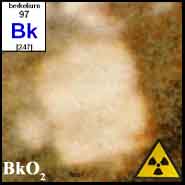
Berkelium oxide chemistry encompasses two primary phases: Bk₂O₃ (yellow-green) and BkO₂ (brown), representing the +3 and +4 oxidation states respectively. Berkelium(III) oxide crystallizes with a melting point of 1920°C and undergoes phase transitions at 1200°C and 1750°C, characteristic of actinide sesquioxides. Reduction of BkO₂ with molecular hydrogen produces the trivalent oxide according to the stoichiometry: 2BkO₂ + H₂ → Bk₂O₃ + H₂O. Halide compounds demonstrate systematic variations across the halogen series, with berkelium(III) fluoride (BkF₃) exhibiting two crystalline modifications depending on temperature. The room-temperature phase adopts yttrium trifluoride structure, while heating to 350-600°C induces transformation to lanthanum trifluoride structure. Berkelium(IV) fluoride (BkF₄) crystallizes as a yellow ionic solid isotypic with uranium tetrafluoride, demonstrating high thermal stability and characteristic actinide tetrafluoride behavior.

Coordination Chemistry and Organometallic Compounds

Berkelium coordination chemistry exhibits preference for hard donor ligands, with documented complexes including phosphate (BkPO₄) and various hydrated salts. The berkelium(III) phosphate demonstrates intense fluorescence under green light excitation, characteristic of f-f electronic transitions within the 5f⁹ configuration. Organometallic chemistry achieved significant advancement in 2025 with synthesis of berkelocene, a tetravalent organometallic complex containing berkelium-carbon bonds. The classic organometallic compound (η⁵-C₅H₅)₃Bk features three cyclopentadienyl rings in trigonal arrangement, synthesized through reaction of berkelium(III) chloride with molten beryllocene at 70°C. This amber-colored complex exhibits density 2.47 g/cm³ and sublimes at 350°C without melting, though radioactive decay gradually destroys the molecular structure over weeks. Coordination geometries typically involve 8-9 coordination in berkelium(III) complexes, with chelating ligands such as DTPA demonstrating high affinity for the large, highly charged berkelium cation.

Natural Occurrence and Isotopic Analysis

Geochemical Distribution and Abundance

Berkelium exhibits no natural terrestrial occurrence due to the absence of isotopes with half-lives approaching geological time scales. The longest-lived isotope, 247Bk, demonstrates a half-life of 1,380 years, insufficient for primordial survival over the 4.5-billion-year age of Earth. Anthropogenic berkelium appears in measurable concentrations at nuclear weapons testing sites, particularly locations of atmospheric thermonuclear tests conducted between 1945 and 1980. Analysis of debris from the Ivy Mike thermonuclear test (November 1952, Enewetak Atoll) revealed berkelium among multiple actinide species, though military secrecy delayed publication until 1956. Nuclear accident sites, including Chernobyl, Three Mile Island, and the Thule Air Base incident, contain trace berkelium concentrations from nuclear fuel activation and subsequent dispersal. Nuclear reactor waste represents the primary terrestrial berkelium reservoir, with 249Bk production occurring through multiple neutron capture processes in high-flux reactor environments.

Nuclear Properties and Isotopic Composition

Berkelium isotopes span mass numbers 233-253 (excluding 235 and 237), encompassing nineteen isotopes and six nuclear isomers, all exhibiting radioactive decay. The most significant isotopes include 247Bk (1,380-year half-life, α-decay), 249Bk (330-day half-life, β⁻-decay), and 248Bk (>300-year half-life). Berkelium-249 undergoes β⁻ decay to californium-249 with decay energy 125 keV, producing relatively low-energy electrons that pose minimal external radiation hazard but require careful handling due to the α-emitting californium daughter product. Nuclear cross-sections include thermal neutron capture (710 barns for 249Bk) and resonance integral (1200 barns), with negligible fission cross-section indicating poor nuclear fuel potential. Systematic nuclear properties demonstrate shell effects and pairing energies characteristic of the actinide region, with odd-mass isotopes generally exhibiting shorter half-lives than even-mass counterparts due to nuclear pairing energy considerations.

Industrial Production and Technological Applications

Extraction and Purification Methodologies

Berkelium production requires specialized high-flux nuclear reactors capable of sustained multiple neutron capture sequences starting from uranium or plutonium targets. The primary production pathway involves neutron irradiation of 244Cm in reactors such as the High Flux Isotope Reactor (HFIR) at Oak Ridge National Laboratory, producing 249Cm which subsequently undergoes β⁻ decay to 249Bk with a 64.15-minute half-life. Industrial separation exploits berkelium's ability to form stable tetravalent compounds, contrasting with most actinides that favor trivalent states. Oxidation procedures employ bromates, bismuthates, chromates, or electrochemical methods to convert Bk(III) to Bk(IV), followed by selective extraction using ion exchange, liquid-liquid extraction with HDEHP, or chromatographic separation. The Oak Ridge procedure involves initial ion exchange with lithium chloride, hydroxide precipitation, nitric acid dissolution, and high-pressure cation exchange elution. Final purification requires multiple separation cycles to achieve >95% purity, with total processing times exceeding one year for milligram quantities.

Technological Applications and Future Prospects

Current berkelium applications remain confined to fundamental scientific research, particularly synthesis of superheavy elements through nuclear bombardment reactions. The element serves as essential target material for producing lawrencium, rutherfordium, and bohrium through charged particle bombardment in particle accelerators. Berkelium-249's most significant application occurred in 2009 when 22 milligrams enabled first synthesis of tennessine (element 117) at the Joint Institute for Nuclear Research in Russia through bombardment with calcium-48 ions. The stable production of californium-249 from berkelium-249 decay provides valuable research material for californium chemistry studies, avoiding complications from more radioactive californium isotopes. Future technological prospects depend on developing more efficient production methods and extending isotope half-lives through nuclear engineering techniques. Potential applications might include specialized radiation sources, advanced nuclear fuel cycle research, and fundamental studies of 5f electron behavior in extreme environments.

Historical Development and Discovery

Berkelium synthesis achieved initial success in December 1949 through the collaborative efforts of Glenn T. Seaborg, Albert Ghiorso, Stanley Gerald Thompson, and Kenneth Street Jr. at the University of California, Berkeley's Radiation Laboratory. The discovery employed the 60-inch cyclotron to bombard americium-241 targets with 35 MeV α-particles, inducing the nuclear reaction 241Am + 4He → 243Bk + 2n. The research team followed established naming conventions by selecting berkelium to honor Berkeley, California, drawing analogy with terbium's derivation from Ytterby, Sweden, maintaining the tradition of relating newly discovered actinides to their lanthanide analogs. Initial characterization proved challenging due to the absence of strong α-emission signatures, requiring X-ray and conversion electron detection methods to confirm element 97's presence. The synthetic procedure involved complex chemical separations, including americium oxidation to the +6 state, hydrofluoric acid precipitation, and ion exchange chromatography at elevated temperatures. Mass number determination initially wavered between 243 and 244 before definitive assignment as 243Bk through decay studies and nuclear reaction analysis.

Conclusion

Berkelium represents a unique intersection of synthetic chemistry and nuclear physics, embodying the challenges and opportunities inherent in transuranium element research. The element's complex production requirements, limited availability, and radioactive instability have not prevented significant advances in fundamental understanding of actinide chemistry and nuclear structure. Its role in superheavy element synthesis demonstrates continuing scientific importance, while studies of its chemical properties contribute to broader understanding of 5f electron behavior and actinide-lanthanide relationships. Future research directions include developing more efficient synthetic pathways, exploring higher oxidation states, and investigating potential applications in advanced nuclear technologies, contingent upon addressing production limitations and radioactive handling challenges.

Periodict table
Please let us know how we can improve this web app.

Menu Balance Molar mass Gas laws Units Chemistry tools Periodic table Chemical forum Symmetry Constants Contribute Contact us
How to cite?