| Element | |
|---|---|
48CdCadmium112.41182
8 18 18 2 |
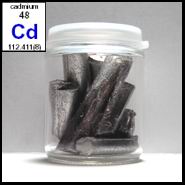
|
| Basic properties | |
|---|---|
| Atomic number | 48 |
| Atomic weight | 112.4118 amu |
| Element family | Transition metals |
| Period | 5 |
| Group | 2 |
| Block | s-block |
| Discovery year | 1817 |
| Isotope distribution |
|---|
106Cd 1.25% 108Cd 0.89% 110Cd 12.51% 111Cd 12.22% 112Cd 24.13% 114Cd 28.72% 116Cd 7.47% |
106Cd (1.43%) 108Cd (1.02%) 110Cd (14.35%) 111Cd (14.02%) 112Cd (27.68%) 114Cd (32.94%) 116Cd (8.57%) |
| Physical properties | |
|---|---|
| Density | 8.69 g/cm3 (STP) |
Atomic hydrogen (H) 8.988E-5 Meitnerium (Mt) 28 | |
| Melting | 321.18 °C |
Helium (He) -272.2 Carbon (C) 3675 | |
| Boiling | 765 °C |
Helium (He) -268.9 Tungsten (W) 5927 | |
| Chemical properties | |
|---|---|
| Oxidation states (less common) | +2 (-2, +1) |
| First ionization potential | 8.994 eV |
Cesium (Cs) 3.894 Helium (He) 24.587 | |
| Electron affinity | -0.700 eV |
Nobelium (No) -2.33 Atomic chlorine (Cl) 3.612725 | |
| Electronegativity | 1.69 |
Cesium (Cs) 0.79 Atomic fluorine (F) 3.98 | |
| Atomic radius | |
|---|---|
| Covalent radius | 1.36 Å |
Atomic hydrogen (H) 0.32 Francium (Fr) 2.6 | |
| Van der Waals radius | 1.58 Å |
Atomic hydrogen (H) 1.2 Francium (Fr) 3.48 | |
| Metallic radius | 1.51 Å |
Beryllium (Be) 1.12 Cesium (Cs) 2.65 | |
| Compounds | ||
|---|---|---|
| Formula | Name | Oxidation state |
| CdCl2 | Cadmium chloride | +2 |
| Cd(NO3)2 | Cadmium nitrate | +2 |
| CdSO4 | Cadmium sulfate | +2 |
| CdBr2 | Cadmium bromide | +2 |
| CdO | Cadmium oxide | +2 |
| CdTe | Cadmium telluride | +2 |
| CdSe | Cadmium selenide | +2 |
| CdI2 | Cadmium iodide | +2 |
| CdF2 | Cadmium fluoride | +2 |
| Cd(BF4)2 | Cadmium tetrafluoroborate | +2 |
| Cd(CN)2 | Cadmium cyanide | +2 |
| Cd(OH)2 | Cadmium hydroxide | +2 |
| Electronic properties | |
|---|---|
| Electrons per shell | 2, 8, 18, 18, 2 |
| Electronic configuration | [Kr] 4d10 |
|
Bohr atom model

| |
|
Orbital box diagram

| |
| Valence electrons | 12 |
| Lewis dot structure |
|
| Orbital Visualization | |
|---|---|
|
| |
| Electrons | - |
| Reactions |
|---|
| Cd + S = CdS |
| 2 Cd + O2 = 2 CdO |
Cadmium (Cd): Periodic Table Element
Abstract
Cadmium (Cd) is a soft, silvery-white post-transition metal located in Group 12 of the periodic table with atomic number 48 and atomic mass 112.414 ± 0.004 u. This element exhibits predominantly +2 oxidation states and forms compounds with significant industrial applications, particularly in nuclear reactor control rods and photovoltaic solar cells. Cadmium demonstrates hexagonal close-packed crystal structure and manifests unique nuclear properties, including extraordinarily high neutron absorption cross-sections in its ¹¹³Cd isotope. The element occurs naturally at concentrations of 0.1-0.5 ppm in Earth's crust, exclusively associated with zinc ores as a byproduct mineral. Despite limited natural abundance, cadmium's specialized applications in nuclear technology and renewable energy systems underscore its importance in modern industrial processes, though environmental toxicity concerns have restricted many traditional uses.
Introduction
Cadmium occupies position 48 in the periodic table as a d-block post-transition metal, completing the second transition series alongside zinc and mercury in Group 12. The element's electronic configuration [Kr] 4d¹⁰ 5s² establishes its characteristic chemical properties, with filled d-orbitals contributing to its soft metallic nature and tendency toward divalent compound formation. Discovered simultaneously in 1817 by Friedrich Stromeyer and Karl Samuel Leberecht Hermann as an impurity in pharmaceutical zinc carbonate, cadmium derived its nomenclature from the Latin "cadmia" and Greek "καδμεία," referencing calamine and the mythological founder of Thebes. The element's industrial significance emerged through specialized applications exploiting its unique nuclear properties and semiconductor characteristics. Modern cadmium utilization centers on nuclear reactor control systems and photovoltaic technology, representing crucial components in energy production and management infrastructure.
Physical Properties and Atomic Structure
Fundamental Atomic Parameters
Cadmium exhibits atomic number 48 with electron configuration [Kr] 4d¹⁰ 5s², positioning the element among post-transition metals with complete d-shell filling. The standard atomic weight measures 112.414 ± 0.004 u in full precision, with abridged notation expressing 112.41 ± 0.01 u for routine calculations. Atomic radius trends reflect the element's position following the first transition series contraction, resulting in metallic radii intermediate between neighboring zinc and indium. The filled 4d¹⁰ subshell configuration eliminates transition metal magnetism while contributing to the element's characteristic softness and malleability. Effective nuclear charge influences manifest through ionization energy patterns, with first ionization energy values reflecting the influence of d-electron shielding on valence s-orbital electrons.
Macroscopic Physical Characteristics
Cadmium presents as a soft, silvery-white to silvery-bluish-gray metallic solid exhibiting hexagonal close-packed crystal structure at ambient conditions. The element demonstrates exceptional malleability and ductility, allowing extensive mechanical deformation without fracture. Density measurements indicate significant mass concentration typical of heavy metals, while thermal properties reflect moderate metallic bonding strength. Crystal structure analysis reveals coordination number twelve with efficient atomic packing, contributing to the material's mechanical properties. Phase behavior encompasses typical metallic characteristics with well-defined melting and boiling transitions. Temperature-dependent property variations follow standard metallic trends with thermal expansion coefficients consistent with close-packed structures.
Chemical Properties and Reactivity
Electronic Structure and Bonding Behavior
Cadmium's chemical reactivity stems from its [Kr] 4d¹⁰ 5s² electronic configuration, promoting predominantly +2 oxidation states through loss of both 5s electrons. The filled d¹⁰ configuration provides exceptional stability, eliminating variable oxidation states characteristic of earlier transition metals. Secondary +1 oxidation states manifest in specialized compounds containing the Cd₂²⁺ dimeric cation, demonstrating metal-metal bonding capabilities. Covalent bonding characteristics emerge in organometallic compounds and coordination complexes, where empty 5p and 5d orbitals facilitate hybridization patterns. The element exhibits moderate electronegativity values on the Pauling scale, indicating balanced ionic and covalent bonding tendencies in compound formation.
Electrochemical and Thermodynamic Properties
Electrochemical behavior of cadmium demonstrates standard reduction potentials characteristic of moderately active metals, with Cd²⁺/Cd couples exhibiting negative values relative to standard hydrogen electrodes. Successive ionization energies reflect the electronic structure, with first ionization requiring moderate energy input while second ionization energies increase significantly due to removal of electrons from the same principal quantum level. Electron affinity measurements indicate limited tendency toward anion formation, consistent with metallic character and electropositive nature. Thermodynamic stability of cadmium compounds varies considerably with anion identity, demonstrating enhanced stability in sulfide and oxide forms compared to halide derivatives. Standard formation enthalpies and Gibbs free energy values establish thermodynamic frameworks for predicting compound stability and reaction spontaneity under various conditions.
Chemical Compounds and Complex Formation
Binary and Ternary Compounds
Cadmium forms extensive binary compound series with virtually all non-metallic elements, exhibiting systematic trends in stability and structure. CdO exists in two polymorphic forms: brown amorphous modification obtained through thermal decomposition and dark red crystalline variety with rock salt structure. Cadmium sulfide CdS crystallizes in hexagonal wurtzite and cubic zinc blende structures, displaying characteristic yellow coloration and photoconductive properties exploited in photovoltaic applications. Halide compounds CdCl₂, CdBr₂, and CdI₂ adopt layered structures with octahedral cadmium coordination, exhibiting high solubility in polar solvents. Ternary compounds include cadmium telluride CdTe, a direct-gap semiconductor with bandgap energy optimal for solar cell applications.
Coordination Chemistry and Organometallic Compounds
Coordination complexes of cadmium demonstrate preference for tetrahedral and octahedral geometries, with coordination numbers ranging from two to six depending on ligand sterics and electronic properties. Soft Lewis acid character promotes strong interactions with sulfur and nitrogen donor ligands, forming stable complexes with thiols, amines, and phosphines. Crystal field stabilization energy considerations prove minimal due to filled d¹⁰ configuration, allowing geometry determination primarily through steric and electrostatic factors. Organometallic chemistry encompasses organocadmium compounds with Cd-C σ-bonds, though limited thermal stability restricts synthetic applications. Specialized coordination compounds include cadmium(I) tetrachloroaluminate containing the dimeric Cd₂²⁺ cation, demonstrating metal-metal bonding in low oxidation states.
Natural Occurrence and Isotopic Analysis
Geochemical Distribution and Abundance
Cadmium exhibits crustal abundance between 0.1 and 0.5 parts per million, representing one of the less abundant metallic elements in terrestrial systems. Geochemical behavior demonstrates exclusive association with zinc mineralization, occurring as trace impurities in sphalerite ZnS deposits without independent cadmium ore formations. The primary cadmium mineral greenockite CdS occurs rarely as secondary alteration products in oxidized zinc deposits. Concentration mechanisms operate through isomorphous substitution in zinc lattices, with ionic radius similarity facilitating Cd²⁺ incorporation into Zn²⁺ sites. Industrial cadmium production derives entirely from zinc smelting operations, with additional recovery from iron and steel scrap processing contributing approximately 10% of global supply.
Nuclear Properties and Isotopic Composition
Natural cadmium comprises eight isotopes spanning mass numbers 106 through 116, with three confirmed stable nuclides: ¹¹⁰Cd, ¹¹¹Cd, and ¹¹²Cd. Long-lived radioactive isotopes ¹¹³Cd and ¹¹⁶Cd exhibit half-lives of 7.7 × 10¹⁵ years and 2.9 × 10¹⁹ years respectively, undergoing β⁻ decay and double β decay processes. Predicted unstable isotopes ¹⁰⁶Cd, ¹⁰⁸Cd, and ¹¹⁴Cd remain unobserved due to extremely long half-lives exceeding experimental detection limits. Artificial isotopes encompass mass range from ⁹⁵Cd to ¹³²Cd, with notable long-lived species ¹⁰⁹Cd (462.6 days) and metastable ¹¹³ᵐCd (14.1 years) finding applications in nuclear research. The ¹¹³Cd isotope exhibits extraordinarily high thermal neutron capture cross-section, establishing the element's utility in nuclear reactor control systems and neutron physics research.
Industrial Production and Technological Applications
Extraction and Purification Methodologies
Industrial cadmium production operates exclusively through zinc pyrometallurgical processing, exploiting differential volatility between zinc and cadmium during high-temperature operations. Primary extraction involves fractional distillation of zinc-cadmium vapors, with cadmium condensing at intermediate temperatures between zinc and more volatile impurities. Electrolytic refining processes achieve high-purity cadmium through electrowinning from sulfate solutions, utilizing controlled current densities and bath compositions to optimize metal quality. Secondary recovery from recycled materials employs similar pyrometallurgical approaches, processing iron and steel industry dusts containing accumulated cadmium from coating operations. Global production statistics indicate annual output of approximately 20,000 metric tons, with primary production centers located in Asia, North America, and Europe corresponding to major zinc smelting operations.
Technological Applications and Future Prospects
Contemporary cadmium utilization focuses on specialized high-technology applications exploiting unique nuclear and semiconductor properties. Nuclear reactor control rods employ cadmium's exceptional thermal neutron absorption characteristics, with ¹¹³Cd providing neutron poison capabilities essential for reactor operation and safety systems. Photovoltaic technology represents the largest growing application sector, utilizing cadmium telluride CdTe thin-film solar cells offering cost-effective renewable energy generation. Specialized metallurgical applications include bearing alloys and low-melting-point solders, where cadmium addition improves anti-friction properties and processing characteristics. Laboratory instrumentation employs helium-cadmium lasers generating coherent radiation at 325 nm, 354 nm, and 442 nm wavelengths for spectroscopic and research applications. Future technological development anticipates continued expansion in renewable energy systems, while environmental regulations increasingly restrict traditional applications in favor of safer alternatives.
Historical Development and Discovery
The discovery of cadmium in 1817 resulted from pharmaceutical quality control investigations conducted simultaneously by Friedrich Stromeyer in Göttingen and Karl Samuel Leberecht Hermann in Berlin. Both chemists identified the unknown element as an impurity in zinc carbonate samples sold by German pharmacies, with Stromeyer's investigation prompted by yellow coloration in supposedly pure zinc carbonate preparations. Isolation methodology employed chemical precipitation and thermal reduction techniques typical of early 19th-century analytical chemistry, with elemental identification confirmed through systematic property comparisons. Historical nomenclature derives from Latin "cadmia" and Greek "καδμεία," classical terms for calamine ore, with mythological reference to Cadmus, legendary founder of Thebes and introducer of the alphabet to Greece. Industrial development commenced in the late 19th century following establishment of large-scale zinc smelting operations, with cadmium initially considered a troublesome impurity requiring removal from zinc products. Commercial applications emerged during the 20th century, with electroplating, pigment production, and battery manufacturing representing major utilization sectors before environmental health concerns prompted usage restrictions and alternative material development.
Conclusion
Cadmium occupies a distinctive position among metallic elements through its combination of specialized nuclear properties and semiconductor characteristics, enabling critical applications in nuclear technology and renewable energy systems. The element's filled d¹⁰ electronic configuration determines its predominantly divalent chemistry and soft metallic properties, while exceptional neutron absorption capabilities establish its importance in nuclear reactor control systems. Modern industrial utilization increasingly emphasizes high-technology applications, particularly cadmium telluride photovoltaic cells contributing to global renewable energy infrastructure. Environmental toxicity concerns have necessitated careful application selection and comprehensive safety protocols, driving continued research into alternative materials and improved handling procedures. Future technological development will likely maintain cadmium's role in specialized applications while expanding sustainable utilization practices and enhanced environmental protection measures.

Please let us know how we can improve this web app.
