| Element | |
|---|---|
98CfCalifornium251.07962
8 18 32 28 8 2 |
|
| Basic properties | |
|---|---|
| Atomic number | 98 |
| Atomic weight | 251.0796 amu |
| Element family | Actinoids |
| Period | 7 |
| Group | 2 |
| Block | s-block |
| Discovery year | 1950 |
| Isotope distribution |
|---|
| None |
| Physical properties | |
|---|---|
| Density | 15.1 g/cm3 (STP) |
Atomic hydrogen (H) 8.988E-5 Meitnerium (Mt) 28 | |
| Melting | 900 °C |
Helium (He) -272.2 Carbon (C) 3675 | |
| Boiling | 1470 °C |
Helium (He) -268.9 Tungsten (W) 5927 | |
| Chemical properties | |
|---|---|
| Oxidation states (less common) | +3 (+2, +4, +5) |
| First ionization potential | 6.301 eV |
Cesium (Cs) 3.894 Helium (He) 24.587 | |
| Electron affinity | -1.010 eV |
Nobelium (No) -2.33 Atomic chlorine (Cl) 3.612725 | |
| Electronegativity | 1.3 |
Cesium (Cs) 0.79 Atomic fluorine (F) 3.98 | |
| Atomic radius | |
|---|---|
| Metallic radius | 1.86 Å |
Beryllium (Be) 1.12 Cesium (Cs) 2.65 | |
| Compounds | ||
|---|---|---|
| Formula | Name | Oxidation state |
| CfI2 | Californium(II) iodide | +2 |
| Cf2O3 | Californium(III) oxide | +3 |
| CfF3 | Californium(III) fluoride | +3 |
| CfI3 | Californium(III) iodide | +3 |
| CfO2 | Californium(IV) oxide | +3 |
| CfOBr | Californium(III) oxybromide | +3 |
| CfOCl | Californium(III) oxychloride | +3 |
| CfOF | Californium(III) oxyfluoride | +3 |
| CfOI | Californium(III) oxyiodide | +3 |
| Electronic properties | |
|---|---|
| Electrons per shell | 2, 8, 18, 32, 28, 8, 2 |
| Electronic configuration | [Rn] 5f10 |
|
Bohr atom model
| |
|
Orbital box diagram
| |
| Valence electrons | 12 |
| Lewis dot structure |
|
| Orbital Visualization | |
|---|---|
|
| |
| Electrons | - |
| Reactions |
|---|
| 8 Cf + S8 = 8 CfS |
Californium (Cf): Periodic Table Element
Abstract
Californium (Cf, atomic number 98) represents a synthetic actinide element with significant neutron emission properties that distinguish it among the transuranium elements. The element exhibits characteristic +3 oxidation state chemistry typical of late actinides, with additional stability in +2 and +4 states under specific conditions. Two crystalline forms exist at ambient pressure: a double-hexagonal close-packed structure below 600-800°C and a face-centered cubic form above this temperature range. The most practically significant isotope, 252Cf, demonstrates intense spontaneous fission with a half-life of 2.645 years, generating approximately 2.3 million neutrons per second per microgram. This neutron emission characteristic enables specialized applications in nuclear reactor startup, neutron activation analysis, and radiographic imaging technologies. The element's scarcity results from its synthetic nature and relatively short half-lives, with 251Cf being the most stable isotope at 898 years.
Introduction
Californium occupies position 98 in the periodic table as the sixth transuranium element and represents the heaviest actinide element with established practical applications beyond fundamental research. The element belongs to the 5f block and exhibits the characteristic electronic structure [Rn] 5f10 7s2, placing it within the late actinide series where 5f electron localization begins to influence chemical behavior significantly. Its discovery in 1950 at Lawrence Berkeley National Laboratory through bombardment of curium-242 with alpha particles marked a critical advancement in heavy element synthesis techniques.
The element's position within the actinide series provides unique insights into the transition between early actinide behavior, characterized by extensive 5f electron delocalization, and the more localized electronic behavior observed in the heaviest members of this series. Californium chemistry demonstrates increasing similarity to the corresponding lanthanide elements, particularly dysprosium, reflecting the actinide contraction and reduced 5f orbital participation in bonding. The practical significance of californium stems primarily from its neutron emission properties, which have established it as an essential material in nuclear technology and analytical chemistry applications.
Physical Properties and Atomic Structure
Fundamental Atomic Parameters
Californium possesses atomic number 98 with an electronic configuration of [Rn] 5f10 7s2. The element demonstrates atomic radius values consistent with actinide contraction, exhibiting a metallic radius of approximately 186 pm and ionic radius of 95 pm for the Cf3+ cation. The 5f electrons in californium show increased localization compared to earlier actinides, resulting in magnetic behavior and coordination chemistry that more closely resembles lanthanide elements.
Effective nuclear charge calculations for californium indicate substantial shielding effects from the filled 6d and partially filled 5f subshells. The first ionization energy measures 608 kJ/mol, reflecting the relatively loose binding of the 7s valence electrons. Successive ionization energies follow the expected pattern for removal of 7s and 5f electrons, with the third ionization energy being particularly significant for accessing the stable +3 oxidation state. The nuclear properties include a calculated nuclear binding energy per nucleon that places californium near the peak of nuclear stability for superheavy elements.
Macroscopic Physical Characteristics
Californium metal exhibits a silvery-white lustrous appearance characteristic of actinide metals. The element crystallizes in two distinct polymorphic forms under standard atmospheric pressure conditions. The α-phase adopts a double-hexagonal close-packed structure with density 15.10 g/cm³ and remains stable below 600-800°C. Above this temperature range, the β-phase assumes a face-centered cubic lattice with significantly reduced density of 8.74 g/cm³.
Thermal properties include a melting point of 900 ± 30°C and an estimated boiling point of 1743 K. The heat of fusion has been measured at approximately 47 kJ/mol, while specific heat capacity values indicate typical metallic behavior with electronic and lattice contributions. Under extreme pressure conditions exceeding 48 GPa, californium undergoes a phase transition to an orthorhombic crystal system, attributed to 5f electron delocalization that enables enhanced metallic bonding character.
The bulk modulus of californium measures 50 ± 5 GPa, indicating moderate mechanical strength comparable to trivalent lanthanide metals but considerably lower than common structural metals. Magnetic properties vary dramatically with temperature: ferromagnetic or ferrimagnetic behavior below 51 K, antiferromagnetic character between 48-66 K, and paramagnetic response above 160 K. These magnetic transitions reflect the complex electronic structure and competing exchange interactions within the 5f electron manifold.
Chemical Properties and Reactivity
Electronic Structure and Bonding Behavior
The 5f10 electronic configuration of californium results in chemical behavior dominated by the +3 oxidation state, achieved through ionization of the two 7s electrons and one 5f electron. This electron configuration places californium at a critical position within the actinide series where 5f electrons begin to exhibit more localized character, resembling the behavior of 4f electrons in lanthanides. The resulting coordination chemistry typically involves eight to nine coordinate complexes with oxygen, nitrogen, and halogen donor atoms.
Bond formation in californium compounds demonstrates increasing ionic character compared to earlier actinides, particularly in the formation of fluorides, oxides, and other highly electronegative ligand complexes. Covalent character persists in certain compounds, notably the californium borate complex Cf[B6O8(OH)5], which represents the heaviest actinide element known to form demonstrably covalent bonds. The 5f orbitals in californium retain sufficient spatial extension to participate in metal-ligand π-bonding interactions, though to a lesser extent than observed in plutonium or americium compounds.
Oxidation states +2 and +4 are accessible under specific chemical conditions, with the +4 state exhibiting strong oxidizing character and the +2 state demonstrating powerful reducing behavior. The stability of these alternative oxidation states reflects the electronic structure flexibility remaining in the 5f manifold, though the +3 state predominates in aqueous solution and most solid-state compounds.
Electrochemical and Thermodynamic Properties
Electronegativity values for californium follow the Pauling scale at approximately 1.3, consistent with metallic character and the tendency to form ionic compounds with electronegative elements. The successive ionization energies demonstrate the characteristic pattern expected for 5f elements: first ionization energy 608 kJ/mol, second ionization energy 1206 kJ/mol, and third ionization energy 2267 kJ/mol. These values reflect the progressive increase in effective nuclear charge experienced by remaining electrons following each ionization step.
Standard reduction potentials for the Cf3+/Cf couple have been estimated at approximately -1.9 V versus the standard hydrogen electrode, indicating strong reducing character for the metallic element. The thermodynamic stability of californium compounds varies significantly with ligand identity, with fluorides and oxides demonstrating exceptional thermal stability while iodides and other heavy halides show greater tendency toward thermal decomposition.
Aqueous chemistry of californium is restricted to the +3 oxidation state, as attempts to stabilize +2 or +4 species in solution have proven unsuccessful due to rapid disproportionation or hydrolysis reactions. The hydrated Cf3+ cation exhibits typical lanthanide-like coordination with water molecules and demonstrates predictable complex formation with oxygen-donor ligands such as acetate, nitrate, and phosphate ions.
Chemical Compounds and Complex Formation
Binary and Ternary Compounds
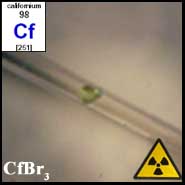
Californium forms an extensive series of binary compounds with halogen elements, exhibiting clear trends in both stability and physical properties. The trifluoride CfF3 appears as bright green crystals with exceptional thermal stability, while the trichloride CfCl3 manifests as emerald green crystalline material. The tribromide CfBr3 displays yellowish-green coloration, and the triiodide CfI3 adopts a characteristic lemon yellow appearance. These color variations reflect the systematic changes in ligand field effects and charge transfer transitions across the halide series.
Binary oxides include the sesquioxide Cf2O3, which exhibits yellow-green coloration and represents the most thermodynamically stable oxide phase. The dioxide CfO2 can be prepared under oxidizing conditions and appears as black-brown crystalline material, though it demonstrates lower thermal stability than the trivalent oxide. Californium sulfides, selenides, and other chalcogenide compounds follow similar patterns, with the +3 oxidation state predominating in these binary phases.
Ternary compounds of particular significance include the complex borate Cf[B6O8(OH)5], which demonstrates remarkable covalent bonding character and represents a unique example of heavy actinide participation in extended network structures. This compound exhibits pale green coloration and provides crucial insights into the boundary between ionic and covalent bonding in superheavy elements.
Coordination Chemistry and Organometallic Compounds
Coordination complexes of californium typically involve eight to nine coordinate geometries with oxygen and nitrogen donor ligands. The coordination behavior closely parallels that of dysprosium and other late lanthanides, reflecting the increasing localization of 5f electrons and their reduced participation in bonding compared to early actinides. Common coordination environments include square antiprismatic and tricapped trigonal prismatic geometries, determined primarily by ligand steric requirements rather than electronic preferences.
Aqueous complex formation follows predictable trends with hard donor atoms, particularly oxygen-containing ligands such as acetate, oxalate, and phosphate. The stability constants for these complexes demonstrate intermediate values between those of curium and berkelium, consistent with the systematic actinide contraction. Fluoride complexes show exceptional stability due to the favorable charge-to-size ratio matching between Cf3+ and F- ions.
Organometallic chemistry of californium remains limited due to the element's radioactivity and scarcity, though theoretical predictions suggest potential stability for cyclopentadienyl and related aromatic ligand complexes. The 5f orbital spatial distribution in californium should permit π-bonding interactions with aromatic systems, though experimental verification of such compounds awaits future synthetic developments in heavy element chemistry.
Natural Occurrence and Isotopic Analysis
Geochemical Distribution and Abundance
Californium does not occur naturally in the Earth's crust due to its synthetic origin and relatively short half-lives compared to geological time scales. The element's crustal abundance is effectively zero, existing only in trace quantities near nuclear facilities where artificial production or testing has occurred. Environmental concentrations remain at femtogram levels or below, detectable only through highly sensitive radiochemical analysis techniques.
Geochemical behavior studies indicate that californium, when present, demonstrates strong affinity for soil particles with concentration factors reaching 500-fold enhancement relative to surrounding water systems. This behavior reflects the high charge density of the Cf3+ cation and its strong electrostatic interactions with negatively charged soil components. The element shows minimal mobility in natural environments, limiting environmental dispersion from point sources.
Nuclear weapons testing prior to 1980 contributed trace quantities of californium isotopes to global atmospheric fallout, with detectable concentrations of 249Cf, 252Cf, 253Cf, and 254Cf identified in radioactive debris analysis. These environmental levels remain several orders of magnitude below those of concern for biological systems and continue to decrease through natural radioactive decay processes.
Nuclear Properties and Isotopic Composition
Twenty isotopes of californium have been characterized, with mass numbers ranging from 237 to 256. The most stable isotope, 251Cf, exhibits a half-life of 898 years and decays primarily through alpha emission to curium-247. The isotope 249Cf demonstrates a half-life of 351 years and serves as a crucial precursor for producing other californium isotopes through neutron capture reactions in nuclear reactors.
The isotope 252Cf possesses extraordinary significance due to its intense spontaneous fission activity, with 3.1% of decay events proceeding through fission while 96.9% follow alpha decay pathways to curium-248. Each spontaneous fission event releases an average of 3.7 neutrons, resulting in a neutron emission rate of 2.3 million neutrons per second per microgram. This property establishes 252Cf as one of the most intense portable neutron sources available for technological applications.
Nuclear cross-sections for californium isotopes show high values for neutron capture, particularly for 251Cf, which limits production efficiency despite its long half-life. The nuclear structure of californium isotopes places them near the edge of the "island of stability" predicted for superheavy nuclei, with shell effects contributing to the observed half-lives being significantly longer than extrapolations from lighter actinides would suggest.
Industrial Production and Technological Applications
Extraction and Purification Methodologies
Industrial production of californium occurs exclusively through nuclear reactor irradiation of lighter actinide targets, primarily berkelium-249 and curium isotopes. The production process involves prolonged neutron bombardment in high-flux nuclear reactors, with the High Flux Isotope Reactor at Oak Ridge National Laboratory and the Research Institute of Atomic Reactors in Russia serving as the primary global production facilities. Annual production capacity reaches approximately 0.25 grams at ORNL and 0.025 grams at the Russian facility.
The multi-step production pathway begins with uranium-238 and requires fifteen successive neutron capture events without intervening fission or alpha decay processes. This chain involves isotopes of plutonium, americium, curium, and berkelium before reaching the desired californium isotopes. Production yields remain low due to competing nuclear processes and the inherent instability of intermediate isotopes in the production chain.
Purification techniques utilize ion exchange chromatography and solvent extraction methods to separate californium from other actinide elements produced simultaneously during irradiation. The chemical similarity among late actinides necessitates precise control of solution chemistry, including pH, ionic strength, and complexing agent concentrations. High-performance liquid chromatography with specialized actinide-selective resins achieves the required separation factors for producing californium samples with sufficient purity for technological applications.
Technological Applications and Future Prospects
Neutron emission properties of 252Cf enable diverse technological applications spanning nuclear engineering, analytical chemistry, and materials characterization. Nuclear reactor startup applications exploit the element's ability to provide initial neutron flux for achieving criticality in fissile fuel assemblies. The compact size and predictable neutron output of californium sources offer advantages over alternative startup methods requiring complex mechanical systems or external neutron generators.
Neutron activation analysis employs californium sources for rapid elemental determination in geological samples, environmental monitoring, and industrial quality control applications. The neutron flux from 252Cf sources enables detection of trace elements at parts-per-million concentrations through characteristic gamma ray spectroscopy of induced radioactivity. This analytical technique proves particularly valuable for determination of elements that are difficult to analyze through conventional methods.
Neutron radiography applications utilize the penetrating power of fast neutrons to examine internal structures in dense materials where conventional X-ray techniques prove inadequate. Aerospace component inspection, nuclear fuel rod scanning, and detection of moisture or corrosion in complex assemblies represent established applications of californium-based neutron imaging systems. The spatial resolution and contrast characteristics of neutron radiography complement X-ray techniques for comprehensive materials characterization.
Emerging applications include neutron-based data transmission systems that exploit the unique penetration characteristics of fast neutrons through matter. Research into superheavy element synthesis continues to rely on californium targets, particularly 249Cf, for production of elements beyond the current periodic table. Future developments may expand californium applications into advanced nuclear technologies and fundamental physics research programs investigating the limits of nuclear stability.
Historical Development and Discovery
The discovery of californium occurred on February 9, 1950, at the University of California Radiation Laboratory in Berkeley through the collaborative efforts of Stanley Thompson, Kenneth Street Jr., Albert Ghiorso, and Glenn Seaborg. The synthesis involved bombardment of a microgram-sized curium-242 target with 35 MeV alpha particles in the 60-inch cyclotron, producing californium-245 through the nuclear reaction 242Cm(α,n)245Cf.
Initial identification required sophisticated radiochemical techniques to separate and characterize the approximately 5,000 atoms produced in the first synthesis experiment. Ion exchange chromatography and alpha particle spectroscopy provided definitive evidence for the new element's existence, with the 44-minute half-life of 245Cf enabling sufficient time for chemical characterization. The element name honored both the University of California and the state, departing from the naming convention established for previous transuranium elements.
Subsequent developments included the first production of weighable quantities at the Materials Testing Reactor in Idaho in 1954, enabling more detailed physical and chemical studies. The isolation of multiple californium isotopes from neutron-irradiated plutonium samples in 1958 expanded understanding of the element's nuclear properties. Chemical compound synthesis began in 1960 with the preparation of californium trichloride, oxychloride, and oxide through steam and hydrochloric acid treatment of metallic samples.
Commercial availability commenced in the early 1970s when the Atomic Energy Commission began distributing 252Cf for industrial and academic applications at $10 per microgram. Production scaling at Oak Ridge National Laboratory eventually achieved annual output levels of approximately 500 mg by 1995, establishing californium as the first transuranium element with significant practical applications beyond research purposes.
Conclusion
Californium represents a unique position within the periodic table as the heaviest element with established practical applications and the most extensively studied member of the late actinide series. Its nuclear properties, particularly the intense neutron emission of 252Cf, have established essential technological applications in nuclear engineering, analytical chemistry, and materials science. The element's chemical behavior demonstrates the transition between early actinide characteristics and the more localized electronic behavior expected for superheavy elements.
Future research directions include investigation of californium's role in superheavy element synthesis, development of advanced neutron-based analytical techniques, and exploration of potential applications in next-generation nuclear technologies. The continuing availability of californium through specialized production facilities ensures its ongoing significance in both fundamental research and practical applications within the nuclear sciences.

Please let us know how we can improve this web app.