Printed from https://www.webqc.org

Gold @ Periodic Table of Chemical Elements

12345678 910111213141516 1718
IIIIIIbIVb VbVIbVIIbVIIIbIb IIbIIIIVVVI VIIVIII
1H
1.0079
2He
4.0026
3Li
6.9412
4Be
9.0121
5B
10.811
6C
12.010
7N
14.006
8O
15.999
9F
18.998
10Ne
20.179
11Na
22.989
12Mg
24.305
13Al
26.981
14Si
28.085
15P
30.973
16S
32.065
17Cl
35.453
18Ar
39.948
19K
39.098
20Ca
40.078
21Sc
44.955
22Ti
47.867
23V
50.941
24Cr
51.996
25Mn
54.938
26Fe
55.845
27Co
58.933
28Ni
58.693
29Cu
63.546
30Zn
65.409
31Ga
69.723
32Ge
72.641
33As
74.921
34Se
78.963
35Br
79.904
36Kr
83.798
37Rb
85.467
38Sr
87.621
39Y
88.905
40Zr
91.224
41Nb
92.906
42Mo
95.942
43Tc
98.906
44Ru
101.07
45Rh
102.90
46Pd
106.42
47Ag
107.86
48Cd
112.41
49In
114.81
50Sn
118.71
51Sb
121.76
52Te
127.60
53I
126.90
54Xe
131.29
55Cs
132.90
56Ba
137.32
57La
138.90
72Hf
178.49
73Ta
180.94
74W
183.84
75Re
186.20
76Os
190.23
77Ir
192.21
78Pt
195.08
79Au
196.96
80Hg
200.59
81Tl
204.38
82Pb
207.21
83Bi
208.98
84Po
208.98
85At
209.98
86Rn
222.01
87Fr
223.01
88Ra
226.02
89Ac
227.02
104Rf
261.10
105Db
262.11
106Sg
266.12
107Bh
264.12
108Hs
269
109Mt
278
110Ds
281
111Rg
282
112Cn
285
113Nh
286
114Fl
289
115Mc
290
116Lv
293
117Ts
294
118Og
294
Lanthanoids58Ce
140.11
59Pr
140.90
60Nd
144.24
61Pm
146.91
62Sm
150.36
63Eu
151.96
64Gd
157.25
65Tb
158.92
66Dy
162.50
67Ho
164.93
68Er
167.25
69Tm
168.93
70Yb
173.04
71Lu
174.96
Actinoids90Th
232.03
91Pa
231.03
92U
238.02
93Np
237.04
94Pu
244.06
95Am
243.06
96Cm
247.07
97Bk
247.07
98Cf
251.07
99Es
252.08
100Fm
257.09
101Md
258.09
102No
259.10
103Lr
260.10
Alkali metals Alkali earth metals Transition metals Other metals Metaloids Non-metals Halogens Noble gases
Element

79

Au

Gold

196.9665694

2
8
18
32
18
1
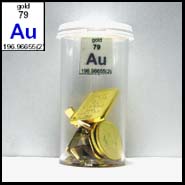
Gold photo
Basic properties
Atomic number79
Atomic weight196.9665694 amu
Element familyTransition metals
Period6
Group1
Blocks-block
Discovery year6000 BC
Isotope distribution
197Au
100%
Physical properties
Density 19.282 g/cm3 (STP)
Atomic hydrogen (H) 8.988E-5
Meitnerium (Mt) 28
Melting1064.58 °C
Helium (He) -272.2
Carbon (C) 3675
Boiling2940 °C
Helium (He) -268.9
Tungsten (W) 5927
Chemical properties
Oxidation states
(less common)
+3
(-3, -2, -1, 0, +1, +2, +5)
First ionization potential 9.225 eV
Cesium (Cs) 3.894
Helium (He) 24.587
Electron affinity 2.309 eV
Nobelium (No) -2.33
Atomic chlorine (Cl) 3.612725
Electronegativity2.54
Cesium (Cs) 0.79
Atomic fluorine (F) 3.98
Atomic radius
Covalent radius 1.24 Å
Atomic hydrogen (H) 0.32
Francium (Fr) 2.6
Van der Waals radius 1.66 Å
Atomic hydrogen (H) 1.2
Francium (Fr) 3.48
Metallic radius 1.44 Å
Beryllium (Be) 1.12
Cesium (Cs) 2.65
79AuWebQC.OrgCovalentMetallicVan der Waals
Compounds
FormulaNameOxidation state
CsAuCaesium auride-1
SiAu4Aurosilane-1
AuClGold(i) chloride+1
Au2SGold(i) sulfide+1
AuBrGold(i) bromide+1
AuCNGold(i) cyanide+1
Au2(SO4)2Gold(II) sulfate+2
AuCl3Gold(III) chloride+3
Au2O3Gold(III) oxide+3
Au2S3Gold(III) sulfide+3
AuF5Gold(V) fluoride+5
AuF6Gold hexafluoride+6
Electronic properties
Electrons per shell2, 8, 18, 32, 18, 1
Electronic configuration[Xe] 4f145d106s1
Bohr atom model
Bohr atom model
Orbital box diagram
Orbital box diagram
Valence electrons11
Lewis dot structure Gold Lewis dot structure
Orbital Visualization
🏠
▶️
📐
Electrons-

Gold (Au): Periodic Table Element

Scientific Review Article | Chemistry Reference Series

Abstract

Gold (Au) stands as the quintessential noble metal with atomic number 79, distinguished by its exceptional resistance to oxidation and corrosion. The element exhibits characteristic yellow metallic luster, crystallizes in the face-centered cubic structure, and possesses a density of 19.3 g/cm³. Gold demonstrates remarkable malleability and ductility, enabling formation of monatomic wires and ultra-thin foils. The element displays predominantly +1 and +3 oxidation states in chemical compounds, though unusual states ranging from -1 to +5 occur under specific conditions. Gold's extraordinary electron affinity of 222.8 kJ/mol represents the highest value among all metals, contributing to its chemical nobility. Natural occurrence remains relatively scarce with crustal abundance of approximately 4 parts per billion, yet concentrated deposits enable economically viable extraction through cyanide leaching and pyrometallurgical processes. Industrial applications exploit gold's electrical conductivity, chemical inertness, and optical properties in electronics, catalysis, and specialized materials.

Introduction

Gold occupies position 79 in the periodic table as a member of Group 11, situated between platinum and mercury in the sixth period. The element belongs to the coinage metals alongside copper and silver, sharing the characteristic d10s1 electronic configuration that confers unique chemical and physical properties. Gold's position in the transition metal series places it among the late d-block elements where relativistic effects significantly influence atomic behavior and chemical bonding patterns.

The discovery of gold predates recorded history, with archaeological evidence indicating human use of native gold dating to the 5th millennium BCE. Ancient civilizations recognized gold's incorruptible nature, leading to its association with permanence and divine attributes. The element derives its symbol Au from the Latin "aurum," meaning "shining dawn," reflecting the characteristic golden luminescence that distinguishes this noble metal from all others.

Modern understanding of gold chemistry emerged through systematic investigation of its coordination compounds, electrochemical behavior, and metallurgical properties. Contemporary research focuses on nanostructured gold materials, catalytic applications, and biomedical technologies where the element's unique combination of chemical stability and biological compatibility proves increasingly valuable.

Physical Properties and Atomic Structure

Fundamental Atomic Parameters

Gold possesses atomic number 79 with standard atomic weight 196.966570 ± 0.000004 u, representing one of the more precisely determined atomic masses in the periodic table. The electronic configuration follows the pattern [Xe] 4f14 5d10 6s1, characteristic of Group 11 elements where the filled d subshell provides exceptional stability while the single s electron remains available for chemical bonding.

Relativistic effects prove particularly significant in gold chemistry due to the high nuclear charge and consequent high velocity of inner electrons. These effects contract the 6s orbital while expanding the 5d orbitals, fundamentally altering the element's chemical behavior compared to lighter congeners. The resulting stabilization of the 6s orbital contributes to gold's reluctance to participate in chemical reactions and helps explain its noble character.

Atomic radius measurements yield values of 144 pm for the metallic radius and 137 pm for the covalent radius. The ionic radii depend strongly on oxidation state and coordination environment, with Au+ exhibiting radius of 137 pm in tetrahedral coordination and Au3+ showing 85 pm in square planar geometry. These dimensional parameters reflect the progressive contraction upon oxidation as nuclear charge increasingly dominates electron-electron repulsion effects.

Macroscopic Physical Characteristics

Gold exhibits distinctive bright yellow metallic appearance that results from selective absorption of blue light wavelengths around 470 nm. The characteristic color originates from relativistic effects that lower the energy gap between the 5d and 6s orbitals, enabling visible light absorption that would not occur in the absence of relativistic considerations. This unique coloration distinguishes gold from silver and other noble metals that appear silvery-white.

The crystal structure consists of face-centered cubic arrangement with lattice parameter a = 407.82 pm at room temperature. This close-packed structure maximizes atomic coordination while minimizing system energy, contributing to the exceptional density of 19.32 g/cm³ at 20°C. The dense packing enables remarkable mechanical properties including outstanding malleability and ductility that allow gold to be beaten into foils as thin as 0.1 μm or drawn into wires of single-atom width.

Thermal properties include melting point of 1064.18°C and boiling point of 2970°C, reflecting strong metallic bonding within the crystal lattice. Heat of fusion equals 12.55 kJ/mol while heat of vaporization reaches 324 kJ/mol. Specific heat capacity at constant pressure equals 25.42 J/(mol·K) at 25°C. Thermal conductivity of 317 W/(m·K) ranks gold among the better thermal conductors, though significantly below copper and silver.

Electrical conductivity reaches 45.2 × 10⁶ S/m at 20°C, representing approximately 70% of copper's conductivity. Despite this moderate value, gold's superior corrosion resistance makes it invaluable for critical electrical connections where long-term reliability outweighs conductivity considerations. The electrical resistivity increases linearly with temperature at a rate of 0.0034 K-1, typical of metallic conductors.

Chemical Properties and Reactivity

Electronic Structure and Bonding Behavior

Gold chemistry centers on the +1 and +3 oxidation states, reflecting the ease of removing the single 6s electron versus the greater difficulty of accessing the filled 5d10 configuration. The Au+ ion adopts linear coordination geometry in most compounds, consistent with d10 electronic configuration that experiences no crystal field stabilization energy preferences. Examples include the cyanide complex [Au(CN)2]- and linear gold(I) halides.

Gold(III) compounds typically exhibit square planar geometry around the metal center, as expected for d8 electronic configuration where crystal field effects strongly favor this arrangement. The square planar preference appears in gold(III) chloride, AuCl3, and numerous coordination complexes with nitrogen, phosphorus, and sulfur donor ligands. Bond lengths in Au(III) complexes typically range from 190-210 pm depending on the specific ligand and coordination environment.

Covalent bonding in gold compounds exhibits significant ionic character due to the high electronegativity of gold (2.54 on the Pauling scale), making it the most electronegative metal. This property contributes to the stability of gold compounds with electronegative elements and helps explain the existence of aurides where gold functions as an anion. The Au-Au bond energy in metallic gold equals approximately 226 kJ/mol, reflecting strong metallic bonding stabilized by relativistic effects.

Electrochemical and Thermodynamic Properties

Gold exhibits remarkably positive standard reduction potentials that quantify its resistance to oxidation. The Au3+/Au couple shows E° = +1.498 V while Au+/Au equals +1.692 V versus the standard hydrogen electrode. These highly positive values indicate that gold oxidation requires extremely powerful oxidizing conditions, consistent with the element's classification as the most noble metal.

Successive ionization energies reveal the electronic structure influence on chemical reactivity. First ionization energy equals 890.1 kJ/mol, reflecting removal of the 6s1 electron, while second ionization energy jumps to 1980 kJ/mol due to disruption of the stable d10 configuration. Third ionization energy reaches 2900 kJ/mol, explaining why Au3+ compounds often exhibit significant covalent character and why higher oxidation states remain uncommon.

The electron affinity of gold equals 222.8 kJ/mol, representing the highest value among all metals and comparable to many nonmetals. This exceptional electron affinity enables formation of auride anions in compounds such as cesium auride, CsAu, where gold formally carries a -1 oxidation state. The high electron affinity results from relativistic contraction of the 6s orbital, which can accommodate additional electron density more readily than in lighter homologs.

Thermodynamic stability of gold compounds varies dramatically with oxidation state and ligand environment. Gold(I) compounds generally exhibit greater stability than gold(III) species, reflecting the reluctance to disturb the d10 configuration. Many gold(III) compounds decompose upon heating to yield gold(I) species or metallic gold, as observed in the thermal decomposition of AuCl3 above 160°C.

Chemical Compounds and Complex Formation

Binary and Ternary Compounds

Gold forms binary compounds with most nonmetals, though many require elevated temperatures or special synthetic conditions due to the element's chemical nobility. Gold(I) halides crystallize as polymeric zigzag chains where each gold center exhibits linear coordination. Gold(I) chloride, AuCl, exists in equilibrium with gold(III) chloride and metallic gold according to the disproportionation reaction 3AuCl → AuCl3 + 2Au.

Gold(III) halides exhibit greater stability and different structural motifs. Gold(III) chloride forms dimeric molecules Au2Cl6 in the gas phase but adopts polymeric structures in the solid state. The compound readily hydrolyzes in water to produce chloroauric acid, HAuCl4, a important reagent in gold chemistry and electroplating applications.

Oxide formation proves challenging due to gold's resistance to oxidation. Gold(III) oxide, Au2O3, can be prepared by dehydration of gold(III) hydroxide but decomposes above 160°C to metallic gold and oxygen. This thermal instability reflects the positive free energy of formation (+80.8 kJ/mol) that makes gold oxides thermodynamically unstable under standard conditions.

Sulfur compounds include gold(I) sulfide, Au2S, and gold(III) sulfide, both of which occur naturally as rare minerals. Gold disulfide, AuS2, forms through reaction of gold with sulfur at elevated temperatures and pressure. These sulfides exhibit greater stability than corresponding oxides, reflecting the softer character of sulfur that matches gold's soft acid properties according to Pearson's hard-soft acid-base theory.

Coordination Chemistry and Organometallic Compounds

Gold coordination chemistry encompasses extensive series of complexes with virtually all donor atom types, though preferences exist based on hard-soft considerations. Gold(I) exhibits strong affinity for soft donors including phosphines, thioethers, and cyanide, forming stable two-coordinate linear complexes. The most important example remains the dicyanoaurate(I) anion, [Au(CN)2]-, which serves as the active species in cyanide leaching of gold ores.

Phosphine complexes of gold(I) demonstrate remarkable stability and structural diversity. Simple complexes such as [Au(PPh3)Cl] exhibit linear coordination while bridged species like [Au2(μ-dppm)2]2+ showcase gold-gold interactions. These aurophilic attractions occur at distances of 270-350 pm, longer than covalent bonds but shorter than van der Waals contacts, and contribute significantly to structural organization in gold(I) systems.

Gold(III) coordination chemistry centers on square planar geometry with coordination numbers typically limited to four. However, rare examples of five- and six-coordinate gold(III) exist under special conditions. Complexes with nitrogen donors such as [AuCl3(py)] and chelating ligands like bipyridine demonstrate the influence of π-acceptor capability on complex stability.

Organometallic gold chemistry has expanded rapidly with discovery of catalytically active gold species. Gold(I) complexes catalyze alkyne activation, cycloisomerization reactions, and carbon-carbon bond formation through unique activation modes. Examples include [(Ph3P)AuCl] and [Au(NHC)Cl] species where NHC represents N-heterocyclic carbene ligands that provide exceptional stability and tunability.

Natural Occurrence and Isotopic Analysis

Geochemical Distribution and Abundance

Gold exhibits extremely low crustal abundance estimated at 4 parts per billion by weight, making it one of the rarest metallic elements in Earth's crust. This scarcity results from gold's siderophile character during planetary differentiation, causing most gold to segregate into Earth's core during early formation. The remaining crustal gold concentrates through hydrothermal processes that transport and deposit the metal in economically viable concentrations.

Seawater contains approximately 13 parts per trillion gold, representing a vast reservoir that totals roughly 20 million tons worldwide. However, the extreme dilution renders seawater extraction economically impractical despite numerous attempts throughout history. Ocean sediments exhibit somewhat higher concentrations, particularly in areas of active hydrothermal venting where metal-rich fluids deposit gold along with other sulfide minerals.

Gold occurs predominantly as native metal in nature, though telluride minerals such as calaverite (AuTe2) and sylvanite [(Au,Ag)Te2] represent important ore types in certain deposits. Native gold typically contains silver as the primary impurity, with natural alloys ranging from pure gold to electrum containing up to 50% silver. Minor amounts of copper, platinum group metals, and base metals occur as trace impurities.

Placer deposits form through weathering and erosion of primary gold-bearing rocks, with gold particles accumulating in stream sediments due to their high density. These secondary deposits historically provided much of the world's gold through simple gravity separation techniques. Notable placer regions include the California Gold Rush deposits, Klondike goldfields, and various African river systems where gold particles range from microscopic flakes to nuggets exceeding several kilograms.

Nuclear Properties and Isotopic Composition

Gold occurs naturally as a single stable isotope, 197Au, with mass number 197 corresponding to 79 protons and 118 neutrons. This isotope exhibits nuclear spin I = 3/2 and magnetic moment μ = +0.148 nuclear magnetons, properties utilized in nuclear magnetic resonance studies of gold compounds and materials. The mono-isotopic nature simplifies analytical chemistry applications and provides precise atomic mass determination.

Artificial gold isotopes span mass numbers from 169 to 205, with half-lives ranging from microseconds to several years. The most important radioisotope, 198Au, exhibits half-life of 2.695 days and decays by beta emission to stable 198Hg. This isotope finds application in nuclear medicine, particularly for cancer therapy where gold nanoparticles tagged with 198Au deliver targeted radiation to tumor sites.

Gold-195 (t1/2 = 186.1 days) serves as another medically relevant radioisotope, decaying by electron capture to 195Pt. Research applications utilize various short-lived gold isotopes for tracer studies in metallurgy and geochemistry, where the distinctive nuclear properties enable tracking of gold behavior in complex systems.

Neutron activation analysis exploits gold's favorable nuclear cross-section for neutron capture (σ = 98.65 barns for thermal neutrons) to produce 198Au from stable 197Au. This technique provides extremely sensitive analytical capability, detecting gold concentrations below 1 part per billion in geological and environmental samples. The high cross-section also necessitates careful shielding considerations in nuclear reactor environments where gold components might undergo significant activation.

Industrial Production and Technological Applications

Extraction and Purification Methodologies

Modern gold extraction relies primarily on cyanide leaching, a hydrometallurgical process that exploits gold's unique chemistry to form soluble cyano complexes. The fundamental reaction proceeds: 4Au + 8CN- + O2 + 2H2O → 4[Au(CN)2]- + 4OH-, requiring both cyanide and oxygen for effective dissolution. Optimal conditions include pH above 10.5, cyanide concentrations of 200-500 mg/L, and adequate dissolved oxygen levels maintained through air sparging.

Heap leaching represents the dominant commercial application of cyanide processing, where ore is stacked on impermeable pads and irrigated with dilute cyanide solution. Gold recovery efficiency typically ranges from 60-90% depending on ore mineralogy and particle size distribution. The pregnant solution undergoes further processing through carbon adsorption, where activated carbon selectively absorbs the aurocyanide complex for subsequent recovery by elution and electrowinning.

Pyrometallurgical methods remain important for high-grade ores and concentrates, utilizing extreme temperatures to reduce gold compounds to metallic form. Smelting in electric or fuel-fired furnaces at temperatures exceeding 1200°C enables separation of gold from gangue minerals and concentration into doré bars containing 80-95% gold. Flux additions facilitate slag formation and improve metal recovery by providing appropriate chemical environment for reduction reactions.

Refining to achieve high purity typically employs the Wohlwill electrolytic process or Miller chlorination technique. The Wohlwill process utilizes electrolysis of chloroauric acid solution with crude gold anodes and pure gold cathodes, achieving purity levels exceeding 99.99%. Miller processing involves chlorine gas treatment of molten gold at temperatures around 1100°C, where base metals form volatile chlorides while gold remains unchanged, yielding purity of approximately 99.5%.

Technological Applications and Future Prospects

Electronics applications exploit gold's exceptional combination of electrical conductivity, corrosion resistance, and stability under diverse environmental conditions. Critical applications include semiconductor wire bonding where gold wires of 15-50 μm diameter connect integrated circuit dies to package leads. The gold-silicon bond formation provides reliable electrical connection capable of withstanding thermal cycling and aging effects that degrade alternative materials.

Printed circuit boards utilize gold plating on contact surfaces, connector pins, and edge fingers where reliability requirements justify the additional cost. Typical coating thickness ranges from 0.5-2.5 μm over nickel barrier layers that prevent copper diffusion. The immersion gold plating process, involving displacement reaction between gold chloride and copper, provides cost-effective method for achieving uniform coverage on complex geometries.

Catalytic applications represent rapidly growing technological area where gold nanoparticles exhibit remarkable activity for various chemical transformations. Carbon monoxide oxidation catalysts employ gold particles below 5 nm diameter supported on metal oxides such as titanium dioxide or iron oxide. The extraordinary activity emerges from quantum size effects that alter electronic structure and create highly active sites for molecule activation.

Biomedical applications leverage gold's biocompatibility and unique optical properties for diagnostics and therapeutics. Gold nanoparticles enable targeted drug delivery systems where surface functionalization directs particles to specific cellular targets. Photothermal therapy utilizes near-infrared absorption by gold nanorods to generate localized heating for cancer treatment, while gold-based contrast agents enhance medical imaging techniques including computed tomography and optical coherence tomography.

Emerging technologies explore gold's potential in renewable energy systems, quantum electronics, and advanced materials. Plasmonic applications harness gold nanostructures to manipulate light at subwavelength scales, enabling enhanced solar cell efficiency and novel optical devices. Research continues into gold-based superconducting devices, single-atom catalysts, and hybrid organic-inorganic materials where gold's unique properties enable previously impossible functionalities.

Historical Development and Discovery

Gold's discovery predates written history, with archaeological evidence indicating human utilization dating to approximately 4600-4200 BCE in the Varna Necropolis of Bulgaria. These earliest gold artifacts demonstrate sophisticated metalworking techniques including alloying, forming, and decorative applications that established gold's association with wealth and permanence. Ancient Egyptian civilization extensively employed gold for ceremonial objects, jewelry, and architectural elements, with tomb paintings depicting gold mining and processing techniques.

Classical antiquity recognized gold's chemical inertness, with Roman authors noting its resistance to fire and corrosion. The Latin name "aurum" derives from Proto-Indo-European roots meaning "to shine" or "dawn," reflecting the characteristic luminous appearance that distinguished gold among metals. Medieval alchemists pursued gold synthesis through transmutation experiments, inadvertently developing many fundamental chemical techniques while seeking to create gold from base metals.

Scientific understanding of gold chemistry emerged during the 18th and 19th centuries through systematic investigation of its compounds and properties. Antoine Lavoisier's work established gold as an elementary substance rather than a compound, while subsequent researchers characterized gold salts, coordination complexes, and electrochemical behavior. The development of aqua regia as a gold solvent provided crucial analytical capability for assaying and purification processes.

Modern gold chemistry developed through 20th century advances in coordination theory, electronic structure understanding, and analytical techniques. Alfred Werner's coordination theory explained gold complex geometry and bonding, while X-ray crystallography revealed detailed structural information. Contemporary research continues expanding gold applications in catalysis, nanotechnology, and materials science, demonstrating that this ancient metal remains at the forefront of chemical innovation.

Conclusion

Gold stands apart in the periodic table as the exemplar of chemical nobility, combining exceptional resistance to oxidation with unique electronic properties arising from relativistic effects. Its distinctive d10s1 configuration enables formation of linear gold(I) and square planar gold(III) complexes while supporting unusual oxidation states that expand the boundaries of transition metal chemistry. The element's high electron affinity and positive reduction potentials quantify its reluctance to participate in chemical reactions, yet gold compounds exhibit rich coordination chemistry with soft donor ligands.

Industrial significance continues expanding beyond traditional applications in jewelry and currency toward high-technology uses in electronics, catalysis, and biomedicine. The exceptional electrical conductivity combined with corrosion resistance ensures gold's continued importance in critical electronic connections, while emerging catalytic applications exploit quantum size effects in gold nanoparticles to achieve unprecedented reaction selectivity and efficiency.

Future research directions encompass single-atom catalysis, plasmonic devices, and biomedical applications where gold's unique combination of stability, conductivity, and biocompatibility enables novel technological solutions. Understanding of relativistic effects in gold chemistry continues deepening, providing insights applicable to other heavy elements and contributing to broader theoretical frameworks for describing chemical bonding and reactivity patterns across the periodic table.

Periodict table
Please let us know how we can improve this web app.

Menu Balance Molar mass Gas laws Units Chemistry tools Periodic table Chemical forum Symmetry Constants Contribute Contact us
How to cite?