| Element | |
|---|---|
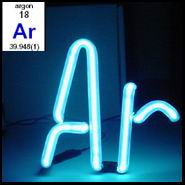
18ArArgon39.94812
8 8 |
|
| Basic properties | |
|---|---|
| Atomic number | 18 |
| Atomic weight | 39.9481 amu |
| Element family | Nobel gases |
| Period | 3 |
| Group | 18 |
| Block | p-block |
| Discovery year | 1894 |
| Isotope distribution |
|---|
36Ar 0.337% 38Ar 0.063% 40Ar 99.600% |
40Ar (99.60%) |
| Physical properties | |
|---|---|
| Density | 0.0017837 g/cm3 (STP) |
Atomic hydrogen (H) 8.988E-5 Meitnerium (Mt) 28 | |
| Melting | -189.19 °C |
Helium (He) -272.2 Carbon (C) 3675 | |
| Boiling | -185.9 °C |
Helium (He) -268.9 Tungsten (W) 5927 | |
| Chemical properties | |
|---|---|
| Oxidation states (less common) | (0) |
| First ionization potential | 15.759 eV |
Cesium (Cs) 3.894 Helium (He) 24.587 | |
| Electron affinity | -1.000 eV |
Nobelium (No) -2.33 Atomic chlorine (Cl) 3.612725 | |
| Atomic radius | |
|---|---|
| Covalent radius | 0.96 Å |
Atomic hydrogen (H) 0.32 Francium (Fr) 2.6 | |
| Van der Waals radius | 1.88 Å |
Atomic hydrogen (H) 1.2 Francium (Fr) 3.48 | |
| Electronic properties | |
|---|---|
| Electrons per shell | 2, 8, 8 |
| Electronic configuration | [Ne] 3s2 |
|
Bohr atom model

| |
|
Orbital box diagram

| |
| Valence electrons | 8 |
| Lewis dot structure |
|
| Orbital Visualization | |
|---|---|
|
| |
| Electrons | - |
Argon (Ar): Periodic Table Element
Abstract
Argon (Ar, atomic number 18) constitutes the third most abundant gas in Earth's atmosphere at 0.934% by volume, representing the most prevalent noble gas in the terrestrial environment. This monatomic element exhibits exceptional chemical inertness due to its complete electron octet configuration [Ne]3s²3p⁶, rendering it virtually unreactive under standard conditions. The predominant terrestrial isotope ⁴⁰Ar (99.6% abundance) originates from radiogenic decay of ⁴⁰K within Earth's crust, distinguishing argon's isotopic composition from other cosmic environments where ³⁶Ar dominates. Industrial applications exploit argon's inertness and low thermal conductivity in high-temperature processes, welding operations, and preservation systems. The element's triple point temperature of 83.8058 K serves as a fundamental reference in the International Temperature Scale of 1990. Recent discoveries of metastable argon compounds, including argon fluorohydride (HArF) stable below 17 K, challenge traditional concepts of noble gas reactivity while expanding understanding of chemical bonding under extreme conditions.
Introduction
Argon occupies position 18 in the periodic table as the terminal member of the third period and first member of the noble gas series to exhibit significant terrestrial abundance. The element's name derives from the Greek ἀργόν (argon), meaning "lazy" or "inactive," reflecting its extraordinary resistance to chemical combination. This chemical inertness stems from argon's complete valence shell configuration, which minimizes the thermodynamic driving force for compound formation and establishes argon as the archetypal unreactive element.
The discovery of argon in 1894 by Lord Rayleigh and Sir William Ramsay marked a paradigm shift in periodic classification, revealing the existence of an entirely new group of elements that challenged Mendeleev's original atomic weight-based arrangement. This discovery ultimately led to recognition of atomic number as the fundamental organizing principle of the periodic table, resolving the apparent anomaly of argon's greater atomic mass relative to potassium despite preceding it in reactivity trends.
Contemporary significance of argon extends far beyond academic interest, encompassing critical industrial applications that exploit its unique combination of chemical inertness, appropriate physical properties, and economic accessibility. The element's abundance in atmospheric sources enables large-scale production through cryogenic air separation, supporting diverse technological applications from metallurgical processes to scientific instrumentation.
Physical Properties and Atomic Structure
Fundamental Atomic Parameters
Argon's atomic structure centers on the nuclear configuration containing 18 protons, establishing its definitive position in the periodic table. The ground-state electron configuration [Ne]3s²3p⁶ represents a closed-shell arrangement with completely filled s and p subshells, conferring exceptional stability through optimal electron-electron repulsion minimization and nuclear-electron attraction optimization.
The atomic radius of argon measures 188 pm (covalent) and 188 pm (van der Waals), reflecting the absence of conventional chemical bonding that would define ionic radii. Effective nuclear charge calculations indicate Z_eff = 6.76 for the outermost electrons, balanced by significant shielding from inner electron shells. This electronic configuration results in exceptionally high ionization energies: first ionization energy 1520.6 kJ/mol, second ionization energy 2665.8 kJ/mol, and third ionization energy 3931 kJ/mol, demonstrating the energetic unfavorability of electron removal from the stable octet configuration.
Nuclear magnetic properties reveal ³⁹Ar possesses nuclear spin I = 7/2 with magnetic moment μ = -1.59 nuclear magnetons, while the predominant ⁴⁰Ar isotope exhibits zero nuclear spin, simplifying spectroscopic analysis in applications requiring nuclear magnetic resonance techniques.
Macroscopic Physical Characteristics
Argon manifests as a colorless, odorless, tasteless gas under standard temperature and pressure conditions, exhibiting characteristic lilac/violet luminescence when subjected to electrical discharge. The monatomic structure prevents molecular vibrations, rotations, or internal energy modes that would contribute to spectroscopic complexity or chemical reactivity.
Critical thermodynamic parameters include a triple point temperature of 83.8058 K at 69.0 kPa pressure, which serves as a fundamental reference standard in precision thermometry. The boiling point occurs at 87.302 K (1 atm), while the melting point corresponds to 83.8058 K under standard pressure. These relatively low phase transition temperatures reflect weak intermolecular forces limited to van der Waals interactions between spherically symmetric electron distributions.
Density measurements yield 1.784 kg/m³ for gaseous argon at standard temperature and pressure, approximately 1.38 times the density of air. Liquid argon exhibits density 1.40 g/cm³ at the boiling point, while solid argon crystallizes in a face-centered cubic structure with density 1.65 g/cm³. The heat of vaporization equals 6.447 kJ/mol, and the heat of fusion measures 1.18 kJ/mol, indicating moderate intermolecular attractive forces sufficient for condensed phase stability but insufficient for strong chemical bonding.
Thermal conductivity of gaseous argon measures 17.72 mW/(m·K) at 300 K, significantly lower than diatomic gases due to the absence of rotational and vibrational energy transfer mechanisms. This property proves advantageous in thermal insulation applications and high-temperature industrial processes requiring heat retention.
Chemical Properties and Reactivity
Electronic Structure and Bonding Behavior
The electronic configuration [Ne]3s²3p⁶ establishes argon's fundamental chemical inertness through complete valence shell occupation, eliminating energetically favorable pathways for conventional electron sharing or transfer reactions. The spherically symmetric 3p⁶ electron distribution maximizes electron-nuclear attractive interactions while minimizing electron-electron repulsions, creating an exceptionally stable electronic arrangement.
Theoretical calculations demonstrate that argon compound formation requires overcoming substantial activation barriers associated with disrupting the closed-shell configuration. The absence of unfilled d orbitals in the valence region further constrains bonding possibilities, preventing the orbital hybridization and electron promotion mechanisms that enable compound formation in transition metals and higher period main group elements.
Under extreme conditions, argon can participate in weakly bound compound formation through mechanisms involving charge transfer, covalent interaction with highly electronegative elements, or matrix isolation stabilization. The compound argon fluorohydride (HArF) represents the most thoroughly characterized stable argon compound, formed through photolysis of hydrogen fluoride in solid argon matrices below 17 K. This compound exhibits Ar-H bond length of 1.27 Å and demonstrates that argon can function as an electron donor in highly polarized environments.
Ion formation proceeds readily under high-energy conditions, with Ar⁺ representing the most common ionic species. The argonium ion ArH⁺ has been detected in interstellar media, specifically in the Crab Nebula supernova remnant, marking the first noble gas molecular ion identified in space. These ionic species demonstrate argon's capacity for chemical interaction when sufficient energy overcomes the closed-shell stability.
Electrochemical and Thermodynamic Properties
Electronegativity values for argon remain undefined in conventional scales due to the absence of stable covalent compounds under normal conditions. Theoretical calculations suggest an electronegativity approaching 3.2 on the Pauling scale, indicating moderate electron-attracting capability when forced into chemical combination.
The first ionization energy of 1520.6 kJ/mol reflects the substantial energy required to remove an electron from the stable 3p⁶ configuration, while successive ionization energies increase dramatically: second ionization energy 2665.8 kJ/mol, third ionization energy 3931 kJ/mol. This pattern demonstrates the exceptional stability of the closed-shell configuration and the progressively increasing difficulty of electron removal from more tightly bound inner shells.
Electron affinity measurements indicate that argon exhibits essentially zero electron affinity (-96 kJ/mol), confirming the thermodynamic instability of anionic argon species. This negative electron affinity reflects the energetic cost of adding an electron to an already complete valence shell, where additional electrons must occupy higher-energy antibonding orbitals.
Standard reduction potentials for argon ionic species demonstrate highly positive values: Ar⁺ + e⁻ → Ar, E° = -15.76 V, indicating extreme oxidizing character for argon cations and the thermodynamic favorability of electron addition to restore the neutral ground state. These values emphasize the energetic penalty associated with disrupting argon's closed-shell configuration.
Chemical Compounds and Complex Formation
Binary and Ternary Compounds
Confirmed stable argon compounds remain extremely limited, with argon fluorohydride (HArF) representing the primary example of a neutral argon-containing molecule stable under accessible laboratory conditions. This compound forms through UV photolysis of hydrogen fluoride in solid argon matrices at temperatures below 17 K, where the low-temperature environment stabilizes the otherwise thermodynamically unstable Ar-H bond.
The HArF molecule exhibits a linear geometry with Ar-H bond length of 1.274 Å and H-F bond length of 0.958 Å. Vibrational spectroscopy reveals Ar-H stretching frequency at 1950 cm⁻¹ and H-F stretching at 4037 cm⁻¹, confirming the covalent nature of both bonds. The binding energy of the Ar-H interaction measures approximately 130 kJ/mol, substantial enough to maintain molecular integrity at cryogenic temperatures but insufficient for room temperature stability.
Theoretical calculations predict the existence of additional metastable argon compounds, including HArCl, HArBr, and potentially HArI, following similar formation mechanisms but with progressively decreasing stability down the halogen series. These compounds have not yet been synthesized experimentally but represent targets for low-temperature matrix isolation studies.
Binary compounds with other noble gases remain purely theoretical, as the weak van der Waals interactions between closed-shell atoms provide insufficient binding energy for stable molecule formation. Mixed noble gas clusters Ar_n·Xe_m can be formed in supersonic molecular beam expansions but possess binding energies on the order of thermal energy at very low temperatures.
Coordination Chemistry and Organometallic Compounds
Argon coordination complexes represent a specialized class of compounds where argon functions as a weakly bound ligand in low-temperature matrix environments. The complex W(CO)₅Ar was among the first reported argon coordination compounds, formed by photochemical CO dissociation from tungsten hexacarbonyl in solid argon matrices. The Ar-W interaction exhibits binding energy approximately 10 kJ/mol, characteristic of weak coordinate covalent bonding.
Matrix isolation techniques enable formation of numerous transient argon-metal complexes through photodissociation of carbonyl or organometallic precursors in argon-rich environments. These complexes typically exhibit argon-metal bond lengths exceeding 2.5 Å and vibrational frequencies below 200 cm⁻¹ for the metal-argon stretching modes, confirming the weak nature of the coordination interaction.
Theoretical studies predict enhanced stability for argon complexes with highly electrophilic metal centers, particularly in high oxidation states where the electron-deficient metal can more effectively interact with argon's electron density. However, these predictions await experimental verification under appropriate low-temperature, matrix-stabilized conditions.
The metastable dication ArCF₂²⁺ has been observed in mass spectrometric studies, demonstrating argon's capacity for incorporation into highly charged species under extreme ionization conditions. This species exhibits remarkable stability in the gas phase, suggesting potential for forming salt-like compounds with appropriate counterions.
Natural Occurrence and Isotopic Analysis
Geochemical Distribution and Abundance
Argon constitutes 0.934% of Earth's atmosphere by volume and 1.288% by mass, establishing it as the third most abundant atmospheric gas after nitrogen and oxygen. This abundance significantly exceeds that of other noble gases: helium (5.24 ppm), neon (18.18 ppm), krypton (1.14 ppm), and xenon (0.087 ppm), reflecting argon's unique geochemical accumulation mechanisms.
Crustal abundance averages 1.2 ppm by mass, while seawater contains approximately 0.45 ppm argon. These concentrations reflect equilibrium partitioning between atmospheric, hydrospheric, and lithospheric reservoirs, with atmospheric argon representing the largest terrestrial reservoir due to continuous radiogenic production and atmospheric retention.
The predominance of atmospheric argon originates from radiogenic decay of ⁴⁰K within Earth's interior, where electron capture and positron emission processes convert potassium-40 to argon-40 with a half-life of 1.25 × 10⁹ years. This decay pathway produces approximately 11.2% ⁴⁰Ar and 88.8% ⁴⁰Ca, with the gaseous argon product migrating to the atmosphere over geological time scales.
Volcanic degassing represents the primary mechanism for argon release from crustal and mantle reservoirs, with volcanic emissions containing elevated ⁴⁰Ar concentrations reflecting long-term potassium decay within magma source regions. Mid-ocean ridge basalts exhibit lower ⁴⁰Ar/³⁶Ar ratios than continental volcanic rocks, indicating shorter residence times in potassium-rich crustal environments.
Nuclear Properties and Isotopic Composition
Terrestrial argon exhibits a distinctive isotopic signature dominated by radiogenic ⁴⁰Ar (99.603%), with minor contributions from primordial ³⁶Ar (0.337%) and ³⁸Ar (0.060%). This composition contrasts sharply with solar system abundances, where ³⁶Ar predominates as the primary product of stellar nucleosynthesis during silicon burning in massive stars.
⁴⁰Ar exhibits nuclear spin I = 0 and magnetic moment μ = 0, simplifying NMR and electron paramagnetic resonance applications. The nucleus contains 18 protons and 22 neutrons in a doubly magic configuration (18 and 20 being magic numbers), contributing to exceptional nuclear stability. Binding energy per nucleon measures 8.52 MeV, reflecting strong nuclear cohesion.
³⁹Ar represents a cosmogenic isotope produced through cosmic ray interactions with atmospheric ⁴⁰Ar via (n,2n) reactions and with ³⁹K via (n,p) reactions. The isotope exhibits a half-life of 269 years through beta decay to ³⁹K, maintaining steady-state atmospheric concentrations around 8 × 10⁻¹⁶ mole fraction. This isotope serves as a valuable tracer for groundwater dating and ocean circulation studies on centennial timescales.
³⁷Ar forms through neutron activation of ⁴⁰Ca during nuclear weapons testing, providing a sensitive indicator of anthropogenic nuclear activity. The 35-day half-life enables detection of recent nuclear events while ensuring rapid decay to background levels. Thermal neutron capture cross-sections measure 0.66 barns for ³⁶Ar and 5.0 barns for ⁴⁰Ar, facilitating neutron activation analysis applications.
Industrial Production and Technological Applications
Extraction and Purification Methodologies
Industrial argon production relies exclusively on cryogenic fractional distillation of liquid air, exploiting the differential volatilities of atmospheric components. The process begins with air compression and purification to remove carbon dioxide, water vapor, and trace contaminants, followed by cooling to cryogenic temperatures where component gases condense at characteristic boiling points.
The distillation sequence separates nitrogen (b.p. 77.3 K) first, followed by argon (b.p. 87.3 K), and finally oxygen (b.p. 90.2 K). Argon concentration occurs in the bottom fraction of the low-pressure column, where argon-oxygen mixtures undergo further separation in dedicated argon columns operating at optimized reflux ratios to achieve commercial purity specifications.
High-purity argon production employs additional purification steps including catalytic oxygen removal through hydrogen combustion over platinum catalysts, molecular sieve adsorption for trace moisture elimination, and activated carbon treatment for hydrocarbon removal. These processes achieve purities exceeding 99.999% for specialized applications requiring ultra-high purity inert atmospheres.
Global argon production exceeds 700,000 tonnes annually, with major production facilities concentrated in regions with large-scale air separation infrastructure supporting steel, chemical, and electronics industries. Economic factors favor production integration with oxygen and nitrogen facilities, optimizing capital equipment utilization and energy efficiency across multiple product streams.
Technological Applications and Future Prospects
Welding and metallurgical applications represent the largest argon consumption sector, exploiting argon's inert atmosphere protection for reactive metals including aluminum, titanium, and stainless steel. Gas tungsten arc welding (GTAW) and gas metal arc welding (GMAW) utilize argon as a shielding gas to prevent oxidation and nitridation of weld pools at elevated temperatures, ensuring high-quality joint formation.
Semiconductor manufacturing employs ultra-high purity argon in crystal growth operations, particularly for silicon and germanium single crystal production where contamination control demands exceptional gas purity. Argon atmospheres prevent unwanted doping and enable precise control of electrical properties in finished semiconductor devices.
Scientific applications utilize liquid argon as a detection medium in neutrino physics experiments and dark matter searches. The high scintillation light yield (51 photons/keV), transparency to its own scintillation light, and distinctive timing characteristics enable discrimination between signal and background events in underground detector facilities. Major experiments including ICARUS, MicroBooNE, and DarkSide rely on multi-tonne liquid argon targets for rare event detection.
Preservation applications exploit argon's higher density than air and chemical inertness for food packaging, pharmaceutical storage, and archival preservation. The U.S. National Archives utilizes argon atmospheres for preserving the Declaration of Independence and Constitution, replacing helium due to argon's superior containment properties and lower permeation rates through storage materials.
Emerging applications include argon ion beam etching for microfabrication, argon plasma processing for surface modification, and argon-enhanced coagulation in medical procedures. Future developments may expand argon utilization in space propulsion systems, leveraging its high molecular weight and ionization characteristics for electric propulsion applications.
Historical Development and Discovery
The discovery of argon emerged from meticulous density measurements conducted by Lord Rayleigh, who observed that atmospheric nitrogen exhibited consistently higher density than nitrogen derived from chemical decomposition of ammonia or nitrous oxide. This 0.5% discrepancy, though seemingly minor, proved sufficiently significant to warrant extensive investigation when reproducible across multiple experimental approaches.
Henry Cavendish's prescient 1785 experiments provided crucial precedent, demonstrating that electrical sparking could remove the bulk of air's nitrogen and oxygen components, leaving a small residual fraction resistant to further chemical treatment. Cavendish estimated this residual gas comprised "not more than 1/120 of the whole," remarkably close to argon's actual atmospheric abundance of 0.934%.
The systematic isolation achieved by Lord Rayleigh and Sir William Ramsay in 1894 employed spark discharge through air over potassium hydroxide solution, gradually removing nitrogen oxides and carbon dioxide while monitoring volume reduction. The residual gas exhibited spectroscopic lines unmatched by any known element, prompting extensive spectroscopic characterization that confirmed the presence of a previously unknown atmospheric constituent.
Initial skepticism from the scientific community centered on argon's apparent violation of Mendeleev's periodic law, as its atomic weight exceeded that of potassium despite exhibiting complete chemical inertness. This paradox found resolution only with Henry Moseley's demonstration that atomic number, rather than atomic weight, governs periodic behavior, establishing the fundamental organizing principle of modern periodic classification.
The Nobel Prize recognition of both discoverers—Rayleigh in Physics (1904) and Ramsay in Chemistry (1904)—acknowledged the profound impact of argon's discovery on atomic theory and periodic classification. Ramsay's subsequent discovery of the remaining noble gases (helium, neon, krypton, xenon) within six years demonstrated the systematic nature of this new element family and revolutionized understanding of atomic structure and chemical periodicity.
Conclusion
Argon exemplifies the unique properties arising from complete valence shell electron configurations, demonstrating how electronic structure governs chemical behavior and technological utility. The element's combination of atmospheric abundance, chemical inertness, and accessible physical properties establishes argon as an indispensable industrial commodity while providing fundamental insights into atomic structure and chemical bonding principles.
The radiogenic origin of terrestrial argon illuminates planetary evolution processes and provides powerful tools for geochronological analysis, while recent discoveries of metastable argon compounds challenge traditional concepts of noble gas reactivity. Future research directions may explore high-pressure synthetic pathways to stable argon compounds, investigate argon's role in exotic matter phases, and develop novel technological applications exploiting argon's unique combination of properties. The element's continued importance in both fundamental research and industrial applications ensures argon's enduring significance in advancing chemical knowledge and enabling technological innovation.

Please let us know how we can improve this web app.
