| Element | |
|---|---|
34SeSelenium78.9632
8 18 6 |
|
| Basic properties | |
|---|---|
| Atomic number | 34 |
| Atomic weight | 78.963 amu |
| Element family | Non-metals |
| Period | 4 |
| Group | 16 |
| Block | p-block |
| Discovery year | 1817 |
| Isotope distribution |
|---|
74Se 0.9% 76Se 9.0% 77Se 7.6% 78Se 23.5% 80Se 49.6% |
74Se (0.99%) 76Se (9.93%) 77Se (8.39%) 78Se (25.94%) 80Se (54.75%) |
| Physical properties | |
|---|---|
| Density | 4.809 g/cm3 (STP) |
Atomic hydrogen (H) 8.988E-5 Meitnerium (Mt) 28 | |
| Melting | 221 °C |
Helium (He) -272.2 Carbon (C) 3675 | |
| Boiling | 685 °C |
Helium (He) -268.9 Tungsten (W) 5927 | |
| Chemical properties | |
|---|---|
| Oxidation states (less common) | -2, +2, +4, +6 (-1, 0, +1, +3, +5) |
| First ionization potential | 9.753 eV |
Cesium (Cs) 3.894 Helium (He) 24.587 | |
| Electron affinity | 2.021 eV |
Nobelium (No) -2.33 Atomic chlorine (Cl) 3.612725 | |
| Electronegativity | 2.55 |
Cesium (Cs) 0.79 Atomic fluorine (F) 3.98 | |
| Atomic radius | |
|---|---|
| Covalent radius | 1.16 Å |
Atomic hydrogen (H) 0.32 Francium (Fr) 2.6 | |
| Van der Waals radius | 1.9 Å |
Atomic hydrogen (H) 1.2 Francium (Fr) 3.48 | |
| Compounds | ||
|---|---|---|
| Formula | Name | Oxidation state |
| H2Se | Hydrogen selenide | -2 |
| CdSe | Cadmium selenide | -2 |
| ZnSe | Zinc selenide | -2 |
| MnSe2 | Manganese diselenide | -1 |
| C3H7NO2Se | Selenocysteine | +1 |
| Se2Cl2 | Selenium monochloride | +1 |
| Se2S6 | Selenium hexasulfide | +1 |
| SeCl2 | Selenium dichloride | +2 |
| SeO2 | Selenium dioxide | +4 |
| H2SeO3 | Selenious acid | +4 |
| H2SeO4 | Selenic acid | +6 |
| SeO3 | Selenium trioxide | +6 |
| Electronic properties | |
|---|---|
| Electrons per shell | 2, 8, 18, 6 |
| Electronic configuration | [Ar] 3d10 |
|
Bohr atom model

| |
|
Orbital box diagram

| |
| Valence electrons | 6 |
| Lewis dot structure |
|
| Orbital Visualization | |
|---|---|
|
| |
| Electrons | - |
Selenium (Se): Periodic Table Element
Abstract
Selenium, atomic number 34, represents a critical element in group 16 of the periodic table, exhibiting distinctive chemical properties that bridge metallic and non-metallic behavior. With a standard atomic weight of 78.971 ± 0.008 u, selenium manifests multiple allotropic forms including grey hexagonal, red monoclinic, and black amorphous structures. The element demonstrates variable oxidation states from −2 to +6, with +4 and +6 being most prevalent in technological applications. Selenium's electronic configuration [Ar] 3d¹⁰ 4s² 4p⁴ confers unique photoconductivity properties that render it indispensable in semiconductor technology, photovoltaic cells, and xerographic processes. Industrial applications span from rectifier production to specialized glass manufacturing, while emerging technologies utilize selenium in quantum dots and advanced photonic devices. The element occurs naturally at approximately 0.05 mg/kg in the Earth's crust, primarily associated with sulfide ore deposits. Five stable isotopes exist, with ⁷⁸Se comprising 23.77% natural abundance and exhibiting the most significant nuclear properties for technological applications.
Introduction
Selenium occupies position 34 in the periodic table within group 16 (chalcogens), situated between sulfur and tellurium in the oxygen family. The element exhibits intermediate properties between non-metals and metalloids, demonstrating characteristic semiconductor behavior that distinguishes it from lighter chalcogens. Its electronic configuration [Ar] 3d¹⁰ 4s² 4p⁴ places selenium in the fourth period with four unpaired electrons in the outer p orbital, establishing the foundation for its diverse chemical reactivity patterns.
The element's significance in modern chemistry stems from its unique photoconductivity properties, where electrical conductivity increases dramatically upon illumination. This phenomenon, first observed systematically in the late 19th century, established selenium as a pioneering material in photoelectric applications. Contemporary industrial chemistry utilizes selenium's properties in rectifier manufacturing, specialized metallurgy, and advanced semiconductor applications where precise control of electronic properties proves essential.
Selenium's discovery by Jöns Jacob Berzelius in 1817 marked a significant advancement in analytical chemistry, as it represented one of the first elements identified through systematic chemical analysis of industrial residues. The element's name derives from the Greek word "selene," meaning moon, reflecting Berzelius's initial belief that he had discovered tellurium, which was named after the Latin "tellus" for earth. Historical development of selenium chemistry has paralleled advances in solid-state physics and materials science, establishing the element as fundamental to modern electronic technology.
Physical Properties and Atomic Structure
Fundamental Atomic Parameters
Selenium exhibits an atomic number of 34 with an electronic configuration of [Ar] 3d¹⁰ 4s² 4p⁴, placing it in the chalcogen group with six valence electrons. The atomic radius measures 120 pm, while the covalent radius extends to 120 pm and the ionic radius varies from 50 pm for Se⁶⁺ to 198 pm for Se²⁻. These radial parameters reflect selenium's intermediate position between sulfur (atomic radius 100 pm) and tellurium (atomic radius 140 pm), demonstrating characteristic periodic trends within group 16.
The effective nuclear charge experienced by valence electrons approximates 6.04, accounting for d-orbital shielding effects that distinguish selenium from lighter chalcogens. First ionization energy measures 941.0 kJ/mol, substantially lower than sulfur's 999.6 kJ/mol, while successive ionization energies increase to 2045 kJ/mol (second) and 2973.7 kJ/mol (third). Electron affinity exhibits a value of 195.0 kJ/mol, indicating moderate tendency for electron acceptance and anion formation.
The electronegativity of selenium registers 2.55 on the Pauling scale, positioning it between sulfur (2.58) and tellurium (2.1). This intermediate electronegativity facilitates formation of both ionic and covalent compounds, depending on the nature of bonding partners. Selenium typically exhibits oxidation states of −2, +2, +4, and +6, with +4 and +6 being most common in stable compounds under standard conditions.
Macroscopic Physical Characteristics
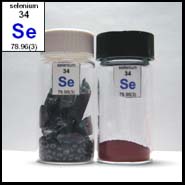
Selenium manifests multiple allotropic forms with distinct physical properties and structural arrangements. Grey hexagonal selenium, the thermodynamically stable form under standard conditions, crystallizes in a hexagonal crystal system with lattice parameters a = 4.3662 Å and c = 4.9536 Å. This allotrope exhibits metallic appearance with density 4.81 g/cm³ and demonstrates semiconductor properties with band gap energy of approximately 1.74 eV.
Red monoclinic selenium forms through rapid cooling from liquid phase, displaying deep red coloration and density 4.46 g/cm³. The crystal structure contains cyclic Se₈ molecules arranged in a monoclinic lattice with space group P2₁/n. Black amorphous selenium, obtained through chemical precipitation or rapid quenching, lacks long-range order and exhibits density 4.28 g/cm³. This form demonstrates superior photoconductivity compared to crystalline modifications, making it particularly valuable in xerographic applications.
Thermal properties include melting point 221.0°C and boiling point 685.0°C, indicating moderate volatility compared to other group 16 elements. Heat of fusion measures 6.69 kJ/mol, while heat of vaporization reaches 95.48 kJ/mol. Specific heat capacity at constant pressure equals 0.321 J/(g·K) at 25°C. Thermal expansion coefficient measures 3.7 × 10⁻⁵ K⁻¹, and thermal conductivity equals 0.52 W/(m·K) at room temperature.
Electrical resistivity varies dramatically with allotropic form and illumination conditions. Grey selenium exhibits resistivity of approximately 10⁻³ Ω·m in darkness, decreasing by several orders of magnitude under illumination. This photoconductivity phenomenon results from light-induced promotion of electrons from valence to conduction bands, creating electron-hole pairs that enhance electrical conductivity.
Chemical Properties and Reactivity
Electronic Structure and Bonding Behavior
Selenium's electronic configuration [Ar] 3d¹⁰ 4s² 4p⁴ establishes the foundation for its chemical behavior, with four electrons in the outer p subshell creating potential for diverse bonding arrangements. The element readily forms covalent bonds through sp³ hybridization in compounds like H₂Se and organic selenides, while higher oxidation states involve d-orbital participation through expanded valence shell configurations.
In the −2 oxidation state, selenium exhibits tetrahedral geometry around bonding partners, similar to sulfur compounds but with longer bond lengths reflecting increased atomic radius. Typical Se-H bond length measures 146 pm compared to 134 pm for S-H bonds, while Se-C bonds range from 194-198 pm depending on the carbon hybridization state. Bond dissociation energies for Se-H bonds (334 kJ/mol) and Se-C bonds (272 kJ/mol) are consistently lower than corresponding sulfur bonds.
Selenium compounds in +4 oxidation state commonly adopt square pyramidal or octahedral geometries through sp³d or sp³d² hybridization. Selenium dioxide (SeO₂) demonstrates bent molecular geometry with Se-O bond length 161 pm and O-Se-O bond angle 113°. The +6 oxidation state appears in selenate compounds where selenium adopts tetrahedral coordination with Se-O bond lengths of approximately 162 pm.
Coordination chemistry reveals selenium's capacity for forming stable complexes with transition metals, particularly in soft donor environments. Selenide ligands demonstrate stronger π-donation compared to sulfide analogs, leading to enhanced metal-selenium bond covalency. Organoselenium compounds exhibit diverse structural motifs, including selenoethers, selenoesters, and diselenides with characteristic Se-Se bond lengths of 233-237 pm.
Electrochemical and Thermodynamic Properties
Electronegativity values for selenium span 2.55 (Pauling), 2.51 (Mulliken), and 2.42 (Allred-Rochow), reflecting moderate electron-attracting capacity intermediate between sulfur and tellurium. These values correlate with selenium's tendency to form polar covalent bonds with electropositive elements while maintaining ionic character with highly electropositive metals.
Standard reduction potentials demonstrate selenium's redox versatility across multiple oxidation states. The SeO₄²⁻/Se couple exhibits E° = +1.15 V, while Se/Se²⁻ shows E° = -0.924 V. Intermediate couples include SeO₃²⁻/Se (E° = +0.74 V) and H₂SeO₃/Se (E° = +0.74 V in acidic solution). These potentials indicate selenium's moderate oxidizing power in higher oxidation states and reducing behavior when converted to selenide.
Successive ionization energies reveal increasing energy requirements: first ionization 941.0 kJ/mol, second 2045 kJ/mol, third 2973.7 kJ/mol, fourth 4144 kJ/mol, fifth 6590 kJ/mol, and sixth 7880 kJ/mol. The large increase between second and third ionization energies reflects the stability of the Se²⁺ configuration, while subsequent increases indicate progressive removal from inner electron shells.
Thermodynamic stability of selenium compounds varies considerably with oxidation state and chemical environment. Selenides generally exhibit negative formation enthalpies, with hydrogen selenide (H₂Se) showing ΔH°f = +29.7 kJ/mol, indicating thermodynamic instability relative to elements. Selenium dioxide demonstrates ΔH°f = -225.4 kJ/mol, reflecting stability in the +4 oxidation state under oxidizing conditions.
Chemical Compounds and Complex Formation
Binary and Ternary Compounds
Selenium forms comprehensive series of binary compounds across multiple oxidation states, with selenides representing the most extensive category. Hydrogen selenide (H₂Se) exhibits thermodynamic instability with positive formation enthalpy (+29.7 kJ/mol), decomposing readily above 150°C into constituent elements. The compound demonstrates acidic behavior in aqueous solution with pKa₁ = 3.89 and pKa₂ = 11.0, intermediate between hydrogen sulfide and hydrogen telluride.
Metal selenides encompass diverse structural types from simple ionic compounds to complex covalent networks. Alkali metal selenides adopt antifluorite structures with predominantly ionic character, while transition metal selenides exhibit layered or three-dimensional frameworks with significant covalent contributions. Iron diselenide (FeSe₂) crystallizes in the pyrite structure type, demonstrating semiconductor properties valuable in thermoelectric applications.
Selenium oxides include selenium dioxide (SeO₂) and selenium trioxide (SeO₃), both exhibiting distinct structural and chemical properties. Selenium dioxide forms chain structures in the solid state with bridging oxygen atoms, subliming at 317°C to yield monomeric molecules in the gas phase. The compound demonstrates strong oxidizing properties and serves as a versatile reagent in organic selenium chemistry.
Halogen compounds of selenium span oxidation states from +2 to +6, with selenium tetrafluoride (SeF₄) and selenium hexafluoride (SeF₆) being particularly significant. SeF₄ adopts square pyramidal geometry due to lone pair influence, while SeF₆ exhibits regular octahedral structure. These compounds demonstrate high reactivity toward moisture and serve as fluorinating agents in specialized synthetic applications.
Ternary compounds include selenates, selenites, and complex chalcogenides with technological importance. Sodium selenate (Na₂SeO₄) and sodium selenite (Na₂SeO₃) serve as selenium sources in analytical chemistry and materials synthesis. Complex selenides such as Cu₂Se and Ag₂Se demonstrate superionic conductivity at elevated temperatures, finding applications in solid-state electrochemical devices.
Coordination Chemistry and Organometallic Compounds
Selenium coordination chemistry encompasses diverse ligand environments where selenium functions both as central atom and coordinating species. As a ligand, selenium typically occupies soft donor positions in complexes with late transition metals, forming stable bonds through σ-donation and π-back-bonding interactions. Selenide complexes demonstrate enhanced covalency compared to sulfide analogs, resulting in increased thermodynamic stability and altered electronic properties.
Coordination geometries around selenium centers reflect electronic configuration and ligand requirements. Selenium(IV) compounds commonly adopt square pyramidal or octahedral arrangements, while selenium(VI) species prefer tetrahedral coordination. Mixed-valence compounds containing multiple selenium oxidation states exhibit complex electronic structures with potential for unusual magnetic and optical properties.
Organoselenium chemistry represents a rapidly expanding field encompassing selenoethers, selenoesters, selenoamides, and organoselenium catalysts. Diphenyl diselenide (Ph₂Se₂) serves as a versatile reagent for selenium incorporation into organic frameworks, while selenocysteine functions as the 21st amino acid in certain biological systems. Organoselenium compounds demonstrate unique reactivity patterns, including facile Se-Se bond formation/cleavage and redox-active behavior.
Selenium-containing heterocycles include selenophenes, selenazoles, and benzoselenophenes, which exhibit electronic properties distinct from sulfur and oxygen analogs. These compounds find applications in organic electronics, pharmaceutical chemistry, and materials science where selenium's unique properties enhance molecular functionality. Ring systems containing selenium typically demonstrate reduced aromaticity compared to thiophene analogs but enhanced polarizability and charge-transfer characteristics.
Natural Occurrence and Isotopic Analysis
Geochemical Distribution and Abundance
Selenium exhibits crustal abundance of approximately 0.05 mg/kg (50 ppb), ranking 69th among elements in terrestrial distribution. This low abundance reflects selenium's chalcophile character and tendency to concentrate in sulfide-rich environments rather than silicate matrices that comprise bulk crustal material. Geochemical behavior closely parallels sulfur, leading to co-occurrence in sulfide ore deposits and volcanic emissions.
Primary selenium concentrations occur in sedimentary environments where reducing conditions promote selenide formation and accumulation. Shale formations typically contain 0.5-2.0 mg/kg selenium, while coal deposits range from 0.2-10 mg/kg depending on geological source and formation conditions. Phosphate rock deposits occasionally contain elevated selenium levels (10-300 mg/kg) through biogenic concentration processes.
Selenium distribution in igneous rocks correlates inversely with silica content, with mafic and ultramafic rocks containing higher concentrations (0.1-0.2 mg/kg) compared to felsic compositions (0.01-0.05 mg/kg). This distribution pattern reflects selenium's affinity for sulfide phases that preferentially partition into basic magmas during differentiation processes.
Hydrothermal environments concentrate selenium through fluid transport and precipitation mechanisms, creating economically viable deposits associated with base metal sulfide mineralization. Major selenium-producing regions include the Keweenaw Peninsula (Michigan), the Mansfeld district (Germany), and volcanic environments in Japan and the Philippines where selenide minerals achieve significant concentrations.
Marine systems maintain dissolved selenium concentrations of approximately 0.15 μg/L, primarily as selenate (SeO₄²⁻) in oxic waters and selenite (SeO₃²⁻) in suboxic environments. Biological uptake by marine organisms creates localized enrichment, while reducing sediments serve as sinks for selenium accumulation through bacterial sulfate reduction processes that simultaneously reduce selenate species.
Nuclear Properties and Isotopic Composition
Natural selenium comprises five stable isotopes with mass numbers 74, 76, 77, 78, 80, and 82, exhibiting distinct nuclear properties and abundance patterns. ⁸⁰Se represents the most abundant isotope at 49.61% natural abundance, followed by ⁷⁸Se (23.77%), ⁷⁶Se (9.37%), ⁸²Se (8.73%), ⁷⁷Se (7.63%), and ⁷⁴Se (0.89%). These abundances result from stellar nucleosynthesis processes, particularly s-process neutron capture in asymptotic giant branch stars.
Nuclear spin states vary among selenium isotopes, with ⁷⁷Se exhibiting nuclear spin I = 1/2 and magnetic moment μ = +0.535 nuclear magnetons, making it suitable for NMR spectroscopy applications. ⁷⁹Se (artificial isotope) possesses I = 1/2 with enhanced magnetic moment, serving as a probe in structural studies of selenoproteins and organoselenium compounds. Even-mass isotopes exhibit zero nuclear spin, simplifying spectroscopic analysis in compound characterization.
Several selenium isotopes undergo radioactive decay with half-lives spanning from minutes to millions of years. ⁷⁵Se (t₁/₂ = 119.8 days) undergoes electron capture to produce ⁷⁵As, finding applications in medical imaging and radiation therapy. ⁸¹Se (t₁/₂ = 18.5 minutes) represents the most commonly produced artificial isotope for research applications, decaying by β⁻ emission to stable ⁸¹Br.
Nuclear cross-sections for neutron absorption vary significantly among selenium isotopes, with thermal neutron capture cross-sections ranging from 11.7 barns (⁷⁴Se) to 42 barns (⁷⁶Se). These values influence reactor physics calculations and isotope production strategies for specialized applications. Resonance integral measurements provide additional nuclear data essential for neutron transport calculations in research reactor environments.
Double beta decay studies utilize ⁸²Se as a candidate nucleus for neutrinoless double beta decay research, potentially providing insights into neutrino mass and lepton number conservation. Current experiments achieve detection sensitivities sufficient to constrain theoretical models, while improved detector technologies promise enhanced precision in fundamental physics measurements.
Industrial Production and Technological Applications
Extraction and Purification Methodologies
Industrial selenium production relies primarily on recovery from copper electrolytic refining processes, where selenium accumulates in anode slimes during copper electrowinning operations. These slimes typically contain 3-25% selenium along with precious metals and other impurities, requiring sophisticated separation techniques to achieve commercial purity levels exceeding 99.5%.
The extraction process begins with anode slime roasting at temperatures 500-600°C in the presence of sodium carbonate and oxidizing atmosphere, converting selenium to water-soluble sodium selenite (Na₂SeO₃). Leaching with water followed by selective precipitation removes copper, lead, and other base metals, while maintaining selenium in solution for subsequent recovery steps.
Purification employs reduction of selenite solutions with sulfur dioxide gas at pH 1-2, precipitating elemental selenium according to the reaction: H₂SeO₃ + 2SO₂ + H₂O → Se + 2H₂SO₄. This process achieves 95-98% selenium recovery with relatively high purity, though further refinement removes traces of sulfur, arsenic, and tellurium contaminants.
Final purification utilizes distillation techniques exploiting selenium's volatility at moderate temperatures (685°C boiling point). Vacuum distillation at reduced pressure enables separation at lower temperatures, minimizing thermal decomposition and achieving ultra-high purity grades required for semiconductor applications. Alternative purification methods include zone refining and chemical vapor transport for specialized applications requiring extreme purity levels.
Global selenium production averages 2,000-2,500 metric tons annually, with major producing countries including Japan, Belgium, Russia, and the United States. Production capacity remains closely tied to copper refining operations, creating supply constraints during periods of reduced copper production. Price volatility reflects both supply limitations and growing demand from emerging technological applications.
Technological Applications and Future Prospects
Selenium's unique photoconductive properties established its earliest technological applications in photocells, xerographic copying machines, and rectifier devices. Modern xerography continues to utilize amorphous selenium films for their superior charge retention and photoconductivity characteristics, though organic photoconductors increasingly compete in certain market segments.
Semiconductor technology employs selenium in specialized applications where its intermediate band gap (1.74 eV) provides optimal electronic properties. Selenium-based thin films serve in photovoltaic cells, particularly in copper indium gallium selenide (CIGS) solar panels that achieve power conversion efficiencies exceeding 23%. The compound semiconductor CuInSe₂ exhibits direct band gap characteristics ideal for efficient solar energy conversion.
Glass manufacturing utilizes selenium for decolorization and ruby red coloration applications. Selenium additions neutralize iron-induced green coloration in clear glass, while controlled selenium concentrations produce characteristic ruby red glasses valued in artistic and decorative applications. Optical glass formulations incorporate selenium to achieve specific refractive index and dispersion characteristics.
Emerging applications include quantum dot synthesis where selenium nanoparticles demonstrate size-dependent optical properties valuable in display technologies and biological imaging. CdSe quantum dots exhibit tunable emission wavelengths throughout the visible spectrum, enabling advanced display technologies with enhanced color reproduction and energy efficiency.
Advanced materials research explores selenium-based compounds for thermoelectric applications, where the combination of semiconductor properties and favorable thermal characteristics enables efficient waste heat recovery. Bismuth selenide (Bi₂Se₃) and related compounds demonstrate promising thermoelectric figures of merit for power generation and cooling applications.
Future technological prospects encompass spintronic devices, advanced photonic crystals, and next-generation solar cell architectures. Selenium's unique combination of semiconductor properties, photoconductivity, and chemical versatility positions it favorably for emerging technologies requiring precise control of electronic and optical characteristics.
Historical Development and Discovery
The discovery of selenium represents a pivotal moment in 19th-century analytical chemistry, illustrating the systematic approach that characterized the scientific method during this era. In 1817, Jöns Jacob Berzelius, working at the Karolinska Institute in Stockholm, encountered an unexpected residue while analyzing sulfuric acid production at the Gripsholm factory. The residue, initially dismissed as tellurium contamination, exhibited properties that defied explanation under existing chemical knowledge.
Berzelius's methodical investigation revealed fundamental differences between this new substance and tellurium, particularly in flame coloration, volatility characteristics, and chemical reactivity patterns. The systematic comparison led to recognition of a previously unknown element, which Berzelius named selenium from the Greek "selene" (moon), acknowledging his initial confusion with tellurium (named from Latin "tellus" for earth). This discovery demonstrated the power of careful analytical chemistry in revealing new elements through systematic investigation of industrial processes.
Early chemical characterization during the 1820s-1840s established selenium's basic properties, including its multiple allotropic forms and variable oxidation states. Chemists recognized selenium's position in what would later become the chalcogen group, noting similarities with sulfur and tellurium while identifying unique characteristics that distinguished it from neighboring elements. The development of systematic analytical methods enabled quantitative determination of selenium's atomic weight and chemical combining ratios.
The late 19th century witnessed recognition of selenium's photoconductivity properties, beginning with Willoughby Smith's 1873 observation of light-dependent electrical conductivity in selenium resistors used for submarine cable testing. This discovery launched extensive research into photoelectric phenomena, establishing selenium as the first practical photoconductive material and laying groundwork for modern optoelectronic technology.
Industrial applications emerged during the early 20th century with development of selenium rectifiers for electrical power conversion and photoelectric cells for light measurement and control applications. The invention of xerographic copying by Chester Carlson in 1938 relied fundamentally on selenium's photoconductive properties, creating a major commercial application that persisted for decades. World War II accelerated selenium research for military electronics applications, particularly in radar and communication systems requiring reliable semiconductor components.
Modern selenium chemistry developed alongside advances in solid-state physics and materials science during the post-war period. Sophisticated characterization techniques revealed detailed understanding of electronic structure, crystal chemistry, and surface properties that enabled rational design of selenium-based materials for specific applications. Contemporary research continues expanding selenium chemistry into nanotechnology, biotechnology, and advanced materials science, maintaining its relevance in cutting-edge technological development.
Conclusion
Selenium occupies a unique position within the periodic table that bridges non-metallic and semiconductor behavior, exhibiting properties that have sustained technological relevance from the earliest photoelectric devices to contemporary nanotechnology applications. The element's electronic configuration [Ar] 3d¹⁰ 4s² 4p⁴ establishes the foundation for its distinctive photoconductivity, variable oxidation states, and diverse compound formation capabilities that distinguish it from other chalcogen family members.
Industrial significance stems from selenium's irreplaceable role in xerographic technology, specialized glass manufacturing, and emerging photovoltaic applications where its unique combination of electronic and optical properties cannot be readily substituted. The element's moderate abundance and established extraction methodologies ensure continued availability for technological applications, while ongoing research expands understanding of selenium chemistry in quantum dots, advanced semiconductors, and materials science applications.
Future research directions encompass spintronic applications, advanced thermoelectric materials, and next-generation solar cell architectures where selenium's properties may enable breakthrough technologies. The element's versatility in forming stable compounds across multiple oxidation states, combined with its favorable nuclear properties for isotopic studies, positions selenium as a continuing subject of fundamental and applied research in chemistry, physics, and materials science.

Please let us know how we can improve this web app.
