| Element | |
|---|---|
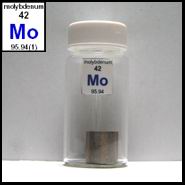
42MoMolybdenum95.9422
8 18 13 1 |
|
| Basic properties | |
|---|---|
| Atomic number | 42 |
| Atomic weight | 95.942 amu |
| Element family | Transition metals |
| Period | 5 |
| Group | 1 |
| Block | s-block |
| Discovery year | 1778 |
| Isotope distribution |
|---|
92Mo 14.84% 94Mo 9.25% 95Mo 15.92% 96Mo 16.68% 97Mo 9.55% 98Mo 24.13% |
92Mo (16.42%) 94Mo (10.24%) 95Mo (17.62%) 96Mo (18.46%) 97Mo (10.57%) 98Mo (26.70%) |
| Physical properties | |
|---|---|
| Density | 10.22 g/cm3 (STP) |
Atomic hydrogen (H) 8.988E-5 Meitnerium (Mt) 28 | |
| Melting | 2617 °C |
Helium (He) -272.2 Carbon (C) 3675 | |
| Boiling | 5560 °C |
Helium (He) -268.9 Tungsten (W) 5927 | |
| Chemical properties | |
|---|---|
| Oxidation states (less common) | +4, +6 (-4, -2, -1, 0, +1, +2, +3, +5) |
| First ionization potential | 7.092 eV |
Cesium (Cs) 3.894 Helium (He) 24.587 | |
| Electron affinity | 0.747 eV |
Nobelium (No) -2.33 Atomic chlorine (Cl) 3.612725 | |
| Electronegativity | 2.16 |
Cesium (Cs) 0.79 Atomic fluorine (F) 3.98 | |
| Atomic radius | |
|---|---|
| Covalent radius | 1.38 Å |
Atomic hydrogen (H) 0.32 Francium (Fr) 2.6 | |
| Metallic radius | 1.39 Å |
Beryllium (Be) 1.12 Cesium (Cs) 2.65 | |
| Compounds | ||
|---|---|---|
| Formula | Name | Oxidation state |
| MoBr2 | Molybdenum(II) bromide | +2 |
| MoBr3 | Molybdenum(III) bromide | +3 |
| MoCl3 | Molybdenum(III) chloride | +3 |
| MoI3 | Molybdenum(III) iodide | +3 |
| MoS2 | Molybdenum disulfide | +4 |
| MoBr4 | Molybdenum(IV) bromide | +4 |
| MoF4 | Molybdenum(IV) fluoride | +4 |
| MoCl5 | Molybdenum(V) chloride | +5 |
| MoF5 | Molybdenum(V) fluoride | +5 |
| MoO3 | Molybdenum trioxide | +6 |
| Na2MoO4 | Sodium molybdate | +6 |
| (NH4)6Mo7O24 | Ammonium heptamolybdate | +6 |
| Electronic properties | |
|---|---|
| Electrons per shell | 2, 8, 18, 13, 1 |
| Electronic configuration | [Kr] 4d5 |
|
Bohr atom model

| |
|
Orbital box diagram

| |
| Valence electrons | 6 |
| Lewis dot structure |
|
| Orbital Visualization | |
|---|---|
|
| |
| Electrons | - |
Molybdenum (Mo): Periodic Table Element
Abstract
Molybdenum (symbol Mo, atomic number 42) represents a transition metal of exceptional industrial significance within the sixth period of the periodic table. This silvery-grey metal exhibits the sixth-highest melting point of naturally occurring elements at 2623°C and demonstrates remarkable thermal stability with one of the lowest thermal expansion coefficients among commercial metals. Molybdenum manifests diverse oxidation states ranging from −4 to +6, with +4 and +6 being most prevalent in terrestrial compounds. The element occurs primarily as molybdenite (MoS2) and finds extensive application in high-strength steel alloys, comprising approximately 80% of global production. Beyond metallurgical applications, molybdenum functions as an essential cofactor in numerous biological enzyme systems, particularly in nitrogen fixation processes catalyzed by nitrogenase.
Introduction
Molybdenum occupies a unique position within the second transition series, positioned between niobium and technetium in the periodic table. The element derives its name from the Ancient Greek μόλυβδος (molybdos), meaning lead, reflecting the historical confusion between molybdenite and galena ores. Carl Wilhelm Scheele definitively characterized molybdenum in 1778, while Peter Jacob Hjelm successfully isolated the metallic element in 1781 through reduction with carbon and linseed oil.
The electronic configuration [Kr]4d55s1 places molybdenum within the chromium group, exhibiting similar chemical versatility in oxidation state accessibility. This electron arrangement contributes to its exceptional bonding capabilities, including the formation of metal-metal multiple bonds and stable cluster compounds. Industrial significance emerged during the twentieth century, particularly following metallurgical advances that enabled large-scale processing of molybdenite ores.
Physical Properties and Atomic Structure
Fundamental Atomic Parameters
Molybdenum exhibits atomic number 42 with a standard atomic weight of 95.95 ± 0.01 g/mol. The electronic configuration [Kr]4d55s1 reflects the characteristic d5s1 pattern observed throughout the chromium family. This configuration results in a first ionization energy of 684.3 kJ/mol, considerably lower than chromium (652.9 kJ/mol) due to increased atomic radius and enhanced electron shielding effects.
The atomic radius measures 139 pm in metallic coordination, while ionic radii vary significantly with oxidation state and coordination environment. The Mo6+ ion exhibits a radius of 59 pm in octahedral coordination, whereas Mo4+ measures 65 pm under similar conditions. Effective nuclear charge calculations indicate substantial screening of outer electrons by the filled 4p subshell, contributing to the relatively moderate ionization energies despite the high nuclear charge.
Macroscopic Physical Characteristics
Molybdenum crystallizes in a body-centered cubic structure with lattice parameter a = 314.7 pm at room temperature. The metal exhibits exceptional thermal stability with a melting point of 2623°C, ranking sixth among naturally occurring elements after carbon, tungsten, rhenium, osmium, and tantalum. The boiling point reaches approximately 4639°C under standard atmospheric pressure.
Density measurements yield 10.22 g/cm3 at 20°C, reflecting the compact metallic structure and high atomic mass. The coefficient of linear thermal expansion measures 4.8 × 10⁻⁶ K−1 between 0°C and 100°C, representing one of the lowest values among commercial metals. This property proves crucial for high-temperature applications where dimensional stability remains paramount. Specific heat capacity equals 0.251 J/g·K at 25°C, while thermal conductivity reaches 142 W/m·K at room temperature.
Chemical Properties and Reactivity
Electronic Structure and Bonding Behavior
The d5s1 electronic configuration enables molybdenum to exhibit oxidation states from −4 to +6, with remarkable stability observed for intermediate oxidation states +4 and +6. The partially filled d-orbital system facilitates extensive π-bonding interactions with appropriate ligands, particularly those containing oxygen, sulfur, and nitrogen donor atoms.
Gaseous molybdenum exists predominantly as the diatomic species Mo2, characterized by an extraordinarily strong sextuple bond. This bonding arrangement involves one σ bond, two π bonds, and two δ bonds, plus an additional electron pair in a bonding orbital, resulting in a bond order of six. The Mo-Mo bond length measures 194 pm with a dissociation energy exceeding 400 kJ/mol.
In solid compounds, molybdenum readily forms metal cluster compounds, particularly in intermediate oxidation states. The Mo6 octahedral clusters represent archetypal examples, stabilized by extensive metal-metal bonding within the cluster core. These clusters exhibit remarkable kinetic stability and serve as building blocks for extended solid-state structures.
Electrochemical and Thermodynamic Properties
Electronegativity values on the Pauling scale register 2.16, positioning molybdenum between chromium (1.66) and tungsten (2.36). This moderate electronegativity reflects the balanced character between metallic and non-metallic properties typical of second-row transition elements.
Successive ionization energies demonstrate the increasing difficulty of electron removal from progressively higher oxidation states. The first through fourth ionization energies measure 684.3, 1560, 2618, and 4480 kJ/mol, respectively. The substantial increase between the fourth and fifth ionization energies (7230 kJ/mol) reflects penetration into the more tightly bound 4d manifold.
Standard reduction potentials vary considerably with solution conditions and ligand environment. The Mo6+/Mo3+ couple exhibits E° = +0.43 V in acidic solution, while the MoO42−/Mo couple registers E° = −0.913 V under standard alkaline conditions. These values indicate moderate oxidizing character for higher oxidation states and strong reducing properties for the metallic element.
Chemical Compounds and Complex Formation
Binary and Ternary Compounds
Molybdenum trioxide (MoO3) represents the most thermodynamically stable binary oxide, featuring a layered structure with distorted octahedral MoO6 coordination. This pale yellow solid sublimes at 795°C and serves as the primary precursor for virtually all molybdenum compounds. The compound exhibits weak acidic properties, dissolving in strong alkaline solutions to form molybdate anions.
Molybdenum disulfide (MoS2) constitutes the principal naturally occurring mineral, adopting a hexagonal layered structure analogous to graphite. The weak van der Waals interactions between sulfide layers confer exceptional lubricating properties, making MoS2 valuable for high-temperature and high-pressure applications where organic lubricants decompose.
Halide compounds span the complete range of accessible oxidation states, from MoCl2 through MoF6. Molybdenum hexafluoride represents the highest binary halide, exhibiting extreme reactivity toward moisture and organic compounds. The hexachloride MoCl6 proves unstable at room temperature, spontaneously decomposing to MoCl5 and chlorine gas.
Coordination Chemistry and Organometallic Compounds
Molybdenum demonstrates remarkable versatility in coordination chemistry, forming stable complexes across multiple oxidation states with diverse ligand sets. Octahedral coordination predominates for Mo(VI) and Mo(IV), while lower oxidation states frequently adopt distorted geometries reflecting metal-metal bonding interactions.
The hexacarbonyl Mo(CO)6 exemplifies zero-valent molybdenum chemistry, featuring octahedral geometry with strong π-backbonding between metal d-orbitals and CO π* orbitals. This compound serves as a versatile precursor for numerous organomolybdenum derivatives through ligand substitution reactions.
Polyoxomolybdate chemistry encompasses an extensive family of discrete and polymeric anions formed through condensation of molybdate units. The Keggin structure P[Mo12O40]3− represents a archetypal heteropolyanion, incorporating a central phosphate tetrahedron surrounded by twelve edge-sharing MoO6 octahedra. These compounds find application in catalysis and analytical chemistry.
Natural Occurrence and Isotopic Analysis
Geochemical Distribution and Abundance
Molybdenum ranks as the 54th most abundant element in Earth's crust with an average concentration of 1.5 ppm by weight. This abundance places molybdenum among the moderately rare elements, significantly less common than iron (56,300 ppm) or chromium (122 ppm) but more abundant than silver (0.075 ppm) or gold (0.004 ppm).
Geochemical behavior reflects the lithophile character of molybdenum in oxidizing environments, where Mo(VI) species predominate. Under reducing conditions typical of certain sedimentary environments, molybdenum concentrates in sulfide minerals through precipitation as MoS2. Seawater contains approximately 10 ppb molybdenum, primarily as the molybdate anion MoO42−.
Primary molybdenum deposits occur in porphyry systems associated with granitic intrusions, where hydrothermal fluids transport molybdenum as various complexes. Secondary concentration mechanisms include weathering and transport processes that can lead to molybdenum enrichment in specific geological formations.
Nuclear Properties and Isotopic Composition
Seven naturally occurring isotopes comprise the molybdenum isotopic distribution: 92Mo (14.84%), 94Mo (9.25%), 95Mo (15.92%), 96Mo (16.68%), 97Mo (9.55%), 98Mo (24.13%), and 100Mo (9.63%). The most abundant isotope 98Mo exhibits complete nuclear stability, while 100Mo undergoes double beta decay with an extraordinarily long half-life of approximately 1019 years.
Synthetic radioisotopes range from 81Mo to 119Mo, with 93Mo representing the most stable artificial isotope (t1/2 = 4,839 years). Medical applications exploit 99Mo (t1/2 = 66.0 hours), produced through neutron activation or fission processes, which decays to technetium-99m for diagnostic imaging procedures.
Nuclear cross-sections vary significantly among isotopes, with 98Mo exhibiting a thermal neutron absorption cross-section of 0.13 barns. These nuclear properties influence reactor applications and isotope production strategies for both research and medical purposes.
Industrial Production and Technological Applications
Extraction and Purification Methodologies
Primary molybdenum production commences with flotation concentration of molybdenite (MoS2) ores, utilizing the natural hydrophobic properties of the mineral. Froth flotation achieves concentration factors exceeding 1000:1, producing concentrates containing 85-92% MoS2.
Roasting of molybdenite concentrates in air at 700°C converts the sulfide to molybdenum trioxide according to the reaction: 2MoS2 + 7O2 → 2MoO3 + 4SO2. Sulfur dioxide recovery for sulfuric acid production represents an important economic consideration in large-scale operations.
Subsequent processing involves ammonia leaching to form soluble ammonium molybdate [(NH4)2MoO4], followed by precipitation as ammonium dimolybdate. Thermal decomposition of this intermediate at 500°C yields high-purity molybdenum trioxide. Metal production proceeds through hydrogen reduction at 1000°C, producing molybdenum powder with purity exceeding 99.95%.
Technological Applications and Future Prospects
Steel industry applications consume approximately 80% of global molybdenum production, where the element functions as a potent strengthening agent in alloy steels. Molybdenum additions of 0.15-0.30% significantly enhance hardenability, creep resistance, and corrosion resistance in stainless steels. High-speed tool steels typically contain 5-10% molybdenum for retention of hardness at elevated temperatures.
Superalloy applications exploit molybdenum's exceptional high-temperature strength and oxidation resistance. Nickel-based superalloys for gas turbine components incorporate 3-6% molybdenum to maintain mechanical properties above 1000°C. Molybdenum-rhenium alloys demonstrate superior ductility for space applications requiring extreme temperature cycling.
Emerging technologies include molybdenum disulfide lubricants for aerospace applications, molybdenum targets for sputtering processes in semiconductor manufacturing, and molybdenum electrodes for glass melting operations. Advanced nuclear reactor designs propose molybdenum-technetium alloys for structural components due to excellent radiation resistance properties.
Historical Development and Discovery
Historical recognition of molybdenite preceded chemical understanding by several millennia, with ancient civilizations utilizing the mineral as a writing material similar to graphite. Systematic chemical investigation began in 1754 when Bengt Andersson Qvist demonstrated that molybdenite did not contain lead, contrary to prevailing assumptions based on its similarity to galena.
Carl Wilhelm Scheele's definitive characterization in 1778 established molybdenite as the ore of a previously unknown element, which he proposed naming molybdenum. Peter Jacob Hjelm achieved first metallic isolation in 1781 through carbon reduction of molybdic acid, though the resulting product contained significant impurities due to primitive purification techniques.
Industrial development remained limited until the twentieth century due to processing difficulties and unclear applications. William D. Coolidge's 1906 patent for rendering molybdenum ductile enabled practical applications in high-temperature environments. Frank E. Elmore's 1913 development of froth flotation processing established the foundation for modern molybdenum extraction methods.
World War I strategic requirements accelerated molybdenum development for armor steel applications, while World War II demand consolidated molybdenum's position as a critical strategic material. Post-war expansion into civilian applications, particularly in stainless steel production and chemical processing, established the modern molybdenum industry.
Conclusion
Molybdenum demonstrates exceptional versatility as both a structural metal and a chemical element, bridging fundamental chemistry and advanced technological applications. Its unique electronic structure enables diverse oxidation state chemistry while maintaining thermal and mechanical stability under extreme conditions. The element's dual role in industrial metallurgy and biological enzyme systems underscores its fundamental importance across multiple disciplines.
Future research directions encompass advanced alloy development for next-generation aerospace applications, exploration of molybdenum-based catalysts for sustainable chemical processes, and investigation of biological molybdenum chemistry for potential therapeutic applications. The continued expansion of high-temperature technologies and renewable energy systems ensures molybdenum's ongoing significance in materials science and chemical engineering.

Please let us know how we can improve this web app.
