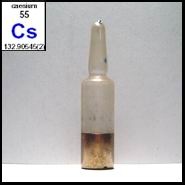
| Element | |
|---|---|
55CsCesium132.905451922
8 18 18 8 1 |
|
| Basic properties | |
|---|---|
| Atomic number | 55 |
| Atomic weight | 132.90545192 amu |
| Element family | Alkali metals |
| Period | 6 |
| Group | 1 |
| Block | s-block |
| Discovery year | 1860 |
| Isotope distribution |
|---|
133Cs 100% |
| Physical properties | |
|---|---|
| Density | 1.873 g/cm3 (STP) |
Atomic hydrogen (H) 8.988E-5 Meitnerium (Mt) 28 | |
| Melting | 28.55 °C |
Helium (He) -272.2 Carbon (C) 3675 | |
| Boiling | 690 °C |
Helium (He) -268.9 Tungsten (W) 5927 | |
| Chemical properties | |
|---|---|
| Oxidation states (less common) | +1 (-1) |
| First ionization potential | 3.894 eV |
Cesium (Cs) 3.894 Helium (He) 24.587 | |
| Electron affinity | 0.472 eV |
Nobelium (No) -2.33 Atomic chlorine (Cl) 3.612725 | |
| Electronegativity | 0.79 |
Cesium (Cs) 0.79 Atomic fluorine (F) 3.98 | |
| Atomic radius | |
|---|---|
| Covalent radius | 2.32 Å |
Atomic hydrogen (H) 0.32 Francium (Fr) 2.6 | |
| Van der Waals radius | 3.43 Å |
Atomic hydrogen (H) 1.2 Francium (Fr) 3.48 | |
| Metallic radius | 2.65 Å |
Beryllium (Be) 1.12 Cesium (Cs) 2.65 | |
| Compounds | ||
|---|---|---|
| Formula | Name | Oxidation state |
| CsCl | Caesium chloride | +1 |
| CsI | Caesium iodide | +1 |
| CsOH | Caesium hydroxide | +1 |
| CsBr | Caesium bromide | +1 |
| Cs2SO4 | Caesium sulfate | +1 |
| CsF | Caesium fluoride | +1 |
| CsNO3 | Caesium nitrate | +1 |
| Cs2CO3 | Caesium carbonate | +1 |
| CsHCO3 | Caesium bicarbonate | +1 |
| C18H35CsO2 | Caesium stearate | +1 |
| Cs2AgBiBr6 | Dicaesium silver hexabromobismuthate | +1 |
| Cs2C2O4 | Cesium oxalate | +1 |
| Electronic properties | |
|---|---|
| Electrons per shell | 2, 8, 18, 18, 8, 1 |
| Electronic configuration | [Xe] 6s1 |
|
Bohr atom model
| |
|
Orbital box diagram
| |
| Valence electrons | 1 |
| Lewis dot structure |
|
| Orbital Visualization | |
|---|---|
|
| |
| Electrons | - |
Caesium (Cs): Periodic Table Element
Abstract
Caesium represents the heaviest stable alkali metal with atomic number 55, exhibiting remarkable chemical and physical properties that distinguish it within Group 1 of the periodic table. The element demonstrates the lowest electronegativity value among all stable elements at 0.79 on the Pauling scale and possesses the largest atomic radius at approximately 260 picometers. Caesium melts at 28.5°C and boils at 641°C, making it one of five elemental metals that remain liquid near room temperature. The single stable isotope Cs-133 serves as the fundamental basis for atomic time measurement, while radioactive Cs-137 finds extensive application in industrial and medical contexts. Industrial applications center primarily on caesium formate drilling fluids, atomic clock technology, and specialized chemical processes requiring its unique electrochemical properties.
Introduction
Caesium occupies position 55 in the periodic table, representing the culmination of alkali metal trends within Group 1. Its electron configuration [Xe] 6s¹ places the single valence electron in the sixth energy level, resulting in the most pronounced metallic character among stable elements. The element demonstrates classical alkali metal behavior while exhibiting extreme values for atomic radius, ionization energy, and electronegativity that reflect the substantial atomic size and nuclear shielding effects.
Discovery occurred in 1860 through the pioneering spectroscopic work of Robert Bunsen and Gustav Kirchhoff, who identified characteristic blue-violet emission lines in mineral water residues. The name derives from the Latin "caesius," meaning blue-grey, reflecting the distinctive spectral lines that enabled its identification. Modern applications exploit caesium's unique position as the most electropositive element, with technological implementations ranging from precision timekeeping to specialized drilling operations in the petroleum industry.
Physical Properties and Atomic Structure
Fundamental Atomic Parameters
Caesium exhibits atomic number 55 with an electron configuration of [Xe] 6s¹, placing the single valence electron in the sixth principal energy level. The atomic mass measures 132.90545196 ± 0.00000006 u, representing the sole stable isotope Cs-133. Nuclear spin quantum number I = 7/2 enables nuclear magnetic resonance applications despite the large nuclear quadrupole moment.
The atomic radius reaches approximately 260 picometers, establishing caesium as the largest naturally occurring element by atomic size. Ionic radius for Cs⁺ measures 174 picometers, significantly exceeding other alkali metal cations and influencing coordination chemistry and crystal structure preferences. Effective nuclear charge experienced by the valence electron remains minimal due to extensive screening by inner electron shells, resulting in the lowest first ionization energy among stable elements at 3.89 eV.
Macroscopic Physical Characteristics
Caesium appears as a soft, silvery-golden metal with distinctive pale gold coloration arising from plasmonic frequency effects. The metal exhibits extreme softness with Mohs hardness of 0.2, surpassing all other room-temperature solids in malleability. Density measures 1.93 g/cm³ at standard conditions, reflecting the large atomic volume despite substantial atomic mass.
Melting point occurs at 28.5°C (301.6 K), positioning caesium among only five elemental metals that achieve liquid state near ambient temperature. Boiling point reaches 641°C (914 K), representing the lowest value among stable metals except mercury. Heat of fusion measures 2.09 kJ/mol, while heat of vaporization reaches 63.9 kJ/mol. Specific heat capacity at constant pressure equals 0.242 J/(g·K), consistent with classical equipartition expectations for monatomic metals.
Crystal structure adopts body-centered cubic (bcc) arrangement with lattice parameter a = 6.13 Å at room temperature. The structure remains stable across the solid temperature range, with thermal expansion coefficient of 97 × 10⁻⁶ K⁻¹ reflecting weak metallic bonding. Electrical conductivity measures 4.8 × 10⁶ S/m, while thermal conductivity reaches 35.9 W/(m·K), both values reflecting the high mobility of the single valence electron.
Chemical Properties and Reactivity
Electronic Structure and Bonding Behavior
The [Xe] 6s¹ electronic configuration dictates caesium's chemical behavior through the readily ionizable nature of the single valence electron. Effective nuclear charge experienced by the 6s electron equals approximately 2.2, substantially reduced from the nuclear charge of +55 due to screening by inner electron shells. This electronic environment promotes facile electron loss, establishing Cs⁺ as the predominant oxidation state under normal conditions.
Chemical bonding in caesium compounds exhibits predominantly ionic character due to the large electronegativity difference between caesium and most other elements. Metallic bonding within pure caesium metal demonstrates weakness consistent with the large atomic radius and diffuse valence electron cloud. The element cannot form multiple bonds or complex coordination geometries characteristic of transition metals, restricting chemistry to simple ionic compounds and alloys.
Under extreme pressure conditions exceeding 30 GPa, theoretical calculations suggest potential involvement of 5p electrons in chemical bonding, enabling oxidation states from +2 to +6 in fluoride compounds. These predictions require experimental validation but indicate possible expansion of caesium chemistry under non-ambient conditions.
Electrochemical and Thermodynamic Properties
Caesium demonstrates the lowest electronegativity value among all stable elements at 0.79 on the Pauling scale, reflecting the minimal attraction for electron density in chemical bonds. Alternative electronegativity scales yield consistent rankings, with Mulliken electronegativity reaching 0.86 eV. This extreme electropositivity drives spontaneous electron transfer to virtually all other elements except the heaviest alkali metals.
First ionization energy measures 3.89 eV (375.7 kJ/mol), representing the lowest value among stable elements and facilitating ready formation of Cs⁺ cations. Second ionization energy increases dramatically to 23.15 eV due to removal of electrons from the stable xenon core configuration. Electron affinity equals 0.472 eV, indicating moderate stability of the Cs⁻ anion under specialized conditions.
Standard reduction potential for the Cs⁺/Cs couple measures -2.92 V versus the standard hydrogen electrode, establishing caesium as the most powerful reducing agent among stable elements. This extreme reducing power drives explosive reactions with water, acids, and numerous organic compounds, necessitating storage under inert atmospheres or hydrocarbon media.
Chemical Compounds and Complex Formation
Binary and Ternary Compounds
Caesium forms extensive series of binary compounds reflecting its highly electropositive character. Caesium oxide Cs₂O crystallizes in the anti-fluorite structure as yellow-orange hexagonal crystals, decomposing above 400°C to yield metal and peroxide. The superoxide CsO₂ represents the primary combustion product in air, demonstrating enhanced stability relative to lighter alkali metal superoxides due to favorable lattice energy relationships.
Multiple suboxides exhibit unusual compositions including Cs₇O, Cs₄O, Cs₁₁O₃, and Cs₃O, featuring caesium in sub-normal oxidation states and displaying distinctive coloration from dark green to bronze. These compounds demonstrate metal cluster behavior with caesium-caesium bonding supplementing conventional ionic interactions.
Halide compounds adopt structures reflecting the large caesium cation size. Caesium fluoride CsF crystallizes in the sodium chloride structure due to optimal packing considerations, while CsCl, CsBr, and CsI adopt the distinctive caesium chloride structure featuring eight-coordinate caesium cations. This cubic structure maximizes coordination number while accommodating the size mismatch between large cations and smaller anions.
Ternary compounds include caesium formate CsHCO₂, which achieves high density (2.3 g/cm³) in concentrated aqueous solutions, enabling specialized drilling fluid applications. Double salts such as caesium alum CsAl(SO₄)₂·12H₂O demonstrate reduced solubility compared to simple caesium salts, facilitating purification procedures.
Coordination Chemistry and Organometallic Compounds
Caesium cation coordination chemistry reflects the large ionic radius and low charge density, favoring high coordination numbers exceeding the typical values for smaller alkali metals. Crown ether complexes demonstrate enhanced stability relative to lighter alkali metals due to improved size matching between caesium and larger crown ether cavities. 18-crown-6 and larger crown ethers exhibit particularly strong binding affinity for Cs⁺.
Cryptand complexes achieve exceptional stability constants, with [2.2.2]cryptand forming extremely stable Cs⁺ inclusion complexes utilized in separation technologies. These hosts exploit the unique size requirements of caesium cation, enabling selective extraction from mixtures containing other alkali metals.
Organometallic chemistry remains limited due to the ionic character of caesium bonding. However, caesium auride CsAu and caesium platinide Cs₂Pt represent unusual intermetallic compounds where gold and platinum function as pseudohalogens, forming anions that balance caesium cations. These compounds demonstrate reactivity with water and ammonia, producing hydrogen gas and metallic precipitates.
Natural Occurrence and Isotopic Analysis
Geochemical Distribution and Abundance
Caesium represents a relatively rare element with crustal abundance averaging 3 parts per million, ranking as the 45th most abundant element and 36th among metals. Geochemical behavior classifies caesium as an incompatible element due to the large ionic radius, which prevents substitution into common rock-forming minerals during crystallization processes. This incompatibility leads to concentration in late-stage magmatic processes and preferential enrichment in pegmatite deposits.
Primary caesium mineralization occurs in lithium-bearing pegmatites associated with granite intrusions. Pollucite Cs(AlSi₂O₆) serves as the principal economic mineral, featuring caesium contents ranging from 20-34% by weight. The mineral forms through hydrothermal alteration of earlier caesium-bearing phases during pegmatite cooling.
Secondary occurrence includes trace quantities in common alkali minerals. Sylvite KCl and carnallite KMgCl₃·6H₂O typically contain 0.002% caesium due to limited ionic substitution. Beryl Be₃Al₂(SiO₃)₆ may incorporate several percent caesium oxide, while specialized minerals including pezzottaite and londonite achieve caesium oxide contents exceeding 8% by weight.
Nuclear Properties and Isotopic Composition
Natural caesium consists entirely of the stable isotope Cs-133 with mass number 133 and nuclear composition of 55 protons and 78 neutrons. Nuclear spin I = 7/2 results from unpaired nuclear particles, enabling nuclear magnetic resonance applications despite quadrupole interactions arising from non-spherical nuclear charge distribution.
Artificial isotopes span mass numbers from 112 to 152, encompassing 41 known nuclides with varying stability. Cs-137 exhibits particular significance due to its 30-year half-life and gamma emission characteristics, making it valuable for industrial radiography and medical applications. Beta decay produces Ba-137m, which subsequently emits 662 keV gamma radiation during transition to stable Ba-137.
Cs-135 demonstrates exceptional longevity with a half-life of 2.3 million years, representing the longest-lived caesium radioisotope. This isotope originates from nuclear fission processes but exhibits limited accumulation in reactor environments due to neutron absorption by the precursor Xe-135. Cs-134 maintains a two-year half-life, finding applications in industrial gauging and medical procedures.
Nuclear cross-sections for neutron absorption remain low for most caesium isotopes, complicating transmutation-based disposal strategies for radioactive waste. Thermal neutron capture cross-section for Cs-133 measures 29 barns, while Cs-137 exhibits 0.11 barns, necessitating passive decay management for nuclear waste applications.
Industrial Production and Technological Applications
Extraction and Purification Methodologies
Industrial caesium production centers on pollucite ore processing through three primary methodologies: acid digestion, alkaline decomposition, and direct reduction. Acid digestion employs hydrofluoric and sulfuric acids to decompose the aluminosilicate matrix, liberating caesium as soluble sulfate. Alkaline decomposition utilizes calcium carbonate fusion at 1000°C, followed by water leaching to extract caesium carbonate.
Direct reduction involves calcium metal reduction of caesium chloride at elevated temperatures under vacuum conditions. This method yields metallic caesium directly but requires careful handling due to the pyrophoric nature of the product. Vacuum distillation enables final purification, exploiting the relatively low boiling point compared to most metallic impurities.
Separation from other alkali metals employs the distinctive properties of caesium compounds. Fractional crystallization of caesium aluminum sulfate exploits reduced solubility compared to corresponding potassium and rubidium salts. Ion exchange resins demonstrate selectivity for caesium cations, particularly with crown ether-modified materials that exploit size-selective binding.
Global production averages 5-10 metric tons annually, with the Tanco Mine in Manitoba, Canada, providing approximately two-thirds of world supply. Economic reserves exceed 300,000 metric tons of contained caesium, ensuring supply security for centuries at current consumption rates. Processing costs remain substantial due to the specialized nature of applications and limited market size.
Technological Applications and Future Prospects
Atomic clock technology represents the most scientifically significant application, utilizing the hyperfine transition of Cs-133 atoms to define the fundamental unit of time. The transition frequency of 9,192,631,770 Hz establishes the international definition of the second since 1967. Caesium fountain clocks achieve accuracy exceeding one part in 10¹⁵, enabling global positioning systems, telecommunications synchronization, and fundamental physics research.
Drilling fluid applications dominate commercial caesium consumption, with caesium formate solutions achieving densities up to 2.3 g/cm³ for high-pressure, high-temperature drilling operations. The benign environmental profile and recycling capability offset the substantial cost, estimated at $4,000 per barrel for concentrated solutions. These fluids enable access to previously uneconomical hydrocarbon reserves in challenging geological formations.
Photoelectric applications exploit the low work function of caesium metal, approximately 2.1 eV, facilitating electron emission under visible light illumination. Caesium-antimony and caesium-oxygen-silver photocathodes achieve quantum efficiencies exceeding 20% for specific wavelength ranges, enabling night vision devices, image intensifiers, and specialized photodetectors.
Catalytic applications utilize caesium compounds as promoters in industrial processes. Caesium carbonate demonstrates exceptional basicity in organic synthesis, enabling reactions impossible with conventional bases. Ion propulsion systems employ caesium as propellant due to the large atomic mass and ready ionization, achieving specific impulse values suitable for satellite station-keeping and deep space missions.
Emerging applications include quantum computing research, where caesium atoms serve as qubits in neutral atom quantum computers. Magneto-optical trapping techniques enable precise manipulation of individual caesium atoms, facilitating quantum gate operations and coherent quantum state evolution. Medical applications of Cs-137 encompass cancer therapy through brachytherapy and external beam radiation, while industrial applications include pipeline inspection and materials testing.
Historical Development and Discovery
Caesium discovery occurred in 1860 through the collaborative efforts of Robert Bunsen and Gustav Kirchhoff at the University of Heidelberg, representing one of the first elements identified through spectroscopic methods. The researchers analyzed mineral water residues from Dürkheim springs using newly developed flame spectroscopy techniques, observing distinctive blue-violet emission lines at wavelengths previously unrecorded for known elements.
The spectroscopic approach represented a revolutionary departure from classical analytical chemistry, enabling detection of elements present in minute quantities below the threshold of conventional chemical tests. Initial isolation attempts proved challenging due to the chemical similarity to other alkali metals and the limited quantity available from natural sources. Bunsen succeeded in isolating measurable quantities of caesium chloride through fractional crystallization of spring water concentrates.
Early applications remained limited to scientific curiosity until the development of vacuum tube technology in the early 20th century. Caesium metal found use as a getter material for removing trace gases from electron tubes, while the photoelectric properties enabled development of photomultiplier tubes and television camera systems. World War II accelerated research into caesium applications, particularly for night vision equipment and radar systems.
The atomic age brought recognition of caesium's unique nuclear properties, with Cs-137 emerging as a significant fission product requiring management in nuclear waste streams. Simultaneously, the precise atomic transition frequencies of Cs-133 attracted attention for timekeeping applications, culminating in the redefinition of the second in 1967.
Modern caesium chemistry evolved through understanding of size effects in alkali metal chemistry and recognition of the unique position of caesium as the most electropositive element. Research into high-pressure chemistry suggests potential expansion of caesium oxidation states beyond the traditional +1 value, opening new frontiers in caesium chemistry and materials science.
Conclusion
Caesium occupies a distinctive position in the periodic table as the heaviest stable alkali metal, exhibiting extreme values for fundamental properties including atomic radius, electronegativity, and ionization energy. The unique electronic structure with a single 6s valence electron creates chemical behavior dominated by ionic bonding and ready electron loss, establishing Cs⁺ as the predominant species under normal conditions.
Industrial significance stems from specialized applications exploiting caesium's unique properties rather than large-volume commodity uses. Atomic clock technology depends on the precise nuclear transitions of Cs-133, while drilling fluid applications utilize the high density achievable with caesium formate solutions. Future developments may expand these applications while exploring potential new chemistry under extreme conditions.
The combination of fundamental scientific importance and specialized technological applications ensures continued research interest in caesium chemistry and physics. Understanding of size effects, electrochemical behavior, and nuclear properties provides insight into broader trends in alkali metal chemistry while supporting development of advanced technologies requiring precise control of atomic and molecular properties.

Please let us know how we can improve this web app.