| Element | |
|---|---|
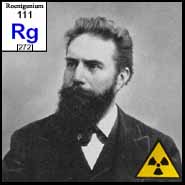
111RgRoentgenium2822
8 18 32 32 17 2 |
|
| Basic properties | |
|---|---|
| Atomic number | 111 |
| Atomic weight | 282 amu |
| Element family | Transition metals |
| Period | 7 |
| Group | 2 |
| Block | s-block |
| Discovery year | 1994 |
| Isotope distribution |
|---|
| None |
| Physical properties | |
|---|---|
| Density | 23 g/cm3 (STP) |
Atomic hydrogen (H) 8.988E-5 Meitnerium (Mt) 28 | |
| Chemical properties | |
|---|---|
| Oxidation states (less common) | (-1, +3, +5) |
| Atomic radius | |
|---|---|
| Covalent radius | 1.21 Å |
Atomic hydrogen (H) 0.32 Francium (Fr) 2.6 | |
| Electronic properties | |
|---|---|
| Electrons per shell | 2, 8, 18, 32, 32, 17, 2 |
| Electronic configuration | [Rn] 5f14 |
|
Bohr atom model

| |
|
Orbital box diagram

| |
| Valence electrons | 11 |
| Lewis dot structure |
|
| Orbital Visualization | |
|---|---|
|
| |
| Electrons | - |
Roentgenium (Rg): Periodic Table Element
Abstract
Roentgenium (symbol Rg, atomic number 111) represents the ninth member of the 6d transition metal series and serves as the heaviest known member of group 11 elements. This synthetic superheavy element exhibits extreme radioactivity with no stable isotopes, requiring laboratory synthesis through ion bombardment techniques. The most stable confirmed isotope, 282Rg, possesses a half-life of 130 seconds, while unconfirmed 286Rg may exhibit enhanced stability with a half-life approaching 10.7 minutes. Theoretical calculations predict roentgenium to manifest chemical properties analogous to its lighter homologues copper, silver, and gold, yet with distinct variations arising from pronounced relativistic effects. The element demonstrates anticipated noble metal characteristics with predicted stable oxidation states of +3 and +5, enhanced by relativistic destabilization of 6d orbitals that facilitates higher oxidation state formation.
Introduction
Roentgenium occupies position 111 in the periodic table as the terminal member of the known group 11 coinage metals, representing a significant milestone in superheavy element research. Named in honor of Wilhelm Conrad Röntgen, the discoverer of X-rays, this element exemplifies the challenges and achievements of modern nuclear chemistry. The element's electronic configuration [Rn] 5f14 6d10 7s1 positions it as the heaviest homologue of gold, with theoretical predictions suggesting both similarities and marked deviations from established group 11 chemistry. Synthesized exclusively through hot fusion reactions, roentgenium's extreme scarcity and brief half-lives present formidable obstacles to experimental characterization. Nevertheless, comprehensive theoretical investigations reveal fascinating insights into relativistic effects on chemical bonding and electronic structure at the far reaches of the periodic table.
Physical Properties and Atomic Structure
Fundamental Atomic Parameters
Roentgenium possesses an atomic number of 111, placing it in the seventh period of the periodic table with a predicted electron configuration of [Rn] 5f14 6d10 7s1. The element's atomic structure reflects significant relativistic effects, particularly affecting the 7s and 6d orbitals through spin-orbit coupling interactions. Theoretical calculations indicate an atomic radius of approximately 114 pm, comparable to gold's radius of 144 pm but subject to substantial relativistic contraction. The effective nuclear charge experienced by valence electrons reaches extreme values due to incomplete shielding by the filled 5f subshell, resulting in enhanced binding energies for outer electrons. First ionization energy calculations yield values near 1020 kJ/mol, approaching those of noble gas radon (1037 kJ/mol), while the second ionization energy approximates 2070 kJ/mol, similar to silver's corresponding value.
Macroscopic Physical Characteristics
Roentgenium exhibits predicted properties consistent with a dense, noble transition metal, with calculated density values ranging between 22-24 g/cm³, potentially exceeding osmium's density of 22.61 g/cm³. Unlike its lighter congeners which crystallize in face-centered cubic structures, roentgenium demonstrates theoretical preference for body-centered cubic crystal packing due to altered electron charge distribution patterns induced by relativistic effects. The element's metallic character emerges from delocalized bonding involving the 6d electrons, though the extent of d-orbital participation in bonding exceeds that observed in lighter group 11 metals. Melting and boiling points remain computationally elusive due to the brief lifetimes of available isotopes, though extrapolation from group trends suggests values potentially lower than gold's corresponding thermal properties. Specific heat capacity and thermal conductivity parameters require experimental determination, currently precluded by synthesis limitations.
Chemical Properties and Reactivity
Electronic Structure and Bonding Behavior
The chemical behavior of roentgenium reflects the profound influence of relativistic effects on its electronic structure, particularly the destabilization of 6d orbitals and stabilization of the 7s orbital. These quantum mechanical phenomena enable enhanced participation of 6d electrons in chemical bonding, facilitating the formation of higher oxidation states compared to lighter group 11 elements. Roentgenium exhibits predicted stable oxidation states of +3 and +5, with the trivalent state representing the most thermodynamically favored configuration. The +5 oxidation state demonstrates greater stability than the corresponding gold(V) compounds due to increased 6d orbital involvement in bonding. Conversely, the monovalent Rg(I) state appears thermodynamically unfavorable, contrasting with the prominence of Cu(I), Ag(I), and Au(I) chemistry. Covalent bonding in roentgenium compounds benefits from enhanced orbital overlap resulting from relativistic contraction, producing stronger metal-ligand interactions than predicted from classical scaling relationships.
Electrochemical and Thermodynamic Properties
Electrochemical calculations reveal roentgenium's enhanced noble character compared to gold, with the standard electrode potential for the Rg³⁺/Rg couple reaching 1.9 V versus 1.5 V for the Au³⁺/Au system. This elevated reduction potential reflects the element's resistance to oxidation and enhanced thermodynamic stability in metallic form. Electronegativity values on the Pauling scale approach those of gold while maintaining slightly elevated character due to increased effective nuclear charge. Successive ionization energies demonstrate the expected increase with progressive electron removal, though the magnitude of increase between first and second ionization energies (approximately 1050 kJ/mol) suggests significant orbital reorganization upon oxidation. Electron affinity calculations indicate values near 1.6 eV, notably lower than gold's 2.3 eV, suggesting reduced tendency toward anion formation. Standard reduction potentials for various roentgenium couples remain theoretically derived, with experimental verification awaiting advances in isotope production and stability.
Chemical Compounds and Complex Formation
Binary and Ternary Compounds
Theoretical investigations predict roentgenium's capacity to form a diverse array of binary compounds, particularly with highly electronegative elements such as fluorine and oxygen. The hexafluoride RgF₆²⁻ emerges as a particularly stable complex ion, demonstrating enhanced stability relative to the corresponding silver analogue due to increased 6d orbital participation in bonding. Rg₂F₁₀ represents a predicted stable binary fluoride, analogous to the known Au₂F₁₀ compound, with theoretical calculations suggesting resistance to decomposition under ambient conditions. Higher fluorides including RgF₇ may exist as true heptavalent compounds, contrasting with gold heptafluoride's structure as a difluorine complex. Oxide formation likely produces Rg₂O₃ as the most stable binary oxide, with higher oxides potentially accessible under oxidizing conditions. Sulfide and selenide compounds remain theoretically viable, though their formation may require elevated temperatures due to roentgenium's noble character.
Coordination Chemistry and Organometallic Compounds
Roentgenium's coordination chemistry reflects its electronic structure with preference for ligands capable of accepting electron density from filled 6d orbitals. Cyanide complexes, particularly [Rg(CN)₂]⁻, demonstrate theoretical stability comparable to the corresponding gold complexes used in metallurgical extraction processes. Aqueous coordination generates [Rg(H₂O)₂]⁺ species with calculated Rg-O bond distances of 207.1 pm, indicating substantial ionic character in metal-ligand interactions. Ammonia, phosphine, and hydrogen sulfide coordination provides additional complex formation pathways, with soft ligands exhibiting enhanced affinity for the Rg⁺ center according to hard-soft acid-base principles. The coordination number typically ranges from two to six, depending on ligand size and electronic requirements. π-acceptor ligands such as carbon monoxide and alkenes may form stable complexes through synergistic σ-donation and π-backbonding interactions, though experimental verification remains challenging due to isotope availability constraints.
Natural Occurrence and Isotopic Analysis
Geochemical Distribution and Abundance
Roentgenium exhibits no natural terrestrial occurrence due to the absence of stable isotopes and the extremely short half-lives of all known isotopic variants. The element's cosmic abundance remains negligible, as stellar nucleosynthesis processes cannot sustain the neutron flux densities required for superheavy element formation. Theoretical models of neutron star collision events suggest possible transient formation of superheavy nuclei, but rapid decay prevents accumulation in cosmic environments. Earth's crust contains no detectable roentgenium, with all known atoms produced exclusively through artificial synthesis in particle accelerator facilities. The element's geochemical behavior remains purely theoretical, though predictions based on group 11 chemistry suggest it would exhibit noble metal characteristics with preference for sulfide mineral associations if naturally occurring isotopes existed.
Nuclear Properties and Isotopic Composition
Nine distinct roentgenium isotopes have been synthesized with mass numbers spanning 272, 274, 278-283, and 286, though isotopes 283 and 286 remain unconfirmed. All roentgenium isotopes undergo radioactive decay through alpha emission or spontaneous fission, with half-lives ranging from milliseconds to minutes. The most stable confirmed isotope, ²⁸²Rg, exhibits a half-life of 130 seconds and decays primarily through alpha emission to dubnium-278. Unconfirmed ²⁸⁶Rg potentially demonstrates enhanced stability with a half-life of approximately 10.7 minutes, suggesting proximity to the predicted island of stability for superheavy nuclei. Nuclear binding energies increase with mass number up to ²⁸²Rg, indicating enhanced nuclear stability for neutron-rich isotopes. Decay chains typically proceed through a sequence of alpha emissions, eventually reaching known heavy elements in the actinide series. Magic number effects near neutron number 172 contribute to enhanced stability for the heaviest isotopes, supporting theoretical predictions of increased half-lives for superheavy nuclei in this mass region.
Industrial Production and Technological Applications
Extraction and Purification Methodologies
Roentgenium synthesis relies exclusively on hot fusion nuclear reactions conducted in heavy-ion accelerator facilities, specifically through bombardment of bismuth-209 targets with accelerated nickel-64 nuclei. The production reaction ²⁰⁹Bi + ⁶⁴Ni → ²⁷²Rg + n proceeds with extremely low cross-sections, typically yielding only a few atoms per experiment. Detection requires sophisticated recoil separation techniques coupled with alpha spectroscopy for isotope identification through characteristic decay signatures. The GSI SHIP (Separator for Heavy Ion reaction Products) represents the primary facility for roentgenium synthesis, utilizing magnetic and electric field separation to isolate product nuclei from the intense beam-induced background. Production rates remain extraordinarily low, with successful synthesis events occurring at frequencies of one atom per several days of continuous operation. No purification methods exist for macroscopic quantities, as only individual atoms have been produced and detected. Future production enhancement may emerge from improved accelerator technologies and optimized target configurations, though fundamental nuclear reaction limitations constrain achievable yields.
Technological Applications and Future Prospects
Current applications for roentgenium remain entirely confined to basic nuclear and atomic physics research, with no practical technological utilization due to extreme scarcity and brief isotopic lifetimes. The element serves primarily as a probe for testing theoretical models of superheavy element chemistry and nuclear structure at the limits of atomic stability. Future applications may emerge if longer-lived isotopes near the predicted island of stability become accessible through advanced synthesis techniques. Potential applications could include specialized catalytic processes if sufficient quantities become available, given roentgenium's predicted chemical properties and noble metal character. The element's extreme density might prove useful in specialized materials applications requiring maximum mass concentration. However, practical utilization remains highly speculative pending dramatic advances in production methods and isotope stability. Research applications continue expanding understanding of relativistic effects in chemical bonding and electronic structure, contributing fundamental knowledge applicable to related heavy element chemistry. Economic considerations preclude any commercial development given current production costs exceeding billions of dollars per atom.
Historical Development and Discovery
The discovery of roentgenium culminated from decades of superheavy element research initiated in the mid-20th century following theoretical predictions of enhanced nuclear stability beyond the actinide series. Initial synthesis attempts began at the Joint Institute for Nuclear Research in Dubna during 1986, utilizing ²⁰⁹Bi + ⁶⁴Ni reaction conditions, but failed to produce confirmed evidence of element 111 formation. The successful discovery occurred at the GSI Helmholtz Centre for Heavy Ion Research near Darmstadt, Germany, on December 8, 1994, when an international team led by Sigurd Hofmann detected three atoms of ²⁷²Rg through characteristic alpha decay signatures. The IUPAC/IUPAP Joint Working Party initially deemed the evidence insufficient in 2001, prompting repeat experiments in 2002 that confirmed the original results through detection of three additional atoms. Official recognition came in 2003, with IUPAC approving the name roentgenium in November 2004 to honor Wilhelm Conrad Röntgen's contributions to physics. The systematic element name unununium served as a placeholder designation until formal naming, though the scientific community typically employed "element 111" during the interim period. Subsequent investigations have expanded the known isotopic series and refined understanding of roentgenium's nuclear properties, establishing it as a cornerstone achievement in superheavy element synthesis.
Conclusion
Roentgenium represents a remarkable achievement in extending the periodic table beyond naturally occurring elements, demonstrating humanity's capability to create and characterize matter at the extremes of nuclear stability. The element's unique position as the heaviest group 11 member reveals the profound influence of relativistic effects on chemical behavior, providing crucial insights into electronic structure theory and bonding models. While practical applications remain absent due to synthetic limitations and isotopic instability, roentgenium's theoretical chemistry suggests fascinating possibilities for novel chemical processes and materials properties. Future research directions focus on synthesizing longer-lived isotopes potentially located near the predicted island of stability, which could enable experimental verification of theoretical predictions and unlock previously inaccessible chemical studies. The element's discovery exemplifies the intersection of advanced nuclear physics, sophisticated detection technologies, and international scientific collaboration required for modern superheavy element research. As accelerator technologies advance and theoretical models evolve, roentgenium will continue serving as a crucial benchmark for understanding the ultimate limits of atomic matter and the fundamental forces governing nuclear stability.

Please let us know how we can improve this web app.
