| Element | |
|---|---|
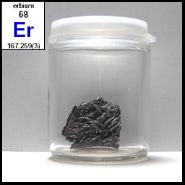
68ErErbium167.25932
8 18 30 8 2 |
|
| Basic properties | |
|---|---|
| Atomic number | 68 |
| Atomic weight | 167.2593 amu |
| Element family | N/A |
| Period | 6 |
| Group | 2 |
| Block | s-block |
| Discovery year | 1843 |
| Isotope distribution |
|---|
162Er 0.14% 164Er 1.61% 166Er 33.6% 167Er 22.95% 168Er 26.8% 170Er 14.9% |
164Er (1.61%) 166Er (33.60%) 167Er (22.95%) 168Er (26.80%) 170Er (14.90%) |
| Physical properties | |
|---|---|
| Density | 9.066 g/cm3 (STP) |
Atomic hydrogen (H) 8.988E-5 Meitnerium (Mt) 28 | |
| Melting | 1522 °C |
Helium (He) -272.2 Carbon (C) 3675 | |
| Boiling | 2510 °C |
Helium (He) -268.9 Tungsten (W) 5927 | |
| Chemical properties | |
|---|---|
| Oxidation states (less common) | +3 (0, +2) |
| First ionization potential | 6.108 eV |
Cesium (Cs) 3.894 Helium (He) 24.587 | |
| Electron affinity | 0.312 eV |
Nobelium (No) -2.33 Atomic chlorine (Cl) 3.612725 | |
| Electronegativity | 1.24 |
Cesium (Cs) 0.79 Atomic fluorine (F) 3.98 | |
| Atomic radius | |
|---|---|
| Covalent radius | 1.65 Å |
Atomic hydrogen (H) 0.32 Francium (Fr) 2.6 | |
| Metallic radius | 1.76 Å |
Beryllium (Be) 1.12 Cesium (Cs) 2.65 | |
| Compounds | ||
|---|---|---|
| Formula | Name | Oxidation state |
| Er(CH3COO)3 | Erbium(III) acetate | +3 |
| Er(NO3)3 | Erbium(III) nitrate | +3 |
| Er(OH)3 | Erbium(III) hydroxide | +3 |
| Er2O3 | Erbium(III) oxide | +3 |
| Er2Se3 | Erbium selenide | +3 |
| ErB4 | Erbium tetraboride | +3 |
| ErB6 | Erbium hexaboride | +3 |
| ErBr3 | Erbium(III) bromide | +3 |
| ErCl3 | Erbium(III) chloride | +3 |
| ErF3 | Erbium(III) fluoride | +3 |
| ErI3 | Erbium(III) iodide | +3 |
| ErP | Erbium phosphide | +3 |
| Electronic properties | |
|---|---|
| Electrons per shell | 2, 8, 18, 30, 8, 2 |
| Electronic configuration | [Xe] 4f12 |
|
Bohr atom model

| |
|
Orbital box diagram

| |
| Valence electrons | 14 |
| Lewis dot structure |
|
| Orbital Visualization | |
|---|---|
|
| |
| Electrons | - |
Erbium (Er): Periodic Table Element
Abstract
Erbium (Er), atomic number 68, constitutes a lanthanide rare-earth element exhibiting distinctive optical properties and technological significance. This silvery-white metal demonstrates ferromagnetic behavior below 19 K, antiferromagnetic characteristics between 19-80 K, and paramagnetic properties above 80 K. The element's trivalent Er3+ ions exhibit characteristic pink coloration and fluorescent properties particularly valuable in laser applications and optical communications. Erbium finds primary applications in erbium-doped fiber amplifiers operating at 1550 nm wavelength, Er:YAG medical lasers emitting at 2940 nm, and specialized metallurgical alloys. The element occurs naturally in gadolinite, monazite, and bastnäsite ores with crustal abundance of approximately 2.8 mg/kg. Erbium's unique electronic configuration [Xe]4f126s2 determines its characteristic spectroscopic properties and coordination chemistry, making it indispensable in modern photonic technologies and specialized materials applications.
Introduction
Erbium occupies position 68 in the periodic table as a member of the lanthanide series, demonstrating the characteristic properties associated with f-block elements. The element's electronic configuration [Xe]4f126s2 places it among the heavy rare earths, where the progressive filling of 4f orbitals influences its chemical and physical behavior. Discovered by Carl Gustaf Mosander in 1843 during systematic investigation of gadolinite minerals from Ytterby, Sweden, erbium represents one of several elements isolated from this historically significant locality. The element's name derives from its geographical origin, continuing the pattern established for yttrium, terbium, and ytterbium. Contemporary understanding of erbium chemistry has evolved substantially since Mosander's initial separation work, particularly regarding its unique optical properties and technological applications. Modern purification techniques employing ion-exchange chromatography have transformed erbium from a laboratory curiosity into an industrially significant material, particularly in telecommunications and laser technologies where its distinctive emission characteristics prove essential.
Physical Properties and Atomic Structure
Fundamental Atomic Parameters
Erbium exhibits atomic number 68 with atomic mass 167.259 u, establishing its position among the heavy lanthanides. The element's electronic configuration [Xe]4f126s2 reflects the characteristic filling pattern of f-orbitals, with twelve electrons occupying the 4f subshell. Atomic radius measurements indicate 176 pm for metallic erbium, while the trivalent ionic radius Er3+ measures 89 pm in octahedral coordination. The effective nuclear charge experienced by valence electrons increases progressively across the lanthanide series, contributing to the lanthanide contraction phenomenon observed in ionic and atomic radii. Spectroscopic analysis reveals complex energy level structures arising from 4f-4f electronic transitions, producing characteristic absorption and emission spectra throughout visible, near-infrared, and infrared regions. The magnetic moment of Er3+ ions reaches 9.6 Bohr magnetons, consistent with theoretical predictions based on J = 15/2 ground state configuration.
Macroscopic Physical Characteristics
Erbium metal exhibits silvery-white metallic luster when freshly prepared, adopting hexagonal close-packed crystal structure with lattice parameters a = 3.559 Å and c = 5.587 Å at room temperature. The metal demonstrates malleable character and relative stability in dry atmospheric conditions, though gradual tarnishing occurs in moist environments. Melting point measurements establish 1529°C (1802 K), while boiling point reaches approximately 2868°C (3141 K) under standard pressure conditions. Density determinations yield 9.066 g/cm³ at 25°C, reflecting the high atomic mass typical of lanthanide elements. Heat capacity measurements indicate 28.12 J/(mol·K) at 298 K, while thermal conductivity reaches 14.5 W/(m·K) at room temperature. The metal's electrical resistivity measures 87.0 μΩ·cm at 25°C, demonstrating typical metallic conduction behavior. Magnetic susceptibility studies reveal complex temperature-dependent behavior, transitioning from ferromagnetic ordering below 19 K through antiferromagnetic phases between 19-80 K to paramagnetic behavior above 80 K.
Chemical Properties and Reactivity
Electronic Structure and Bonding Behavior
Chemical reactivity patterns of erbium derive primarily from its electronic configuration and the accessibility of the 6s and 5d orbitals for bonding interactions. The element preferentially adopts +3 oxidation state through loss of two 6s electrons and one 4f electron, forming Er3+ ions with [Xe]4f11 configuration. Recent investigations have documented unusual oxidation states including Er2+ and Er+ in specialized organometallic complexes, though these remain thermodynamically unstable under normal conditions. Coordination chemistry studies demonstrate preference for high coordination numbers, typically 8-9, with oxide, fluoride, and aqua ligands. Bond formation occurs predominantly through ionic interactions due to the limited availability of 4f orbitals for covalent bonding. The contracted nature of 4f orbitals results in minimal ligand field effects, producing relatively simple electronic spectra compared to transition metals. Electronegativity values place erbium at 1.24 on the Pauling scale, reflecting its electropositive character and tendency toward ionic bond formation.
Electrochemical and Thermodynamic Properties
Electrochemical characterization reveals standard reduction potential E°(Er3+/Er) = -2.331 V versus standard hydrogen electrode, establishing erbium as strongly reducing metal. Successive ionization energies demonstrate progressive increase: first ionization 589.3 kJ/mol, second ionization 1151 kJ/mol, and third ionization 2194 kJ/mol, consistent with removal of 6s electrons followed by 4f electron extraction. Thermodynamic stability calculations for erbium compounds indicate high formation enthalpies for oxides and fluorides, reflecting strong ionic interactions. Standard enthalpy of formation for Er2O3 reaches -1897.9 kJ/mol, while ErF3 exhibits -1634.7 kJ/mol, demonstrating thermodynamic preference for high oxidation state compounds. Hydration enthalpy of Er3+ ions measures -3517 kJ/mol, contributing to high solubility of erbium salts in aqueous media. Redox behavior in aqueous solutions follows predictable patterns, with Er3+ remaining stable across wide pH ranges, though hydrolysis becomes significant above pH 6-7.
Chemical Compounds and Complex Formation
Binary and Ternary Compounds
Erbium forms extensive series of binary compounds reflecting its +3 oxidation state preference. Erbium(III) oxide (Er2O3, erbia) adopts cubic bixbyite structure with Er3+ centers in distorted octahedral coordination. Formation occurs readily through combustion of metallic erbium in oxygen according to 4Er + 3O2 → 2Er2O3. Halide compounds exhibit systematic trends: ErF3 (pink crystalline solid), ErCl3 (violet hygroscopic crystals), ErBr3 (violet crystals), and ErI3 (slightly pink solid). Erbium(III) fluoride demonstrates exceptional thermal stability and optical transparency, making it valuable for infrared optics applications. Erbium reacts vigorously with halogens at elevated temperatures, producing trivalent halides with high lattice energies. Sulfides, nitrides, and phosphides represent additional binary systems, though these remain less extensively characterized. Ternary compounds include perovskite-structured materials such as ErAlO3 and garnets like Er3Al5O12, both significant in optical applications.
Coordination Chemistry and Organometallic Compounds
Coordination complexes of erbium typically exhibit high coordination numbers ranging from 8 to 10, reflecting the large ionic radius of Er3+ and minimal crystal field stabilization. Aqueous solutions contain predominantly [Er(OH2)9]3+ complexes, though coordination number varies with concentration and counter-ions present. Chelating ligands such as ethylenediaminetetraacetate (EDTA) and acetylacetonate form stable complexes used in analytical chemistry and materials synthesis. Crown ethers and cryptands demonstrate exceptional binding affinity for Er3+, producing complexes with well-defined geometries suitable for photophysical studies. Organometallic chemistry remains limited due to the ionic character of erbium bonding, though cyclopentadienyl complexes Er(C5H5)3 have been characterized. Recent advances in organolanthanide chemistry have produced novel Er2+ complexes stabilized by bulky ligands, though these remain air-sensitive and require specialized handling procedures. Fullerene encapsulation studies demonstrate formation of unique Er3N clusters within C80 cages, representing an unusual coordination environment.
Natural Occurrence and Isotopic Analysis
Geochemical Distribution and Abundance
Erbium demonstrates crustal abundance of approximately 2.8 mg/kg, classifying it among the more abundant rare-earth elements despite its designation as "rare." Geochemical behavior follows typical lanthanide patterns, concentrating in igneous rocks through magmatic differentiation processes. Primary mineral sources include gadolinite [(Ce,La,Nd,Y)2FeBe2Si2O10], monazite [(Ce,La,Nd,Th)PO4], bastnäsite [(Ce,La,Nd)CO3F], and xenotime (YPO4). Seawater concentrations measure approximately 0.9 ng/L, reflecting low solubility and rapid hydrolysis of erbium compounds under oceanic conditions. Ion-adsorption clay deposits in southern China represent increasingly important commercial sources, where erbium concentrates through weathering processes and subsequent adsorption onto clay minerals. Hydrothermal processes contribute to erbium concentration in certain pegmatite systems, though these remain relatively minor sources compared to primary magmatic deposits.
Nuclear Properties and Isotopic Composition
Natural erbium comprises six stable isotopes with mass numbers 162, 164, 166, 167, 168, and 170. Isotopic abundances demonstrate 166Er as most prevalent at 33.503%, followed by 168Er (26.978%), 167Er (22.869%), 170Er (14.910%), 164Er (1.601%), and 162Er (0.139%). Nuclear spin properties vary among isotopes, with 167Er exhibiting I = 7/2 while even-mass isotopes maintain I = 0. Artificial radioisotopes span mass range 143-180, with 169Er representing the most stable radioactive isotope (t1/2 = 9.392 days). This isotope undergoes electron capture decay to 169Ho, finding applications in Auger therapy due to its gamma-radiation-free decay pathway. Nuclear cross-sections for thermal neutron absorption reach 160 barns for 167Er, contributing to erbium's utility in nuclear reactor control systems. Metastable states include 149mEr with half-life 8.9 seconds, though most excited nuclear states exhibit microsecond lifetimes.
Industrial Production and Technological Applications
Extraction and Purification Methodologies
Commercial erbium production begins with ore processing using hydrochloric or sulfuric acid digestion to solubilize rare-earth oxides into chloride or sulfate solutions. pH adjustment to 3-4 using sodium hydroxide precipitates thorium hydroxide, which undergoes removal through filtration. Subsequent treatment with ammonium oxalate converts dissolved rare earths into insoluble oxalate precipitates, followed by calcination to produce mixed rare-earth oxides. Nitric acid dissolution selectively removes cerium oxide, while magnesium nitrate addition crystallizes double salts facilitating preliminary separation. Modern ion-exchange chromatography employs specialized resins loaded with hydrogen, ammonium, or copper ions to achieve selective sorption of individual rare-earth species. Sequential elution using complexing agents such as α-hydroxyisobutyric acid or diethylenetriaminepentaacetic acid achieves high-purity separation with efficiencies exceeding 99.9%. Final metal production involves fluoride intermediate preparation followed by calcium reduction at 1450°C under inert atmosphere conditions.
Technological Applications and Future Prospects
Erbium-doped fiber amplifiers represent the predominant commercial application, exploiting Er3+ emission at 1550 nm wavelength where silica optical fibers exhibit minimal transmission losses. These devices achieve optical gain through stimulated emission following optical pumping at 980 nm or 1480 nm wavelengths. Medical laser systems utilize erbium's 2940 nm emission, which demonstrates exceptional water absorption (absorption coefficient ~12,000 cm-1) enabling precise tissue ablation with minimal thermal damage to surrounding structures. Er:YAG laser systems find applications in dermatological procedures, dental treatments, and ophthalmological surgeries. Metallurgical applications include specialized alloys where erbium additions modify mechanical properties: Er3Ni alloys exhibit unusual specific heat capacity at cryogenic temperatures, proving valuable in refrigeration systems. Nuclear technology employs erbium in control rod applications due to high thermal neutron absorption cross-sections. Emerging applications encompass quantum dot technologies, upconversion phosphors, and advanced ceramic materials where erbium's optical properties enable novel functionalities.
Historical Development and Discovery
Carl Gustaf Mosander discovered erbium in 1843 during systematic analysis of gadolinite minerals obtained from Ytterby, Sweden. Mosander's spectroscopic investigations revealed that presumed pure yttria actually contained multiple distinct metal oxides, leading to isolation of both erbia and terbia. Initial nomenclature confusion arose when Marc Delafontaine inadvertently reversed the names erbia and terbia, creating confusion that persisted until nomenclature standardization in 1877. Georges Urbain and Charles James independently achieved purification of erbium oxide in 1905, though metallic erbium remained elusive until Wilhelm Klemm and Heinrich Bommer accomplished reduction of anhydrous erbium chloride with potassium vapor in 1934. Subsequent developments in rare-earth separation techniques during the mid-20th century transformed erbium from an expensive laboratory reagent into commercially viable material. Discovery of erbium's optical amplification properties in the 1960s catalyzed intensive research into fiber optic applications, ultimately revolutionizing telecommunications technology. Modern understanding encompasses detailed spectroscopic characterization, comprehensive thermodynamic data, and sophisticated applications spanning multiple technological sectors.
Conclusion
Erbium maintains unique significance within the lanthanide series through its exceptional optical properties and resulting technological importance. The element's characteristic 4f11 electronic configuration in the trivalent state produces distinctive emission spectra that have enabled revolutionary advances in optical communications and medical laser systems. Industrial applications continue expanding as new synthetic methodologies provide access to previously unknown oxidation states and coordination environments. Future research directions encompass quantum information technologies, advanced photonic materials, and specialized alloy development where erbium's magnetic and optical properties offer unique advantages. Environmental considerations regarding sustainable extraction and recycling of rare-earth elements increasingly influence production strategies, driving development of more efficient separation techniques and alternative sources including ion-adsorption clays and electronic waste streams.

Please let us know how we can improve this web app.
