| Element | |
|---|---|
23VVanadium50.941512
8 11 2 |
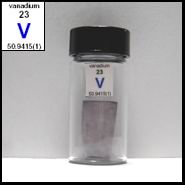
|
| Basic properties | |
|---|---|
| Atomic number | 23 |
| Atomic weight | 50.94151 amu |
| Element family | Transition metals |
| Period | 4 |
| Group | 2 |
| Block | s-block |
| Discovery year | 1830 |
| Isotope distribution |
|---|
51V 99.750% |
| Physical properties | |
|---|---|
| Density | 6.11 g/cm3 (STP) |
Atomic hydrogen (H) 8.988E-5 Meitnerium (Mt) 28 | |
| Melting | 1902 °C |
Helium (He) -272.2 Carbon (C) 3675 | |
| Boiling | 3380 °C |
Helium (He) -268.9 Tungsten (W) 5927 | |
| Chemical properties | |
|---|---|
| Oxidation states (less common) | +5 (-3, -1, 0, +1, +2, +3, +4) |
| First ionization potential | 6.746 eV |
Cesium (Cs) 3.894 Helium (He) 24.587 | |
| Electron affinity | 0.528 eV |
Nobelium (No) -2.33 Atomic chlorine (Cl) 3.612725 | |
| Electronegativity | 1.63 |
Cesium (Cs) 0.79 Atomic fluorine (F) 3.98 | |
| Atomic radius | |
|---|---|
| Covalent radius | 1.34 Å |
Atomic hydrogen (H) 0.32 Francium (Fr) 2.6 | |
| Metallic radius | 1.34 Å |
Beryllium (Be) 1.12 Cesium (Cs) 2.65 | |
| Compounds | ||
|---|---|---|
| Formula | Name | Oxidation state |
| VO | Vanadium(II) oxide | +2 |
| VCl2 | Vanadium(II) chloride | +2 |
| VBr2 | Vanadium(II) bromide | +2 |
| V2O3 | Vanadium(III) oxide | +3 |
| VBr3 | Vanadium(III) bromide | +3 |
| VCl3 | Vanadium(III) chloride | +3 |
| VO2 | Vanadium(IV) oxide | +4 |
| VOSO4 | Vanadium(IV) sulfate | +4 |
| VCl4 | Vanadium(IV) chloride | +4 |
| V2O5 | Vanadium(V) oxide | +5 |
| VOCl3 | Vanadium(V) oxide trichloride | +5 |
| NH4VO3 | Ammonium metavanadate | +5 |
| Electronic properties | |
|---|---|
| Electrons per shell | 2, 8, 11, 2 |
| Electronic configuration | [Ar] 3d3 |
|
Bohr atom model

| |
|
Orbital box diagram

| |
| Valence electrons | 5 |
| Lewis dot structure |
|
| Orbital Visualization | |
|---|---|
|
| |
| Electrons | - |
Vanadium (V): Periodic Table Element
Abstract
Vanadium (symbol V, atomic number 23) represents a transition metal distinguished by its remarkable accessibility to four adjacent oxidation states and diverse industrial applications. The element exhibits characteristic blue-silver-grey metallic appearance with atomic mass 50.9415 ± 0.0001 u and electron configuration [Ar] 3d³ 4s². Vanadium demonstrates exceptional utility in steel alloy production, accounting for 85% of global consumption, while serving critical roles in catalytic processes, particularly sulfuric acid manufacturing via the contact process. The element's unique chemistry manifests through colorimetrically distinct aqueous complexes: lilac V²⁺, green V³⁺, blue VO²⁺, and yellow-orange VO₃⁻ species. Natural occurrence spans 65 minerals with significant concentrations in fossil fuel deposits, crude oil containing up to 1200 ppm vanadium content. Industrial extraction primarily derives from steel smelter slag and magnetite processing. Contemporary applications encompass vanadium redox batteries for grid energy storage and specialized titanium alloys for aerospace applications. The element's biological role includes essential functions in marine organisms and nitrogen-fixing bacteria through vanadium-dependent enzymes.
Introduction
Vanadium occupies position 23 in the periodic table as a Group 5 transition metal, situated between titanium and chromium in the first transition series. The element's electronic structure, characterized by the [Ar] 3d³ 4s² configuration, provides access to multiple oxidation states ranging from +2 to +5, establishing vanadium as one of the most versatile redox-active elements in the periodic system. This electronic versatility underlies its widespread technological applications and unique coordination chemistry. Discovered initially in 1801 by Andrés Manuel del Río and conclusively identified by Nils Gabriel Sefström in 1831, vanadium derives its name from Vanadís, the Old Norse designation for the goddess Freyja, reflecting the beautiful multicolored compounds characteristic of its various oxidation states. The element's industrial significance emerged prominently in the early 20th century through Ford Motor Company's utilization of vanadium steel alloys in automotive manufacturing, demonstrating the metal's capacity to enhance mechanical properties while reducing overall weight. Modern vanadium chemistry encompasses sophisticated applications in catalysis, energy storage, and advanced materials science, positioning this transition metal as a critical component in contemporary technological infrastructure.
Physical Properties and Atomic Structure
Fundamental Atomic Parameters
Vanadium's atomic structure exhibits the characteristic features of early transition metals with atomic number Z = 23 and ground-state electron configuration [Ar] 3d³ 4s². The element possesses atomic radius 134 pm and ionic radii varying systematically with oxidation state: V²⁺ (79 pm), V³⁺ (64 pm), V⁴⁺ (58 pm), and V⁵⁺ (54 pm), demonstrating the expected contraction with increasing positive charge. The effective nuclear charge experienced by valence electrons approximates 4.98, accounting for shielding effects from the inner electron shells. Successive ionization energies reflect the progressive removal of electrons: first ionization energy 650.9 kJ/mol, second ionization energy 1414 kJ/mol, third ionization energy 2830 kJ/mol, fourth ionization energy 4507 kJ/mol, and fifth ionization energy 6298 kJ/mol. The relatively accessible nature of the first three ionization processes contributes to vanadium's stability in +2, +3, and +4 oxidation states under appropriate chemical conditions. Electron affinity measurements indicate a value of 50.6 kJ/mol, reflecting moderate tendency for electron acquisition in forming anionic species.
Macroscopic Physical Characteristics
Vanadium manifests as a hard, ductile metal with distinctive blue-silver-grey coloration and metallic luster. The element crystallizes in a body-centered cubic structure with lattice parameter a = 3.024 Å at room temperature, providing a atomic packing density consistent with metallic bonding characteristics. Standard density measures 6.11 g/cm³ at 293.15 K, positioning vanadium among the moderately dense transition metals. Thermal properties include melting point 2183 K (1910°C), boiling point 3680 K (3407°C), and specific heat capacity 489 J/(kg·K) at ambient conditions. Heat of fusion equals 21.5 kJ/mol while heat of vaporization reaches 459 kJ/mol, indicating substantial intermolecular forces typical of transition metal structures. The element exhibits paramagnetism with magnetic susceptibility χ = +285 × 10⁻⁶ emu/mol, consistent with unpaired d electrons in the electronic structure. Electrical resistivity measures approximately 197 nΩ·m at room temperature, demonstrating moderate conductivity characteristic of transition metals. Vanadium forms a protective oxide passivation layer upon atmospheric exposure, conferring resistance to further oxidation below 933 K (660°C).
Chemical Properties and Reactivity
Electronic Structure and Bonding Behavior
The d³ electronic configuration of vanadium provides exceptional flexibility in bonding arrangements and oxidation state accessibility. Three unpaired electrons in the 3d subshell participate readily in covalent bonding, ionic interactions, and coordination complex formation. Common oxidation states +2, +3, +4, and +5 correspond respectively to d³, d², d¹, and d⁰ electronic configurations, each exhibiting distinct spectroscopic and magnetic properties. Vanadium(II) compounds demonstrate strong reducing character with standard reduction potential E°(V³⁺/V²⁺) = -0.255 V, while vanadium(V) species function as oxidizing agents with E°(VO₂⁺/VO²⁺) = +1.000 V. Coordination chemistry typically involves octahedral geometry for V²⁺, V³⁺, and V⁴⁺ species, while V⁵⁺ often adopts tetrahedral coordination in oxoanions such as vanadate. Covalent bond formation exhibits varying degrees of ionic character depending on oxidation state, with V⁵⁺ compounds displaying more covalent character than lower oxidation states. Average V-O bond lengths range from 1.59 Å in VO₄³⁻ tetrahedra to 2.00 Å in octahedral V²⁺ complexes, reflecting the systematic variation in ionic radii and bond covalency.
Electrochemical and Thermodynamic Properties
Vanadium exhibits electronegativity 1.63 on the Pauling scale, intermediate between neighboring transition metals and consistent with moderate electron-attracting ability. The Mulliken electronegativity scale provides a comparable value of 3.6 eV, supporting the element's classification as moderately electronegative. Standard reduction potentials demonstrate systematic trends across oxidation states: E°(V²⁺/V) = -1.175 V, E°(V³⁺/V²⁺) = -0.255 V, E°(VO²⁺/V³⁺) = +0.337 V, and E°(VO₂⁺/VO²⁺) = +1.000 V. These values indicate thermodynamic stability of intermediate oxidation states in aqueous solution, particularly V³⁺ and VO²⁺. Electron affinity measurements yield 50.6 kJ/mol, reflecting moderate tendency for anionic species formation. Thermodynamic stability of vanadium compounds correlates strongly with oxidation state, with V₂O₅ representing the most thermodynamically stable oxide under ambient conditions. Standard enthalpy of formation for V₂O₅(s) equals -1550.6 kJ/mol, while VO(s) exhibits ΔH°f = -431.8 kJ/mol. Redox behavior in different media shows pH dependence, with acidic conditions favoring higher oxidation states and alkaline media stabilizing lower oxidation states through complexation effects.
Chemical Compounds and Complex Formation
Binary and Ternary Compounds
Vanadium forms an extensive series of binary oxides reflecting its multiple oxidation states: VO (rock salt structure), V₂O₃ (corundum structure), VO₂ (rutile structure), and V₂O₅ (layered structure). Vanadium pentoxide represents the most industrially significant oxide, crystallizing in an orthorhombic structure with V-O bond distances ranging from 1.59 to 2.02 Å depending on coordination environment. The compound exhibits amphoteric behavior, dissolving in acids to form vanadyl species and in bases to produce vanadate anions. Halide compounds include VCl₂, VCl₃, VCl₄, and VF₅, with tetrachloride serving as a catalyst precursor in Ziegler-Natta polymerization. Vanadium carbide VC and vanadium nitride VN exhibit exceptional hardness and thermal stability, finding applications in cutting tool manufacture. Sulfide formation produces VS, V₂S₃, and VS₂ with layered structures analogous to corresponding oxides. Ternary compounds encompass vanadates such as Ca₃(VO₄)₂ and Mg₃(VO₄)₂, exhibiting diverse crystal structures and optical properties.
Coordination Chemistry and Organometallic Compounds
Vanadium coordination complexes demonstrate remarkable diversity in geometry, electronic structure, and reactivity patterns. Aqueous chemistry features characteristic colored complexes: [V(H₂O)₆]²⁺ (lilac), [V(H₂O)₆]³⁺ (green), [VO(H₂O)₅]²⁺ (blue), and [VO₂(H₂O)₄]⁺ (yellow). Coordination geometries range from octahedral for V²⁺ and V³⁺ to square pyramidal for vanadyl complexes and tetrahedral for vanadate species. Ligand field stabilization energies contribute significantly to complex stability, with d² and d¹ configurations exhibiting substantial LFSE values in octahedral environments. Organometallic chemistry includes vanadocene V(C₅H₅)₂ and related cyclopentadienyl derivatives demonstrating 15-electron configuration and paramagnetic properties. Vanadium carbonyls such as [V(CO)₆]⁻ exhibit unusual electronic structures requiring extensive back-bonding for stabilization. Alkoxide complexes like V(OR)₄ serve as precursors for chemical vapor deposition of vanadium oxide films. Schiff base complexes demonstrate catalytic activity in oxidation reactions, utilizing accessible oxidation state changes for electron transfer processes.
Natural Occurrence and Isotopic Analysis
Geochemical Distribution and Abundance
Vanadium ranks as the 19th most abundant element in Earth's crust with average concentration 120 ppm, significantly exceeding copper (60 ppm) and zinc (70 ppm) abundance levels. Geochemical behavior reflects strong affinity for oxygen-bearing environments, commonly associating with iron and titanium minerals in magmatic processes. Primary mineral occurrences include vanadinite [Pb₅(VO₄)₃Cl], patronite [VS₄], and carnotite [K₂(UO₂)₂(VO₄)₂·3H₂O], spanning approximately 65 distinct mineral species. Sedimentary concentrations reach exceptional levels in black shales, oil sands, and phosphorite deposits, with certain formations containing 1000-3000 ppm vanadium. Fossil fuel deposits exhibit variable vanadium content, with crude oil concentrations ranging from trace levels to 1200 ppm, particularly in heavy oils and bitumens. Seawater contains vanadium at 30 nM concentration (1.5 mg/m³), predominantly as vanadyl ions stabilized through complex formation. Marine sediments demonstrate vanadium accumulation through biogenic and chemical precipitation processes, creating potential future extraction resources. Atmospheric vanadium derives primarily from fossil fuel combustion, contributing approximately 110,000 metric tons annually to global environmental cycling.
Nuclear Properties and Isotopic Composition
Natural vanadium consists of two isotopes: stable ⁵¹V (99.75% abundance) and long-lived radioactive ⁵⁰V (0.25% abundance, t₁/₂ = 2.71×10¹⁷ years). The stable isotope ⁵¹V possesses nuclear spin I = 7/2 and magnetic moment μ = +5.1487 nuclear magnetons, enabling ⁵¹V NMR spectroscopy applications in structural chemistry. Radioactive ⁵⁰V undergoes electron capture decay to produce ⁵⁰Ti with extremely low decay rate, making the isotope effectively stable for most practical purposes. Artificial radioisotopes encompass mass numbers 40-65, with ⁴⁸V (t₁/₂ = 16.0 days) and ⁴⁹V (t₁/₂ = 330 days) representing the longest-lived species. Neutron activation produces ⁵²V (t₁/₂ = 3.75 minutes) through (n,γ) reactions, finding applications in neutron activation analysis. Nuclear cross-sections include thermal neutron absorption σₐ = 5.08 barns for ⁵¹V and coherent neutron scattering length b = -0.3824 fm. Beta decay pathways characterize neutron-rich isotopes producing chromium daughters, while electron capture processes in neutron-deficient species yield titanium products. The long half-life of ⁵⁰V enables precise geochronological applications and studies of early solar system nucleosynthesis.
Industrial Production and Technological Applications
Extraction and Purification Methodologies
Industrial vanadium production employs several distinct extraction routes depending on source material composition and economic considerations. Primary sources include steel smelter slag containing 10-25% V₂O₅, magnetite deposits with 0.3-2.0% vanadium content, and uranium mining residues yielding vanadium as byproduct. Chinese production, representing approximately 60% of global output, utilizes stone coal processing through roasting, leaching, and precipitation sequences. Russian production centers on titanomagnetite processing, employing high-temperature smelting followed by slag treatment with sodium carbonate to produce sodium vanadate. South African operations extract vanadium from magnetite through direct reduction and selective leaching procedures. Purification typically involves ammonium metavanadate precipitation from vanadium-containing solutions, achieving 99.5% purity levels. Subsequent reduction with aluminum or calcium produces ferrovanadium alloys containing 35-80% vanadium for steel industry applications. Pure vanadium metal preparation requires additional reduction steps using aluminum or hydrogen at elevated temperatures, yielding electronic-grade material with >99.9% purity. Global production capacity exceeds 85,000 metric tons annually, with China dominating output followed by Russia and South Africa.
Technological Applications and Future Prospects
Steel industry applications account for 85% of vanadium consumption, primarily through ferrovanadium additions ranging from 0.15-5.0% depending on alloy specifications. High-strength low-alloy steels incorporate 0.05-0.15% vanadium for grain refinement and precipitation hardening, achieving yield strengths exceeding 550 MPa. Tool steels containing 1-5% vanadium demonstrate exceptional wear resistance and hot hardness retention above 600°C, enabling high-speed machining applications. Catalytic applications center on vanadium pentoxide utilization in sulfuric acid production via the contact process, where V₂O₅/K₂S₂O₇ catalyst systems achieve >99.5% SO₂ conversion efficiency at 400-500°C. Emerging vanadium redox battery technology exploits all four oxidation states in grid-scale energy storage systems, providing 10-20 year operational lifetimes with minimal capacity degradation. Aerospace applications include vanadium-aluminum-titanium alloys for jet engine components, where thermal stability and low density prove advantageous. Future prospects encompass vanadium dioxide smart window applications utilizing metal-insulator phase transitions, hydrogen storage in vanadium-based alloys, and superconducting V₃Si conductors for fusion reactor applications. Market projections indicate continued growth driven by renewable energy storage demands and advanced steel grades for automotive lightweighting initiatives.
Historical Development and Discovery
Vanadium discovery encompasses a complex chronology spanning three decades and multiple independent investigators. Initial identification occurred in 1801 when Spanish-Mexican scientist Andrés Manuel del Río analyzed lead-bearing ores from the Zimapán mines in Mexico. Del Río observed distinctive color changes upon treatment with acids and initially termed the new element "panchromium" due to its chromatic versatility, later renamed "erythronium" for its red coloration in acidic solution. However, French chemist Hippolyte Victor Collet-Descotils disputed the discovery in 1805, incorrectly asserting the samples contained only chromium, leading to temporary abandonment of del Río's claim. Definitive recognition emerged in 1831 through Swedish chemist Nils Gabriel Sefström's investigation of iron slag from the Taberg mine. Sefström's systematic analysis confirmed a new element, which he designated "vanadium" after Vanadís, the Old Norse name for the goddess Freyja, acknowledging the beautiful colored compounds characteristic of vanadium chemistry. Contemporaneous work by German chemist Friedrich Wöhler established the identity between del Río's and Sefström's elements, restoring del Río's priority in discovery. Pure metallic vanadium isolation proved challenging until Henry Enfield Roscoe achieved success in 1867 through vanadium(II) chloride reduction with hydrogen gas. Industrial applications emerged in the early 20th century when Henry Ford utilized vanadium steel alloys in automotive manufacturing, demonstrating superior strength-to-weight ratios. Modern vanadium chemistry development accelerated through X-ray crystallography, electron paramagnetic resonance spectroscopy, and quantum chemical calculations, revealing detailed electronic structure and bonding principles underlying the element's remarkable chemical versatility.
Conclusion
Vanadium occupies a distinctive position among transition metals through its accessible multiple oxidation states, diverse coordination chemistry, and extensive technological applications. The element's unique electronic structure enables sophisticated redox processes fundamental to catalytic systems, energy storage technologies, and advanced materials development. Industrial significance spans traditional steel metallurgy to cutting-edge battery technologies, demonstrating vanadium's continued relevance in modern technological infrastructure. Future research directions encompass smart materials applications, sustainable energy storage systems, and advanced catalytic processes leveraging vanadium's exceptional redox versatility. The element's role in biological systems, particularly marine environments and nitrogen fixation, suggests additional research opportunities in bioinorganic chemistry and environmental applications.

Please let us know how we can improve this web app.
