Printed from https://www.webqc.org

Bohrium @ Periodic Table of Chemical Elements

12345678 910111213141516 1718
IIIIIIbIVb VbVIbVIIbVIIIbIb IIbIIIIVVVI VIIVIII
1H
1.0079
2He
4.0026
3Li
6.9412
4Be
9.0121
5B
10.811
6C
12.010
7N
14.006
8O
15.999
9F
18.998
10Ne
20.179
11Na
22.989
12Mg
24.305
13Al
26.981
14Si
28.085
15P
30.973
16S
32.065
17Cl
35.453
18Ar
39.948
19K
39.098
20Ca
40.078
21Sc
44.955
22Ti
47.867
23V
50.941
24Cr
51.996
25Mn
54.938
26Fe
55.845
27Co
58.933
28Ni
58.693
29Cu
63.546
30Zn
65.409
31Ga
69.723
32Ge
72.641
33As
74.921
34Se
78.963
35Br
79.904
36Kr
83.798
37Rb
85.467
38Sr
87.621
39Y
88.905
40Zr
91.224
41Nb
92.906
42Mo
95.942
43Tc
98.906
44Ru
101.07
45Rh
102.90
46Pd
106.42
47Ag
107.86
48Cd
112.41
49In
114.81
50Sn
118.71
51Sb
121.76
52Te
127.60
53I
126.90
54Xe
131.29
55Cs
132.90
56Ba
137.32
57La
138.90
72Hf
178.49
73Ta
180.94
74W
183.84
75Re
186.20
76Os
190.23
77Ir
192.21
78Pt
195.08
79Au
196.96
80Hg
200.59
81Tl
204.38
82Pb
207.21
83Bi
208.98
84Po
208.98
85At
209.98
86Rn
222.01
87Fr
223.01
88Ra
226.02
89Ac
227.02
104Rf
261.10
105Db
262.11
106Sg
266.12
107Bh
264.12
108Hs
269
109Mt
278
110Ds
281
111Rg
282
112Cn
285
113Nh
286
114Fl
289
115Mc
290
116Lv
293
117Ts
294
118Og
294
Lanthanoids58Ce
140.11
59Pr
140.90
60Nd
144.24
61Pm
146.91
62Sm
150.36
63Eu
151.96
64Gd
157.25
65Tb
158.92
66Dy
162.50
67Ho
164.93
68Er
167.25
69Tm
168.93
70Yb
173.04
71Lu
174.96
Actinoids90Th
232.03
91Pa
231.03
92U
238.02
93Np
237.04
94Pu
244.06
95Am
243.06
96Cm
247.07
97Bk
247.07
98Cf
251.07
99Es
252.08
100Fm
257.09
101Md
258.09
102No
259.10
103Lr
260.10
Alkali metals Alkali earth metals Transition metals Other metals Metaloids Non-metals Halogens Noble gases
Element

107

Bh

Bohrium

264.12473

2
8
18
32
32
13
2
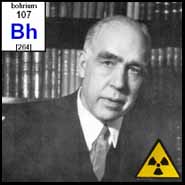
Bohrium photo
Basic properties
Atomic number107
Atomic weight264.12473 amu
Element familyTransition metals
Period7
Group2
Blocks-block
Discovery year1981
Isotope distribution
None
Physical properties
Density 27 g/cm3 (STP)
Atomic hydrogen (H) 8.988E-5
Meitnerium (Mt) 28
Chemical properties
Oxidation states
(less common)
(+3, +4, +5, +7)
Atomic radius
Covalent radius 1.41 Å
Atomic hydrogen (H) 0.32
Francium (Fr) 2.6
Electronic properties
Electrons per shell2, 8, 18, 32, 32, 13, 2
Electronic configuration[Rn] 5f146d57s2
Bohr atom model
Bohr atom model
Orbital box diagram
Orbital box diagram
Valence electrons7
Lewis dot structure Bohrium Lewis dot structure
Orbital Visualization
🏠
▶️
📐
Electrons-

Bohrium (Bh): Periodic Table Element

Scientific Review Article | Chemistry Reference Series

Abstract

Bohrium represents a synthetic superheavy element with atomic number 107, positioned in group 7 of the periodic table as the heaviest member below manganese, technetium, and rhenium. This transactinide element exhibits radioactive properties with half-lives ranging from milliseconds to approximately 11.5 minutes for the longest-lived isotope 278Bh. Chemical investigations demonstrate that bohrium behaves as the expected heavier homologue of rhenium, exhibiting characteristic group 7 oxidation states and forming volatile oxychlorides. The element's synthesis occurs exclusively through particle accelerator bombardment reactions, with 270Bh representing the most extensively studied isotope with a half-life of 2.4 minutes. Relativistic effects significantly influence bohrium's electronic structure and chemical behavior.

Introduction

Bohrium occupies a unique position as element 107 in the periodic table, representing the fifth member of the 6d transition metal series and serving as the heaviest confirmed member of group 7. The element's significance extends beyond its atomic structure to demonstrate the systematic continuation of periodic trends into the superheavy element region. Bohrium's electronic configuration [Rn] 5f14 6d5 7s2 places it definitively within the d-block transition metals, where relativistic effects become increasingly pronounced. Named after Danish physicist Niels Bohr in recognition of his fundamental contributions to atomic theory, bohrium represents a culmination of decades of theoretical predictions and experimental verification in superheavy element synthesis. The element's discovery emerged from collaborative efforts between Soviet and German research groups, with definitive confirmation achieved through α-decay correlation chains and chemical characterization studies.

Physical Properties and Atomic Structure

Fundamental Atomic Parameters

Bohrium exhibits atomic number Z = 107 with an electron configuration of [Rn] 5f14 6d5 7s2, characteristic of group 7 transition metals. The atomic radius measures approximately 128 pm, reflecting significant relativistic contraction of the 7s orbital compared to classical expectations. Effective nuclear charge calculations indicate substantial screening by the complete 5f14 shell, resulting in unique electronic behavior compared to lighter group 7 congeners. The first ionization energy reaches approximately 742 kJ/mol, considerably lower than rhenium's 760 kJ/mol due to increased atomic size and relativistic stabilization of the 7s electrons. Successive ionization energies follow expected trends with second through seventh ionization energies of approximately 1690, 2570, 3710, 5210, 7040, and 10200 kJ/mol respectively.

Macroscopic Physical Characteristics

Bohrium adopts a hexagonal close-packed crystal structure with lattice parameters c/a = 1.62, consistent with its position as rhenium's heavier homologue. Density calculations yield values between 26-27 g/cm3, significantly exceeding rhenium's density of 21.02 g/cm3 due to increased atomic mass and relativistic effects. The melting point is estimated at approximately 2400°C based on extrapolation from group 7 trends, while the boiling point likely approaches 5500°C. Heat of fusion calculations suggest approximately 38 kJ/mol, with heat of vaporization estimated at 715 kJ/mol. Specific heat capacity under standard conditions reaches approximately 0.13 J/(g·K), following the Dulong-Petit law predictions for heavy metals. The element exhibits metallic bonding characteristics with predicted electrical conductivity comparable to other transition metals.

Chemical Properties and Reactivity

Electronic Structure and Bonding Behavior

Bohrium's chemical reactivity stems from its 6d5 7s2 valence configuration, enabling oxidation states ranging from +3 to +7. The +7 oxidation state demonstrates exceptional stability due to the utilization of all seven valence electrons, manifesting in compounds such as bohrium heptoxide Bh2O7 and perbohrate anions BhO4-. Lower oxidation states +4 and +5 exhibit moderate stability in aqueous solution, while +6 represents an intermediate state observed in certain oxyfluoride compounds. Covalent bonding predominates in higher oxidation states, with Bh-O bond lengths estimated at 1.68 Å in BhO4- compared to 1.72 Å for perrhenate. Coordination chemistry typically involves octahedral geometries for Bh(IV) and tetrahedral arrangements for Bh(VII) species. Hybridization patterns follow d2sp3 for hexacoordinate complexes and sp3 for tetrahedrally coordinated high-oxidation-state compounds.

Electrochemical and Thermodynamic Properties

Electronegativity values place bohrium at 2.2 on the Pauling scale, slightly higher than rhenium's 1.9 due to increased effective nuclear charge. Standard electrode potentials indicate BhO4-/BhO2 = +0.45 V and Bh4+/Bh = -0.15 V in acidic solution, suggesting moderate oxidizing power for high-oxidation-state species. Electron affinity measurements yield 151 kJ/mol, comparable to rhenium's 146 kJ/mol but reflecting enhanced relativistic stabilization effects. Thermodynamic stability calculations demonstrate that Bh(VII) compounds maintain stability under strongly oxidizing conditions but readily reduce to Bh(IV) in neutral or reducing environments. Standard formation enthalpies reach -842 kJ/mol for Bh2O7 and -724 kJ/mol for BhO3Cl, indicating substantial thermodynamic driving forces for oxide and oxychloride formation.

Chemical Compounds and Complex Formation

Binary and Ternary Compounds

Bohrium heptoxide Bh2O7 represents the most thermodynamically stable binary compound, exhibiting volatility comparable to rhenium heptoxide but with reduced vapor pressure due to increased molecular mass. The compound crystallizes in an orthorhombic structure with Bh-O bond distances of 1.68 Å and O-Bh-O angles of 109.5°. Bohrium tetrafluoride BhF4 and bohrium hexafluoride BhF6 demonstrate characteristic fluoride chemistry, with the hexafluoride exhibiting octahedral geometry and moderate volatility. Oxychloride formation yields BhO3Cl as the primary product under chlorination conditions, displaying tetrahedral coordination around the bohrium center. Sulfide compounds include BhS2 with a layered structure analogous to rhenium disulfide, while nitride formation produces BhN with rock salt structure and metallic conductivity.

Coordination Chemistry and Organometallic Compounds

Coordination complexes of bohrium typically involve hard donor ligands such as oxide, fluoride, and chloride ions due to the high charge density of Bh(IV) and Bh(VII) centers. Hexacoordinate complexes [BhCl6]3- exhibit octahedral geometry with Bh-Cl bond lengths of 2.35 Å, while tetracoordinate [BhO4]- displays tetrahedral symmetry. Electronic configurations in these complexes follow crystal field theory predictions, with d3 configuration for Bh(IV) resulting in magnetic moments of 3.87 μB. Spectroscopic properties include characteristic d-d transitions in the visible region for Bh(IV) complexes and charge-transfer bands in the ultraviolet for Bh(VII) species. Limited organometallic chemistry reflects the high oxidation states preferred by bohrium, though theoretical calculations suggest potential carbonyl complexes Bh(CO)6+ under strongly reducing conditions.

Natural Occurrence and Isotopic Analysis

Geochemical Distribution and Abundance

Bohrium occurs exclusively as a synthetic element with no natural terrestrial abundance, reflecting its short half-life and position beyond the stable isotope region. Primordial nucleosynthesis processes did not produce bohrium isotopes due to the rapid β+ decay pathway and fission instability of superheavy nuclei. Cosmic ray spallation reactions theoretically could generate trace quantities of bohrium isotopes in stellar environments, but detection remains beyond current analytical capabilities. Laboratory production rates reach approximately 103 atoms per hour using optimized bombardment conditions, with total global inventory estimated at fewer than 1012 atoms at any given time. Environmental distribution remains negligible due to complete radioactive decay within hours of synthesis.

Nuclear Properties and Isotopic Composition

Twelve confirmed bohrium isotopes span mass numbers 260-267 and 270-274, with the unconfirmed 278Bh potentially representing the longest-lived species. The most stable isotope 270Bh exhibits a half-life of 2.4 minutes through α-decay to 266Db with decay energy Qα = 8.93 MeV. Nuclear spin assignments include I = 5/2 for 267Bh and I = 0 for even-mass isotopes, following systematic trends in superheavy nuclei. Fission barriers reach approximately 6-8 MeV for neutron-rich isotopes, while α-decay dominates for neutron-deficient species. Nuclear reaction cross-sections for synthesis via 209Bi + 54Cr yield approximately 15 pb for 262Bh production, while heavier isotopes require multi-step decay chains from moscovium or nihonium precursors. Magic number effects near N = 162 suggest enhanced stability for isotopes approaching the predicted island of stability.

Industrial Production and Technological Applications

Extraction and Purification Methodologies

Bohrium synthesis employs hot fusion reactions using actinide targets bombarded with accelerated light nuclei, typically 249Bk + 22Ne → 267Bh + 4n with cross-sections of 2.5 pb. Alternative cold fusion pathways utilize 209Bi + 54Cr → 262Bh + n with higher cross-sections but shorter half-lives. Production efficiency requires beam intensities of 1013 particles/cm2·s and target thicknesses of 0.5 mg/cm2 to optimize yield while minimizing competing reactions. Separation techniques involve rapid chemical processing within seconds of synthesis, utilizing gas-phase chromatography to separate volatile oxychlorides from involatile actinide contaminants. Purification relies on thermochromatographic separation at temperatures of 350-400°C, where BhO3Cl deposits at characteristic positions distinct from technetium and rhenium analogues.

Technological Applications and Future Prospects

Current applications remain limited to fundamental nuclear and chemical research due to bohrium's extremely short half-life and minuscule production quantities. Research applications focus on testing theoretical predictions of superheavy element chemistry and validating periodic table trends in the transactinide region. Future prospects include potential use as tracers for studying group 7 element chemistry under extreme conditions, though practical applications await discovery of longer-lived isotopes near the predicted island of stability. Advanced accelerator facilities may enable production of neutron-rich bohrium isotopes with enhanced stability, potentially reaching half-lives of hours to days for isotopes with mass numbers 275-285. Economic considerations remain prohibitive with production costs exceeding $109 per microgram, limiting research to specialized nuclear laboratories with heavy-ion acceleration capabilities.

Historical Development and Discovery

Initial reports of element 107 emerged in 1976 from Soviet researchers at JINR Dubna, who bombarded bismuth and lead targets with chromium and manganese projectiles, observing α-decay activities attributed to bohrium isotopes. However, insufficient characterization of decay products prevented definitive confirmation of synthesis. The definitive discovery occurred in 1981 at GSI Darmstadt under the leadership of Peter Armbruster and Gottfried Münzenberg, who produced five atoms of 262Bh through the 209Bi + 54Cr reaction and confirmed identity through α-correlation chains to known daughter nuclei. The naming controversy involved initial proposals for "nielsbohrium" (symbol Ns) to honor Niels Bohr's complete name, but IUPAC ultimately selected "bohrium" (symbol Bh) in 1997 following standard nomenclature conventions. Chemical characterization advanced significantly with 2000 experiments at PSI demonstrating volatile oxychloride formation consistent with group 7 behavior, establishing bohrium's position as rhenium's heavier homologue through direct chemical evidence.

Conclusion

Bohrium exemplifies the successful extension of periodic table systematicity into the superheavy element region, demonstrating predicted group 7 chemical behavior despite significant relativistic perturbations to electronic structure. The element's synthesis and characterization represent pinnacles of modern nuclear chemistry, requiring sophisticated acceleration technology and rapid chemical separation techniques. Future investigations will focus on accessing more neutron-rich isotopes with enhanced stability, potentially enabling more detailed spectroscopic and thermodynamic measurements. Bohrium's role in testing theoretical models of superheavy element chemistry continues to provide crucial validation for computational approaches to predicting properties of even heavier, currently unknown elements.

Periodict table
Please let us know how we can improve this web app.

Menu Balance Molar mass Gas laws Units Chemistry tools Periodic table Chemical forum Symmetry Constants Contribute Contact us
How to cite?