| Element | |
|---|---|
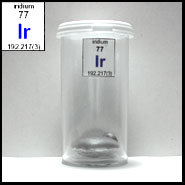
77IrIridium192.21732
8 18 32 15 2 |
|
| Basic properties | |
|---|---|
| Atomic number | 77 |
| Atomic weight | 192.2173 amu |
| Element family | Transition metals |
| Period | 6 |
| Group | 2 |
| Block | s-block |
| Discovery year | 1803 |
| Isotope distribution |
|---|
191Ir 37.3% 193Ir 62.7% |
191Ir (37.30%) 193Ir (62.70%) |
| Physical properties | |
|---|---|
| Density | 22.65 g/cm3 (STP) |
Atomic hydrogen (H) 8.988E-5 Meitnerium (Mt) 28 | |
| Melting | 2443 °C |
Helium (He) -272.2 Carbon (C) 3675 | |
| Boiling | 4130 °C |
Helium (He) -268.9 Tungsten (W) 5927 | |
| Chemical properties | |
|---|---|
| Oxidation states (less common) | +3, +4 (-3, -2, -1, 0, +1, +2, +5, +6, +7, +8, +9) |
| First ionization potential | 9.120 eV |
Cesium (Cs) 3.894 Helium (He) 24.587 | |
| Electron affinity | 1.564 eV |
Nobelium (No) -2.33 Atomic chlorine (Cl) 3.612725 | |
| Electronegativity | 2.2 |
Cesium (Cs) 0.79 Atomic fluorine (F) 3.98 | |
| Atomic radius | |
|---|---|
| Covalent radius | 1.22 Å |
Atomic hydrogen (H) 0.32 Francium (Fr) 2.6 | |
| Metallic radius | 1.36 Å |
Beryllium (Be) 1.12 Cesium (Cs) 2.65 | |
| Compounds | ||
|---|---|---|
| Formula | Name | Oxidation state |
| IrCl2 | Iridium(II) chloride | +2 |
| IrCl3 | Iridium(III) chloride | +3 |
| Ir2S3 | Iridium(III) sulfide | +3 |
| IrF3 | Iridium trifluoride | +3 |
| IrBr4 | Iridium tetrabromide | +4 |
| IrCl4 | Iridium(IV) chloride | +4 |
| IrF4 | Iridium tetrafluoride | +4 |
| IrI4 | Iridium(IV) iodide | +4 |
| IrO2 | Iridium(IV) oxide | +4 |
| IrF5 | Iridium(V) fluoride | +5 |
| IrF6 | Iridium hexafluoride | +6 |
| IrO4 | Iridium tetroxide | +8 |
| Electronic properties | |
|---|---|
| Electrons per shell | 2, 8, 18, 32, 15, 2 |
| Electronic configuration | [Xe] 4f14 |
|
Bohr atom model

| |
|
Orbital box diagram

| |
| Valence electrons | 9 |
| Lewis dot structure |
|
| Orbital Visualization | |
|---|---|
|
| |
| Electrons | - |
Iridium (Ir): Periodic Table Element
Abstract
Iridium (Ir, atomic number 77) stands as one of the most remarkable elements in the periodic table, distinguished by its exceptional physical and chemical properties. This second-densest naturally occurring element, with a density of 22.56 g/cm³, exhibits extraordinary corrosion resistance and represents the most chemically inert metal known to science. Iridium possesses a face-centered cubic crystal structure and maintains mechanical stability at temperatures exceeding 1600°C. The element demonstrates unique oxidation chemistry, achieving the highest known oxidation state of +9 among all elements. With a standard atomic weight of 192.217 ± 0.002 u, iridium occurs naturally as two stable isotopes with abundances of 37.3% (¹⁹¹Ir) and 62.7% (¹⁹³Ir). Its extreme rarity, at 0.001 ppm crustal abundance, combined with specialized applications in high-temperature processes, catalysis, and precision instruments, establishes iridium as one of the most valuable and scientifically significant transition metals.
Introduction
Iridium occupies position 77 in the periodic table as a member of Group 9 and the sixth period, representing the culmination of the platinum group metals (PGMs) in terms of chemical inertness and physical durability. The element's electron configuration [Xe] 4f¹⁴ 5d⁷ 6s² places it among the transition metals with partially filled d-orbitals, contributing to its unique coordination chemistry and catalytic properties. The name "iridium," derived from the Greek word "iris" meaning rainbow, reflects the diverse coloration observed in its various compounds and salts.
Discovered in 1803 by British chemist Smithson Tennant during systematic analysis of platinum ore residues, iridium was identified simultaneously with osmium through careful chemical separation techniques. The element's discovery marked a significant advancement in analytical chemistry and contributed to the complete characterization of the platinum group metals. Modern understanding of iridium's properties has established its position as an essential material in high-performance applications where extreme conditions demand uncompromising chemical and mechanical stability.
Physical Properties and Atomic Structure
Fundamental Atomic Parameters
Iridium's atomic structure exhibits the characteristic features of late transition metals, with its 77 protons balanced by a corresponding number of electrons in the neutral atom. The electron configuration [Xe] 4f¹⁴ 5d⁷ 6s² indicates seven electrons in the 5d subshell and two in the 6s orbital, resulting in nine valence electrons available for chemical bonding. This electronic arrangement contributes to the element's ability to achieve multiple oxidation states ranging from -3 to +9, with the most common being +1, +2, +3, and +4.
The atomic radius of iridium reflects the lanthanide contraction effect, where the progressive increase in nuclear charge across the lanthanide series results in a smaller than expected atomic size for the subsequent transition metals. Effective nuclear charge calculations indicate strong electron-nucleus attraction, contributing to the element's high ionization energies and exceptional mechanical properties. The nuclear stability of iridium manifests in its two stable isotopes, with nuclear spin states that contribute to its magnetic properties and spectroscopic characteristics.
Macroscopic Physical Characteristics
Iridium exhibits a lustrous silvery-white metallic appearance with exceptional reflectivity across the visible spectrum. The element crystallizes in a face-centered cubic (fcc) structure with space group Fm3̄m, providing optimal atomic packing efficiency that contributes to its extraordinary density of 22.56 g/cm³. This density value, determined through X-ray crystallographic methods, establishes iridium as the second-densest naturally occurring element, exceeded only by osmium.
The mechanical properties of iridium demonstrate remarkable characteristics that distinguish it from other metals. The element possesses the second-highest modulus of elasticity among all metals, approximately 528 GPa, combined with an exceptionally high shear modulus and very low Poisson's ratio. These properties result in extreme stiffness and resistance to deformation, making iridium one of the most difficult metals to fabricate through conventional mechanical processing. The hardness of pure iridium measures approximately 1670 MPa on the Vickers scale, though this value can vary significantly with processing conditions and impurity content.
Thermal properties of iridium reflect its robust atomic structure and strong intermetallic bonding. The melting point occurs at 2466°C, while the boiling point reaches 4428°C, ranking tenth highest among all elements. Heat capacity measurements indicate a value of 25.10 J/(mol·K) at standard conditions, with thermal conductivity of 147 W/(m·K) at room temperature. The coefficient of thermal expansion measures 6.4 × 10⁻⁶ K⁻¹, indicating dimensional stability across wide temperature ranges essential for precision applications.
Chemical Properties and Reactivity
Electronic Structure and Bonding Behavior
The chemical reactivity of iridium stems from its unique electronic configuration and the availability of d-orbitals for bonding interactions. The presence of seven electrons in the 5d subshell allows for extensive orbital overlap in chemical bonding, contributing to the formation of strong covalent and coordinate bonds with various ligands. Crystal field theory applications to iridium complexes demonstrate significant d-orbital splitting due to the metal's high charge density and strong ligand field interactions.
Iridium exhibits remarkable oxidation state versatility, achieving formal oxidation states from -3 to +9, with the latter representing the highest known oxidation state for any element. This extraordinary range results from the metal's ability to utilize both s and d electrons in bonding, combined with the stabilization provided by strong ligand fields. Common oxidation states include +1 in complexes such as IrCl(CO)(PPh₃)₂, +2 in [IrCl₆]²⁻, +3 in [IrCl₆]³⁻, and +4 in IrO₂. The highest oxidation state of +9 occurs in the gaseous cation [IrO₄]⁺, demonstrating the element's exceptional electron-donating capability under extreme conditions.
Coordination chemistry of iridium encompasses a vast array of geometries and ligand types, reflecting the metal's flexible electronic structure and high coordination numbers. Octahedral geometry predominates in many iridium(III) complexes, while square-planar arrangements characterize numerous iridium(I) species. The metal demonstrates particular affinity for π-accepting ligands such as carbon monoxide, phosphines, and alkenes, forming stable complexes with significant metal-to-ligand backbonding. Bond lengths in iridium complexes typically range from 1.9 to 2.4 Å for single bonds, depending on the oxidation state and ligand environment.
Electrochemical and Thermodynamic Properties
Electrochemical characterization of iridium reveals exceptional stability across a wide range of conditions, contributing to its reputation as the most corrosion-resistant metal known. Standard reduction potentials for various iridium couples demonstrate the thermodynamic stability of different oxidation states. The Ir³⁺/Ir couple exhibits a standard reduction potential of +1.156 V, while the IrO₂/Ir couple shows +0.926 V, indicating favorable reduction thermodynamics under standard conditions.
Electronegativity values for iridium, measured on the Pauling scale, equal 2.20, reflecting moderate electron-attracting ability compared to other transition metals. This value positions iridium between rhodium (2.28) and platinum (2.28), consistent with periodic trends in electronegativity across the transition series. Successive ionization energies demonstrate the progressive difficulty of electron removal: first ionization energy 8.967 eV, second ionization energy 16.716 eV, and third ionization energy 25.56 eV. These values reflect the strong nuclear attraction and contribute to the metal's chemical stability.
Thermodynamic analysis of iridium compounds reveals generally high formation enthalpies and Gibbs free energies, indicating thermodynamic stability under standard conditions. The standard enthalpy of formation for IrO₂ equals -274.4 kJ/mol, while IrCl₃ exhibits -245.6 kJ/mol. These negative values demonstrate favorable compound formation, though the magnitudes are generally smaller than those of more reactive metals, reflecting iridium's inherent chemical inertness.
Chemical Compounds and Complex Formation
Binary and Ternary Compounds
Binary compounds of iridium demonstrate the element's ability to combine with most elements across the periodic table, though formation often requires elevated temperatures or aggressive chemical conditions. Iridium oxide IrO₂ represents the most thermodynamically stable binary oxide, crystallizing in the rutile structure with space group P42/mnm. This compound exhibits metallic conductivity and serves as an important electrocatalytic material, particularly in oxygen evolution reactions where its exceptional stability in acidic media proves advantageous.
Halide chemistry of iridium encompasses compounds in multiple oxidation states, with trihalides being most common and stable. Iridium trichloride IrCl₃ exists in both anhydrous and hydrated forms, with the anhydrous material forming a layered structure containing octahedral iridium centers. The compound demonstrates remarkable thermal stability, decomposing only above 760°C in an inert atmosphere. Iridium tetrafluoride IrF₄ represents a less common but structurally interesting halide, exhibiting polymeric chain structures with bridging fluoride ligands.
Sulfide and nitride formation with iridium requires high-temperature synthesis methods due to the metal's chemical inertness. Iridium disulfide IrS₂ adopts the pyrite structure and demonstrates semiconducting properties with applications in electronic devices. The formation mechanism involves direct combination of the elements at temperatures exceeding 600°C under controlled atmospheric conditions. Ternary compounds such as BaIrO₃ and Sr₂IrO₄ represent important materials in solid-state chemistry, exhibiting novel electronic and magnetic properties due to strong spin-orbit coupling effects in the iridium 5d orbitals.
Coordination Chemistry and Organometallic Compounds
Coordination complexes of iridium demonstrate extraordinary diversity in structure and reactivity, reflecting the metal's flexible coordination preferences and stable oxidation states. Octahedral iridium(III) complexes represent the largest class of iridium coordination compounds, with examples including [Ir(NH₃)₆]³⁺, [IrCl₆]³⁻, and numerous mixed-ligand species. These complexes exhibit kinetic inertness characteristic of low-spin d⁶ configuration, resulting in well-defined stereochemistry and predictable reaction pathways.
Square-planar iridium(I) complexes constitute another important class, exemplified by Vaska's compound IrCl(CO)(PPh₃)₂, which demonstrates reversible oxygen binding and serves as a model for small molecule activation. The electronic structure of these d⁸ systems favors square-planar geometry through crystal field stabilization, with the metal center exhibiting pronounced nucleophilic character. Oxidative addition reactions with these complexes proceed readily, enabling catalytic applications in organic synthesis and industrial processes.
Organometallic chemistry of iridium encompasses a vast array of compounds containing metal-carbon bonds, ranging from simple alkyl and aryl derivatives to complex π-bonded systems. Iridium hydrides such as IrH₃(PPh₃)₃ demonstrate exceptional thermal stability and serve as important catalytic intermediates in hydrogenation reactions. Cyclometalated iridium complexes, where the metal forms bonds to both carbon and nitrogen or other heteroatoms, exhibit unique photophysical properties that make them valuable in organic light-emitting diode (OLED) applications. The strong ligand field provided by cyclometalating ligands results in efficient luminescence with controllable emission wavelengths across the visible spectrum.
Natural Occurrence and Isotopic Analysis
Geochemical Distribution and Abundance
Iridium ranks among the nine least abundant stable elements in the Earth's crust, with an average concentration of approximately 0.001 ppm (1 ppb). This extreme rarity results from the element's siderophile character, causing preferential segregation into the metallic core during planetary differentiation. Geochemical behavior analysis indicates that iridium exhibits strong affinity for iron-nickel alloys and tends to concentrate in metal-rich phases during magmatic processes.
Natural occurrences of iridium concentrate primarily in three geological environments: igneous intrusions associated with basic and ultrabasic rocks, impact crater deposits, and certain sedimentary layers marking major extinction events. The Bushveld Igneous Complex of South Africa represents the world's largest iridium resource, containing approximately 80% of known reserves within the Merensky Reef and UG-2 Chromitite layers. These deposits formed through fractional crystallization of mafic magmas, with platinum group metals segregating into sulfide-rich cumulate layers.
Meteoritic abundances of iridium typically range from 0.5 to 5.0 ppm, representing concentrations 500 to 5000 times greater than crustal values. This enrichment reflects the primitive composition of meteorites and the absence of core-mantle differentiation processes that depleted terrestrial surface rocks. The famous iridium anomaly at the Cretaceous-Paleogene boundary, discovered by Luis and Walter Alvarez, provided crucial evidence supporting the asteroid impact theory for mass extinction events. This geochemical signature demonstrates iridium concentrations elevated by factors of 30-160 times background levels across globally distributed sedimentary sections.
Nuclear Properties and Isotopic Composition
Natural iridium consists of two stable isotopes: ¹⁹¹Ir with 37.3% abundance and ¹⁹³Ir with 62.7% abundance. Both isotopes possess nuclear spin quantum numbers: ¹⁹¹Ir has I = 3/2 with magnetic moment μ = +0.1507 nuclear magnetons, while ¹⁹³Ir has I = 3/2 with magnetic moment μ = +0.1637 nuclear magnetons. These nuclear properties enable nuclear magnetic resonance spectroscopy applications and contribute to the magnetic behavior of iridium-containing materials.
Radioisotopic characterization reveals at least 37 synthetic iridium isotopes with mass numbers ranging from 164 to 202. The most stable radioisotope, ¹⁹²Ir, exhibits a half-life of 73.827 days and undergoes electron capture to form ¹⁹²Os with simultaneous gamma ray emission at characteristic energies. This isotope finds important applications in medical brachytherapy for cancer treatment and industrial radiography for non-destructive testing of metal components.
Nuclear cross-section measurements for neutron interactions with stable iridium isotopes reveal significant absorption cross-sections: ¹⁹¹Ir shows 954 barns for thermal neutrons, while ¹⁹³Ir exhibits 111 barns. These values indicate strong neutron absorption, leading to rapid transmutation in nuclear reactor environments. The high cross-sections result in production of ¹⁹²Ir through neutron activation of natural iridium, providing the primary source for medical and industrial radioisotope applications.
Industrial Production and Technological Applications
Extraction and Purification Methodologies
Industrial production of iridium relies exclusively on primary recovery from platinum group metal ores, as no economically viable secondary sources currently exist. The extraction process begins with mining of platinum-bearing ores from major deposits in South Africa (Bushveld Complex), Russia (Norilsk-Talnakh deposits), and Canada (Sudbury Basin). Initial processing involves flotation concentration to produce platinum group metal concentrates containing 10-100 g/t total PGMs, with iridium representing approximately 3-5% of the total platinum group metal content.
Hydrometallurgical processing follows a complex multi-stage sequence designed to separate individual platinum group metals based on their distinct chemical properties. The process initiates with pressure leaching using chlorine and hydrochloric acid at elevated temperatures (150-200°C) to dissolve platinum, palladium, and rhodium while leaving iridium and osmium in the insoluble residue. Subsequent treatment of this residue requires fusion with sodium peroxide or sodium hydroxide at temperatures exceeding 650°C to break down refractory sulfide and alloy phases.
Purification of crude iridium involves dissolution in concentrated hydrochloric acid with sodium hypochlorite addition, followed by selective precipitation and ion exchange chromatography to achieve purities exceeding 99.9%. The final product typically contains less than 100 ppm total impurities, with platinum, rhodium, and ruthenium being the primary contaminants. Annual world production reaches approximately 7,300 kg, making iridium one of the rarest commercially produced metals. Production efficiency demonstrates that for every 190 tonnes of platinum extracted, only 7.5 tonnes of iridium can be recovered, highlighting the element's extreme scarcity.
Technological Applications and Future Prospects
High-performance applications utilize iridium's exceptional properties in environments where other materials fail. Spark plug electrodes represent a significant application area, where iridium's resistance to chemical attack and erosion extends service life compared to conventional platinum or nickel alloys. The automotive industry employs iridium-tipped spark plugs in high-performance engines, where the element's durability enables firing rates exceeding 100,000 cycles without significant degradation.
Crucible applications exploit iridium's chemical inertness and high-temperature stability for crystal growth and semiconductor processing. Iridium crucibles can operate continuously at temperatures up to 2100°C in oxidizing atmospheres without contamination of the contained materials. This capability proves essential for growing high-purity single crystals of refractory compounds and processing advanced ceramic materials where contamination would compromise product quality.
Electrochemical applications leverage iridium's exceptional stability in harsh chemical environments. Industrial chlor-alkali processes employ iridium-coated titanium anodes for chlorine production, where the coating maintains activity and selectivity over thousands of hours of operation in concentrated brine solutions. Iridium oxide demonstrates superior performance as an oxygen evolution catalyst in proton exchange membrane electrolyzers for hydrogen production, exhibiting minimal degradation under the acidic conditions required for efficient operation.
Emerging applications in renewable energy and advanced materials present significant growth opportunities. Iridium-based catalysts show promising activity for water splitting reactions in artificial photosynthesis systems, potentially enabling large-scale hydrogen production from solar energy. In particle physics research, iridium serves as target material for antiproton production due to its high density and nuclear stability. Medical applications continue expanding with development of new iridium radiopharmaceuticals and implantable devices utilizing the element's biocompatibility and corrosion resistance.
Historical Development and Discovery
The discovery of iridium in 1803 by Smithson Tennant emerged from systematic investigations into the composition of platinum ores, marking a pivotal moment in the development of analytical chemistry and the understanding of platinum group metals. Tennant's work originated from his observation that crude platinum contained insoluble residues after treatment with aqua regia, contradicting the contemporary belief that platinum represented a pure element. Through careful chemical separation and analysis, Tennant identified two distinct new elements within these residues, naming them iridium and osmium based on their characteristic properties.
The isolation methodology developed by Tennant involved dissolution of platinum ore in aqua regia, followed by precipitation of known platinum compounds and systematic analysis of the remaining black residue. Treatment of this residue with potassium hydroxide at high temperature produced water-soluble osmates, while the remaining material, when dissolved in hydrochloric acid with chlorine addition, yielded solutions containing iridium compounds. The name "iridium" derived from the Latin word "iris," referring to the rainbow-like coloration of iridium salts, which displayed vivid hues ranging from yellow and red to blue and green depending on oxidation state and coordination environment.
Early attempts to work with metallic iridium revealed the extraordinary difficulties associated with the element's processing and fabrication. John George Children achieved the first recorded melting of iridium in 1813 using "the greatest galvanic battery that has ever been constructed," demonstrating the extreme conditions required for thermal processing. Robert Hare's work in 1842 produced the first high-purity iridium samples with measured density approaching 21.8 g/cm³, establishing the element's position among the densest known materials.
Twentieth-century developments in iridium chemistry and applications proceeded alongside advances in high-temperature processing techniques and understanding of coordination chemistry. The synthesis of Vaska's compound IrCl(CO)(PPh₃)₂ in 1961 revolutionized organometallic chemistry by demonstrating reversible oxygen binding and small molecule activation. This discovery opened new avenues for catalytic applications and contributed to fundamental understanding of metal-ligand interactions in transition metal complexes. Modern analytical techniques have revealed the full extent of iridium's oxidation state chemistry, including the identification of the +9 oxidation state as the highest known formal oxidation state for any element.
Conclusion
Iridium occupies a unique position among the chemical elements through its combination of exceptional physical durability, chemical inertness, and remarkable oxidation state versatility. The element's extraordinary density of 22.56 g/cm³, coupled with its status as the most corrosion-resistant metal known, establishes iridium as an indispensable material for extreme-condition applications. Its ability to achieve oxidation states ranging from -3 to +9 demonstrates unprecedented electronic flexibility, while maintaining thermodynamic stability across diverse chemical environments.
Current applications spanning high-performance automotive components, industrial electrolysis, semiconductor processing, and medical radiotherapy represent merely the beginning of iridium's technological potential. Future research directions point toward expanded roles in renewable energy systems, artificial photosynthesis, and advanced catalytic processes where the element's unique properties can address critical technological challenges. The continued scarcity of iridium, with annual production limited to approximately 7,300 kg worldwide, ensures that applications will focus on high-value, performance-critical uses where no substitute materials can provide equivalent functionality.

Please let us know how we can improve this web app.
