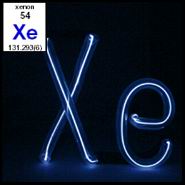
| Element | |
|---|---|
54XeXenon131.29362
8 18 18 8 |
|
| Basic properties | |
|---|---|
| Atomic number | 54 |
| Atomic weight | 131.2936 amu |
| Element family | Nobel gases |
| Period | 5 |
| Group | 18 |
| Block | p-block |
| Discovery year | 1898 |
| Isotope distribution |
|---|
124Xe 0.10% 126Xe 0.09% 128Xe 1.91% 129Xe 26.4% 130Xe 4.1% 131Xe 21.2% 134Xe 10.4% 136Xe 8.9% |
128Xe (2.61%) 129Xe (36.11%) 130Xe (5.61%) 131Xe (29.00%) 134Xe (14.23%) 136Xe (12.18%) |
| Physical properties | |
|---|---|
| Density | 0.005887 g/cm3 (STP) |
Atomic hydrogen (H) 8.988E-5 Meitnerium (Mt) 28 | |
| Melting | -111.7 °C |
Helium (He) -272.2 Carbon (C) 3675 | |
| Boiling | -107 °C |
Helium (He) -268.9 Tungsten (W) 5927 | |
| Chemical properties | |
|---|---|
| Oxidation states (less common) | +2, +4, +6 (0, +8) |
| First ionization potential | 12.130 eV |
Cesium (Cs) 3.894 Helium (He) 24.587 | |
| Electron affinity | -0.800 eV |
Nobelium (No) -2.33 Atomic chlorine (Cl) 3.612725 | |
| Electronegativity | 2.6 |
Cesium (Cs) 0.79 Atomic fluorine (F) 3.98 | |
| Atomic radius | |
|---|---|
| Covalent radius | 1.31 Å |
Atomic hydrogen (H) 0.32 Francium (Fr) 2.6 | |
| Van der Waals radius | 2.16 Å |
Atomic hydrogen (H) 1.2 Francium (Fr) 3.48 | |
| Compounds | ||
|---|---|---|
| Formula | Name | Oxidation state |
| XeCl | Xenon monochloride | +1 |
| XeRhF6 | Xenon hexafluororhodate | +1 |
| XeF2 | Xenon difluoride | +2 |
| XeBr2 | Xenon dibromide | +2 |
| XeCl2 | Xenon dichloride | +2 |
| XeF4 | Xenon tetrafluoride | +4 |
| N(CH3)4XeF5 | Tetramethylammonium pentafluoroxenate | +4 |
| XeCl4 | Xenon tetrachloride | +4 |
| (NO)2XeF8 | Nitrosonium octafluoroxenate(VI) | +6 |
| H2XeO4 | Xenic acid | +6 |
| XeO4 | Xenon tetroxide | +8 |
| H4XeO6 | Perxenic acid | +8 |
| Electronic properties | |
|---|---|
| Electrons per shell | 2, 8, 18, 18, 8 |
| Electronic configuration | [Kr] 4d10 |
|
Bohr atom model
| |
|
Orbital box diagram
| |
| Valence electrons | 8 |
| Lewis dot structure |
|
| Orbital Visualization | |
|---|---|
|
| |
| Electrons | - |
| Reactions |
|---|
| Xe + 3 F2 = XeF6 |
| Xe + 2 F2 = XeF4 |
Xenon (Xe): Periodic Table Element
Abstract
Xenon (Xe, atomic number 54) represents a noble gas of exceptional scientific and technological significance. With a standard atomic weight of 131.293 ± 0.006 u, xenon exhibits remarkable chemical versatility despite its noble gas classification. The element displays unique physical properties including high density (5.894 kg/m³ at STP), unusual polarizability, and distinctive optical characteristics under electrical excitation. Xenon demonstrates unprecedented reactivity among noble gases, forming stable compounds with highly electronegative elements such as fluorine and oxygen. The element's seven stable isotopes and numerous radioactive variants provide crucial tools for nuclear physics, cosmochemistry, and medical applications. Industrial utilization spans specialized lighting systems, medical anesthesia, ion propulsion, and advanced laser technologies. Current research applications include dark matter detection, nuclear magnetic resonance imaging enhancement, and protein crystallography studies.
Introduction
Xenon occupies a distinctive position in Group 18 of the periodic table as the heaviest naturally occurring noble gas with stable isotopes. Located in period 5, xenon exhibits the characteristic electron configuration [Kr] 4d10 5s2 5p6, possessing a complete valence shell that traditionally conferred chemical inertness. However, xenon's extended atomic radius and reduced ionization energy relative to lighter noble gases enable unprecedented reactivity, fundamentally challenging early assumptions about noble gas chemistry. The element's discovery by William Ramsay and Morris Travers in 1898 through fractional distillation of liquid air marked the culmination of noble gas identification efforts during the late nineteenth century.
Modern understanding of xenon chemistry has revolutionized inorganic synthesis and coordination theory. Neil Bartlett's 1962 synthesis of xenon hexafluoroplatinate demonstrated that noble gases could participate in conventional chemical bonding under appropriate conditions. This breakthrough established xenon as the most chemically versatile noble gas, capable of forming stable compounds in multiple oxidation states. The element's unique combination of high atomic mass, substantial van der Waals forces, and moderate ionization energy creates distinctive applications across diverse technological sectors.
Physical Properties and Atomic Structure
Fundamental Atomic Parameters
Xenon possesses atomic number 54 with ground-state electron configuration [Kr] 4d10 5s2 5p6. The filled 4d subshell provides additional shielding effects that reduce the effective nuclear charge experienced by valence electrons, contributing to xenon's chemical reactivity relative to lighter noble gases. The atomic radius measures 216 pm while the van der Waals radius extends to 216 pm, reflecting substantial electron cloud polarizability. First ionization energy equals 1170.4 kJ/mol, significantly lower than helium (2372.3 kJ/mol) or neon (2080.7 kJ/mol).
Electronic structure analysis reveals substantial orbital mixing in the valence region, with 5p orbitals exhibiting considerable spatial extension. The filled d-orbital manifold contributes to unique bonding capabilities through d-orbital participation in compound formation. Effective nuclear charge calculations indicate reduced electrostatic attraction between nucleus and valence electrons compared to earlier period noble gases, facilitating electron removal during chemical reactions.
Macroscopic Physical Characteristics
Xenon exists as a colorless, odorless gas under standard conditions with density 5.894 kg/m³, approximately 4.5 times greater than air density at sea level. The element exhibits distinctive blue luminescence when subjected to electrical discharge, producing characteristic spectral emission lines utilized in specialized lighting applications. Critical temperature reaches 289.77 K with critical pressure 5.842 MPa, indicating substantial intermolecular interactions.
Phase behavior demonstrates triple point conditions at 161.405 K and 81.77 kPa. Liquid xenon displays maximum density 3.100 g/mL near the triple point, while solid xenon achieves density 3.640 g/cm³, exceeding typical granite density values. The melting point occurs at 161.4 K (-111.8°C) with heat of fusion 2.30 kJ/mol. Boiling point measurements yield 165.05 K (-108.1°C) with heat of vaporization 12.57 kJ/mol. Specific heat capacity for gaseous xenon equals 20.786 J/(mol·K) at constant pressure.
Chemical Properties and Reactivity
Electronic Structure and Bonding Behavior
Xenon demonstrates remarkable chemical reactivity through utilization of vacant d-orbitals and low-lying antibonding orbitals for compound formation. The element exhibits oxidation states ranging from +2 to +8, with +6 representing the most stable configuration in fluoride compounds. Bond formation typically involves highly electronegative atoms including fluorine, oxygen, and chlorine, which can accommodate xenon's electron-donating capabilities.
Molecular orbital calculations reveal significant covalent character in xenon compounds through orbital overlap between xenon 5p, 5d orbitals and ligand orbitals. XeF6 exhibits distorted octahedral geometry due to lone pair effects, while XeF4 adopts square planar configuration. Xenon-fluorine bond lengths typically measure 195-200 pm with bond energies ranging from 130-180 kJ/mol depending on oxidation state and molecular environment.
Electrochemical and Thermodynamic Properties
Electronegativity values place xenon at 2.6 on the Pauling scale, substantially higher than typical metals but lower than highly electronegative nonmetals. Sequential ionization energies demonstrate characteristic noble gas patterns: first ionization energy 1170.4 kJ/mol, second ionization energy 2046.4 kJ/mol, and third ionization energy 3099.4 kJ/mol. Electron affinity measurements indicate slightly positive values around 41 kJ/mol, reflecting weak tendency for electron addition.
Thermodynamic stability analysis shows xenon compounds exhibit positive formation enthalpies, indicating endothermic formation processes. XeF6 demonstrates ΔH°f = -294 kJ/mol, while XeF4 exhibits ΔH°f = -218 kJ/mol. Standard reduction potentials reflect xenon's oxidizing capabilities: XeF6 + 6H+ + 6e- → Xe + 6HF shows E° = +2.64 V, indicating powerful oxidizing behavior in aqueous solutions.
Chemical Compounds and Complex Formation
Binary and Ternary Compounds
Xenon fluorides constitute the most extensively characterized xenon compounds. XeF2 crystallizes in a linear molecular geometry with I3d space group symmetry and demonstrates selective fluorinating properties in organic synthesis. XeF4 exhibits square planar coordination geometry and serves as a powerful oxidizing agent in both organic and inorganic reactions. XeF6 represents the most reactive xenon fluoride, adopting distorted octahedral geometry with C3v symmetry in the gas phase.
Xenon oxides include XeO3 and XeO4, both highly explosive compounds requiring careful handling procedures. XeO3 exhibits pyramidal molecular geometry and demonstrates extreme sensitivity to shock, heat, and light. XeO4 adopts tetrahedral coordination and represents one of the most powerful oxidizing agents known. Xenon-chlorine compounds include XeCl2 and XeCl4, though these species demonstrate limited thermal stability compared to fluoride analogues.
Coordination Chemistry and Organometallic Compounds
Xenon coordination complexes feature diverse ligand environments including halide ions, oxygen donors, and nitrogen-containing ligands. The XeF5− anion demonstrates square pyramidal geometry with C4v symmetry, while XeF7− exhibits pentagonal bipyramidal coordination. Xenon cations such as XeF+ and XeF3+ demonstrate strong electrophilic character and participate in various substitution reactions.
Organoxenon chemistry remains limited due to the inherent instability of carbon-xenon bonds. However, theoretical calculations suggest possible formation of metastable xenon-carbon species under specific conditions. Xenon insertion compounds with noble gas-hydrogen and noble gas-carbon bonds have been observed in matrix isolation studies at cryogenic temperatures. Xenon hydrides including HXeOH and HXeCl demonstrate stability only under extreme conditions or in rare gas matrices.
Natural Occurrence and Isotopic Analysis
Geochemical Distribution and Abundance
Terrestrial xenon abundance measures approximately 0.087 parts per million by volume in Earth's atmosphere, making it the rarest naturally occurring noble gas. Atmospheric xenon concentration equals roughly 0.0000087% by volume or 5.15 × 10⁻⁶ kg/m³ under standard conditions. The element's high atomic mass and chemical inertness result in gravitational concentration effects that enrich xenon in the lower atmosphere compared to lighter gases.
Geological xenon distribution reflects the element's production through radioactive decay processes and outgassing from crustal and mantle sources. Xenon isotope ratios in natural gas deposits provide valuable tracers for geological processes and hydrocarbon migration pathways. The element's low solubility in water and minimal reactivity with crustal minerals result in efficient atmospheric transport and long-term stability in the atmosphere.
Nuclear Properties and Isotopic Composition
Natural xenon comprises nine isotopes including seven stable species: 126Xe (0.09%), 128Xe (1.92%), 129Xe (26.44%), 130Xe (4.08%), 131Xe (21.18%), 132Xe (26.89%), and 134Xe (10.44%). Two additional isotopes, 124Xe and 136Xe, exhibit extremely long half-lives exceeding 1014 years, contributing 0.09% and 8.87% abundance respectively. Nuclear spin properties include 129Xe (I = 1/2) and 131Xe (I = 3/2), enabling nuclear magnetic resonance applications.
Radioactive xenon isotopes span mass numbers from 108 to 147, with 135Xe representing particular nuclear engineering significance. This isotope possesses an enormous thermal neutron absorption cross-section of 2.65 × 10⁶ barns, creating substantial reactivity effects in nuclear reactor operation. 133Xe (t1/2 = 5.243 days) serves as a crucial fission product tracer in nuclear monitoring applications. Xenon isotope systematics provide powerful chronometric tools for meteorite dating and early Solar System evolutionary studies.
Industrial Production and Technological Applications
Extraction and Purification Methodologies
Industrial xenon production relies primarily on fractional distillation of liquid air using cryogenic separation techniques. The process exploits xenon's high boiling point (165.05 K) relative to major atmospheric components including nitrogen (77.4 K), oxygen (90.2 K), and argon (87.3 K). Initial air separation yields crude xenon concentrates requiring multiple distillation stages to achieve commercial purity levels exceeding 99.995%.
Advanced purification methods employ selective adsorption techniques using activated carbon or molecular sieve materials operating at controlled temperatures. Gettering processes remove trace reactive impurities including hydrogen, carbon monoxide, and hydrocarbons through catalytic conversion or chemical absorption. Final purification stages utilize hot metal getters containing titanium or zirconium to eliminate residual oxygen and nitrogen contaminants. Global xenon production capacity remains limited at approximately 40 tonnes annually, contributing to the element's high market value relative to lighter noble gases.
Technological Applications and Future Prospects
Xenon's primary technological applications exploit its unique optical and electronic properties. High-intensity discharge lamps utilize xenon as both starting gas and primary discharge medium, providing superior color rendering and spectral characteristics for automotive headlighting systems. Xenon arc lamps serve critical functions in solar simulation testing, cinema projection, and specialized scientific instrumentation requiring high-brightness, stable illumination sources.
Medical applications encompass both therapeutic and diagnostic uses. Xenon functions as a potent general anesthetic with minimal cardiovascular depression and rapid elimination kinetics. Nuclear medicine employs 133Xe for ventilation studies and cerebral blood flow measurements using gamma scintigraphy. Hyperpolarized 129Xe enhances magnetic resonance imaging contrast, enabling detailed visualization of lung structure and function with unprecedented spatial resolution.
Emerging technologies include xenon-based ion propulsion systems for spacecraft applications, offering high specific impulse and exceptional reliability for deep space missions. Dark matter detection experiments utilize liquid xenon detectors to identify potential weakly interacting massive particles through nuclear recoil signatures. Future prospects encompass xenon excimer laser development for advanced materials processing and potential applications in quantum information processing systems utilizing xenon nuclear spin states.
Historical Development and Discovery
Xenon discovery resulted from systematic investigations of atmospheric composition conducted by William Ramsay and Morris Travers at University College London during the late nineteenth century. Following their successful isolation of argon, krypton, and neon, Ramsay and Travers employed increasingly refined fractional distillation techniques to examine residual components of liquid air. On July 12, 1898, spectroscopic analysis revealed distinctive emission lines characteristic of a new element in the heaviest fraction of their distillation apparatus.
The element's nomenclature derives from the Greek term "ξένον" meaning stranger or foreigner, reflecting its unexpected presence in atmospheric samples. Early abundance estimates by Ramsay suggested xenon concentration of approximately one part in twenty million atmospheric molecules, establishing its status as the rarest naturally occurring noble gas. Initial applications remained limited to spectroscopic studies and fundamental investigations of gas behavior until technological developments in the mid-twentieth century created demand for xenon's unique properties.
Chemical understanding underwent revolutionary advancement following Neil Bartlett's 1962 synthesis of xenon hexafluoroplatinate, the first authenticated noble gas compound. This breakthrough demolished the theoretical foundation of noble gas inertness and initiated intensive research into xenon chemistry. Subsequent developments established xenon as the most chemically versatile noble gas, capable of forming stable compounds in multiple oxidation states through conventional covalent bonding mechanisms.
Conclusion
Xenon represents a paradigmatic element demonstrating the evolution of chemical understanding from classical inert gas theory to modern coordination chemistry principles. The element's unique combination of substantial atomic mass, moderate ionization energy, and extensive orbital availability enables unprecedented reactivity among noble gases while maintaining characteristic atmospheric stability. Industrial applications continue expanding across diverse technological sectors including advanced lighting systems, medical diagnostics, space propulsion, and fundamental physics research.
Future research directions encompass quantum applications utilizing xenon nuclear spin properties, enhanced medical imaging techniques employing hyperpolarized xenon isotopes, and potential roles in dark matter detection experiments. The element's isotopic diversity provides invaluable tools for cosmochemical investigations and nuclear chronometry applications. Xenon's distinctive position in periodic table Group 18 ensures continued scientific and technological significance as advanced applications demand increasingly sophisticated understanding of noble gas chemistry and physics.

Please let us know how we can improve this web app.