Printed from https://www.webqc.org

Thulium @ Periodic Table of Chemical Elements

12345678 910111213141516 1718
IIIIIIbIVb VbVIbVIIbVIIIbIb IIbIIIIVVVI VIIVIII
1H
1.0079
2He
4.0026
3Li
6.9412
4Be
9.0121
5B
10.811
6C
12.010
7N
14.006
8O
15.999
9F
18.998
10Ne
20.179
11Na
22.989
12Mg
24.305
13Al
26.981
14Si
28.085
15P
30.973
16S
32.065
17Cl
35.453
18Ar
39.948
19K
39.098
20Ca
40.078
21Sc
44.955
22Ti
47.867
23V
50.941
24Cr
51.996
25Mn
54.938
26Fe
55.845
27Co
58.933
28Ni
58.693
29Cu
63.546
30Zn
65.409
31Ga
69.723
32Ge
72.641
33As
74.921
34Se
78.963
35Br
79.904
36Kr
83.798
37Rb
85.467
38Sr
87.621
39Y
88.905
40Zr
91.224
41Nb
92.906
42Mo
95.942
43Tc
98.906
44Ru
101.07
45Rh
102.90
46Pd
106.42
47Ag
107.86
48Cd
112.41
49In
114.81
50Sn
118.71
51Sb
121.76
52Te
127.60
53I
126.90
54Xe
131.29
55Cs
132.90
56Ba
137.32
57La
138.90
72Hf
178.49
73Ta
180.94
74W
183.84
75Re
186.20
76Os
190.23
77Ir
192.21
78Pt
195.08
79Au
196.96
80Hg
200.59
81Tl
204.38
82Pb
207.21
83Bi
208.98
84Po
208.98
85At
209.98
86Rn
222.01
87Fr
223.01
88Ra
226.02
89Ac
227.02
104Rf
261.10
105Db
262.11
106Sg
266.12
107Bh
264.12
108Hs
269
109Mt
278
110Ds
281
111Rg
282
112Cn
285
113Nh
286
114Fl
289
115Mc
290
116Lv
293
117Ts
294
118Og
294
Lanthanoids58Ce
140.11
59Pr
140.90
60Nd
144.24
61Pm
146.91
62Sm
150.36
63Eu
151.96
64Gd
157.25
65Tb
158.92
66Dy
162.50
67Ho
164.93
68Er
167.25
69Tm
168.93
70Yb
173.04
71Lu
174.96
Actinoids90Th
232.03
91Pa
231.03
92U
238.02
93Np
237.04
94Pu
244.06
95Am
243.06
96Cm
247.07
97Bk
247.07
98Cf
251.07
99Es
252.08
100Fm
257.09
101Md
258.09
102No
259.10
103Lr
260.10
Alkali metals Alkali earth metals Transition metals Other metals Metaloids Non-metals Halogens Noble gases
Element

69

Tm

Thulium

168.934212

2
8
18
31
8
2
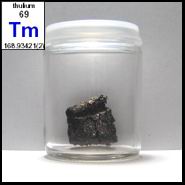
Thulium photo
Basic properties
Atomic number69
Atomic weight168.934212 amu
Element familyN/A
Period6
Group2
Blocks-block
Discovery year1879
Isotope distribution
169Tm
100%
Physical properties
Density 9.321 g/cm3 (STP)
Atomic hydrogen (H) 8.988E-5
Meitnerium (Mt) 28
Melting1545 °C
Helium (He) -272.2
Carbon (C) 3675
Boiling1727 °C
Helium (He) -268.9
Tungsten (W) 5927
Chemical properties
Oxidation states
(less common)
+3
(0, +1, +2)
First ionization potential 6.184 eV
Cesium (Cs) 3.894
Helium (He) 24.587
Electron affinity 1.029 eV
Nobelium (No) -2.33
Atomic chlorine (Cl) 3.612725
Electronegativity1.25
Cesium (Cs) 0.79
Atomic fluorine (F) 3.98
Atomic radius
Covalent radius 1.64 Å
Atomic hydrogen (H) 0.32
Francium (Fr) 2.6
Metallic radius 1.76 Å
Beryllium (Be) 1.12
Cesium (Cs) 2.65
69TmWebQC.OrgCovalentMetallic
Compounds
FormulaNameOxidation state
TmBr2Thulium dibromide+2
TmCl2Thulium(II) chloride+2
TmF2Thulium(II) fluoride+2
Tm(NO3)3Thulium(III) nitrate+3
Tm(OH)3Thulium(III) hydroxide+3
Tm2O3Thulium(III) oxide+3
Tm2Se3Thulium selenide+3
TmBr3Thulium(III) bromide+3
TmCl3Thulium(III) chloride+3
TmF3Thulium(III) fluoride+3
TmI3Thulium(III) iodide+3
TmPThulium phosphide+3
Electronic properties
Electrons per shell2, 8, 18, 31, 8, 2
Electronic configuration[Xe] 4f136s2
Bohr atom model
Bohr atom model
Orbital box diagram
Orbital box diagram
Valence electrons15
Lewis dot structure Thulium Lewis dot structure
Orbital Visualization
🏠
▶️
📐
Electrons-

Thulium (Tm): Periodic Table Element

Scientific Review Article | Chemistry Reference Series

Abstract

Thulium is a chemical element with atomic number 69 and symbol Tm, representing the thirteenth member of the lanthanide series. This silvery-gray metal exhibits characteristic properties of the rare earth elements, including a predominant +3 oxidation state and formation of coordination complexes with nine water molecules in aqueous solution. Despite being the second-least abundant lanthanide in Earth's crust after promethium, thulium finds specialized applications as a dopant in solid-state lasers and as a radiation source in portable X-ray devices. The element demonstrates typical lanthanide chemical behavior while maintaining sufficient stability and workability for industrial applications. Its discovery in 1879 by Per Teodor Cleve marked an important milestone in rare earth chemistry, though pure samples were not achieved until the early twentieth century.

Introduction

Thulium occupies position 69 in the periodic table, situated within the lanthanide series between erbium and ytterbium. The element demonstrates characteristic 4f electron configuration properties that define the chemical and physical behavior of the rare earth metals. Thulium's electronic structure, [Xe] 4f13 6s2, places it among the later lanthanides where the progressive filling of the 4f orbital approaches completion. This electronic configuration contributes to the element's unique spectroscopic properties and magnetic behavior patterns observed throughout the lanthanide series.

The element exhibits pronounced lanthanide contraction effects, resulting from poor shielding of the 4f electrons that causes successive reduction in atomic and ionic radii across the series. Thulium's position near the end of the lanthanide series amplifies these contraction effects, influencing its coordination chemistry and solid-state properties. Industrial applications remain limited due to the element's scarcity and high extraction costs, though specialized uses in laser technology and medical imaging demonstrate its technological significance.

Physical Properties and Atomic Structure

Fundamental Atomic Parameters

Thulium possesses an atomic number of 69 with a standard atomic weight of 168.934219 ± 0.000005 u. The element's electron configuration follows the expected lanthanide pattern: [Xe] 4f13 6s2. This configuration places thirteen electrons in the 4f subshell, one electron short of the complete f14 configuration observed in ytterbium. The partially filled 4f subshell contributes significantly to thulium's magnetic properties and spectroscopic characteristics.

The effective nuclear charge experienced by the outermost electrons increases substantially across the lanthanide series due to inadequate shielding provided by the 4f electrons. This phenomenon results in progressive reduction of atomic and ionic radii, known as lanthanide contraction. Thulium's ionic radius in the +3 oxidation state measures approximately 1.02 Å in eight-fold coordination, demonstrating the cumulative effects of lanthanide contraction when compared to earlier series members.

Macroscopic Physical Characteristics

Pure thulium exhibits a bright silvery-gray metallic luster that gradually tarnishes upon exposure to atmospheric oxygen. The metal demonstrates considerable malleability and ductility, with a Mohs hardness rating between 2 and 3, allowing it to be cut with a knife under ambient conditions. These mechanical properties reflect the metallic bonding characteristics typical of the lanthanide elements.

Thulium crystallizes in a hexagonal close-packed structure under standard conditions, though it exhibits polymorphism with a tetragonal α-Tm phase and the more thermodynamically stable hexagonal β-Tm phase. The hexagonal structure represents the preferred arrangement for most lanthanide metals and reflects the particular size and electronic properties of the Tm3+ cation. Precise thermodynamic measurements indicate specific melting and boiling temperatures consistent with medium-strength metallic bonding within the lanthanide series.

Chemical Properties and Reactivity

Electronic Structure and Bonding Behavior

Thulium demonstrates characteristic lanthanide chemical behavior dominated by the +3 oxidation state. This oxidation state arises from the loss of the two 6s electrons and one 4f electron, leaving a stable 4f12 configuration in the Tm3+ cation. The +3 state exhibits exceptional stability across virtually all chemical environments, with alternative oxidation states remaining extremely rare and typically observed only under specialized conditions.

The element exhibits electropositive character typical of the lanthanides, readily forming ionic compounds with electronegative elements. Covalent bonding contributions remain minimal in most thulium compounds, though some degree of covalency emerges in organometallic complexes and compounds with highly polarizable anions. The 4f electrons remain essentially non-bonding due to their contracted spatial distribution, contributing primarily to magnetic and spectroscopic properties rather than chemical bonding.

Electrochemical and Thermodynamic Properties

Thulium demonstrates strongly reducing behavior, with a standard electrode potential of approximately -2.3 V for the Tm3+/Tm couple. This negative potential reflects the high thermodynamic stability of the +3 oxidation state and the element's tendency to undergo oxidation in aqueous environments. The electrochemical behavior aligns with patterns observed throughout the lanthanide series, where increasingly negative potentials accompany the progression from light to heavy rare earth elements.

Successive ionization energies for thulium reflect the electronic structure and effective nuclear charge effects characteristic of the lanthanide series. The first ionization energy measures approximately 596 kJ/mol, with subsequent ionizations requiring significantly greater energy input. The third ionization energy demonstrates relatively favorable values due to the stability achieved upon reaching the 4f12 configuration in Tm3+.

Chemical Compounds and Complex Formation

Binary and Ternary Compounds

Thulium oxide, Tm2O3, represents the most thermodynamically stable binary compound and exhibits the characteristic sesquioxide structure common to lanthanide oxides. The compound forms readily upon heating metallic thulium in oxygen at temperatures above 150°C, following the reaction: 4Tm + 3O2 → 2Tm2O3. This pale green oxide demonstrates considerable thermal stability and resistance to reduction under normal conditions.

The halide series demonstrates systematic trends in stability and properties. Thulium trifluoride, TmF3, exhibits the highest lattice energy and thermal stability among the halides, appearing as a white crystalline solid. The heavier halides - TmCl3, TmBr3, and TmI3 - display decreasing stability and increasing covalent character, with colors ranging from yellow to pale yellow reflecting charge transfer transitions.

Coordination Chemistry and Organometallic Compounds

Aqueous thulium chemistry centers on the formation of [Tm(OH2)9]3+ complexes, where nine water molecules surround the central Tm3+ cation in a tricapped trigonal prismatic geometry. This high coordination number reflects the large ionic radius of the lanthanide cations and their preference for maximizing electrostatic interactions with ligands. The coordination sphere remains highly labile, with rapid water exchange rates typical of lanthanide aqua complexes.

Organometallic chemistry of thulium remains relatively underdeveloped compared to transition metals, primarily due to the ionic nature of Tm-carbon bonds and limited orbital overlap between the contracted 4f electrons and ligand orbitals. Cyclopentadienyl complexes represent the most stable organometallic derivatives, though these compounds exhibit primarily ionic bonding character rather than true covalent metal-carbon interactions.

Natural Occurrence and Isotopic Analysis

Geochemical Distribution and Abundance

Thulium ranks as the second-least abundant lanthanide in Earth's crust, with an average crustal abundance of approximately 0.5 mg/kg. This scarcity exceeds only that of the radioactive element promethium among the lanthanide series. The element occurs primarily in association with other heavy rare earth elements in minerals such as gadolinite, monazite, xenotime, and euxenite, though no mineral species exhibits thulium as the dominant rare earth component.

Geochemical fractionation processes favor concentration of thulium in igneous rocks with high silica content, particularly granites and pegmatites. Marine sediments contain thulium at concentrations of approximately 250 parts per quadrillion in seawater, reflecting the element's limited solubility and tendency to associate with particulate matter. Soil concentrations typically range from 0.4 to 0.8 parts per million, with variation dependent on local geological conditions and weathering processes.

Nuclear Properties and Isotopic Composition

Natural thulium consists entirely of the stable isotope 169Tm, making it one of the mononuclidic elements. This isotope possesses 100 neutrons alongside the 69 protons that define the element, resulting in a neutron-to-proton ratio of 1.45. The isotope demonstrates remarkable nuclear stability, though theoretical calculations suggest possible alpha decay to 165Ho with an extraordinarily long half-life exceeding 1024 years.

Artificial isotopes of thulium span a mass range from 144Tm to 183Tm, with most exhibiting short half-lives measured in minutes or hours. The radioisotope 170Tm, produced through neutron activation of 169Tm, possesses particular technological significance due to its 128.6-day half-life and favorable gamma-ray emission characteristics suitable for industrial radiography applications.

Industrial Production and Technological Applications

Extraction and Purification Methodologies

Commercial thulium production begins with the processing of monazite sand concentrates, where thulium typically comprises approximately 0.007% of the total rare earth content. Initial separation involves acid digestion followed by precipitation and dissolution cycles to concentrate the heavy rare earth fraction. Modern separation techniques employ ion-exchange chromatography and solvent extraction methods to achieve the high purity levels required for technological applications.

The ion-exchange process utilizes the slight differences in ionic radii among the heavy lanthanides to achieve separation through preferential binding to resin functional groups. Solvent extraction techniques employ organophosphorus compounds that demonstrate selective complexation behavior based on the lanthanide contraction effects. These methods have significantly reduced production costs since their commercial introduction in the 1950s, though thulium remains among the most expensive rare earth elements.

Technological Applications and Future Prospects

Solid-state laser applications represent the primary technological use for thulium compounds. Thulium-doped yttrium aluminum garnet (Tm:YAG) operates at wavelengths around 2010 nm, providing efficient near-infrared emission suitable for medical and industrial laser systems. The Ho:Cr:Tm:YAG system demonstrates enhanced efficiency through energy transfer mechanisms, operating at 2080 nm with applications in military rangefinding and medical surgery.

Radiological applications utilize 170Tm as an X-ray source for industrial testing and medical diagnosis. The isotope's 128.6-day half-life provides practical operational lifespans while emitting characteristic X-rays at energies of 7.4, 51.354, 52.389, 59.4, and 84.253 keV. These emission lines offer excellent penetration characteristics for non-destructive testing applications and require minimal radiation shielding compared to alternative sources.

Historical Development and Discovery

Per Teodor Cleve achieved the initial discovery of thulium in 1879 through systematic investigation of impurities within erbia (Er2O3). His analytical approach paralleled the methodology employed by Carl Gustaf Mosander in earlier rare earth discoveries, involving spectroscopic examination of crystallization residues and systematic removal of known components. Cleve successfully separated two previously unknown oxides from the erbium concentrate: holmia (holmium oxide) and thulia (thulium oxide).

The nomenclature derives from Thule, the ancient Greek designation for the northernmost inhabited region, typically associated with Scandinavia or Iceland. Cleve's choice reflected both his Swedish nationality and the geographical context of the discovery. The element's original atomic symbol Tu was subsequently modified to Tm to maintain consistency with modern chemical nomenclature standards.

Purification to spectroscopically pure levels required several decades of methodological advancement. Charles James achieved the first substantially pure thulium oxide in 1911 using fractional crystallization of bromate salts, requiring approximately 15,000 sequential purification operations. Metallic thulium remained elusive until 1936, when Wilhelm Klemm and Heinrich Bommer successfully reduced thulium oxide using calcium metal under controlled atmospheric conditions.

Conclusion

Thulium exemplifies the characteristic properties and challenges associated with the heavy lanthanide elements. Its position near the end of the 4f series results in pronounced lanthanide contraction effects and high-coordinate aqueous chemistry dominated by the +3 oxidation state. Despite significant scarcity and extraction costs, the element maintains technological relevance through specialized applications in laser systems and radiological devices. Future research directions likely focus on expanding applications in luminescent materials and energy-related technologies, where the unique optical properties of thulium compounds may provide advantages in emerging photonic applications.

Periodict table
Please let us know how we can improve this web app.

Menu Balance Molar mass Gas laws Units Chemistry tools Periodic table Chemical forum Symmetry Constants Contribute Contact us
How to cite?